What Are The Strings On A Violin Tuned To: Notes Explained
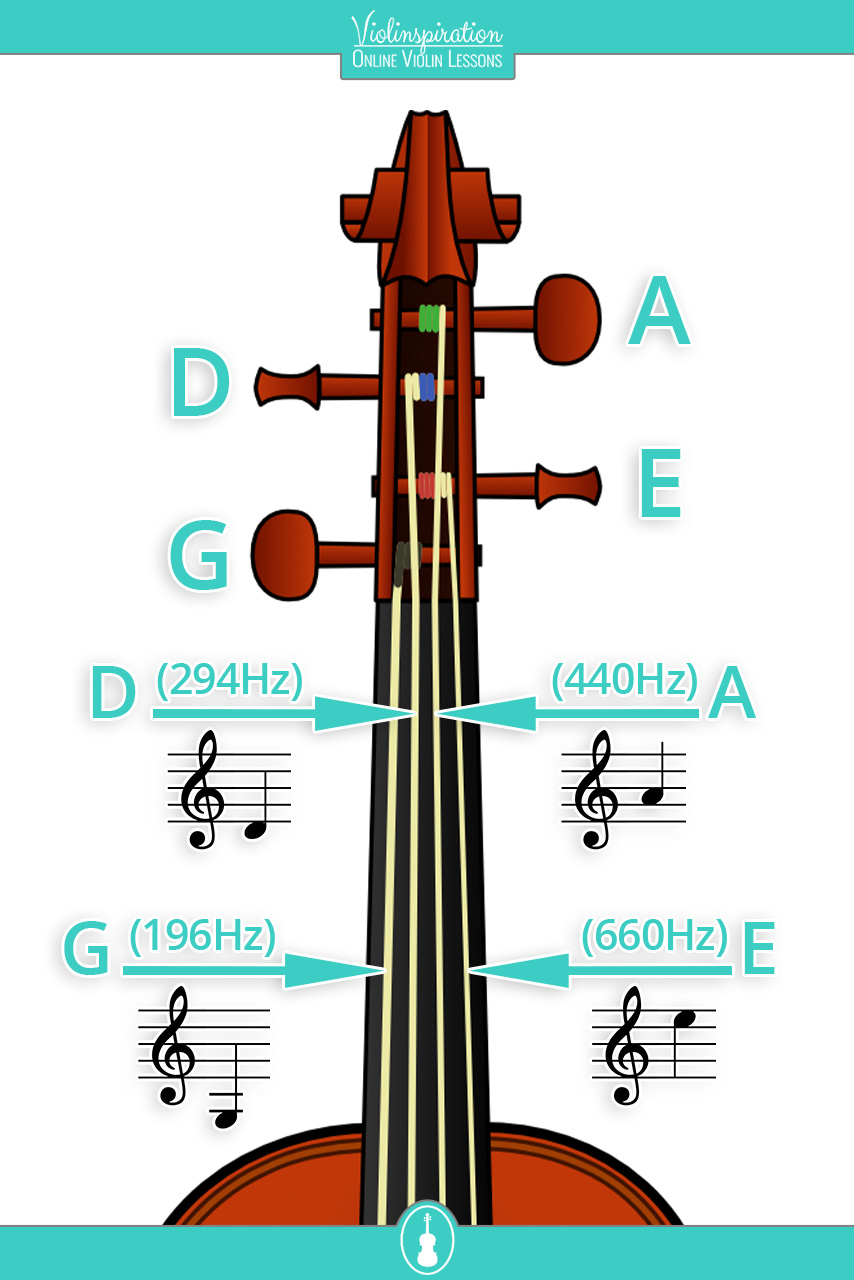
A violin’s four strings are tuned, from lowest to highest, to G, D, A, and E.
Knowing what are the strings on a violin tuned to is the first step toward tuning, playing, and understanding the instrument. These notes form a balanced pattern of perfect fifths, and they give the violin its bright, rich voice. This guide explains the standard notes, pitch numbers, tuning methods, common mistakes, and useful variations.
What are the strings on a violin tuned to?
A standard violin has four strings. From the thickest string to the thinnest string, they are tuned to:
| String | Note | Scientific pitch | Approximate frequency |
|---|---|---|---|
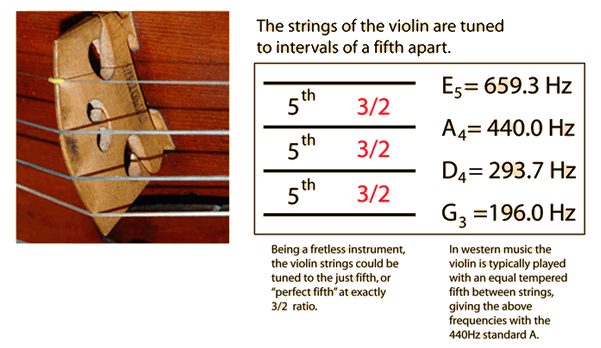
| G string | G | G3 | 196 Hz |
| D string | D | D4 | 293.66 Hz |
| A string | A | A4 | 440 Hz |
| E string | E | E5 | 659.25 Hz |
So, what are the strings on a violin tuned to? The answer is G3, D4, A4, and E5 in standard modern tuning.
The strings are tuned upward by perfect fifths. The distance from G to D is a perfect fifth, as is the distance from D to A and A to E. This pattern helps violinists play scales, chords, and double stops with a natural hand shape.
The A string usually provides the main tuning reference. Many players tune the A string to 440 Hz, which is the common concert pitch used in much of modern music. Some orchestras tune A to 442 or 443 Hz for a slightly brighter sound.
Why does a violin use G, D, A, and E?
The violin’s tuning is designed to balance range, comfort, and tone. The G string gives the instrument a deep, warm low note, while the E string reaches high and sounds clear and brilliant.
Perfect fifths also make the violin easy to tune by ear. When two neighboring strings are close to the correct pitch, they create a smooth, steady sound. If they are out of tune, the player hears a pulsing wobble called a beat.
This tuning also supports common violin techniques:
• Open strings provide strong reference notes.
• Fifths allow quick movement between nearby notes.
• Double stops can use open strings as a pitch guide.
• The four strings cover a wide range without requiring a very large instrument.
A violin has no frets, unlike a guitar. Players must place each finger by ear and muscle memory. Accurate open-string tuning gives the left hand a reliable foundation.

What are the strings on a violin tuned to in different notation systems?
The same violin tuning may look different depending on the notation system being used. In scientific pitch notation, the strings are G3, D4, A4, and E5.
Some music books use Helmholtz notation instead. In that system, the strings may appear as G, d, a, and e′. The symbols differ, but the pitches are the same.
You may also see solfège names:
• G is sol
• D is re
• A is la
• E is mi
The most useful idea is to remember the order: G, D, A, E. A simple memory phrase is “Good Dogs Always Eat.” It follows the string order from lowest to highest.
The note A4 is especially important because it is often used as the tuning standard. When a teacher, orchestra, piano, or electronic tuner gives an A, the violinist adjusts the A string to match it.
How to tune a violin correctly
Tuning a violin takes care. The strings are under strong tension, and turning a peg too far can break a string or damage the instrument.
Follow these steps:
-
Place the violin in a safe playing position or rest it securely on a soft surface.
-
Turn on an electronic tuner and set it to chromatic mode if needed.
-
Tune the A string first.
-
Use the fine tuner for small changes.
-
Tune the D string to the A string.
-
Tune the G string to the D string.
-
Tune the E string last.
-
Play each string again because adjusting one string can affect the others.
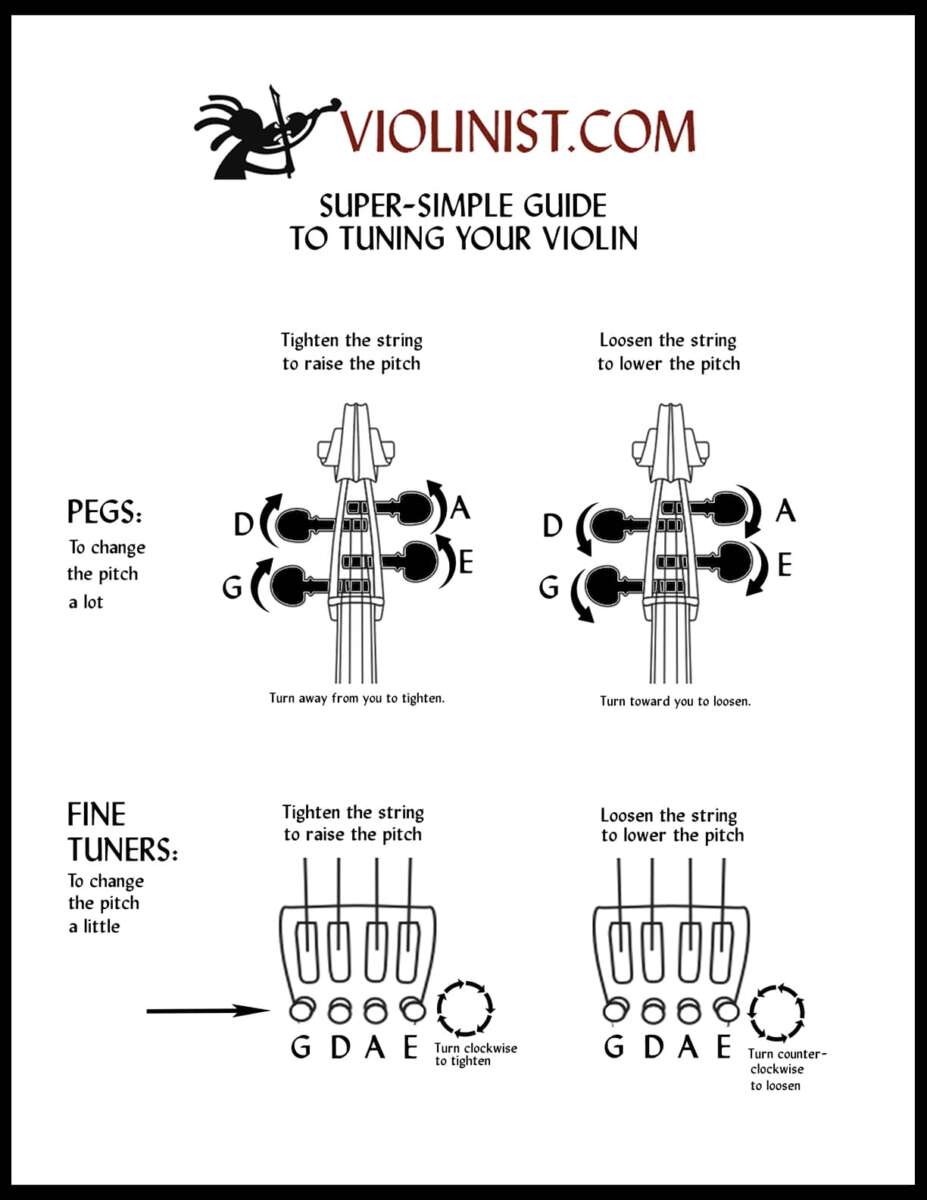
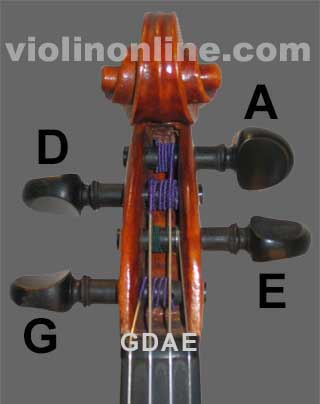
Most beginners should use the fine tuners for small pitch changes. The tuning pegs are better for larger changes, but they require a gentle touch. Turn the peg slowly while pushing it inward so it stays in place.
If the peg feels stiff, loose, or difficult to control, do not force it. A violin shop or teacher can correct the problem safely.
Tuning by ear with perfect fifths
Electronic tuners are helpful, but tuning by ear teaches an important violin skill. Start with a reliable A reference at 440 Hz. Then compare the open D string with the A string.
When the D and A strings are correctly tuned, the sound should feel stable and clean. If the notes are slightly apart, you may hear regular pulses. These beats become slower as the strings move closer to the same interval.
Next, tune the G string against the D string. Finally, tune the E string against the A string. The E string can be sensitive, so make very small adjustments.
A useful practical lesson is to avoid judging a string after one quick pluck. Let the note ring for a moment. The pitch may settle as the string vibrates.

How violin string tension affects tuning
String tension depends on several factors. These include string length, string material, string thickness, and pitch. Two strings tuned to the same note can feel very different under the bow.
Steel strings often respond quickly and hold pitch well. Synthetic core strings can offer a warmer and more complex sound. Gut strings are traditional and can sound rich, but they are more sensitive to changes in temperature and humidity.
When replacing strings, change them one at a time. Removing all four strings at once can allow the bridge to move or fall. The bridge depends on string pressure to remain in its correct position.
New strings may stretch for several days. During that time, the violin may need frequent tuning. This is normal, not necessarily a sign that the instrument has a serious fault.

What are the strings on a violin tuned to in an orchestra?
In most modern orchestras, the principal oboist plays an A. The violinists then tune their A strings to that note before tuning the other strings.
The exact pitch may be higher than A4 at 440 Hz. Many professional orchestras use A4 at 442 Hz or 443 Hz. This can make the sound slightly brighter and may help the ensemble produce a strong, unified tone.
The choice depends on the orchestra, conductor, hall, and musical tradition. A player should always follow the pitch given by the ensemble rather than assuming that every group uses 440 Hz.
Professional players also listen across the section. A violin can show the correct reading on a tuner but still sound slightly different from nearby instruments because of tone, vibrato, or tuning stability.

Baroque violin tuning and other variations
Standard modern tuning is not the only answer to what are the strings on a violin tuned to. Historical performers may use a lower pitch called A415, which is about a semitone below modern A440.
Baroque musicians may also use different strings. Gut strings were common in the Baroque period, and the sound and tension can differ greatly from modern violin setups.
Some composers and performers use scordatura, which means deliberately changing the normal tuning. A string may be raised or lowered to create a special effect, simplify a passage, or produce unusual resonance.
These tunings are not suitable for every violin. Raising a string too far can increase tension and may harm the instrument. Scordatura should be used only with reliable musical guidance and a suitable setup.

Common violin tuning mistakes to avoid
Many tuning problems come from small habits rather than a lack of musical ability. The following mistakes are easy to prevent: