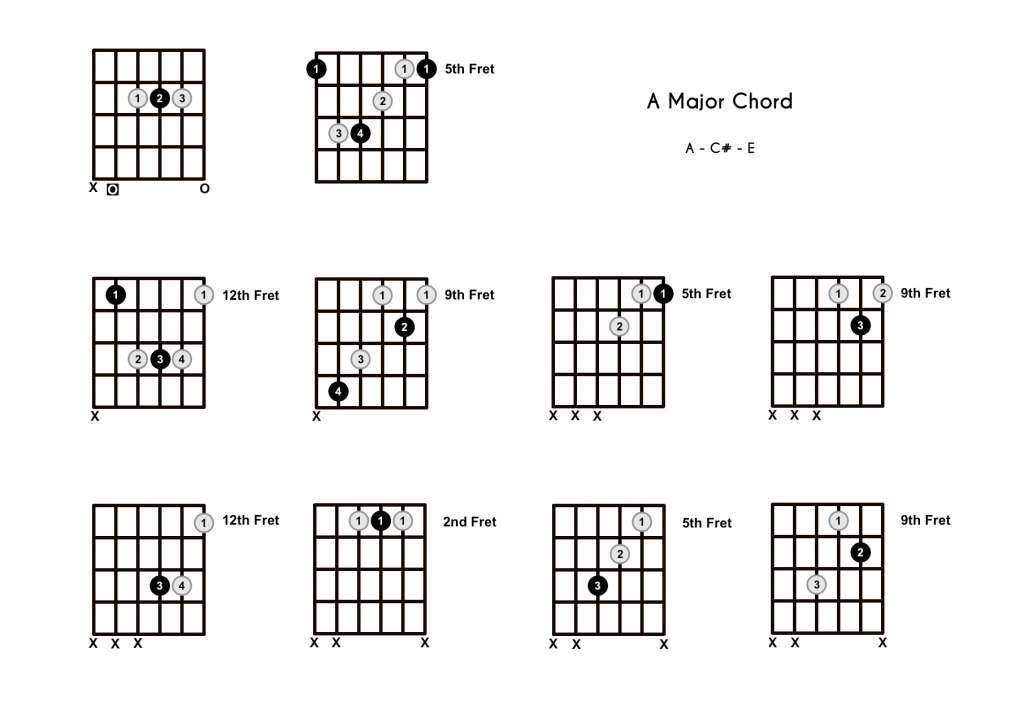
A Major On The Guitar: Easy Chord Guide
A major on the guitar uses the notes A, C-sharp, and E to create a bright, strong, and useful chord.
Learning a major on the guitar gives you one of the most useful shapes in rock, pop, country, blues, and folk music. The chord is easy to play in open position, works well with many common progressions, and helps build a strong base for scales, barre chords, and songwriting.

What Is A Major on the Guitar?
A major on the guitar is a major triad built from three notes:
• A is the root note
• C-sharp is the major third
• E is the perfect fifth
These notes give the chord its clear and happy sound. The major third, C-sharp, is the note that separates A major from A minor. If you lower C-sharp to C natural, the chord becomes A minor.
The most common open A major chord uses five strings. Its chord shape is:
A major: x 0 2 2 2 0
Read the shape from the sixth string to the first string:
E  A  D  G  B  E
x  0  2  2  2  0
The “x” means you should not play the low E string. The open A string acts as the root note. The second fret on the D, G, and B strings adds C-sharp, E, and A. The high E string remains open.
A major on the guitar may feel crowded at first because three fingers must fit on the same fret. Place your fingers close to the fret wire, not in the middle of the fret. This helps each note ring with less pressure.

How to Play the Open A Major Chord
There are two common ways to finger the open A major chord. Both create the same basic sound, so choose the version that feels most natural.
The three-finger shape
Use these fingers:
• Index finger on the D string, second fret
• Middle finger on the G string, second fret
• Ring finger on the B string, second fret
Strum from the open A string down to the high E string. Avoid the low E string.
This version is easy to understand and works well for beginners. It also helps you prepare for chord changes because each finger has a clear job.
The one-finger shape
Some players use one finger to cover the D, G, and B strings at the second fret. This can be fast, but it may mute nearby strings if your finger lies too flat.
Try both methods and listen carefully. Every string should sound clean. If the G or B string sounds dull, lift your finger slightly and place more pressure near the fret wire.
A simple practice method
Follow these steps:
- Form the A major shape without strumming.
- Pick each string one at a time.
- Fix any muted or buzzing note.
- Release your hand.
- Form the shape again.
- Strum slowly four times.
This method trains your hand to build the shape by feel. Chord changes become much easier when your fingers remember the movement instead of searching for each fret.
One mistake I often see is rushing into full-speed strumming. Slow practice may feel less exciting, but it builds cleaner muscle memory. Think of it like laying a firm road before driving fast.

A Major Guitar Chord Variations
A major on the guitar has several useful forms. Learning more than one shape lets you move around the neck and avoid awkward chord changes.
A major barre chord at the fifth fret
The E-shape barre chord begins at the fifth fret:
A major: 5 7 7 6 5 5
Place your index finger across all six strings at the fifth fret. Then use your other fingers to form an E major shape above it.
The root note is on the low E string at the fifth fret. This is an A note, which tells you the chord name. The same shape can move to other frets to create different major chords.
For example:
• Fifth fret gives A major
• Seventh fret gives B major
• Eighth fret gives C major
• Tenth fret gives D major
The shape stays the same. Only the root position changes.
A major barre chord at the seventh fret
You can also use a C-shape barre chord:
A major: x 12 11 9 10 9
This shape is more advanced and can feel uncomfortable. It is useful for players who want a different voicing with a higher sound.
A major power chord
A power chord uses the root and fifth:
A5: x 0 2 2 x x
This shape contains A and E but leaves out the major third. Because it has no C-sharp, it is neither major nor minor.
Power chords are common in rock and punk music. They sound strong and open, especially with distortion.
A major seventh chord
A major seventh version adds G-sharp:
Amaj7: x 0 2 1 2 0
A major seventh on the guitar sounds smooth and soft. It works well in jazz, soul, R&B, and mellow pop.
The notes are A, C-sharp, E, and G-sharp. The added G-sharp gives the chord a richer color than a basic A major chord.

A Major Scale on the Guitar
The A major scale contains seven notes:
A B C-sharp D E F-sharp G-sharp
It has three sharps: C-sharp, F-sharp, and G-sharp. On the guitar, the notes repeat at the octave, so you can play the scale in many positions.
The scale formula for any major scale is:
Whole step, whole step, half step, whole step, whole step, whole step, half step
A whole step equals two frets. A half step equals one fret.
The notes of the A major scale create these diatonic chords:
• A major
• B minor
• C-sharp minor
• D major
• E major
• F-sharp minor
• G-sharp diminished
This group of chords is called the key of A major. It is useful for songwriting because the chords naturally work together.
A common progression is:
A D E A
This is the I-IV-V progression in the key of A. You can hear this pattern in countless rock, country, blues, and folk songs.
Another popular progression is:
A E F-sharp minor D
This progression has a wide, emotional sound. Practice changing between these chords while keeping your strumming hand steady.
When learning the A major scale, do not focus only on speed. First, learn where the root notes are. Knowing every A on the fretboard helps you connect scales, chords, and melodies.

Chord Progressions Using A Major
A major on the guitar appears in many simple and powerful progressions. Start with progressions that use open chords, then try the same ideas with barre chords.
I-IV-V progression
A D E
This is one of the most important progressions in Western music. Try four beats on each chord:
A | A | D | D | E | E | A | A |
Use a steady downstroke pattern first. When the changes feel comfortable, try:
Down, down-up, up, down-up
Keep your wrist loose. A stiff wrist often causes uneven rhythm and tiredness.
I-V-vi-IV progression
A E F-sharp minor D
This progression works well for pop and acoustic songs. It creates movement without sounding too tense.
If F-sharp minor is difficult, practice the change from E to F-sharp minor by moving your index finger into position first. Then place the remaining fingers. This small adjustment can make the change smoother.
I-vi-IV-V progression
A F-sharp minor D E
This progression has a classic, warm sound. It is a good exercise for learning minor and major chord contrast.
Try playing it with different rhythms:
• Four slow downstrokes per chord
• Down-up eighth notes
• A light fingerpicking pattern
• A muted rock rhythm