What Is A Piano Chord: Easy Guide For Beginners
A piano chord is two or more notes played together to create harmony, mood, and musical direction.
If you have ever heard a song feel warm, sad, tense, or triumphant, piano chords helped create that feeling. Learning what is a piano chord gives you a clear path into music theory, songwriting, accompaniment, and improvisation. This guide explains chord structure, types, symbols, examples, and practical ways to use chords at the piano.
What Is a Piano Chord?
A piano chord is a group of two or more notes played at the same time. Most common piano chords use three or more notes, such as a C major chord with C, E, and G.
Each note has a role. The lowest note often gives the chord its name and sense of balance. The other notes add color, emotion, and shape.
For example:
• C is the root note.
• E is the third.
• G is the fifth.
Together, these notes form a C major triad. It sounds bright and stable because of the space between its notes.
A piano chord can be simple or complex. A beginner may play a basic three note chord, while a jazz pianist may use six, seven, or more notes to create rich harmony.
How Piano Chords Work
To understand what is a piano chord, it helps to understand intervals. An interval is the distance between two notes. Chords are built by stacking certain intervals above a starting note.
The starting note is called the root. From there, musicians often add notes based on the major scale.
For a major chord, the basic pattern is:
• Root
• Major third
• Perfect fifth
In half steps, this pattern is 4 half steps from the root to the third, followed by 3 half steps from the third to the fifth.
For C major:
• C to E equals 4 half steps.
• E to G equals 3 half steps.
This creates the notes C, E, and G.
A minor chord changes the third. The minor pattern uses 3 half steps from the root to the third, followed by 4 half steps to the fifth.
For C minor:
• C to E-flat equals 3 half steps.
• E-flat to G equals 4 half steps.
The result is C, E-flat, and G. This small change gives the chord a darker or more reflective sound.

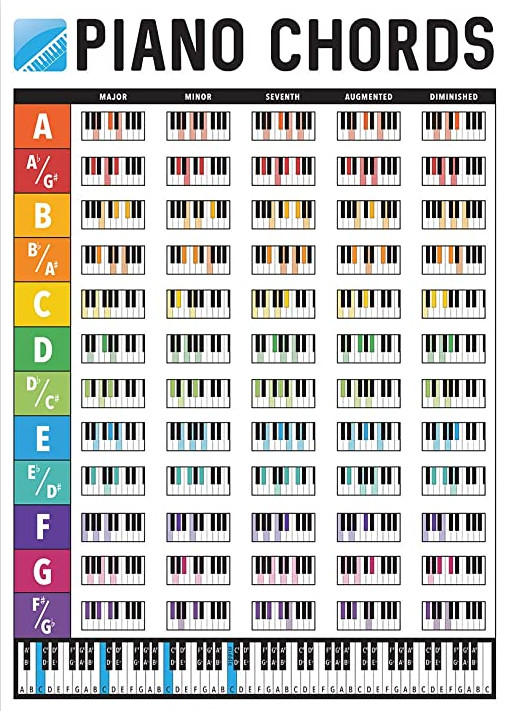
The Main Types of Piano Chords
Piano chords come in many forms. Each type has a different sound and purpose.
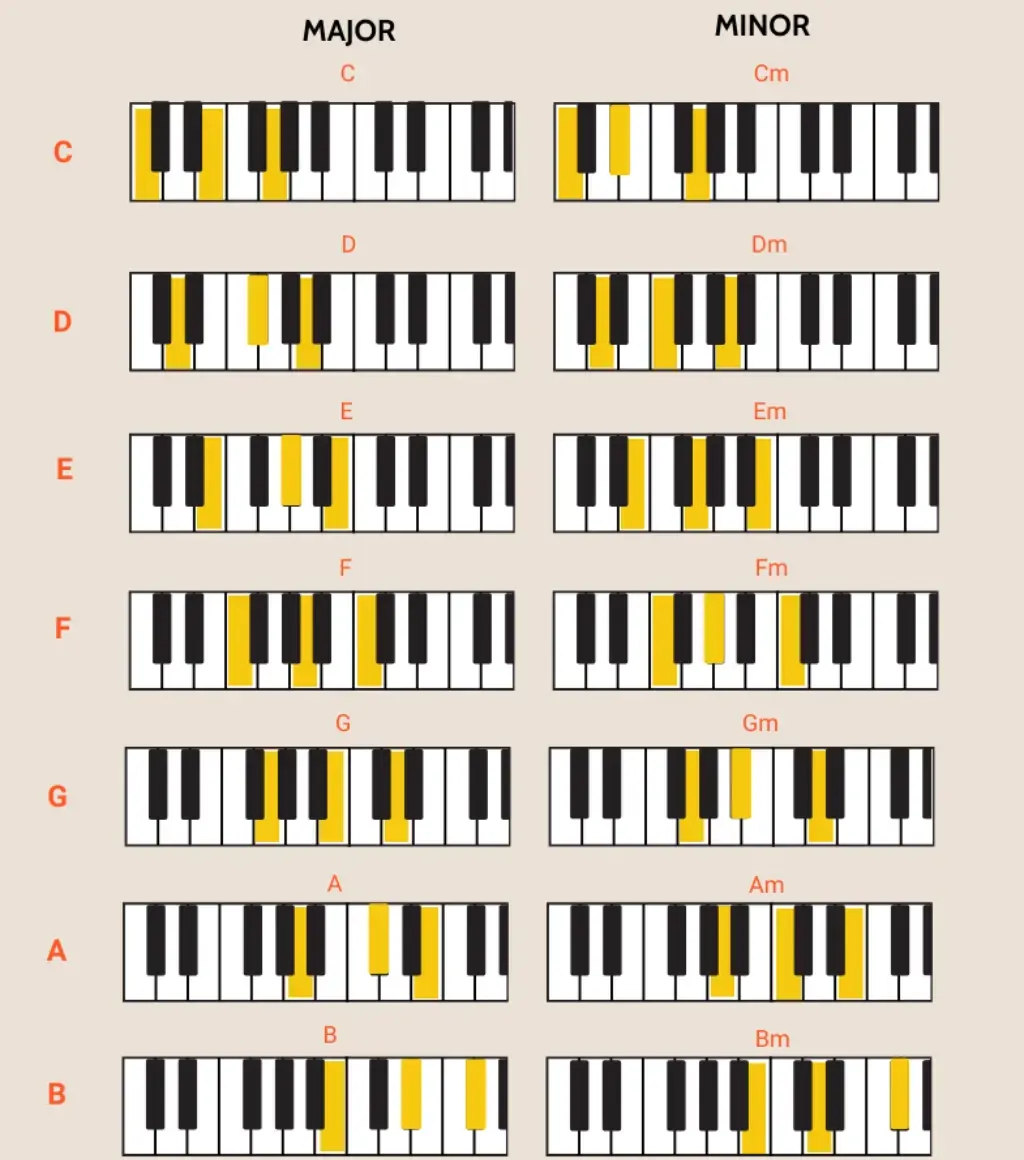
Major Chords
Major chords often sound bright, strong, and settled. They appear in pop, rock, classical music, gospel, country, and many other styles.
Examples include:
• C major: C, E, G
• F major: F, A, C
• G major: G, B, D
Major chords do not always sound happy. Their mood depends on tempo, melody, rhythm, and the chords around them.
Minor Chords
Minor chords often sound sad, serious, calm, or emotional. They are common in ballads, film music, blues, and dramatic songs.
Examples include:
• A minor: A, C, E
• D minor: D, F, A
• E minor: E, G, B
A minor chord is not automatically sad. A fast song in a minor key can sound exciting, mysterious, or powerful.
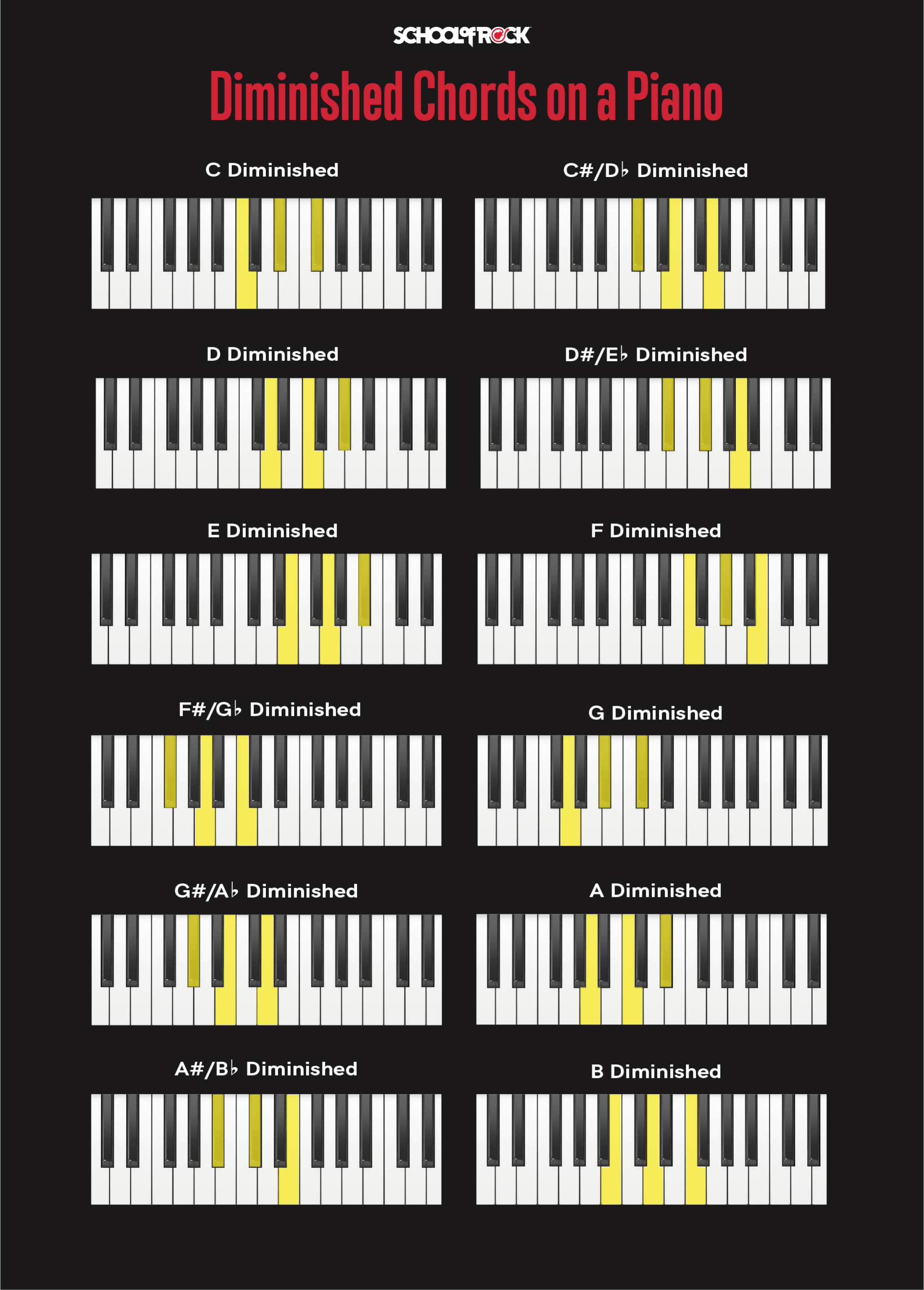
Diminished Chords
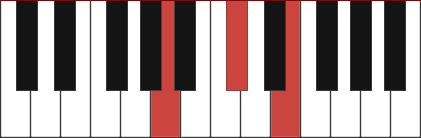
A diminished chord contains a root, minor third, and diminished fifth. The notes are closer together than in a major or minor chord.
For example, B diminished contains:
• B
• D
• F
Diminished chords often sound tense or unstable. They usually lead to another chord instead of ending a song.
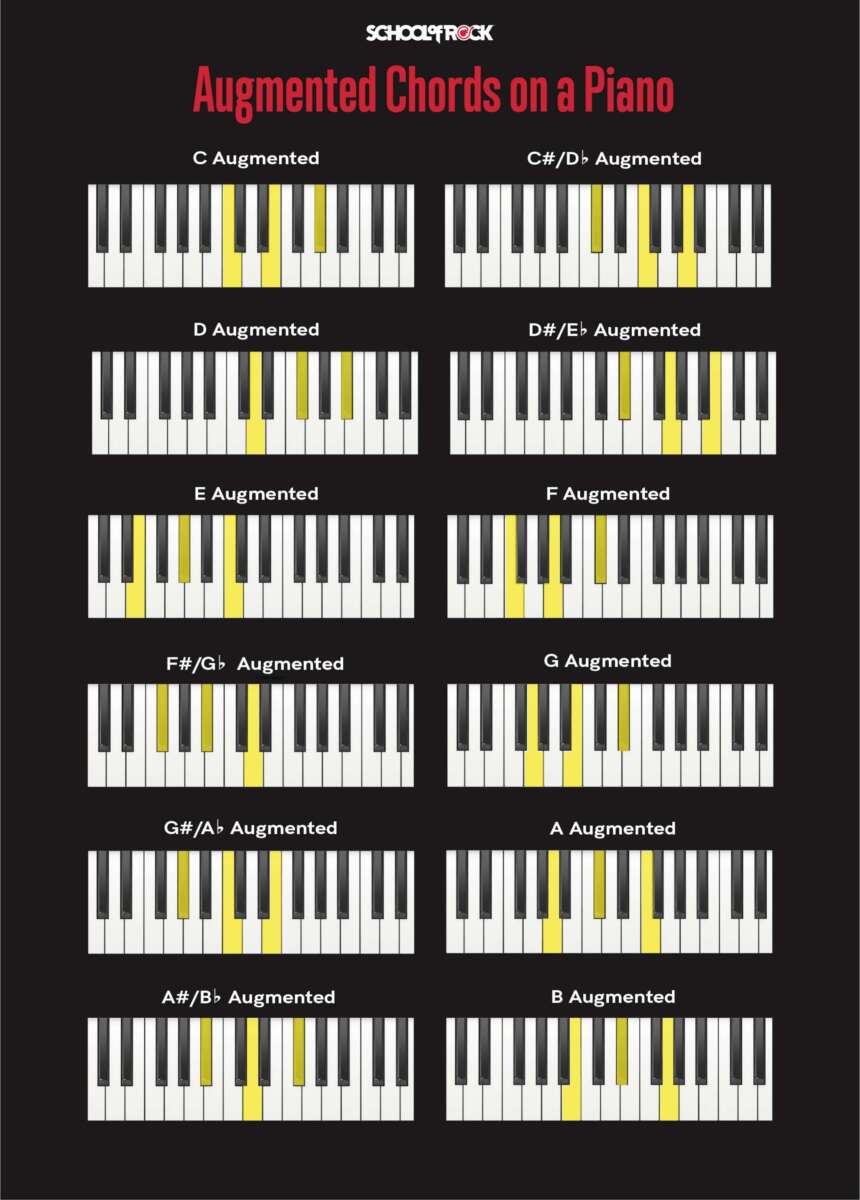
Augmented Chords
An augmented chord contains a root, major third, and raised fifth.
C augmented contains:
• C
• E
• G-sharp
This chord has a floating, unusual sound. Composers often use it to create suspense or movement.
Seventh Chords
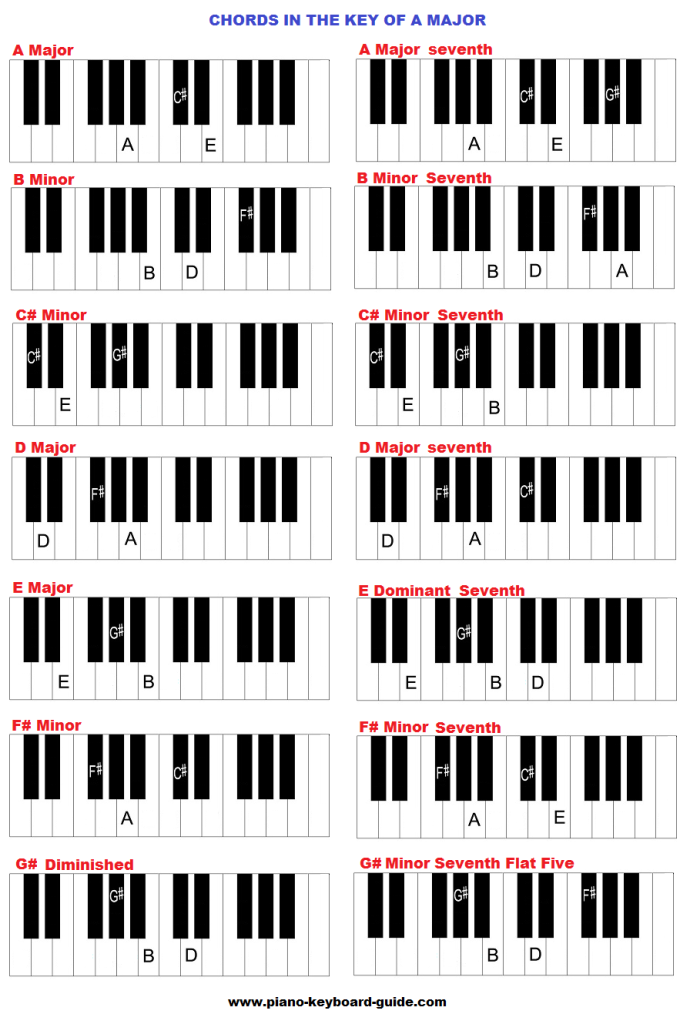
A seventh chord adds a seventh note above a basic triad. Seventh chords are important in blues, jazz, gospel, soul, and classical harmony.
Common examples include:
• C major seventh: C, E, G, B
• C dominant seventh: C, E, G, B-flat
• C minor seventh: C, E-flat, G, B-flat
A dominant seventh chord often creates a strong desire to resolve. For example, G7 usually moves to C major in the key of C.
Piano Chord Names and Symbols
Chord symbols give musicians a short way to read harmony. You may see them above lyrics, on lead sheets, or in digital piano lessons.
Here are common chord symbols:
• C means C major.
• Cm means C minor.
• Cdim means C diminished.
• Caug means C augmented.
• C7 means C dominant seventh.
• Cmaj7 means C major seventh.
• Cm7 means C minor seventh.
• Csus4 means C suspended fourth.
If a chord symbol has no extra letters, it usually means a major chord. For example, D normally means D major.
The symbol slash can show a different bass note. C/E means to play a C chord with E as the lowest note. This is called a slash chord.
Learning chord symbols helps you play songs without reading every note on the page. It also makes it easier to work with singers, guitar players, and other musicians.

Piano Chords Versus Single Notes
A single note has one pitch. A chord combines several pitches at once.
Think of a single note as one voice speaking. A chord is like several voices speaking together in harmony. The notes can support one another, create tension, or form a musical color.
A melody uses single notes in a sequence. Chords usually support the melody underneath. In many songs, the right hand plays the melody while the left hand plays piano chords or bass notes.
For example, a simple song may use:
• C major for a calm opening
• G major for movement
• A minor for a softer mood
• F major for a return to stability
This type of chord movement is called a chord progression.
Common Piano Chord Progressions
A chord progression is a series of chords played in order. Progressions give songs structure and emotional direction.
The I–V–vi–IV Progression
This progression is common in pop music:
• C major
• G major
• A minor
• F major
In the key of C, these chords are called I, V, vi, and IV. Roman numerals show the chord’s position in the key.
The I–IV–V Progression
This is one of the most important progressions in blues, rock, folk, and country music.
In the key of C, it uses:
• C major
• F major
• G major
It sounds familiar because the progression creates a clear sense of departure and return.
The ii–V–I Progression
Jazz musicians use the ii–V–I progression often. In C major, it is:
• D minor seventh
• G dominant seventh
• C major seventh
This progression teaches an important lesson about harmony. Some chords create tension, and the final chord provides release.
When I help beginners learn what is a piano chord, I often start with three progressions. Students quickly discover that they can play parts of many songs with only a few chord shapes.
Piano Chord Inversions
A chord inversion uses the same notes in a different order. The root does not have to be the lowest note.
C major in root position is:
• C
• E
• G
The first inversion is:
• E
• G
• C
The second inversion is:
• G
• C
• E
The chord remains C major because it still contains C, E, and G. However, the sound becomes smoother or more connected.
Inversions help your hands move less. Instead of jumping from one root position chord to another, you can choose nearby notes.
For example, moving from C major to F major can feel easier when you use an inversion. This reduces large jumps and creates a more professional sound.
One mistake I often see is that new players use root position for every chord. That is not wrong, but it can make the music sound blocky. Try nearby inversions when you want smoother chord changes.
How to Play a Piano Chord
You do not need advanced skills to begin playing piano chords. Start with one hand and focus on clean sound.
Follow these steps:
- Find the root note on the keyboard.
- Add the third above it.
- Add the fifth above the root.
- Press all notes together.
- Listen for a clear, even sound.
- Release the notes at the same time.
Start with C major because it uses only white keys. Then practice F major and G major.
Use a relaxed hand shape. Your fingers should curve gently, as if holding a small ball. Avoid pressing too hard. A chord should sound full, not forced.
Practice each chord slowly. Hold it for four counts, release it, and repeat. Then move between two chords without stopping.
A useful beginner routine is:
• C major for four beats
• F major for four beats
• G major for four beats
• C major for four beats
This simple pattern builds finger control and musical timing.

How Piano Chords Support a Melody
Piano chords make a melody sound complete. Without harmony, a tune may feel empty or uncertain. With the right chords, the same melody can sound warm, dramatic, peaceful, or powerful.
The melody note does not always need to be the root of the chord. It may be the third, fifth, or seventh. These notes create different colors.
For example, over a C major chord:
• C sounds stable.
• E sounds bright and clear.
• G sounds open and strong.
• B can create a richer major seventh color.
Good accompaniment supports the melody without covering it. Use lower notes with the left hand and lighter chord shapes with the right hand.
If the melody sounds crowded, reduce the number of notes. A simple chord played with good timing is often better than a large chord played too loudly.

Benefits of Learning Piano Chords
Learning what is a piano chord has practical benefits beyond music theory.
• You can play songs faster.
• You can accompany yourself while singing.
• You can understand song structure.
• You can write your own music.
• You can improvise with more confidence.
• You can work from chord charts.
• You can recognize patterns across different keys.
Chords also improve your ear. As you practice, you begin to hear the difference between major, minor, dominant, and diminished sounds.
You may not identify every chord at once. That is normal. Ear training develops through repeated listening and playing.
Common Mistakes to Avoid
Many beginners make the same small mistakes. Fixing them early makes learning much easier.
• Playing too loudly: Use only enough pressure to create a clear tone.
• Holding tension: Keep your wrists and shoulders loose.
• Ignoring rhythm: A correct chord at the wrong time still sounds wrong.
• Avoiding inversions: Nearby chord shapes often sound smoother.
• Learning too many chords at once: Master a few basic shapes first.
• Skipping ear training: Listen to each chord and describe its mood.
• Looking only at theory: Put each idea into a song or progression.
Another common error is confusing a chord name with a scale. A scale is a series of notes played one after another. A chord is usually played at the same time.
There are exceptions. Broken chords, arpeggios, and rolling patterns play chord notes one after another. They still come from the same harmonic structure.
A Simple Piano Chord Practice Plan
Use this plan for 10 to 15 minutes each day.
- Play C, F, and G major in root position.
- Play A, D, and E minor.
- Change between C and G without stopping.
- Practice one inversion for each chord.
- Play a four chord progression with a steady beat.
- Add a simple melody with your right hand.
- Listen back and note what feels smooth or difficult.
Practice in short sessions. Daily work usually helps more than one long session each week.
Once these chords feel easy, move the same patterns to another key. The shape may change because black keys enter the pattern, but the musical idea remains the same.
A metronome can help with timing. Begin slowly, perhaps at 60 beats per minute. Increase the speed only when every chord sounds clean.
Frequently Asked Questions About What Is a Piano Chord
How many notes are in a piano chord?
A piano chord can contain two or more notes. Most basic chords have three notes, while seventh chords and extended chords may contain four, five, or more notes.
What is the easiest piano chord to learn?
C major is often the easiest starting chord because it uses C, E, and G, all white keys. A minor is also simple because it uses A, C, and E.
What is the difference between a piano chord and a piano scale?
A chord usually plays several notes at the same time. A scale plays notes in order, usually moving upward or downward by step.
Do I need to read music to play piano chords?
No. You can learn chords from chord symbols, diagrams, or note names. Reading music becomes useful later, but it is not required to begin playing chord progressions.
Why do piano chords sound different in different songs?
A chord’s mood depends on its type, rhythm, register, volume, inversion, and surrounding chords. The same C major chord can sound gentle in one song and powerful in another.
How long does it take to learn piano chords?
Many beginners can learn a few basic chords within a day or week. Smooth changes, strong rhythm, and confident use of inversions usually take regular practice over several weeks or months.
Conclusion
A piano chord is a group of notes that creates harmony and supports musical emotion. Basic chords include major, minor, diminished, augmented, and seventh chords. Chord symbols, inversions, and progressions help you play songs with less effort and more expression.
Start with C, F, G, and A minor. Practice them slowly, listen to their sound, and use them in simple progressions. Then explore inversions and new keys as your hands grow stronger. Keep a chord chart nearby, play a favorite song, and share your progress or questions in the comments.

Senior Music Reviewer
Alex Carter is a seasoned music reviewer with over a decade of experience in the world of sound and instruments. Passionate about helping musicians and enthusiasts make informed choices, he brings sharp insights and in-depth knowledge to every review. From classical instruments to modern gear, Alex combines technical expertise with a love for music to deliver content that resonates with readers.
As a Senior Music Reviewer and expert author on Tuneluma.com, Alex is dedicated to sharing honest evaluations, practical advice, and thoughtful commentary to guide readers in their musical journey.