What Is A Piano Chord: Easy Guide For Beginners
A piano chord is two or more notes played together to create harmony, mood, and musical direction.
If you have ever heard a song feel warm, sad, tense, or triumphant, piano chords helped create that feeling. Learning what is a piano chord gives you a clear path into music theory, songwriting, accompaniment, and improvisation. This guide explains chord structure, types, symbols, examples, and practical ways to use chords at the piano.
What Is a Piano Chord?
A piano chord is a group of two or more notes played at the same time. Most common piano chords use three or more notes, such as a C major chord with C, E, and G.
Each note has a role. The lowest note often gives the chord its name and sense of balance. The other notes add color, emotion, and shape.
For example:
• C is the root note.
• E is the third.
• G is the fifth.
Together, these notes form a C major triad. It sounds bright and stable because of the space between its notes.
A piano chord can be simple or complex. A beginner may play a basic three note chord, while a jazz pianist may use six, seven, or more notes to create rich harmony.
How Piano Chords Work
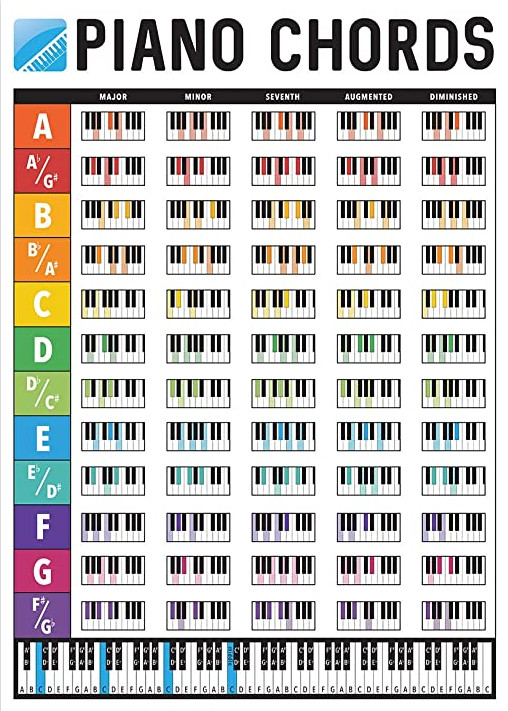
To understand what is a piano chord, it helps to understand intervals. An interval is the distance between two notes. Chords are built by stacking certain intervals above a starting note.
The starting note is called the root. From there, musicians often add notes based on the major scale.
For a major chord, the basic pattern is:
• Root
• Major third
• Perfect fifth
In half steps, this pattern is 4 half steps from the root to the third, followed by 3 half steps from the third to the fifth.
For C major:
• C to E equals 4 half steps.
• E to G equals 3 half steps.
This creates the notes C, E, and G.
A minor chord changes the third. The minor pattern uses 3 half steps from the root to the third, followed by 4 half steps to the fifth.
For C minor:
• C to E-flat equals 3 half steps.
• E-flat to G equals 4 half steps.
The result is C, E-flat, and G. This small change gives the chord a darker or more reflective sound.

The Main Types of Piano Chords
Piano chords come in many forms. Each type has a different sound and purpose.
Major Chords
Major chords often sound bright, strong, and settled. They appear in pop, rock, classical music, gospel, country, and many other styles.
Examples include:
• C major: C, E, G
• F major: F, A, C
• G major: G, B, D
Major chords do not always sound happy. Their mood depends on tempo, melody, rhythm, and the chords around them.
Minor Chords
Minor chords often sound sad, serious, calm, or emotional. They are common in ballads, film music, blues, and dramatic songs.
Examples include:
• A minor: A, C, E
• D minor: D, F, A
• E minor: E, G, B
A minor chord is not automatically sad. A fast song in a minor key can sound exciting, mysterious, or powerful.
Diminished Chords
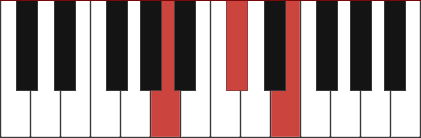
A diminished chord contains a root, minor third, and diminished fifth. The notes are closer together than in a major or minor chord.
For example, B diminished contains:
• B
• D
• F
Diminished chords often sound tense or unstable. They usually lead to another chord instead of ending a song.
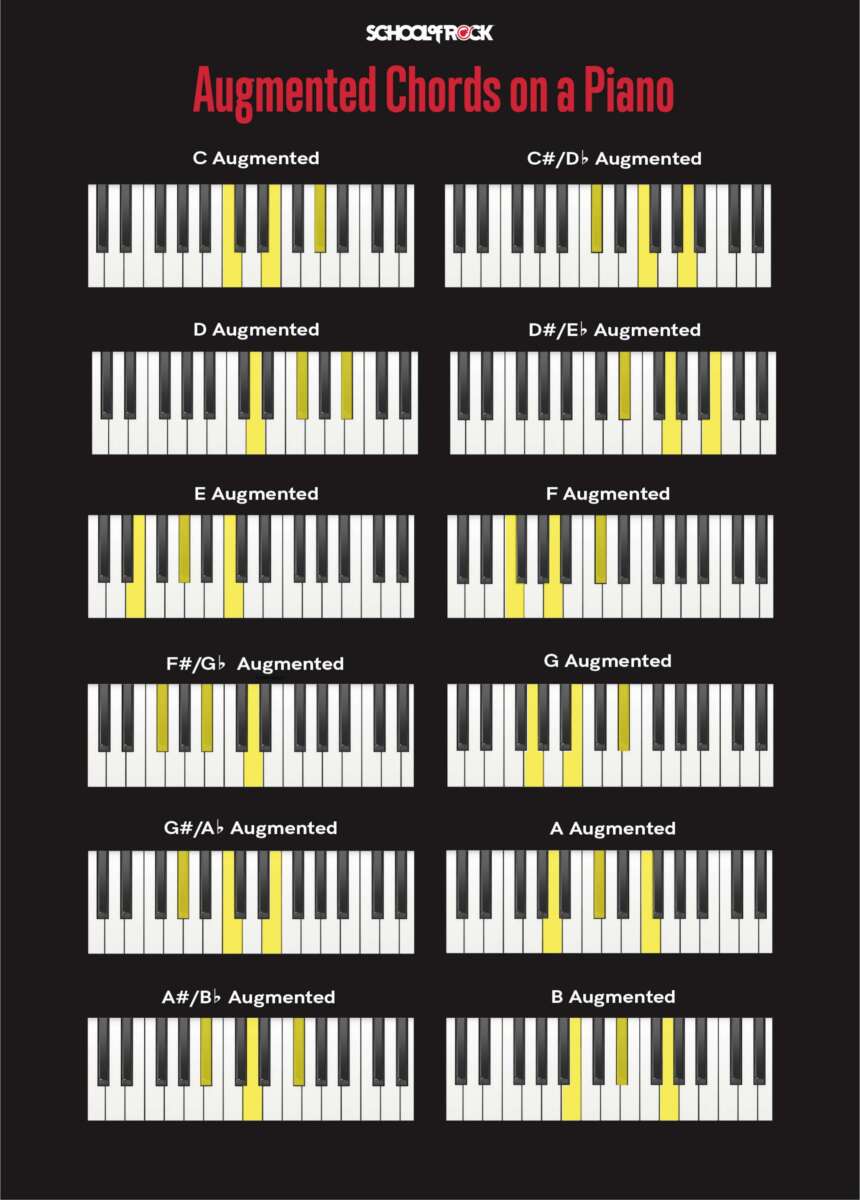
Augmented Chords
An augmented chord contains a root, major third, and raised fifth.
C augmented contains:
• C
• E
• G-sharp
This chord has a floating, unusual sound. Composers often use it to create suspense or movement.
Seventh Chords
A seventh chord adds a seventh note above a basic triad. Seventh chords are important in blues, jazz, gospel, soul, and classical harmony.
Common examples include:
• C major seventh: C, E, G, B
• C dominant seventh: C, E, G, B-flat
• C minor seventh: C, E-flat, G, B-flat
A dominant seventh chord often creates a strong desire to resolve. For example, G7 usually moves to C major in the key of C.
Piano Chord Names and Symbols
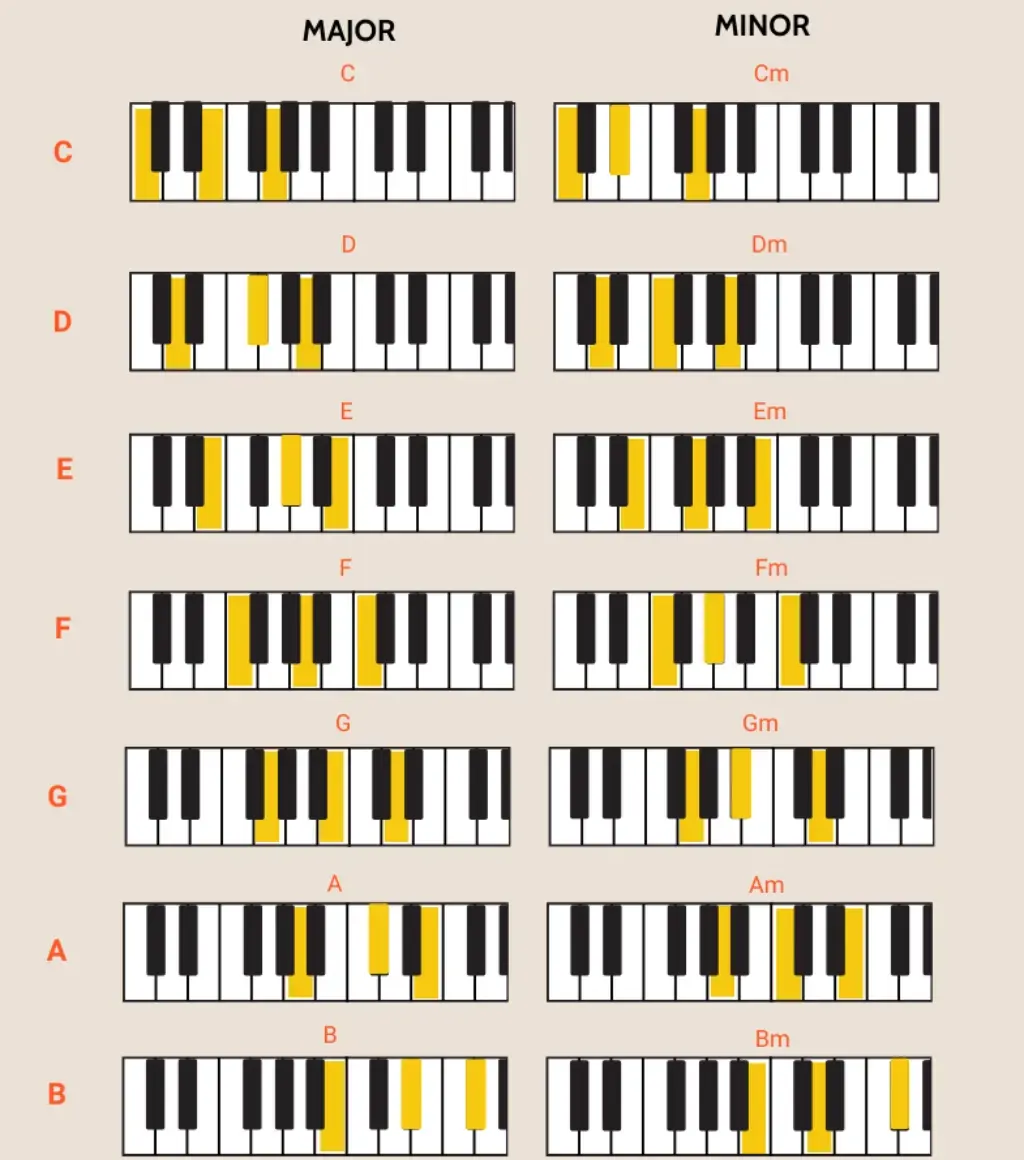
Chord symbols give musicians a short way to read harmony. You may see them above lyrics, on lead sheets, or in digital piano lessons.
Here are common chord symbols:
• C means C major.
• Cm means C minor.
• Cdim means C diminished.
• Caug means C augmented.
• C7 means C dominant seventh.
• Cmaj7 means C major seventh.
• Cm7 means C minor seventh.
• Csus4 means C suspended fourth.
If a chord symbol has no extra letters, it usually means a major chord. For example, D normally means D major.
The symbol slash can show a different bass note. C/E means to play a C chord with E as the lowest note. This is called a slash chord.
Learning chord symbols helps you play songs without reading every note on the page. It also makes it easier to work with singers, guitar players, and other musicians.

Piano Chords Versus Single Notes
A single note has one pitch. A chord combines several pitches at once.
Think of a single note as one voice speaking. A chord is like several voices speaking together in harmony. The notes can support one another, create tension, or form a musical color.
A melody uses single notes in a sequence. Chords usually support the melody underneath. In many songs, the right hand plays the melody while the left hand plays piano chords or bass notes.
For example, a simple song may use:
• C major for a calm opening
• G major for movement
• A minor for a softer mood
• F major for a return to stability
This type of chord movement is called a chord progression.
Common Piano Chord Progressions
A chord progression is a series of chords played in order. Progressions give songs structure and emotional direction.
The I–V–vi–IV Progression
This progression is common in pop music: