Yes, you should buy a violin if you feel ready to practice, learn steadily, and choose an instrument that fits.
Wondering “should I buy a violin” is a smart question, not a sign of doubt. A violin can bring years of joy, but the wrong instrument, poor setup, or unrealistic expectations can make learning harder than it needs to be. This guide will help you judge your goals, budget, skill level, and best buying options so you can make a confident choice.

Should I Buy a Violin or Rent One First?
For many beginners, renting a violin is the best first step. It lowers the cost and gives you time to learn whether you enjoy the instrument before making a larger purchase.


A violin is not like buying a simple school supply. It needs the right size, setup, strings, bow, case, and care. A cheap violin may look attractive online, but it can have stiff strings, a warped bridge, weak tuning pegs, or poor sound. These problems can discourage a new player.
You may want to rent first if:
• You have never played a violin before
• You are unsure whether you will practice often
• Your child may outgrow the instrument
• You want to test different sizes
• You are not yet sure what sound you prefer
A rental program may also let you apply part of your payments toward a future purchase. This can be useful for children, since violin sizes change as they grow.
Buying makes more sense when:
• You have played for several months
• You practice on a regular schedule


• You know the correct violin size
• You understand basic violin care
• You have tried several instruments
My strongest general advice is simple: if you are a complete beginner, rent a properly set-up violin or buy only with help from a teacher or trusted violin shop.

Reasons to Buy a Violin
There are good reasons to buy a violin instead of renting one. The right instrument can become a long-term partner in your musical life.
You plan to play for years
If you already know that you want to learn violin seriously, buying can cost less over time. Long-term rental payments may eventually equal the price of a reliable student violin.
A purchased violin also has resale value. A well-made instrument in good condition may retain much of its value, especially when it comes from a respected maker or shop.
You want a better playing experience
A quality violin responds more easily. It may feel smoother under the bow, hold its tuning better, and produce a clearer tone.
This does not mean an expensive violin will instantly make you sound like a professional. Technique still matters. However, a properly adjusted instrument removes barriers that can make learning frustrating.
You want a personal connection
Musicians often build a strong bond with their instruments. A violin becomes part of daily practice, performances, lessons, and personal progress.
Buying a violin can make practice feel more meaningful. You are not just borrowing a tool. You are choosing an instrument that may grow with you.
You need a full-size violin
adults and many older teens usually need a full-size 4/4 violin. If you are at this stage and expect to continue, buying may be practical.
Children need more care. A child may start with a 1/16, 1/10, 1/8, 1/4, 1/2, or 3/4 violin before moving to a 4/4 size. Renting is often easier during these changes.


Reasons to Wait Before Buying
Sometimes the best answer to “should I buy a violin” is “not yet.” Waiting can protect your money and improve your choice.
You may want to wait if you have not taken a lesson. A teacher can help you understand posture, bow hold, violin size, and the difference between a good setup and a poor one.
You may also want to wait if your budget is very limited. A violin, bow, case, rosin, shoulder rest, and tuner all add to the total cost.
Another reason to wait is unrealistic expectations. Violin playing often sounds rough at first. That is normal. Most beginners need time to develop:
• Finger placement
• Bow control
• Intonation
• Rhythm
• Relaxed posture
• Ear training
A violin is not hard because it is poorly designed. It is hard because it has no frets, so your fingers must learn exact positions. Think of it like drawing a straight line without a ruler. Practice teaches your hand where to go.
If you expect beautiful concert sound after a few days, you may feel disappointed. If you expect small improvements each week, the process becomes far more rewarding.

How Much Does a Violin Cost?
The right violin budget depends on your goals and experience. Prices vary by region, materials, setup quality, brand, age, and condition.
Typical US price ranges include:


• Beginner rental: About $15 to $50 per month, depending on the program
• Basic factory-made violin outfit: About $150 to $400
• Reliable student violin: About $400 to $1,000
• Advanced student or serious amateur violin: About $1,000 to $3,000
• Professional violin: Several thousand dollars and upward
These are broad estimates, not fixed rules. A $250 violin with expert setup may be easier to play than a $600 violin sold without proper adjustment.
Remember the extra costs:
• Bow
• Case
• Rosin
• Shoulder rest
• Extra strings
• Music stand
• Tuner or metronome
• Professional adjustments


• Future repairs
Avoid spending your entire budget on the violin alone. A badly fitted bow can limit your progress, even if the violin itself is decent.
For a new adult player, a sensible starter budget is often around $400 to $800 for a complete, properly adjusted outfit. Renting may still be better if you are uncertain.

What Type of Violin Should a Beginner Buy?
Most beginners should look for a student violin made from solid tonewood and professionally set up by a reliable shop. You do not need an expensive antique or professional instrument.
A beginner violin should have:
• Smooth, properly fitted tuning pegs
• A straight bridge
• A fingerboard without deep grooves
• Strings that sit at a comfortable height
• A tailpiece with working fine tuners
• A soundpost that is correctly placed
• A bow that holds its hair well
• A sturdy case
• A clear return or trial policy


Avoid instruments described only with dramatic words such as “master quality” or “concert professional.” Marketing language does not prove sound or playability.
A violin should feel comfortable in your hands. Its neck should not feel excessively thick. The strings should not sit so high that pressing them becomes painful. The bow should move smoothly without excessive bouncing.
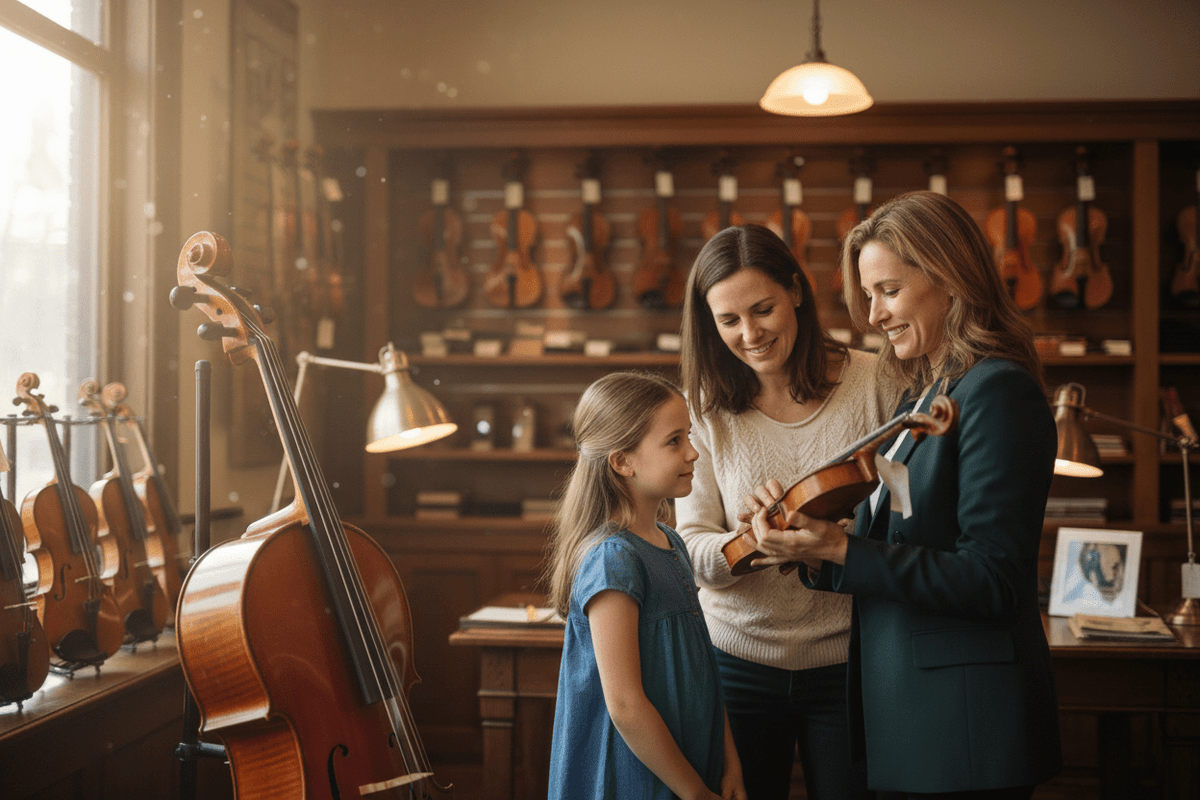
A teacher or experienced player can spot these details quickly. If you cannot bring someone with you, buy from a shop that offers a trial period and setup support.

New Violin or Used Violin?
Both new and used violins can be good choices. The condition and setup matter more than age alone.
A new violin may offer:
• A warranty
• A return period
• Predictable condition
• Easy access to replacement parts
• Support from the seller
A used violin may offer:
• Better materials for the same price
• A more mature tone
• Higher resale value
• A chance to find a well-made older instrument
Used violins also carry risks. Look for cracks, open seams, neck damage, worn pegs, loose purfling, and signs of poor repairs. Small repairs may be normal. Major structural damage can become expensive.
Never buy a valuable used violin without an inspection from a qualified luthier. A luthier is a specialist who builds, repairs, and adjusts string instruments.
Online marketplaces can work for experienced buyers, but they are risky for beginners. Photos may hide cracks or poor setup. If you buy online, choose a seller with a clear return policy and professional support.

What Should I Check Before Buying a Violin?
Before you buy, examine the instrument and ask practical questions. Do not feel rushed by a seller.
Check the violin
Look for:
• A bridge that stands straight
• Even string spacing
• No large cracks near the soundpost
• Tuning pegs that turn smoothly
• A fingerboard that looks straight
• A tailpiece that is not damaged
• No buzzing from loose parts
• A comfortable string height
The finish does not need to look perfect. Small marks may not affect sound. Structural cracks and poor repairs matter much more than scratches.
Test the sound
Play open strings first. Listen for buzzing, rattling, or a weak tone. Then play a simple scale or song across the strings.
A good beginner violin should produce a clear, stable sound without requiring extreme pressure. It may sound bright, warm, dark, or focused. Tone preference is personal, but the sound should not feel trapped or painfully harsh.
Test the bow
The bow should have straight or slightly controlled camber, clean hair, and a working screw. The hair should tighten and loosen properly.
Do not tighten the bow too much. Over-tightening can damage it. A teacher can show you the correct tension.
Ask about setup
Ask who set up the violin. A professional setup often includes bridge fitting, peg adjustment, soundpost placement, string installation, and fingerboard inspection.
This question can reveal the quality of the seller. A trustworthy shop should explain the setup clearly.
Common Mistakes to Avoid
New buyers often make the same mistakes. Avoiding them can save money and reduce frustration.
Choosing the cheapest violin
The cheapest instrument may need repairs that cost more than the violin. It may also make learning harder.
A low price is not always a bargain. Think about total value, playability, and support.
Buying based on appearance
A shiny finish does not guarantee a good sound. Some factory instruments look impressive but have poor bridges or stiff tuning pegs.
Listen first. Inspect the setup. Ask for expert help.
Buying a violin that is too large
A child should not use a full-size violin simply to avoid buying another later. An oversized instrument can cause tension and poor posture.
Correct sizing supports comfort and healthy technique. A teacher or violin shop can measure the player properly.
Forgetting the bow
Many beginners focus on the violin and ignore the bow. This is a mistake. The bow creates the sound, and a poor bow can make tone control difficult.
A balanced student bow is usually better than a decorative bow with poor balance.
Skipping lessons
Videos can help, but they may not catch tension, poor wrist position, or an incorrect bow hold. Even a few lessons with a qualified teacher can prevent habits that take months to correct.
Buying without a return policy
Your first choice may not be your best choice. A return or trial period lets you compare instruments in a calm setting.

Should I Buy a Violin for a Child?
A child can benefit from learning violin, but the decision should match the child’s interest and family routine.
Do not force a child to practice for long periods at first. Short, regular sessions are more effective. Ten focused minutes can be better than one stressful hour.
Before buying, consider:
• Does the child ask to play?
• Can the family support regular lessons?
• Is an adult available to supervise practice?
• Can the child handle the instrument carefully?
• Is the correct violin size available?
Renting is often the safest choice for a growing child. Many rental programs allow size exchanges, which can make each transition easier.
Parents should also expect some early noise. Every violin student begins with scratchy notes. Encouragement matters. A calm home practice routine helps more than criticism.
Is Learning Violin Worth It?
Learning violin is worth it for many people, but the benefits depend on your expectations and commitment.
Playing can support:
• Musical listening skills
• Fine motor control
• Rhythm and timing
• Memory
• Patience
• Confidence
• Creative expression
Research on music education suggests that active musical training can support attention, coordination, and social connection. However, it should not be treated as a guaranteed way to improve every academic skill. Progress varies from person to person.
The greatest benefit may be personal. Playing gives you a way to slow down, listen, and make something with your own hands.
You do not need to become an orchestra musician. You can play folk songs, movie themes, classical music, worship music, fiddle tunes, or music with friends. There is room for many goals.
A Simple Violin Buying Checklist
Use this checklist before you make a purchase:
-
Decide whether renting makes more sense than buying.
-
Confirm the correct violin size.
-
Set a total budget, including accessories.
-
Try the instrument with a teacher or skilled player.
-
Check the bridge, pegs, strings, fingerboard, and soundpost area.
-
Test the violin on every string.
-
Check the bow for balance and condition.
-
Ask about professional setup.
-
Confirm the return, exchange, and repair policy.
-
Keep the receipt and purchase records.
If you buy online, record the unboxing and inspect the instrument at once. Do not remove tags or make changes until you are sure you will keep it.
For most beginners, the safest path is a reputable rental or a student outfit from a specialist shop. The goal is not to own the most impressive violin. The goal is to own one that helps you practice comfortably.
When Should I Buy a Better Violin?
You may be ready for an upgrade when your current violin limits your playing or no longer matches your goals.
Signs include:
• You practice consistently
• Your teacher notices clear progress
• You can compare tone across instruments
• Your current violin has poor response
• You need better projection for performances
• You understand what sound you prefer
Do not upgrade only because another player owns a more expensive violin. A better instrument should solve a real need.
When comparing violins, play the same short pieces on each one. Test low, middle, and high positions. Ask someone else to listen from across the room because the sound under your ear can differ from the sound in an audience.
Give yourself time. Some violins sound better after you adjust to them. A trial period of several days is more useful than a rushed decision in a loud shop.
Frequently Asked Questions About Should I Buy a Violin
Should I buy a violin as a complete beginner?
You can buy one as a beginner, but renting is often safer until you know that you enjoy playing. If you buy, choose a properly set-up student violin from a reputable shop and ask a teacher to help.
Is a cheap violin good enough to learn on?
A low-cost violin can work if it has a professional setup and acceptable materials. Extremely cheap instruments may be difficult to tune and play, so a reliable rental or shop-approved student violin is often a better value.
How much should I spend on my first violin?
Many beginners do well with a complete outfit in the $400 to $800 range, though prices vary. Your budget should include the bow, case, rosin, shoulder rest, strings, and possible setup work.
Is it better to rent or buy a violin?
Renting is usually better when you are uncertain, when the player is a growing child, or when your budget is limited. Buying may be better when you plan to play for years and have enough knowledge to choose a suitable instrument.
Can I buy a violin online?
You can buy a violin online, but beginners face more risk because photos cannot show every setup problem. Choose a seller with a clear return policy, professional support, and enough information about the instrument’s condition.
What size violin should an adult buy?
Most adults use a full-size 4/4 violin. Smaller adults may still need a 4/4 instrument, but comfort and arm length matter, so a teacher or violin shop should confirm the fit.
Do I need a teacher before buying a violin?
A teacher is not required, but expert guidance can prevent costly mistakes. A teacher can help you check size, sound, setup, bow quality, and comfort before you commit.
Conclusion
So, should I buy a violin? Buy one if you are ready to practice, have chosen the right size, and can purchase a well-set-up instrument from a trustworthy seller. If you are unsure, rent first and use lessons to learn what you need.
Focus on playability, support, and long-term value instead of a flashy finish or the lowest price. Try several instruments, ask an experienced player for help, and give yourself time to grow. Explore local violin shops, book an introductory lesson, and share your questions or buying experience in the comments.

Senior Music Reviewer
Alex Carter is a seasoned music reviewer with over a decade of experience in the world of sound and instruments. Passionate about helping musicians and enthusiasts make informed choices, he brings sharp insights and in-depth knowledge to every review. From classical instruments to modern gear, Alex combines technical expertise with a love for music to deliver content that resonates with readers.
As a Senior Music Reviewer and expert author on Tuneluma.com, Alex is dedicated to sharing honest evaluations, practical advice, and thoughtful commentary to guide readers in their musical journey.