Who Made The First Electric Guitar: The Untold Origin
George Beauchamp made the first practical electric guitar, with Adolph Rickenbacker helping manufacture it in 1931.
The story of who made the first electric guitar is more complex than one name on a label. George Beauchamp created the key pickup design, while Adolph Rickenbacker helped turn the idea into the famous metal “Frying Pan.” Together, they changed music by making a guitar loud enough to compete with horns, drums, and full dance bands.
Who Made the First Electric Guitar?
George Beauchamp is widely credited with making the first successful electric guitar. He was an American inventor and musician who worked in Los Angeles during the early 1930s.
Beauchamp understood that a guitar needed more than a louder acoustic body. It needed a device that could sense the movement of its strings and turn that movement into an electrical signal.
His solution was a magnetic pickup. The pickup used coils of wire and magnets to detect the vibration of metal strings. An amplifier then increased the signal and sent it to a speaker.
Adolph Rickenbacker played an important role as well. He was a skilled metalworker and business partner who helped build the guitar body and produce the instrument. That is why early examples are often linked to both Beauchamp and Rickenbacker.
So, who made the first electric guitar? The most accurate answer is:
• George Beauchamp designed the working electric guitar system.
• Adolph Rickenbacker helped build and manufacture the instrument.
• Their company brought the design to the market as the Rickenbacker “Frying Pan.”
What Was the First Electric Guitar?
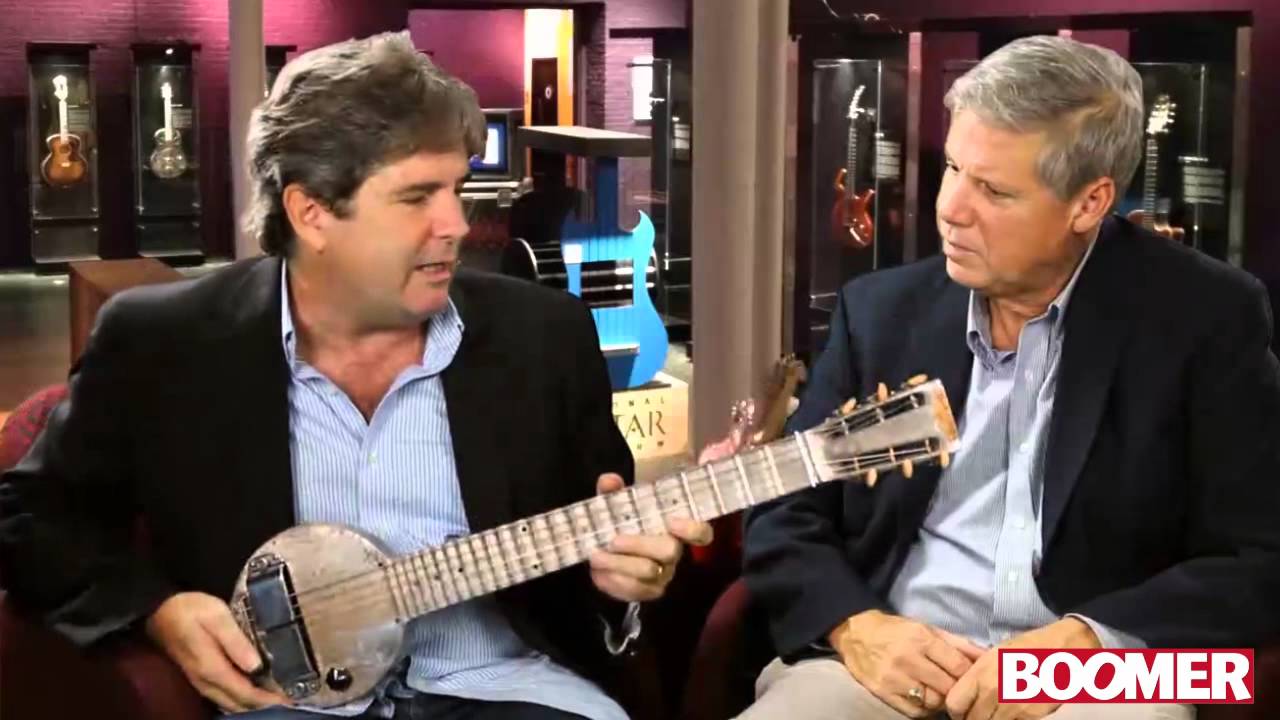
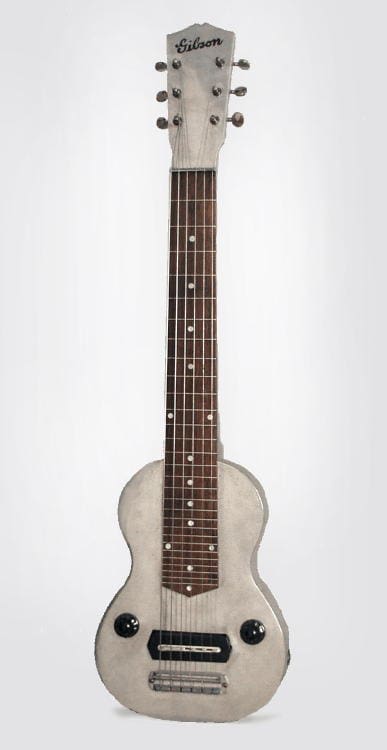
The first widely recognized electric guitar was the Rickenbacker “Frying Pan.” Its formal name was the Rickenbacker Electro A-25.
It was not shaped like a modern Fender Stratocaster or Gibson Les Paul. Instead, it had a long, narrow metal body and a circular pickup area. Its shape looked like a frying pan, which gave the guitar its popular nickname.
The instrument was made for Hawaiian music. Players often placed it across their laps and used a steel bar to slide across the strings. This style is known as lap steel guitar.
The “Frying Pan” used a small electric pickup under the strings. The pickup sent the string signal to an external amplifier. This allowed the guitar to produce a strong, clear sound without relying on a large acoustic body.
The instrument was unusual, but its basic idea was powerful. It treated the guitar less like a small wooden speaker and more like an electronic sound source.
That change became the foundation of the modern electric guitar.
When Was the First Electric Guitar Invented?
The first successful electric guitar was developed around 1931. Beauchamp and Rickenbacker produced early prototypes during this period.
Beauchamp had experimented with ways to amplify guitars before the “Frying Pan” reached the market. His work included efforts to improve the pickup and make the signal strong enough for live performance.
A United States patent connected to Beauchamp’s pickup design was filed in the early 1930s and later granted in 1937. The patent history helps confirm his central role in the invention.
However, invention dates can be confusing. Several musicians and inventors had already tested electrical amplification before Beauchamp’s final design. Some earlier instruments used microphones, telephone technology, or experimental pickups.
For that reason, historians often separate these ideas:
• The first amplified string instruments appeared before 1931.
• George Beauchamp developed the first practical magnetic guitar pickup.
• The Rickenbacker “Frying Pan” became the first well-known commercial electric guitar.
This distinction gives a clearer answer to who made the first electric guitar without ignoring earlier experiments.

How Did George Beauchamp Invent the Electric Guitar?
Beauchamp faced a simple problem. Acoustic guitars could not produce enough volume for large dance bands.
In the 1920s and early 1930s, big bands were becoming popular. Horns, brass sections, drums, and piano could easily cover the sound of a normal guitar. Musicians needed more volume, but simply making the guitar body larger was not enough.
Beauchamp tested several solutions. His most important breakthrough was using electromagnetic principles.
A magnetic pickup works in a simple way:
- A magnet creates a magnetic field around the strings.
- A metal string vibrates inside that field.
- The vibration changes the magnetic field.
- A coil of wire converts that change into a small electrical signal.
- An amplifier increases the signal.
- A speaker turns the signal back into sound.
This process is similar to turning motion into a message. The string moves, the pickup reads that movement, and the amplifier makes the message loud.
Beauchamp’s early pickup used horseshoe-shaped magnets placed around the strings. The design was large and unusual, but it produced a usable signal.
That was the key achievement. He did not just make a guitar louder by mechanical means. He created an electric instrument that could work with amplification.
What Role Did Adolph Rickenbacker Play?
Adolph Rickenbacker did not invent the pickup itself, but his contribution was still essential.
Rickenbacker owned a metalworking business that could produce the unusual body needed for Beauchamp’s instrument. The early guitar had a steel or aluminum body, which made it durable and easy to shape.
Rickenbacker also helped with production and business development. An invention can remain a clever prototype if nobody can build it reliably. Rickenbacker helped move the design from a workshop experiment to a commercial product.
The company first used the name Ro-Pat-In Corporation. Later, the Rickenbacker name became closely connected with the instrument.
This is why the answer to who made the first electric guitar should not erase Rickenbacker’s role. Beauchamp supplied the central electrical idea. Rickenbacker helped make the instrument practical, recognizable, and available to players.
The story is a good example of how inventions often come from teamwork. One person may solve the technical problem, while another provides the tools, materials, and business support.
Was the Rickenbacker “Frying Pan” the First Electric Guitar?
The “Frying Pan” is generally considered the first commercially successful electric guitar. It was not necessarily the first instrument that ever used electricity to increase string volume.
Earlier experiments existed. Some musicians used microphones near acoustic guitars. Others tried pickups based on telephone receivers or other electrical devices.
Those early systems had serious limits. Microphones could create feedback, pick up unwanted sound, or fail to capture the guitar clearly. A magnetic pickup worked more directly with the vibrating strings.
The “Frying Pan” became important because it combined several useful features:
• It used a dedicated magnetic pickup.
• It worked with an external amplifier.
• It produced a stronger and more controlled signal.
• It was designed for real musicians and live settings.
• It could be manufactured and sold.
That combination made it more than a laboratory experiment. It became a usable musical tool.
When people ask who made the first electric guitar, they usually mean the first practical, purpose-built, commercially available model. Under that definition, Beauchamp and Rickenbacker deserve the credit.

Did Lloyd Loar Invent the First Electric Guitar?
Lloyd Loar was an important inventor, but he did not make the first commercial electric guitar.
Loar worked for Gibson and explored electric amplification in the 1920s. He tested instruments with pickups and electrical components while studying ways to improve their sound.
His work came before the Rickenbacker “Frying Pan.” However, Loar’s experiments did not lead to the first widely sold electric guitar.
His research still matters because it shows that several inventors were trying to solve the same problem at nearly the same time. The demand for a louder guitar was growing, and musicians needed better tools for modern performance.
This is one reason the history of who made the first electric guitar can seem unclear. The electric guitar did not appear from one isolated idea. It developed through many experiments in acoustics, magnetism, electronics, and instrument building.

How Did the First Electric Guitar Change Music?
The first electric guitar helped move the instrument from the background to the front of the band.
Before amplification, guitars often supported rhythm and harmony. They were useful, but they could struggle to compete with louder instruments. Electric amplification changed that balance.
Guitarists could now:
• Play melodic lines that audiences could hear.
• Use stronger attacks and longer sustain.
• Perform with larger groups.
• Explore distortion and electronic effects.
• Develop new lead guitar styles.
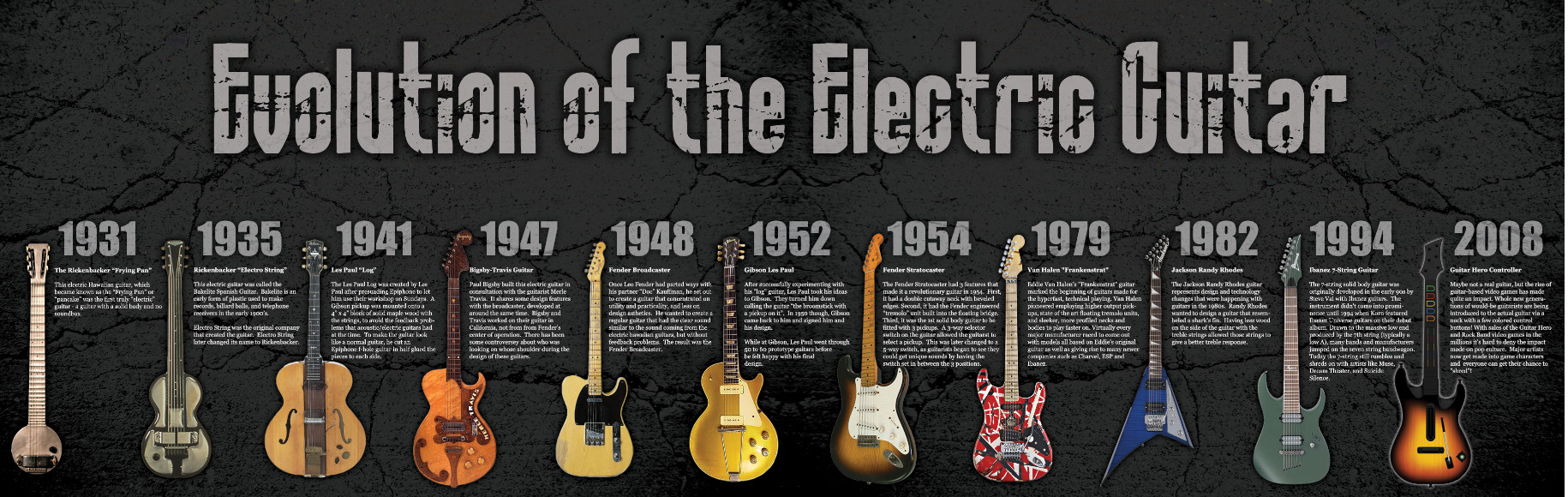
The earliest electric guitars were mostly used in Hawaiian music, jazz, and dance-band settings. Later, electric guitar makers created solid-body instruments for blues, country, rock, and pop.
The electric guitar also changed how musicians think about sound. The guitar was no longer limited to the natural tone of wood and strings. Pickups, amplifiers, speakers, pedals, and recording equipment all became part of the instrument.
In that sense, who made the first electric guitar is not only a history question. It is also the beginning of a major change in popular music.
How the First Electric Guitar Differs From Modern Guitars
The “Frying Pan” looks very different from most electric guitars today.
Modern guitars often have a wooden body, a shaped neck, frets, tuning machines, and one or more pickups. The Rickenbacker model had a metal body and a design made for lap playing.
Here are some major differences:
| Feature | Rickenbacker “Frying Pan” | Modern electric guitar |
|---|---|---|
| Body style | Lap steel design | Handheld guitar design |
| Main material | Metal body | Usually wood |
| Playing position | Across the player’s lap | Held against the body |
| Pickup | Early horseshoe magnet design | Single-coil or humbucker |
| Typical use | Hawaiian music | Rock, blues, jazz, country, and pop |
| Sound control | Basic amplification | Amplifiers, pedals, and effects |
The early instrument also had a limited range of tonal colors compared with modern guitars. Yet its simple design offered something vital: volume and clarity.
That is often how progress works. The first version does not need to do everything. It only needs to prove that a new idea can work.
Common Mistakes When Researching Who Made the First Electric Guitar
Many articles give a one-name answer without explaining the history. That can create confusion.
Here are the most common mistakes:
• Saying Leo Fender invented the first electric guitar. Fender developed some of the most influential later models, but he was not the first electric guitar inventor.
• Saying Gibson made the first electric guitar. Gibson produced important early electric instruments, but the Rickenbacker “Frying Pan” came earlier.
• Ignoring earlier experiments. Beauchamp’s guitar was not the first attempt to amplify strings.
• Treating the patent date as the invention date. The design process began before the patent was granted.
• Giving Rickenbacker all the credit. Rickenbacker helped build and sell the instrument, while Beauchamp developed the key pickup concept.
A careful answer should explain the difference between invention, commercial production, and later development.
That approach is more accurate and gives credit to the people who contributed to the instrument’s success.
A Practical Way to Understand the “Frying Pan” Sound
The best way to understand the first electric guitar is to think about signal control.
An acoustic guitar creates sound through the vibration of its body. A magnetic electric guitar creates a small electrical signal from the strings. The amplifier then shapes and increases that signal.
This design has several benefits:
• The guitar can be much louder.
• The body does not need to produce all the volume.
• The signal can be recorded or processed.
• The player can control tone through amplification.
It also creates challenges. Early pickups could sound harsh, and high volume could cause feedback. Players had to learn how far to stand from the amplifier and how to control unwanted noise.
These lessons still matter for modern guitarists. Good pickup height, clean cables, proper amplifier settings, and controlled volume can make a large difference.
Even though the technology has improved, the basic idea remains the same as it was in Beauchamp’s early design.
Why the First Electric Guitar Still Matters Today
The first electric guitar was not perfect. It was heavy, limited, and designed for a specific playing style. Yet it solved a real problem for musicians.
Its influence can be seen in nearly every electric guitar made today. Modern instruments still rely on the same basic chain:
- Metal strings vibrate.
- Pickups sense the vibration.
- A cable carries the signal.
- An amplifier increases and shapes the sound.
- A speaker produces the final tone.
The materials and electronics have changed, but the foundation remains.
When asking who made the first electric guitar, it is useful to remember the larger lesson. Major inventions often begin when a musician faces a practical problem and an engineer finds a new way to solve it.
George Beauchamp saw that guitars needed more volume. Adolph Rickenbacker helped turn his idea into a real instrument. Their work gave future builders the platform for the Telecaster, Stratocaster, Les Paul, SG, and countless other models.
Frequently Asked Questions
Who made the first electric guitar?
George Beauchamp developed the first practical electric guitar and its magnetic pickup system. Adolph Rickenbacker helped build and manufacture the instrument, known as the Rickenbacker “Frying Pan.”
What was the first electric guitar called?
The first widely recognized commercial model was the Rickenbacker Electro A-25. Players later nicknamed it the “Frying Pan” because of its long neck and circular metal body.
When was the first electric guitar invented?
The first successful electric guitar was developed around 1931. Its related pickup patent was granted later, in 1937.
Did Leo Fender invent the first electric guitar?
No. Leo Fender created several highly influential electric guitars later, including the Broadcaster, Telecaster, and Stratocaster. The Rickenbacker “Frying Pan” appeared more than a decade before Fender’s major designs.
Did Gibson make the first electric guitar?
No. Gibson made important early electric guitars, including the ES-150, but the Rickenbacker “Frying Pan” came first as a successful commercial electric guitar.
Why was the first electric guitar made from metal?
The metal body suited the lap steel design and was practical for early production. The instrument’s main goal was to support the pickup and provide a stable platform for amplified performance.
Was the first electric guitar a solid-body guitar?
It was a solid instrument, but it was not shaped like the solid-body electric guitars that became popular later. The “Frying Pan” was a lap steel guitar with a metal body and a narrow neck.
How did the first electric guitar produce sound?
Its magnetic pickup detected the vibration of metal strings. The pickup changed that motion into an electrical signal, which an amplifier increased and sent to a speaker.
Conclusion
George Beauchamp made the first practical electric guitar by developing a working magnetic pickup around 1931. Adolph Rickenbacker helped build and market the design as the Rickenbacker “Frying Pan,” the first widely recognized commercial electric guitar.
Earlier inventors explored electrical amplification, and later builders transformed the instrument into the guitars used in jazz, blues, rock, country, and pop. Still, Beauchamp and Rickenbacker solved the central problem: making the guitar loud enough to lead.
Understanding who made the first electric guitar also shows how invention works in real life. Technical skill, creative testing, and practical manufacturing all played a part. Explore the history of the “Frying Pan,” compare it with a modern electric guitar, and share your favorite early guitar design with other music fans.

Senior Music Reviewer
Alex Carter is a seasoned music reviewer with over a decade of experience in the world of sound and instruments. Passionate about helping musicians and enthusiasts make informed choices, he brings sharp insights and in-depth knowledge to every review. From classical instruments to modern gear, Alex combines technical expertise with a love for music to deliver content that resonates with readers.
As a Senior Music Reviewer and expert author on Tuneluma.com, Alex is dedicated to sharing honest evaluations, practical advice, and thoughtful commentary to guide readers in their musical journey.