Introduction
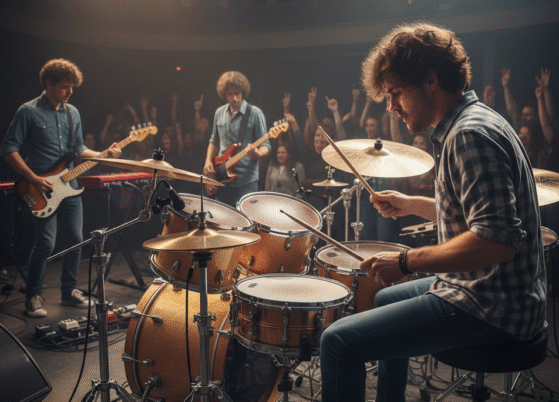
In a U.S. band, the drums help turn separate musical parts into one coordinated performance. They set the pulse, shape the groove, mark changes, build energy, and support the other musicians. The drummer also helps control how the band starts, stops, grows, and moves through a song.
The drum part is not just a loud beat in the background. It is a form of musical direction. A good drummer listens closely and chooses when to lead, when to support, and when to leave space.

The Short Answer: What Do Drums Do in a Band?
The main role of drums in a band is to provide rhythm, time, energy, and structure.


A drummer may:
- Set the song’s tempo.
- Create the main rhythmic feel.
- Support the bass line.
- Mark the start and end of sections.
- Build tension before a chorus or solo.
- Add accents that make a riff stand out.
- Help musicians stay together.
- Control the energy of a live performance.
- Add sound, texture, and emotion to a recording.
The exact role changes by style. A rock drummer may drive the song with a strong backbeat. A jazz drummer may interact with the band through subtle accents and changing patterns. A country drummer may support the vocal and guitar with a steady, restrained groove.
In every style, the drummer helps answer one basic question: Where is the music going, and how should it feel?
Why Rhythm Matters So Much
Rhythm is the organized pattern of sounds and silences. It gives music movement. Without rhythm, a band can have strong melodies and chords but still sound disconnected.
The drums make rhythm easy to hear. The kick drum often supports the low, physical pulse. The snare drum often marks the backbeat. The hi-hat or ride cymbal helps divide the beat into smaller parts.
For example, a common rock pattern places:
- The kick drum on beats one and three.
- The snare drum on beats two and four.
- The hi-hat on steady eighth notes.
This pattern is simple, but it gives the rest of the band a clear frame. The bass can lock with the kick. The guitar can fit around the snare. The singer can phrase words against the beat.
Pulse, tempo, and groove
These terms are related but not identical:
- Pulse: The steady underlying beat that listeners may tap with a foot.
- Tempo: The speed of that pulse, often measured in beats per minute, or BPM.
- Groove: The way the rhythm feels, including timing, accents, note length, and dynamics.
Two drummers can play the same written rhythm at the same tempo and still create different grooves. One may sound relaxed and deep. Another may sound tight and urgent.
Groove comes from more than perfect timing. It also comes from touch, sound choice, note placement, and how the drummer responds to the other musicians.


How Drums Support the Rest of the Band
Drums work as part of a musical network. The drummer does not operate alone. Each drum part connects with another instrument.
The drummer and bass player
The drummer and bass player form the core of many bands’ rhythm sections. The bass often connects rhythm with harmony, while the drums give that motion shape and weight.
When the kick drum and bass line work well together, the song can feel solid and powerful. They do not need to play the exact same notes or rhythms at all times. They do need to agree on the main pulse and important accents.
A useful approach is to decide:
- Which kick drum hits match the bass line.
- Which notes should remain open.
- Where both players should accent a riff.
- Where one player should create contrast.
If the kick drum plays too many unrelated notes, it can compete with the bass. If it plays too few, the low end may lose movement. The best choice depends on the song.
The drummer and guitarist
Guitarists often create riffs, chords, and repeated patterns. The drummer can reinforce those parts by matching key accents.
For example, a guitar riff may have three strong hits. The drummer might place the kick drum with those hits and use a crash cymbal at the start of each phrase. This makes the riff sound larger without simply copying every note.
The drummer can also create contrast. A guitar may play long, sustained chords while the drums use a busy pattern. Or the guitar may play a dense riff while the drums leave more space.
The drummer and singer
A drummer must support the vocal. The vocal usually carries the main message of the song, so the drum part should not bury it.
A loud cymbal pattern may make a chorus feel exciting, but it can also make words harder to hear. Many drummers use lighter cymbal playing under verses and open up during choruses.
The drummer can also help the singer with phrasing. A short fill before a vocal line may signal the next phrase. A strong accent at the end of a line can make the lyric feel more complete.
The drummer and other instruments
In a larger band, the drums may interact with keyboards, horns, strings, percussion, or electronic sounds. The drummer may support a horn hit, follow a keyboard pattern, or leave room for a featured instrument.
The main lesson is simple: the drum part should serve the full arrangement, not just display the drummer’s skill.


The Main Parts of a Drum Set and Their Jobs
A standard drum set contains several parts. Each part has a different musical purpose.
| Drum set part | Common role |
|---|---|
| Kick drum | Adds low-end weight and supports the main pulse |
| Snare drum | Creates backbeats, accents, and sharp rhythmic contrast |
| Hi-hat | Keeps time and adds control over note density |
| Rack toms | Provide rising or falling fills and melodic drum movement |
| Floor tom | Adds a deep voice for fills and larger accents |
| Ride cymbal | Gives a clear, sustained time pattern |
| Crash cymbal | Marks entrances, section changes, and strong accents |
| China or effect cymbals | Adds a special color when the arrangement needs it |
This list describes common uses, not strict rules. A drummer may use the ride cymbal for a verse, the hi-hat for a chorus, or the floor tom as part of the main groove.
The kick drum
The kick drum gives the beat physical force. It often works with the bass guitar, but it can also create independent patterns.
A kick pattern can make a song feel:
- Heavy and direct.
- Fast and urgent.
- Funky and syncopated.
- Relaxed and spacious.
- Uneven in a deliberate way.
The snare drum
The snare often carries the backbeat. In many rock, pop, and R&B songs, a strong snare hit on beats two and four helps define the style.
The snare can also create ghost notes. These are quiet notes placed between louder hits. Ghost notes add motion without taking attention away from the main beat.
Cymbals
Cymbals add brightness and sustain. They can make a section feel wider, louder, or more open.
Because cymbals can dominate a mix, the drummer must control them carefully. A strong cymbal hit may be right for a chorus but too much for a verse.

How Drummers Shape a Song
Drums help listeners understand a song’s form. A song’s form is its sequence of sections, such as an intro, verse, chorus, bridge, solo, and outro.
Starting the song
The drummer may count in the band with spoken numbers, stick clicks, or a short pickup. The count-in sets the tempo and gives everyone a shared starting point.
A poor count-in can cause the band to begin too fast, too slow, or on the wrong beat. A clear count-in should match the actual feel of the song.
Moving between sections
Drummers often use fills to connect sections. A fill is a brief change from the main pattern. It may use toms, snare notes, cymbals, or a change in the kick pattern.
A useful fill does more than show speed. It tells the band and audience that something is about to change.
A fill should usually:


- Fit the song’s tempo.
- Lead clearly into the next section.
- Leave room for the vocal or main riff.
- End with the band together.
- Match the energy of the section.
Building energy
Drummers control energy through volume, note density, sound choice, and dynamics. Dynamics are changes in loudness and intensity.
A drummer can build energy by:
- Opening the hi-hat.
- Moving from hi-hat to ride cymbal.
- Adding more kick drum notes.
- Playing larger snare accents.
- Using toms before a chorus.
- Raising the volume gradually.
The drummer can also reduce energy. Playing fewer notes, using softer strokes, or moving to a closed hi-hat can make space for a quiet verse.
Ending the song
The ending may include a final crash, a marked stop, a repeated groove, or a gradual fade. The drummer often helps make the final moment clear.
If the band has a written ending, the drummer should know exactly where the last hit occurs. If the ending is improvised, the drummer may communicate the final cue through a fill or visual signal.
The Role of Drums in Different Music Styles
The drum role changes with the style, but the core duties remain similar.
Rock
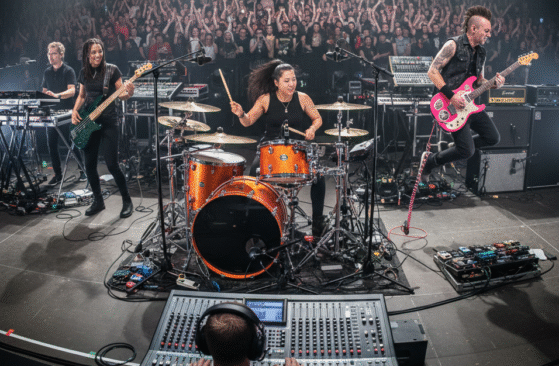
Rock drums often emphasize a strong backbeat, clear kick patterns, and powerful transitions. The drummer may help make guitar riffs feel larger and create a sense of forward motion.
Rock drumming can be simple or highly complex. A basic beat may serve a song better than a busy pattern if the vocal and guitar already contain a lot of activity.
Pop
Pop drumming usually supports the vocal and the song’s main hook. The part may be carefully arranged to create contrast between sections.
Modern pop may use acoustic drums, electronic samples, programmed beats, or a mix of all three. The drummer’s role is still to support timing, structure, and emotional shape.
Jazz
Jazz drumming often involves conversation. The drummer may respond to the soloist, change the texture, and shift accents during the performance.
The ride cymbal may carry the main time pattern while the snare and bass drum add quieter comments. The drummer may also interact with the bass and piano rather than repeat one fixed beat.
Country
Country drumming often supports the vocal, guitar, and groove with clear but controlled patterns. The drummer may use a steady backbeat, train-style rhythms, brushes, or light cymbal work.
The right part depends on the song. A dance-focused country track may need a strong kick and snare pattern. A ballad may need restraint.


Funk and R&B
Funk and R&B rely heavily on placement, repetition, and feel. A small change in the kick, snare, or hi-hat can change the entire groove.
These styles often reward space. The drummer must make each note count and lock closely with the bass player.
Metal and punk
Metal may use fast double-kick patterns, strong accents, and detailed coordination with guitars. Punk often uses direct, forceful beats that support speed and energy.
In both styles, endurance matters. The drummer must maintain control without rushing or losing sound quality.
Worship, gospel, and live community music
In church and community settings across the United States, drummers may follow a musical director, support a choir, and respond to changes made in real time. The role can include both steady support and spontaneous interaction.
The drummer must listen for cues from the leader and other musicians. Musical awareness often matters more than technical complexity.
What Makes a Good Drummer in a Band?
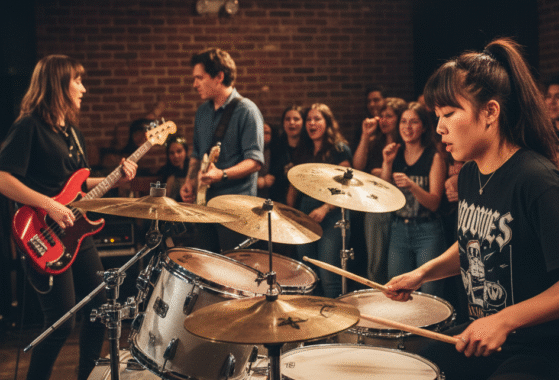
A good drummer does more than play difficult patterns. Good band drumming combines time, listening, control, and judgment.
Reliable time
The band needs a stable pulse. A drummer who speeds up during loud sections or slows down during difficult fills can make the whole performance feel uncertain.
Good time does not always mean rigid timing. Some styles use expressive movement. The key is that any movement should support the song rather than happen by accident.
Strong listening
A drummer should listen to the bass, vocal, guitar, and overall arrangement. Listening helps the drummer decide when to add notes and when to simplify.
This is one reason experienced drummers may look less busy than beginners. They often play fewer notes because they understand what the song needs.
Dynamic control
A drummer should be able to play softly, loudly, and at every level between those extremes. Dynamic control helps the band create contrast.
Practice the same groove at several volume levels. Keep the tempo steady while changing the force of each stroke.
Clear communication
Drummers communicate through count-ins, fills, eye contact, body movement, and consistent patterns. These signals help the band coordinate without stopping the song.


In a live show, the drummer may also help the band recover from a missed cue. A steady groove can give other players time to reconnect.
Good judgment
The best drum part is not always the most complex one. A simple pattern may serve a verse. A larger fill may suit a final chorus. The choice should follow the arrangement.
A useful test is to mute the drum track and ask what the band loses. If the answer is only “many notes,” the part may need a clearer purpose.

Drums in Rehearsals, Recording, and Live Shows
The drummer’s role changes slightly based on the setting.
During rehearsal
At rehearsal, the drummer helps the band find the tempo and arrange transitions. The group can test different grooves, endings, fills, and dynamics.
Record a rehearsal when possible. Listening back can reveal rushing, unclear endings, or parts that cover the vocal.
In the recording studio
In a recording, timing and sound become especially important. Microphones capture details that may be less obvious in a loud rehearsal room.
A studio drum part may need to fit a click track, a programmed element, or a fixed arrangement. The drummer must balance a natural performance with the needs of editing and mixing.
The kick and bass should occupy compatible rhythmic and sonic spaces. The snare should support the vocal and main accents. Cymbal control matters because sustained cymbal sound can be difficult to remove from a recording.
During a live performance
Live drums provide physical impact and help the band manage energy in the room. The drummer may respond to the audience, the singer, or changes in the venue.
A live drummer also needs a backup plan. If a monitor fails or a musician misses a cue, the drummer should keep the pulse clear and avoid sudden changes that make the problem worse.
Common Mistakes Drummers Make
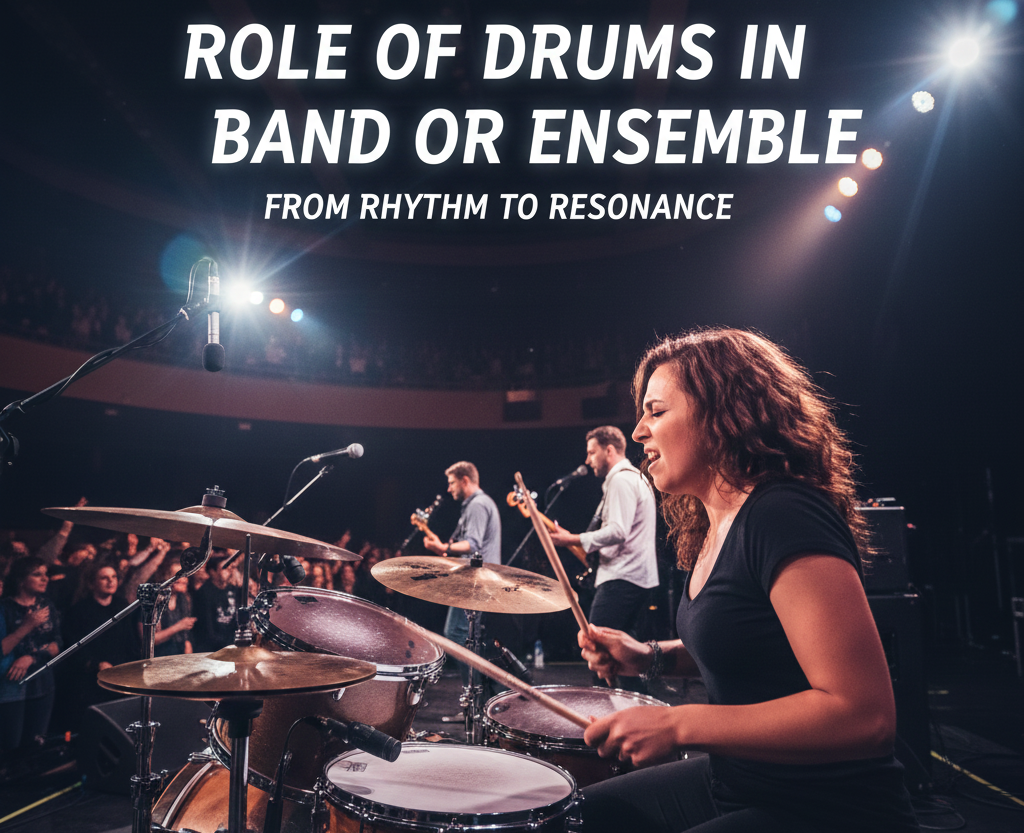
Several mistakes can weaken a band even when the drummer has strong technique.
Playing too many fills
A fill should help the song move. Too many fills can interrupt the vocal, distract from the hook, or make the arrangement feel crowded.
Start with the main groove. Add fills only where they support a clear transition or accent.
Playing at one volume
A song with the same volume from start to finish can feel flat. Use softer playing in low sections and stronger playing when the arrangement opens up.
Rushing after fills
Many drummers speed up after a busy fill. Practice fills with a metronome. Focus on landing the first beat of the next section at the correct tempo.
Hitting cymbals too hard
Hard cymbal hits can overwhelm vocals and other instruments. They can also increase the risk of hearing damage over time.
Use controlled strokes and choose the cymbal sound that fits the room. More force does not always create more musical impact.
Copying a recording without serving the band
A drummer may learn every detail of a recorded part but struggle when the live band uses a different tempo, key, or arrangement.
Learn the function of each part. Then adapt it to the musicians in front of you.
Ignoring the song’s form
A drummer who does not know where the verse, chorus, bridge, and ending occur may miss important cues.
Study the arrangement before rehearsal. Mark transitions on a chart if needed.

Hearing Safety for Drummers
Drums can produce high sound levels, especially in small rooms and enclosed stages. Repeated exposure to loud sound can harm hearing and may cause ringing or muffled hearing.
The National Institute for Occupational Safety and Health and the Occupational Safety and Health Administration provide guidance on reducing occupational noise exposure. Their principles support practical steps for musicians too.
Drummers can reduce risk by:
- Wearing musician earplugs or other suitable hearing protection.
- Taking breaks from loud playing.
- Increasing distance from loud amplifiers when possible.
- Using sound checks to control stage volume.
- Watching for ringing, pain, or muffled hearing after playing.
- Seeking a hearing professional’s advice if symptoms continue.
Do not treat hearing protection as a sign of weak musicianship. A drummer needs reliable hearing to control tone, timing, and balance. Protection can help preserve those skills.
If hearing suddenly changes, one ear becomes blocked, or ringing continues, seek prompt medical advice.

Key Takeaways
- The main role of drums in a band is to provide rhythm, time, energy, and structure.
- The drummer supports the bass, guitar, vocal, and other instruments.
- Kick drum, snare, hi-hat, toms, and cymbals each add different sounds and functions.
- Fills help mark transitions, but they should serve the song.
- Dynamics help a band build and release energy.
- A good drummer listens, keeps dependable time, communicates clearly, and chooses parts that fit the arrangement.
- Hearing protection matters because repeated loud sound can damage hearing.
Frequently Asked Questions
Do drums lead the band?
Drums can lead the band by setting the tempo, marking transitions, and controlling energy. However, leadership is shared. The singer, conductor, bandleader, or another instrument may give the main cues in some groups.
Can a band play without drums?
Yes. A band can use bass, guitar, keyboards, hand percussion, electronic beats, or no rhythm instrument at all. Without drums, another instrument must often provide the pulse or rhythmic shape.
Do drums have to play the same rhythm as the bass?
No. The kick drum and bass often work together, but they do not need to copy each other. Matching key accents can create unity, while different rhythms can add movement and contrast.
How loud should drums be in a band?
The drums should be loud enough to support the arrangement but not so loud that they cover the vocal or other instruments. The right level depends on the room, style, equipment, and performance setting.
How can a beginner learn to play drums in a band?
Start with steady quarter-note and eighth-note patterns. Practice with a metronome, learn complete songs, and rehearse with other musicians. Focus first on tempo, listening, clean transitions, and dynamics rather than complex fills.
What is the difference between a drummer and a percussionist?
A drummer usually plays a drum set built around kick, snare, toms, and cymbals. A percussionist may play hand drums, shakers, tambourines, mallets, or other rhythm instruments. Some musicians perform both roles.
Conclusion
The role of drums in a band is to give music a clear pulse, strong movement, and emotional shape. Drums connect the parts of a song and help musicians stay together from the first count-in to the final hit.
The strongest drum part is not always the fastest or most complex. It is the part that supports the song, fits the style, and helps the whole band sound more connected.
A useful next step is to listen to one favorite song and identify three things: where the drummer marks the beat, where the drummer changes energy, and how the drum part supports the bass and vocal.
Sources and Further Reading
- National Institute for Occupational Safety and Health: Noise and Hearing Loss Prevention
- Occupational Safety and Health Administration: Occupational Noise Exposure
- Library of Congress: National Recording Preservation Board
- Berklee College of Music
- Encyclopaedia Britannica: Drum

Senior Music Reviewer
Alex Carter is a seasoned music reviewer with over a decade of experience in the world of sound and instruments. Passionate about helping musicians and enthusiasts make informed choices, he brings sharp insights and in-depth knowledge to every review. From classical instruments to modern gear, Alex combines technical expertise with a love for music to deliver content that resonates with readers.
As a Senior Music Reviewer and expert author on Tuneluma.com, Alex is dedicated to sharing honest evaluations, practical advice, and thoughtful commentary to guide readers in their musical journey.