Does Playing Piano Make You Smarter: The Science Explained
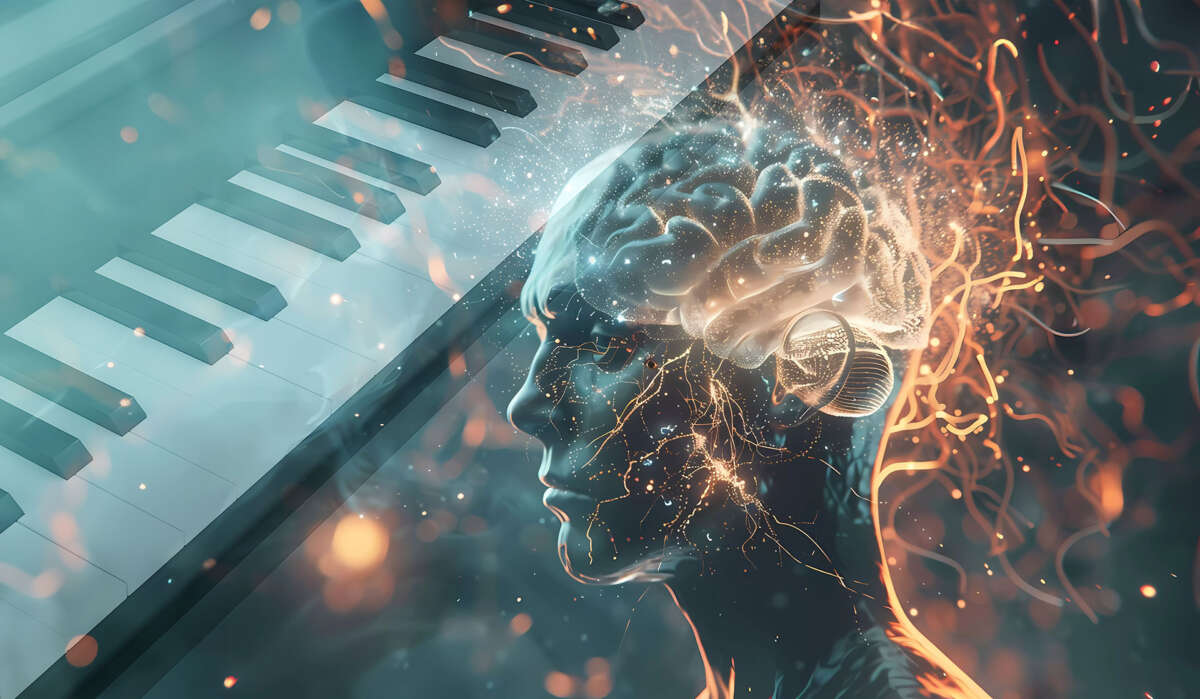
Playing piano can sharpen memory, attention, coordination, and problem-solving, but it does not automatically raise overall intelligence.
Does playing piano make you smarter? Research suggests that regular piano practice can strengthen several mental skills, especially working memory, focus, auditory processing, and self-control. However, the benefits depend on practice quality, age, motivation, and how “smarter” is defined. This guide explains what science shows, what it does not prove, and how to practice for the best mental results.

Does playing piano make you smarter?
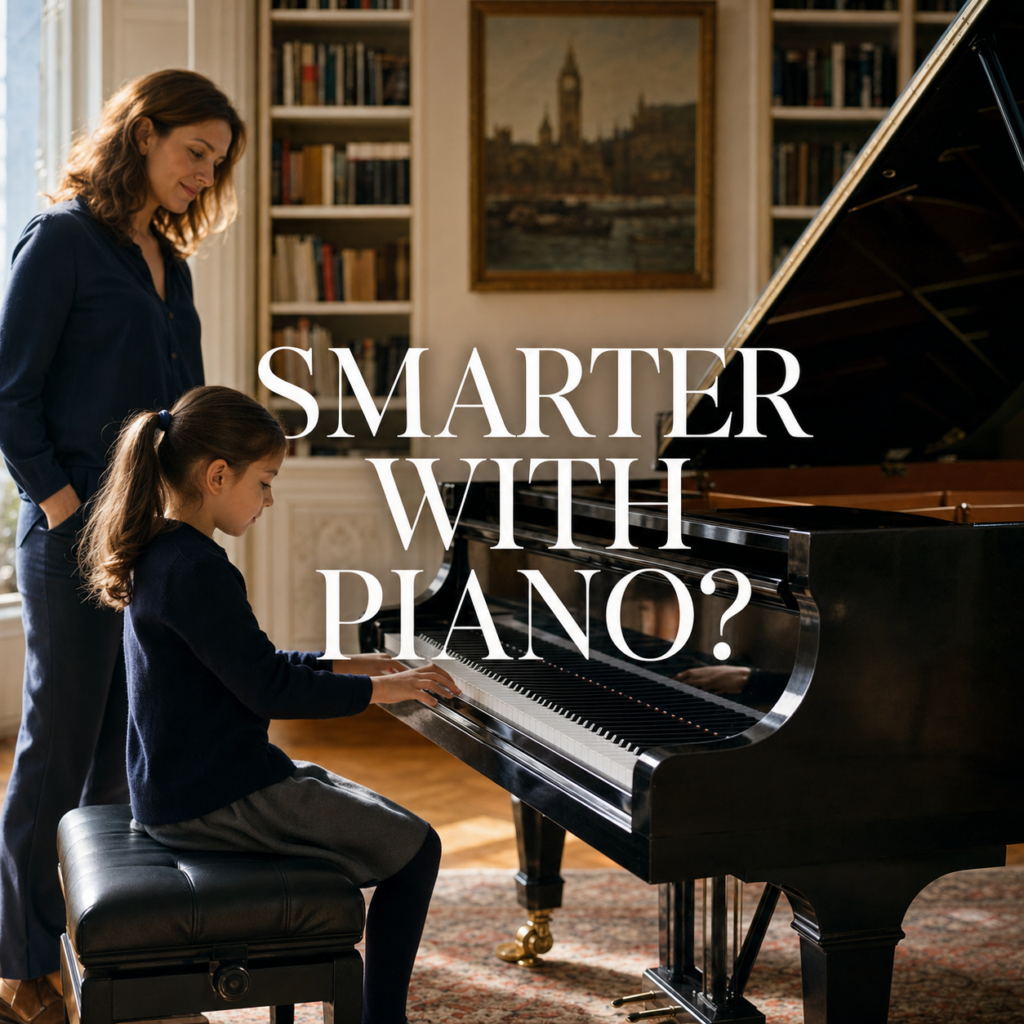
The short answer is yes, in some meaningful ways. Playing piano gives your brain a complex task that combines sound, movement, reading, timing, memory, and emotion. Each hand may play a different pattern while your eyes read music and your ears check the result.
Still, piano lessons do not act like a magic IQ booster. They may improve specific skills that support learning, yet they may not make someone better at every type of test or task.
A useful way to think about it is this: playing piano is like taking your brain to the gym. It trains certain “muscles,” such as attention and coordination. It does not guarantee that every mental skill will grow at the same rate.
Studies on music training often find links between musical experience and stronger executive function. Executive function includes skills such as:
• Planning and organizing
• Holding information in mind
• Switching between tasks
• Controlling impulses
• Staying focused
• Solving problems
The key issue is cause and effect. People who choose piano may already be patient, curious, or motivated to learn. Those traits can also support better academic performance. So, research must separate the effect of piano practice from the traits of the people who practice.
How piano practice changes the brain
Learning piano requires the brain to connect hearing, vision, touch, and movement. When you read a note, your brain must identify it, locate the correct key, control a finger, judge the timing, and listen for accuracy.
This creates a fast feedback loop. Your ears tell you what happened, and your brain adjusts the next movement. With practice, this process becomes smoother and more automatic.
Brain imaging research has found differences in areas linked to movement, hearing, and coordination among trained musicians. These differences are often related to years of practice. They show that the brain can adapt to repeated demands, a process known as neuroplasticity.
Piano practice may support:
• Auditory processing, or the ability to notice and understand sound
• Fine motor control in the fingers and hands
• Visual-spatial skills used to read patterns
• Timing and rhythm
• Working memory
• Attention control
• Emotional expression and self-awareness
These changes do not mean that every pianist has a higher IQ. They show that the brain becomes more efficient at skills used during music training.
For example, a beginner may need several seconds to find each note. An experienced player can read groups of notes and predict the shape of a phrase. This is not just faster finger movement. It reflects improved pattern recognition and mental organization.

Cognitive benefits of playing piano
Better memory
Piano players use several kinds of memory. They may remember notes, chords, finger patterns, rhythm, song structure, and changes in volume. They also build muscle memory through repeated movement.
This practice can strengthen working memory, which helps you hold and use information for a short time. Working memory is useful when following directions, doing mental math, reading, or planning a task.
Memorizing a song can also teach the brain to break a large task into smaller sections. A player may learn four bars at a time, connect those sections, and then practice the difficult transitions.
Stronger attention
Playing piano demands focused attention. A player must notice rhythm, pitch, fingering, timing, and expression at once. If attention drifts, even for a moment, the mistake is often clear.
This makes practice a form of attention training. Over time, a student may become better at staying with one task instead of checking a phone or giving up at the first sign of difficulty.
The benefit is strongest when practice is active. Simply playing the same piece without listening or correcting errors may not challenge the brain very much.
Improved problem-solving
Learning a difficult piece is a series of small problems. You might ask:
• Why does this passage feel tense?
• Which fingering makes the run easier?
• Should I practice each hand alone?
• Is the rhythm wrong, or is the movement too fast?
• How can I play this section with less effort?
These questions develop flexible thinking. A pianist learns to test one approach, notice the result, and try another.
This process is similar to solving a puzzle. The answer is not always obvious, so the player must stay patient and adjust the plan.
Better coordination
Piano playing builds cooperation between the hands. It also links what the eyes see with what the fingers do and what the ears hear.
This eye-hand coordination can support other activities, such as typing, drawing, sports, and crafts. However, the transfer is not always automatic. A person usually gains the greatest benefit in skills that share similar demands.
Stronger self-control
A student cannot master a difficult piece by rushing through it. Piano rewards slow, careful work. Players must control the urge to speed up, skip hard bars, or stop after a mistake.
This practice can strengthen patience and delayed gratification. Those habits may help with school, work, and long-term goals.
Does playing piano make you smarter in school?
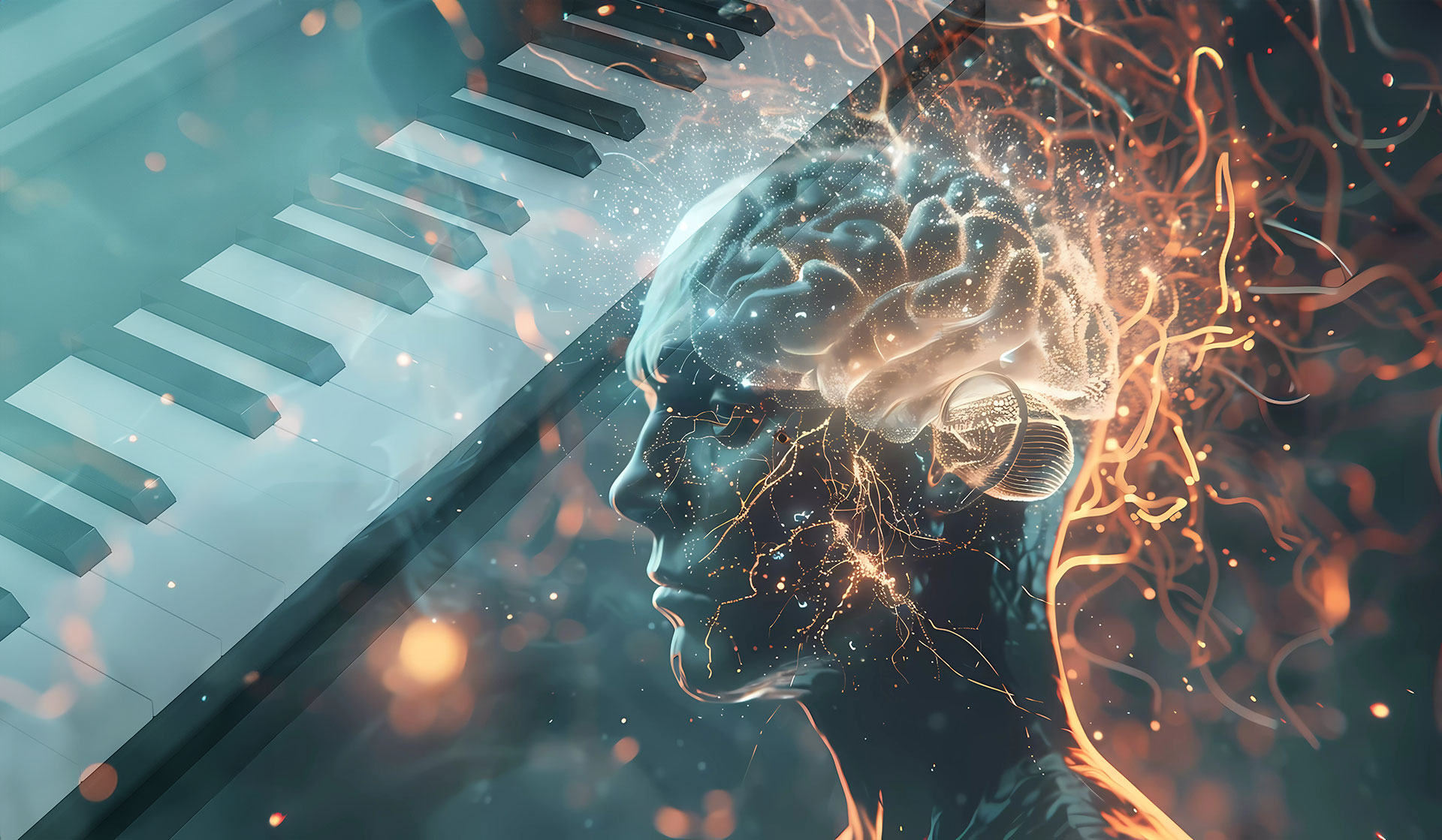
Piano practice may support school-related skills, but it should not replace strong teaching, sleep, reading, exercise, or study habits.
Some research links music training with improved language, memory, and executive function. Children who study music may also show stronger academic performance. Yet these results do not prove that piano alone caused the improvement.
Family support can affect both music lessons and grades. A child with access to private lessons, quiet practice space, and educational support may have advantages unrelated to piano.
The most reasonable claim is that piano can provide useful mental training. It may help a student listen closely, follow patterns, remember information, and persist through challenging work.
For example, reading music shares some features with reading language. Both require attention to symbols, sequence, timing, and meaning. But music reading does not automatically make someone a stronger reader in every area.
Piano may also help with math-related thinking. Rhythm uses division and proportion, while chords involve relationships between notes. These links can make abstract ideas feel more concrete. Still, direct math improvement depends on how the learner connects music concepts to math practice.
Does piano increase IQ?
Research does not support a simple claim that piano lessons make everyone’s IQ rise. Some studies report small improvements in general cognitive scores after music training, while other studies find limited or mixed effects.
One reason is that intelligence tests measure many different abilities. Piano may improve attention, memory, and processing speed without producing a large change in overall IQ.
The famous “Mozart effect” also caused confusion. Early research suggested that listening to classical music might briefly improve performance on certain spatial tasks. Later work showed that the effect was small, temporary, and likely linked to mood or alertness. Listening to music is not the same as learning to play an instrument.
Active piano training is more demanding than passive listening. The learner must make decisions, control movement, monitor sound, and correct mistakes. These actions may create stronger skill-based benefits than simply hearing music.
It is best to measure progress in practical terms:
• Can you focus longer?
• Can you remember a piece more easily?
• Can you solve difficult passages with a plan?
• Can you stay calm after mistakes?
• Can you learn new patterns faster?
These changes matter, even if they do not appear as a dramatic IQ increase.

How much piano practice is needed?
You do not need to practice for hours each day to gain mental benefits. Regular practice matters more than occasional marathon sessions.
For a beginner, 15 to 30 minutes on most days can build a useful habit. Intermediate players may need 30 to 60 minutes, depending on their goals. Advanced students often practice longer, but they also use more focused methods.
A practical session may include:
- Two minutes of relaxed warmups
- Five minutes of scales or simple patterns
- Ten minutes on a difficult passage
- Ten minutes on a full piece
- Two minutes of review and goal setting
Short sessions work well because attention can fade during long practice. A focused 20-minute session may be more valuable than an unfocused hour.
Use slow practice when learning new material. Slow playing gives your brain time to connect the right notes, movements, and rhythm. Speed should come after accuracy.
A common mistake is practicing mistakes. If you repeat an error many times, your brain may learn that error as part of the movement. Stop, reduce the speed, isolate the problem, and rebuild it correctly.
Does playing piano make you smarter at any age?
Piano can support learning at nearly any age, but the experience may look different for children, adults, and older adults.
Children
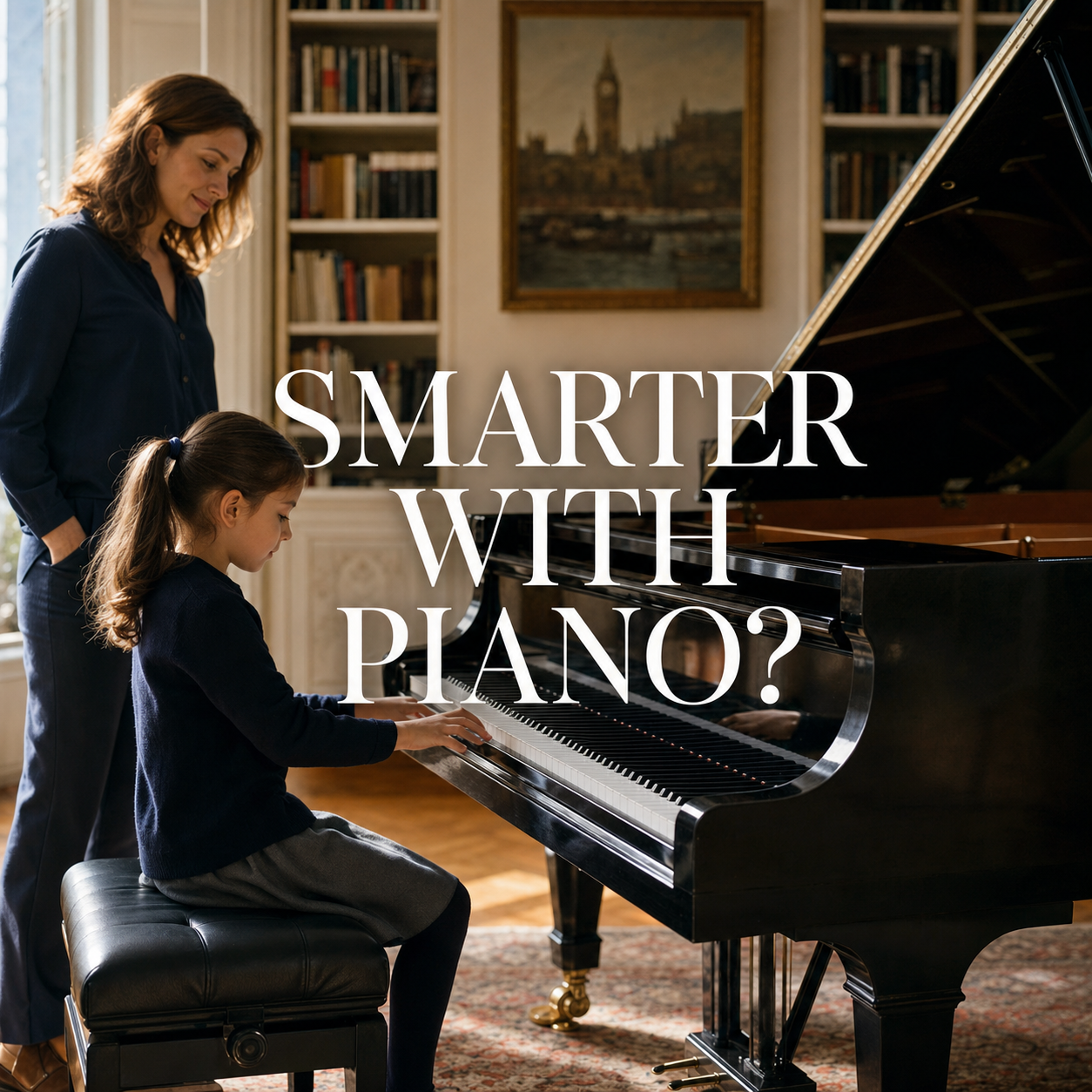
Children may develop musical awareness, attention, coordination, and practice habits. Lessons can also teach them how to work toward a long-term goal.
The best approach is enjoyable and age-appropriate. Too much pressure can turn practice into a source of stress. A child who enjoys music is more likely to practice consistently.
Adults
Adults often bring strong motivation and life experience to piano. They may learn more slowly in some areas but understand patterns and goals more clearly.
Adult learners should avoid comparing themselves with children or professional musicians. Progress is easier to maintain when the goal is personal growth rather than perfection.
Older adults
Music practice can provide mental stimulation, social connection, and a rewarding routine. Some studies suggest that lifelong musical activity is associated with healthier cognitive aging, although it is difficult to prove that music alone prevents decline.
Older beginners should choose a comfortable bench height, take breaks, and stop if they feel pain. Good posture and relaxed movement matter at every age.
Does playing piano make you smarter than other activities?
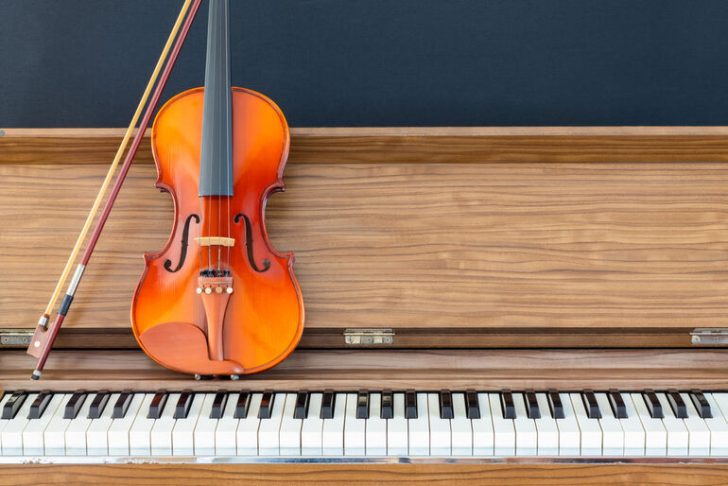
Piano is valuable, but it is not the only activity that challenges the brain. Learning a language, dancing, painting, coding, reading, and playing strategy games can also build useful skills.
The best activity is one that is:
• Challenging but manageable
• Practiced on a regular schedule
• Meaningful to you
• Flexible enough to keep you interested
• Rich in feedback and problem-solving
Piano has one special advantage: it combines mental and physical training. You think, move, listen, remember, and express emotion at the same time.
It also provides clear feedback. A wrong note, uneven rhythm, or tense hand is easy to hear. This makes it easier to adjust your approach.
Still, variety can help. A pianist who also reads, exercises, sleeps well, and learns new skills gives the brain a broader form of support.
Common mistakes that limit the benefits
Playing piano can become less useful when practice lacks focus. Many learners spend most of their time replaying songs from the beginning, even though the same difficult section keeps causing trouble.
Avoid these mistakes:
• Practicing too fast
• Ignoring rhythm
• Skipping warmups when your hands feel stiff
• Playing without listening
• Practicing only easy songs
• Using poor posture
• Comparing your progress with others
• Treating mistakes as proof that you lack talent
A better method is deliberate practice. Choose one clear goal for each session. Work on a small section, use a slow tempo, and check whether the problem improves.
In teaching and practice settings, one lesson appears again and again: consistency beats intensity. Students often expect a major change after one long session, but real progress usually comes from many calm, focused sessions.
What the research cannot prove
Research on music and intelligence has limits. Studies use different ages, lesson lengths, instruments, tests, and definitions of intelligence. This makes direct comparisons difficult.
Many studies are observational. They find that musicians and nonmusicians differ, but they cannot always show why. Genetics, personality, family income, education, and motivation may affect the result.
There is also a publication concern. Studies with interesting findings may receive more attention than studies with neutral results. This can make benefits seem larger than they are.
The safest conclusion is balanced: piano practice can improve musical skills and may strengthen related mental abilities. It is not proven to create a broad, permanent increase in intelligence for every player.
That does not make piano less valuable. Better focus, memory, coordination, patience, and self-expression are practical gains that can improve daily life.
Frequently Asked Questions About Does Playing Piano Make You Smarter
Does playing piano make you smarter than listening to music?
Active piano practice usually demands more attention, memory, movement, and decision-making than simply listening. Listening can affect mood and alertness, but it does not provide the same level of mental training.
How long does it take to see cognitive benefits from piano?
Some benefits, such as better focus and coordination, may appear after several weeks of regular practice. Larger changes depend on practice quality, age, previous experience, and how the benefit is measured.
Can piano lessons improve memory?
Yes, piano lessons exercise working memory, musical memory, and movement memory. However, improved piano memory does not guarantee a large improvement in every type of memory.
Does playing piano help children do better in school?
Piano may support attention, persistence, listening, and pattern recognition, which can help with schoolwork. It should be viewed as one helpful activity, not a guaranteed way to raise grades.
Is piano good for older adults?
Piano can offer mental stimulation, fine motor practice, emotional expression, and social connection. Older adults should practice comfortably and speak with a health professional if pain, numbness, or weakness develops.
Do you need natural talent to gain the benefits of piano?
No. Regular, focused practice matters more than early talent for most beginners. Talent may affect the starting point, but steady practice builds skill and mental flexibility.
Can playing piano prevent dementia?
There is no strong proof that piano alone prevents dementia. Musical activity may support cognitive engagement and social well-being, but it should be part of a wider healthy lifestyle.
Conclusion
So, does playing piano make you smarter? It can make you better at several mental skills, including attention, memory, coordination, pattern recognition, and problem-solving. The strongest benefits come from regular, active practice rather than passive listening or rushed repetition.
Piano is not a shortcut to a higher IQ. It is a powerful form of brain training that also offers creativity, emotional release, and a clear sense of progress. Start with 15 focused minutes a day, practice slowly, and choose music you genuinely enjoy. Explore a beginner lesson, set a small weekly goal, and share your experience with other learners.

Senior Music Reviewer
Alex Carter is a seasoned music reviewer with over a decade of experience in the world of sound and instruments. Passionate about helping musicians and enthusiasts make informed choices, he brings sharp insights and in-depth knowledge to every review. From classical instruments to modern gear, Alex combines technical expertise with a love for music to deliver content that resonates with readers.
As a Senior Music Reviewer and expert author on Tuneluma.com, Alex is dedicated to sharing honest evaluations, practical advice, and thoughtful commentary to guide readers in their musical journey.