How Wide Is A Piano Key: Standard Piano Key Sizes
A standard piano key is about 0.93 inches wide, though sizes vary by design and maker.
Knowing how wide is a piano key helps with hand position, piano moving, keyboard design, repairs, and choosing a digital piano. After comparing common acoustic and electronic instruments, the clearest answer is that a full-size white key usually measures about 22 to 24 millimeters across, while a standard 88-key piano is about 48 to 49 inches wide.
How Wide Is a Piano Key?
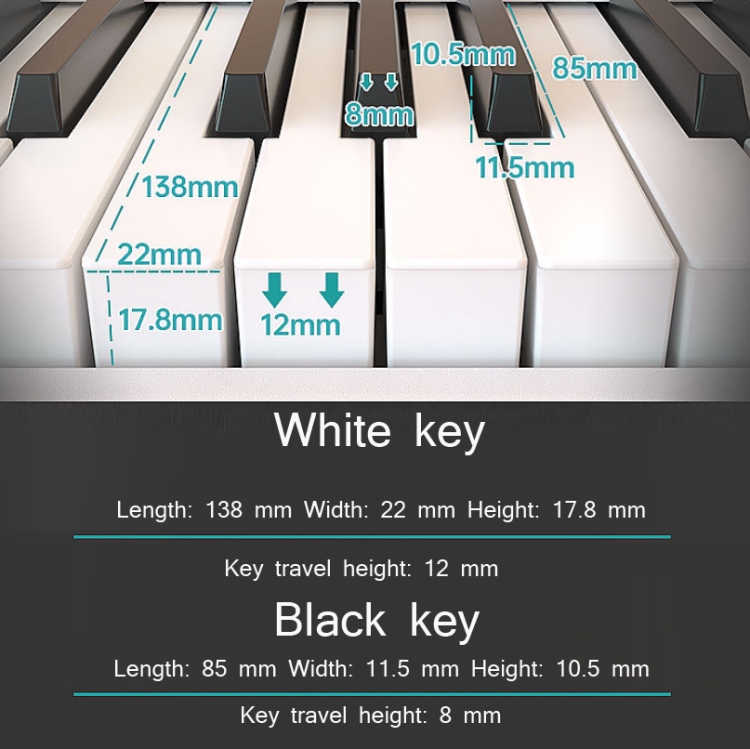
A standard white piano key is usually about 0.93 inches wide, or 23.5 millimeters. Some keys measure closer to 0.88 inches, while others reach about 0.95 inches.
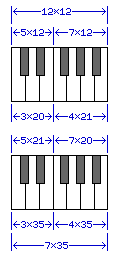
A full-size piano has 52 white keys. When these keys sit side by side, they create most of the instrument’s total width. On a typical 88-key piano, the keyboard section measures about 48 inches wide.
The exact size can change because of:
- The piano brand
- The keyboard design
- The key spacing
- The shape of the key fronts
- Whether the instrument is acoustic or digital
- The location where the key is measured
So, when someone asks, “How wide is a piano key?” the best practical answer is about 23 millimeters for one standard white key.
Standard Piano Key Dimensions
Piano keys have more than one measurement. Width is only one part of their size. Key length, height, spacing, and the shape of the playing surface also affect how the keyboard feels.
White key width
A standard white key is generally:
- 22 to 24 millimeters wide
- About 0.87 to 0.94 inches wide
- Around 130 to 150 millimeters long from the front edge to the balance area
The visible part of the key is not always the same as its full working length. A grand piano key extends much farther inside the case than the part you see.
Black key width
Black keys are narrower than white keys. Their top surface is often about:
- 10 to 12 millimeters wide
- 0.39 to 0.47 inches wide
- Longer than the visible section may suggest because part of the key extends into the action
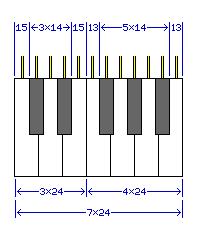
The black keys sit between the white keys in groups of two and three. Their shape is slightly raised and often tapered. This design lets your fingers locate notes by touch without looking down.
Key spacing
Key spacing is not always identical to the visible key width. A white key may be 23 millimeters wide, but small gaps and the black-key layout affect the total spacing.
This is why multiplying one key’s width by 88 will not give the full width of a piano. There are 52 white keys, not 88 white keys, and the black keys overlap the spaces between them.

How Wide Is a Piano Keyboard With 88 Keys?
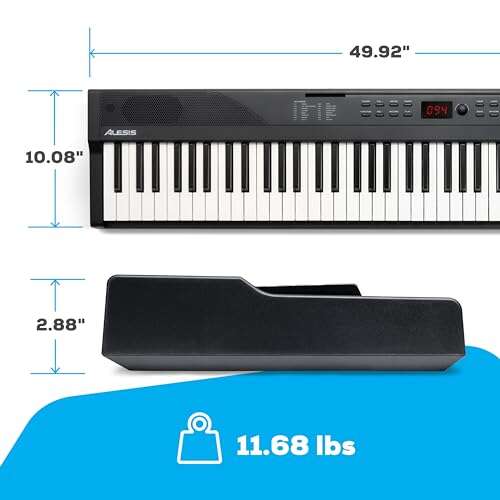
A typical 88-key piano keyboard is about 48 inches wide. That equals roughly 122 centimeters.
Most standard acoustic pianos use 52 white keys and 36 black keys. The white keys establish the main width, while the black keys sit above them and do not add much to the total side-to-side measurement.
A normal range for an 88-key keyboard is:
- About 47 to 49 inches wide
- Roughly 120 to 125 centimeters wide
- Around 12 to 14 inches deep for many digital models
- Wider or deeper when controls, speakers, or side panels are included
A concert grand can have a keyboard close to the same width as an upright piano. The case may be far larger, but the key scale is usually based on the same familiar 88-note layout.
This standard size matters to players. A pianist can move from an upright piano to a grand piano without learning a new distance between notes. The action and touch may feel different, but the basic key arrangement remains familiar.
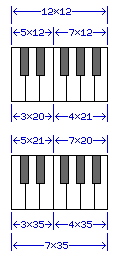
Do All Piano Keys Have the Same Width?
No. Most full-size acoustic pianos use similar key dimensions, but not every piano key is exactly the same width.
Manufacturers may adjust the size by a small amount. Older pianos, compact keyboards, children’s keyboards, and portable digital pianos can use different measurements.
The phrase “full-size keys” usually means the keys follow the general scale used by acoustic pianos. It does not guarantee that every key measures exactly 23.5 millimeters.
Common keyboard sizes include:
- Full-size keys, which are close to acoustic piano dimensions
- Slim keys, which are narrower and common on some portable keyboards
- Mini keys, which are designed for children or compact instruments
- Semi-weighted keys, which may have full width but a lighter action
- Weighted keys, which usually copy both the size and resistance of an acoustic piano
A useful lesson is to measure the actual instrument when fit matters. For example, a keyboard stand, music desk, sliding drawer, or custom cover must match the complete keyboard, not just the stated number of keys.

Why Piano Key Width Matters
The width of a piano key affects comfort, technique, and hand movement. Even a small change can feel noticeable during repeated chords or fast passages.
Playing comfort
A standard key gives most adult fingers enough room to land cleanly. If keys are too narrow, nearby notes are easier to hit by mistake. If keys are too wide, large stretches may feel harder.
Children and players with small hands may find compact keys more comfortable. However, moving between a compact keyboard and a full-size piano can require an adjustment period.
Chords and intervals
Piano technique depends on consistent distances. A major third, octave, or tenth must feel predictable across the keyboard.
For example, an octave spans 12 half steps. Its physical distance depends on the width and spacing of the keys. On a standard piano, the octave feels familiar because most instruments use a similar key scale.
Hand position
Teachers often ask students to keep the fingers curved and relaxed. Correct key width supports this posture. A player should not stretch the hand flat just to reach notes.
One common mistake is judging a keyboard only by its number of keys. An instrument may have 61 keys but still use full-size keys, while another 61-key model may use narrower keys. The key width and action matter as much as the key count.
How to Measure the Width of a Piano Key
You can measure a piano key in less than a minute with a ruler or digital caliper.
Follow these steps:
- Turn off and unplug a digital piano before measuring it.
- Choose a white key near the middle of the keyboard.
- Measure across the front playing surface from one side to the other.
- Avoid measuring the gap between keys.
- Record the result in millimeters and inches.
- Measure two or three keys to check for small differences.
For a more accurate result, measure the key at the front, middle, and rear. Some keys taper slightly or have curved edges.
If you need the full keyboard width, measure from the outside edge of the lowest key to the outside edge of the highest key. Include side cheeks or end blocks only if you are measuring the complete instrument.
A ruler works well for a quick check. A digital caliper gives better detail, but use gentle pressure. Pressing too hard can damage the finish or shift a key.

How Wide Is a Piano Key on a Digital Piano?
Most full-size digital pianos use white keys close to the standard acoustic width of about 23 millimeters. Many 88-key digital pianos are therefore around 48 inches wide.
Digital models can still vary. Some have slightly narrower keys to reduce the cabinet size. Others use a full-size key scale but add wide speaker housings or control panels.
When shopping, check these details:
- The width of each white key
- The total body width
- Whether the keys are weighted
- Whether the key surface is full length
- The distance between the outer keys
- The space needed for cables and controls
A digital piano listed as “88 keys” is not automatically the same size as an acoustic piano. The number tells you the note range, not the exact key dimensions.
For serious classical study, full-size weighted keys are usually the safest choice. They offer a more familiar layout and help build habits that transfer well to acoustic instruments.
How Wide Is a Piano Key on a 61-Key Keyboard?
A 61-key keyboard may use either full-size or compact keys. If it uses full-size keys, each white key may be close to 23 millimeters wide.
Because it has fewer keys, the total keyboard is shorter. A 61-key instrument with full-size keys is often about 35 to 40 inches wide, though the case can make it wider.
A 61-key keyboard with mini keys may be much narrower. This can be useful for travel, small desks, or young learners. The trade-off is that the hand spacing feels different from a standard acoustic piano.
Before buying, look for terms such as:
- Full-size keys
- Standard key width
- Mini keys
- Slim keys
- Compact keyboard
- Piano-size keys
Product photos can be misleading. The best information usually appears in the technical specifications.
Piano Key Width Compared With Other Keyboards
Piano keys are wider than many keys found on small electronic instruments. This difference helps explain why some keyboards feel easy to carry but unfamiliar to a pianist.
Here is a general comparison:
- Standard piano key: about 22 to 24 millimeters wide
- Full-size electronic keyboard key: often about 21 to 23 millimeters wide
- Slim key: commonly below standard piano width
- Mini key: often much narrower than a standard piano key
These figures are typical ranges, not universal rules. Each manufacturer may use its own design.
A synthesizer may prioritize portability and control features. A digital piano usually prioritizes piano-like touch and spacing. Neither design is automatically better; the right choice depends on your goals.
If you plan to practice classical music, compare the keyboard with an acoustic piano before buying. If you mainly play simple chords, create music, or travel often, a compact design may be more practical.
The Difference Between Key Width and Keyboard Width
These two terms sound similar but describe different things.
Piano key width means the side-to-side size of one key. Keyboard width means the full distance from the lowest key to the highest key, including the outer edges of the instrument.
For example, a single white key may be about 23.5 millimeters wide. An 88-key piano may be about 48 inches wide. These numbers describe different parts of the instrument.
Keyboard width also depends on:
- The number of keys
- The white key scale
- End blocks
- Control panels
- Speaker cabinets
- Decorative side panels
- Manufacturing tolerances
This distinction is important when planning a room. A keyboard may have a 48-inch playing area but need 52 inches of wall space because of its side panels.
What Affects the Feel of a Piano Key?
Width is important, but it is not the only reason one keyboard feels different from another.
Key length
Longer keys can provide more consistent leverage. This is especially noticeable on a grand piano, where the key extends a long way into the instrument.
Key weight
Weighted keys resist your fingers more than unweighted keys. Acoustic pianos use hammers and other mechanical parts, while digital pianos use springs, counterweights, or electronic sensors to imitate that feel.
Key surface
Matte surfaces can feel less slippery than glossy plastic. Some digital pianos use textured materials to imitate ivory or ebony.
Key travel
Key travel is the distance a key moves downward. A deeper or more controlled movement can make a keyboard feel more like an acoustic piano.
Key spacing
Even when two pianos use almost the same key width, different spacing or edge shapes can change the playing experience.
In practice, I recommend testing a keyboard for at least several minutes rather than judging it from specifications alone. The numbers tell you the size, but your hands tell you whether the design feels natural.
Common Mistakes When Measuring Piano Keys
Measuring sounds simple, but several errors can produce the wrong result.
Avoid these mistakes:
- Measuring a black key and calling it a white key
- Including the gap between two keys
- Measuring only the visible front panel
- Counting all 88 keys as white keys
- Measuring the cabinet instead of the keyboard
- Assuming every “full-size” model has identical dimensions
- Using a flexible tape that bends around the key edges
For a replacement key or repair, width alone is not enough. You may also need the key’s length, height, balance-pin hole, front rail position, and material.
Piano parts are not always interchangeable across brands. A replacement key should match the specific model whenever possible.
How Wide Is a Piano Key for Children?
A child can learn on standard piano keys, but compact keys may feel easier for very small hands. The best choice depends on age, hand size, goals, and access to a full-size instrument.
Standard keys help children develop spacing that transfers to acoustic pianos. Narrow keys can reduce stretching, but they may require an adjustment later.
For a young beginner, consider:
- A full-size keyboard if long-term piano study is the goal
- A compact keyboard if space or hand size is a major concern
- Weighted keys when building traditional piano technique
- A teacher’s advice before investing in an expensive instrument
- A bench height that lets the child keep relaxed shoulders and curved fingers
The goal is not to force a child to stretch. Good technique should feel calm and controlled, much like walking across stepping stones that are placed at a comfortable distance.
Frequently Asked Questions About How Wide Is a Piano Key
How wide is a standard white piano key?
A standard white piano key is usually about 22 to 24 millimeters wide, or roughly 0.87 to 0.94 inches. Many full-size pianos use a measurement near 23.5 millimeters.
How wide is a black piano key?
A black piano key is commonly about 10 to 12 millimeters wide at its top surface. Its exact shape and width can vary by manufacturer and by the point where you measure it.
How wide is an 88-key piano?
An 88-key piano is usually about 47 to 49 inches wide, or approximately 120 to 125 centimeters. The cabinet may be wider because of side panels, speakers, or control sections.
Are digital piano keys the same width as acoustic piano keys?
Many full-size digital pianos use keys close to acoustic piano dimensions. However, some portable keyboards use slim or mini keys, so checking the manufacturer’s specifications is important.
Are all piano keys exactly the same size?
No. Standard pianos follow a similar scale, but small differences exist between brands, models, and older instruments. Compact keyboards can have much narrower keys.
How many white keys are on a standard piano?
A standard 88-key piano has 52 white keys and 36 black keys. The white keys create most of the keyboard’s total width.
Is key width more important than the number of keys?
Both matter, but they answer different needs. The number of keys determines range, while key width affects hand spacing, comfort, and how closely the instrument feels like an acoustic piano.
Conclusion
A standard piano key is about 0.93 inches wide, or close to 23.5 millimeters. Most 88-key pianos are about 48 inches wide, but digital keyboards, compact models, and older instruments may use slightly different dimensions.
When choosing or measuring a piano, check the key width, total keyboard width, key weight, and playing feel. If you are buying a keyboard for serious study, compare its dimensions with an acoustic piano before making a decision. Measure your instrument carefully, test it with your own hands, and explore more piano measurement guides to find the best fit.

Senior Music Reviewer
Alex Carter is a seasoned music reviewer with over a decade of experience in the world of sound and instruments. Passionate about helping musicians and enthusiasts make informed choices, he brings sharp insights and in-depth knowledge to every review. From classical instruments to modern gear, Alex combines technical expertise with a love for music to deliver content that resonates with readers.
As a Senior Music Reviewer and expert author on Tuneluma.com, Alex is dedicated to sharing honest evaluations, practical advice, and thoughtful commentary to guide readers in their musical journey.