How Many Black And White Keys On A Piano: Key Facts
A standard piano has 88 keys: 52 white keys and 36 black keys.
If you have ever looked at a piano and wondered how many black and white keys it has, the answer depends on the instrument’s size and design. Most full-size acoustic and digital pianos follow the 88-key standard, but smaller keyboards may have 61, 76, or even 49 keys. This guide explains the key count, layout, history, and practical differences so you can identify any piano with confidence.

How Many Black and White Keys Are on a Standard Piano?
A standard modern piano has 88 keys in total:
• 52 white keys
• 36 black keys
• 88 keys altogether
The 52 white keys play the natural notes: A, B, C, D, E, F, and G. The 36 black keys play the sharp and flat notes between most natural notes.
The full keyboard begins with A0, the lowest note, and ends with C8, the highest note. This range covers seven full octaves plus a minor third. It gives pianists enough room to play deep bass lines, rich chords, melodies, and bright high notes.
When people ask how many black and white keys on a piano, they usually mean a full-size piano. In that case, the answer is always 52 white keys and 36 black keys.
Why Does a Piano Have 88 Keys?
The 88-key layout became standard because it offers a wide musical range without making the instrument too large for most homes and performance spaces.
Early pianos had fewer keys. Some instruments from the 18th century had about 49 keys. As composers asked for lower bass notes and higher treble notes, piano makers expanded the keyboard. By the late 19th century, the 88-key design had become widely accepted.
The range from A0 to C8 works well for most classical, jazz, pop, film, and worship music. Only a small number of compositions require notes outside this range. For most players, an 88-key piano provides all the notes they will ever need.
A useful way to picture it is to think of the keyboard as a musical road. The low keys form the deep left side, the high keys form the bright right side, and the middle keys support most melodies and chords.

How Many White Keys Are on a Piano?
A full-size piano has 52 white keys. These keys represent the seven natural notes:
• A
• B
• C
• D
• E
• F
• G
The pattern repeats across the keyboard. After G, the notes begin again at A in the next octave.
The white keys are not all the same pitch. Each key moves higher as you travel from left to right. The distance from one C to the next C is called an octave. A standard piano contains seven complete octaves, along with a few extra notes at each end.
White keys are often easier for beginners to recognize because they form a simple visual line. However, their spacing does not tell the whole story. The musical distance between some neighboring white keys is a whole step, while the distance between E and F and between B and C is a half step.
In my experience helping beginners understand keyboard layouts, many first assume that every white key is separated by a black key. That is not true. Remembering the missing black keys between B and C and between E and F makes note reading much easier.
How Many Black Keys Are on a Piano?
A standard piano has 36 black keys. These keys represent the sharps and flats that sit between most natural notes.
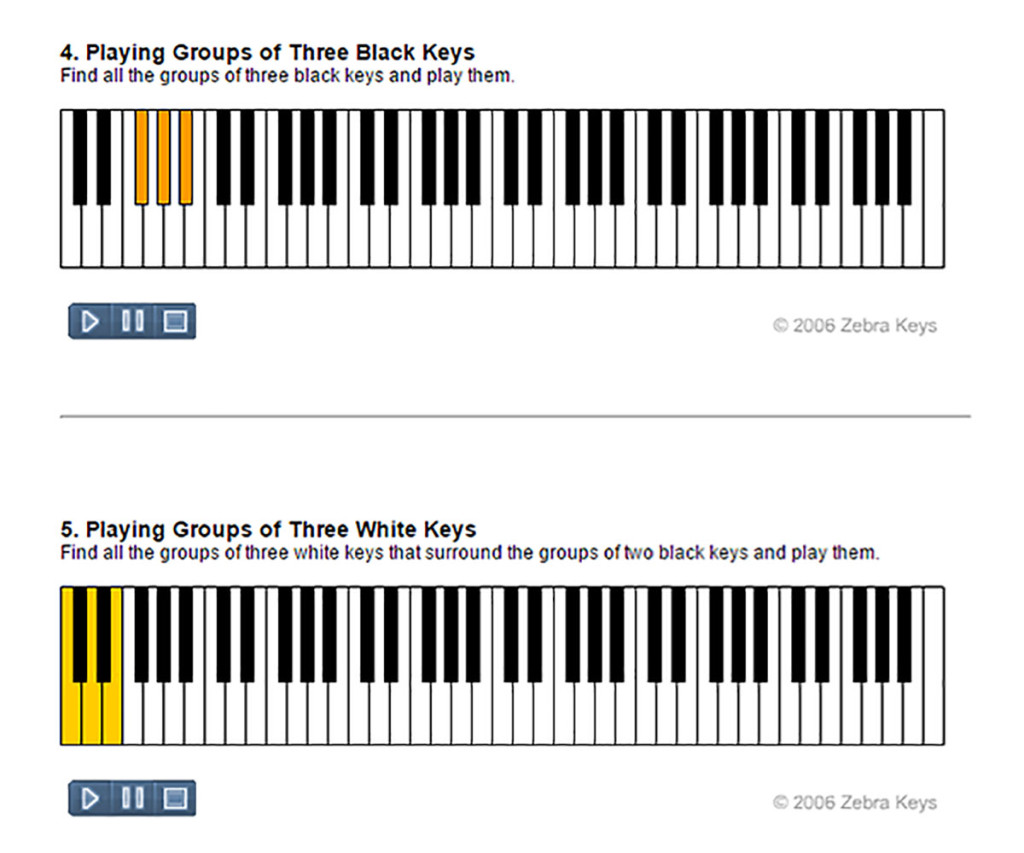
The black keys use a repeating pattern of groups:
• Two black keys
• Three black keys
• Two black keys
• Three black keys
This pattern repeats across the keyboard. The black keys are raised and set farther back than the white keys, which helps players find notes by touch.
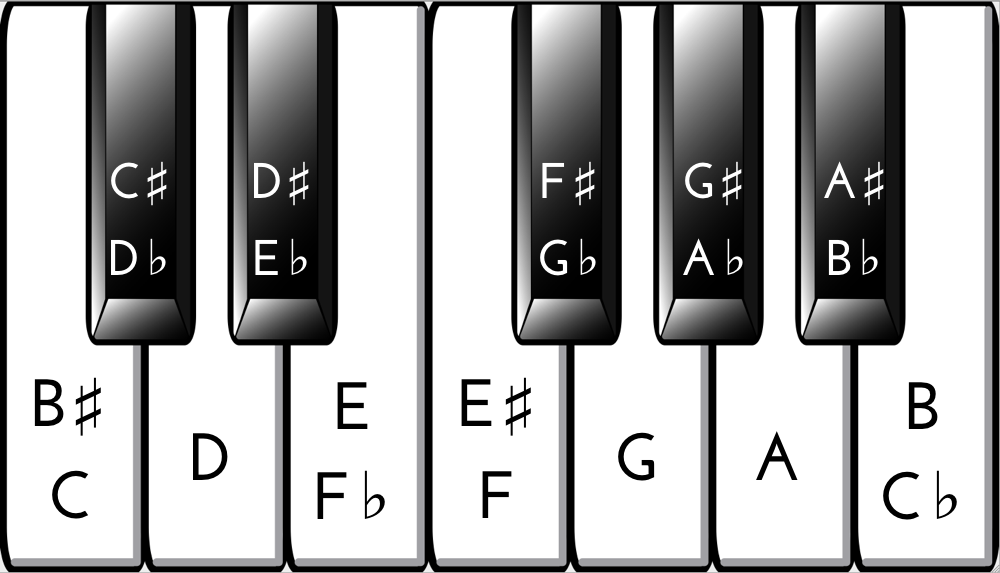
A black key can have two names. For example, the key between C and D may be called C-sharp or D-flat. These names describe the same pitch on a normally tuned piano. The correct name depends on the musical key and the notes around it.
There are no black keys between B and C or between E and F. This is why the pattern contains groups of two and three rather than a continuous row.
If you count the repeating groups, the 36 black keys become easier to understand. A full keyboard has seven complete groups of five black keys, plus one extra group of one black key at the upper end. Seven times five equals 35, and the extra black key brings the total to 36.
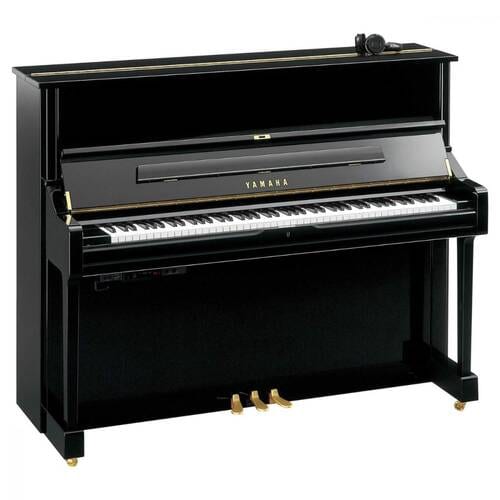
Piano Key Layout Explained
The easiest way to understand the piano key layout is to find the groups of black keys.
Start by locating a group of two black keys. The white key immediately to the left is C. From there, the white keys move in this order:
C, D, E, F, G, A, B
Then the pattern starts again at C.
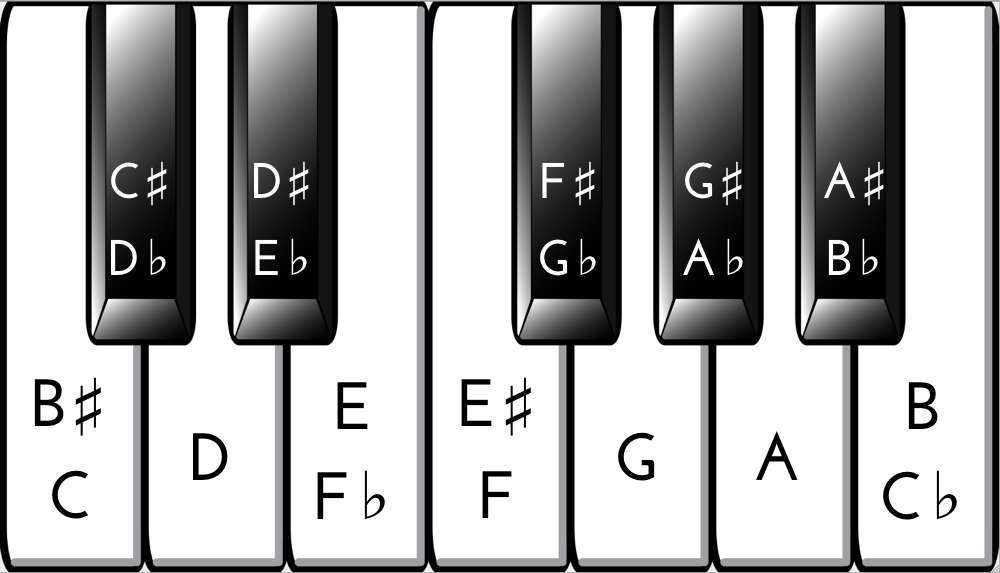
The black keys are named in relation to nearby white keys:
• The black key above C is C-sharp or D-flat
• The black key above D is D-sharp or E-flat
• The black key above F is F-sharp or G-flat
• The black key above G is G-sharp or A-flat
• The black key above A is A-sharp or B-flat
This layout is consistent across acoustic pianos, digital pianos, and most electronic keyboards. Once you learn to spot the two-key group, you can find any C without memorizing the entire keyboard.
A practical tip is to use the middle C area as your main reference point. Middle C is near the center of an 88-key piano. It is often used as a starting point for beginner lessons, sight reading, and hand position.

Why Are Some Pianos Smaller Than 88 Keys?
Not every keyboard is a full-size piano. Many portable keyboards use fewer keys to reduce weight, cost, and physical size.
Common keyboard sizes include:
• 25 keys for compact controllers and simple music production
• 49 keys for basic playing and studio work
• 61 keys for beginners, bands, and general keyboard playing
• 76 keys for players who need a wider range
• 88 keys for complete piano range and weighted action
A 61-key keyboard usually covers about five octaves. It can play many songs, but it may not include the lowest bass notes or highest treble notes found on a full piano.
A 76-key keyboard offers more range than a 61-key model while remaining smaller than an 88-key piano. It can be a useful compromise for performers who need portability.
When considering how many black and white keys on a piano, check whether the product is a true piano or a keyboard. A small keyboard may have a familiar black-and-white layout, but it does not have the full range of a standard piano.
Do Digital Pianos Have the Same Number of Keys?
Many digital pianos have 88 keys, just like acoustic pianos. They are designed to copy both the range and playing feel of a traditional piano.
An 88-key digital piano may include:
• Weighted keys
• Hammer action
• Touch sensitivity
• Sustain pedal support
• Headphone output
• Digital recording features
Some digital instruments have 61 or 76 keys. These are often called keyboards or arranger keyboards rather than full digital pianos. They may offer useful sounds and features, but they do not provide the complete 88-key range.
The key count is only one part of the buying decision. Key width, action, touch response, sound quality, speaker strength, and pedal support also matter. A low-cost 88-key keyboard may feel very different from a well-built digital piano with graded hammer action.
One mistake I often see is choosing a keyboard based only on its number of keys. If your goal is to learn classical piano, an 88-key model with weighted action is usually the better long-term choice. If you mainly want to make beats or play simple pop songs, a smaller keyboard may be more practical.
How Piano Keys Relate to Octaves
An octave is the distance between one note and the next note with the same name. For example, the distance from one C to the next C is one octave.
A standard piano has:
• Seven complete octaves
• Three additional notes above the lowest full octave
• A total range from A0 to C8
Each complete octave contains 12 notes:
• Seven white keys
• Five black keys
Seven octaves contain 49 white keys and 35 black keys. The remaining three white keys and one black key create the extended range at the ends of the keyboard. That produces the familiar total of 52 white keys and 36 black keys.
This is also why the answer to how many black and white keys on a piano is more than a simple count. The keys form a carefully designed pitch system. Their spacing allows composers and players to use the same note patterns in different octaves.
You can test this yourself by playing every C on the keyboard. Each C sounds related to the others, but each one is higher or lower. This repeated structure helps pianists learn scales, chords, and songs across the entire instrument.
Historical Pianos Did Not Always Have 88 Keys
The 88-key piano is common today, but it was not the original design.
Early pianos had shorter keyboards because piano technology was still developing. Some early instruments had fewer than five octaves. As musical styles changed, composers began writing music with a wider range, and manufacturers responded by adding more keys.
Historical instruments may have:
• 49 keys
• 61 keys
• 73 keys
• 85 keys
• Other custom ranges
Some modern concert pianos also include special features outside the standard range. A few instruments extend slightly below A0 or above C8, but these are unusual and not required for most music.
This history explains why old pianos and modern keyboards can have different key counts. If you are restoring an antique piano, do not assume that missing keys are always a defect. The instrument may have been built with a smaller original range.
For accurate identification, check the maker, model, age, and first and last notes. Counting the keys alone may not tell you the full story.
How to Count Piano Keys Correctly
Counting keys is simple if you use a clear method.
- Count all the white keys from left to right.
- Count all the black keys separately.
- Add both numbers together.
- Compare the result with common keyboard sizes.
For a standard piano, your count should be:
• 52 white keys
• 36 black keys
• 88 total keys
Be careful not to count only the visible front edge of the keys. Black keys sit behind the white keys, so their full length is not always easy to see from a distance.
You can also identify an 88-key piano by its note range. The far-left key should be A, and the far-right key should be C. If the keyboard begins or ends on a different note, it may have a smaller range or a special design.
Counting the keys is useful when buying a used instrument. Sellers sometimes use words such as “full keyboard” loosely. Ask for the exact number of keys and confirm whether the instrument has weighted action if you need it for piano study.
Does the Number of Keys Affect Piano Playing?
The number of keys affects the range of music you can play, but it does not automatically determine sound quality or skill level.
An 88-key piano allows you to play:
• Full classical piano works
• Wide orchestral arrangements
• Deep bass and high treble parts
• Advanced scales and exercises
• Music written across the complete piano range
A smaller keyboard can still be useful. Beginners may learn basic chords and melodies on 61 keys. Music producers may prefer a compact controller because it fits on a desk. Gigging musicians may choose 61 or 76 keys to save space during transport.
The main limitation is range. If a song uses notes below or above your keyboard, you may need to move the part up or down an octave. Many digital keyboards also include octave-shift buttons, but these controls change the pitch range rather than adding physical keys.
For traditional piano training, an 88-key instrument gives you the most natural path. It lets you learn hand positions and music without constantly adjusting the octave range.
Common Mistakes When Choosing a Piano
Understanding how many black and white keys on a piano can prevent several common buying mistakes.
• Assuming every keyboard has 88 keys: Many portable keyboards have 61 or fewer keys.
• Counting only the white keys: A piano’s total key count includes both white and black keys.
• Ignoring key action: A keyboard can have 88 keys but still feel very different from an acoustic piano.
• Confusing a keyboard with a digital piano: Digital pianos usually focus on piano sound and weighted action, while keyboards may offer many instrument sounds.
• Buying too little range for your goals: A 49-key controller may not suit someone studying advanced piano music.
• Paying for range you will not use: A large 88-key piano may be unnecessary for simple songwriting or basic beat production.
Before buying, play the instrument if possible. Notice whether the keys feel firm, even, and responsive. Also consider room size, noise level, headphone use, portability, and maintenance.
Frequently Asked Questions About How Many Black and White Keys on a Piano
How many keys does a full-size piano have?
A full-size piano has 88 keys. This includes 52 white keys and 36 black keys, with a range from A0 to C8.
How many white keys are on a piano?
A standard piano has 52 white keys. These keys play the natural notes A, B, C, D, E, F, and G across several octaves.
How many black keys are on a piano?
A standard piano has 36 black keys. They play sharp and flat notes and appear in repeating groups of two and three.
Do all pianos have 88 keys?
No. Most modern acoustic pianos and full-size digital pianos have 88 keys, but historical pianos and smaller electronic keyboards may have fewer.
Is an 88-key piano better for beginners?
An 88-key piano is usually the best choice for students who want to study piano seriously. It provides the full range and supports proper learning as pieces become more advanced.
Why are there no black keys between B and C or E and F?
The natural half steps in Western music occur between B and C and between E and F. Because those notes are already a half step apart, no separate black key is needed between them.
Can you learn piano on a 61-key keyboard?
Yes, you can learn basic notes, chords, scales, and many songs on a 61-key keyboard. However, advanced pieces may require the wider range and playing feel of an 88-key piano.
Conclusion
A standard piano has 88 keys: 52 white keys and 36 black keys. The white keys play natural notes, while the black keys play sharps and flats in a repeating pattern of two and three.
Smaller keyboards may have 49, 61, or 76 keys, so always check the exact size before buying. If you want the full piano range and plan to study seriously, choose an 88-key model with responsive or weighted action.
Now that you know how many black and white keys on a piano, try locating middle C and counting the keys on your own instrument. Explore more piano guides, compare models carefully, and share your questions or playing goals in the comments.

Senior Music Reviewer
Alex Carter is a seasoned music reviewer with over a decade of experience in the world of sound and instruments. Passionate about helping musicians and enthusiasts make informed choices, he brings sharp insights and in-depth knowledge to every review. From classical instruments to modern gear, Alex combines technical expertise with a love for music to deliver content that resonates with readers.
As a Senior Music Reviewer and expert author on Tuneluma.com, Alex is dedicated to sharing honest evaluations, practical advice, and thoughtful commentary to guide readers in their musical journey.