What Is Cb On Piano: Note And Chord Guide
C♭ on piano means the note C lowered by one half step, which sounds the same as B natural.
If you have seen “Cb” in sheet music or chord symbols, you may wonder why a note seems to use an unusual name. Understanding what is cb on piano helps you read key signatures, scales, chords, and advanced music theory with confidence. This guide explains the meaning, sound, spelling, uses, and common mistakes in a clear way.
What Is C♭ on Piano?
What is cb on piano? C♭, written as C-flat, is a C note lowered by one semitone, or half step. On a standard piano, it uses the same key as B natural.
The flat symbol is written as ♭. It tells you to move one half step to the left on the keyboard. Since B is already one half step below C, lowering C by one half step produces the same pitch as B.
In simple terms:
• C♭ sounds like B natural.
• C♭ and B are enharmonic equivalents.
• They sound the same on an equal-tempered piano.
• Their written names are different because they serve different roles in music theory.
Where Is C♭ on the Piano Keyboard?
To find C♭ on piano, first locate any C key. C is the white key directly to the left of each group of two black keys. Move one half step lower, or one key to the left, and you reach B.
This means there is no separate black key for C♭. The note is played on the white B key.
A quick way to remember it is:
-
Find C.
-
Move left by one key.
-
Play B.
The same idea works throughout the piano. Every C♭ has the same pitch as the B directly below it in the same octave area.
One detail matters when reading music. C♭ may appear on the C position of the staff, even though you play the B key. The written position tells you the note’s musical spelling, not only its physical piano key.

What Does C♭ Sound Like?
What is cb on piano in terms of sound? It sounds exactly like B natural on an equal-tempered piano. If you play B and C♭ one after the other, you will hear no difference in pitch.
This is called an enharmonic relationship. Two notes are enharmonic when they sound the same but have different names or spellings.
Other common enharmonic pairs include:
• C♯ and D♭
• D♯ and E♭
• F♯ and G♭
• G♯ and A♭
• A♯ and B♭
The sound is the same, but the spelling changes the note’s job inside a scale or chord. It is much like using two different words that point to the same object. The object stays the same, but the meaning in the sentence can change.

Why Use C♭ Instead of B?
A natural question is: if C♭ sounds like B, why not always write B? The answer is correct musical spelling.
Music notation usually aims to give each letter name its own place in a scale or chord. For example, a theoretical scale may need the notes C, D, E, F, G, A, and B. If the final note must be lowered, it may be written C♭ rather than B to preserve the letter pattern in a different musical context.
This matters in:
• Key signatures
• Diatonic scales
• Chord construction
• Voice leading
• Modulation
• Classical harmony
Suppose a chord is spelled C♭, E♭, and G♭. The letters show a root, third, and fifth pattern. Replacing C♭ with B may make the chord look like B, D♯, and F♯, which can suggest a different harmonic function.
The piano key does not change. The musical meaning can change.

C♭ in Scales and Key Signatures
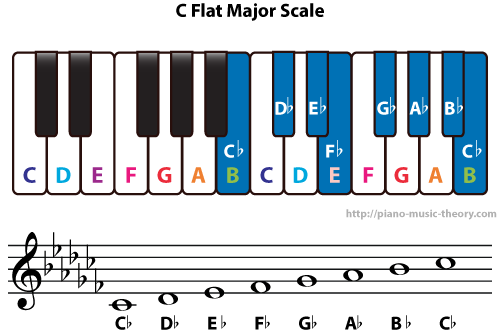
What is cb on piano in a scale? C♭ appears most famously in the key of C♭ major. The C♭ major scale is spelled:
C♭, D♭, E♭, F♭, G♭, A♭, B♭, C♭
On the piano, these notes sound the same as the notes in B major:
B, C♯, D♯, E, F♯, G♯, A♯, B
However, the written key signatures differ. C♭ major contains seven flats, including the less familiar F♭. B major contains five sharps.
The C♭ major key signature is not common in beginner piano music because it is harder to read. Composers and arrangers often choose B major instead when the sound and harmonic setting allow it.
Still, C♭ major is valid. It may appear when a composer wants the notation to match nearby keys, chord patterns, or a chromatic progression.
C♭ Major and Its Relative Minor
The relative minor of C♭ major is A♭ minor. Both keys use the same seven flat notes:
C♭, D♭, E♭, F♭, G♭, A♭, and B♭
In practice, you may see A♭ minor more often than C♭ major. The key signature for A♭ minor has seven flats, although its harmonic minor and melodic minor forms can add accidentals.
When practicing a piece in a flat-heavy key, do not rename every note based on the piano key. Read the written note first. This keeps the scale pattern and chord function clear.
A useful practice method is to say the note names aloud while playing. It may feel slow at first, but it builds a strong link between the page, the keyboard, and the sound.
C♭ in Chords
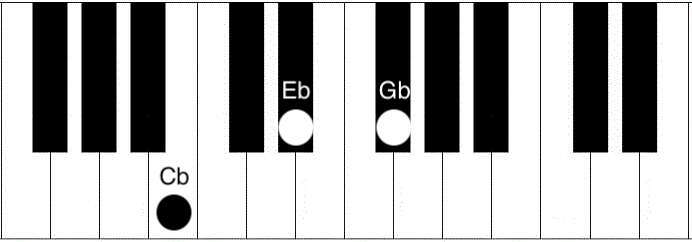
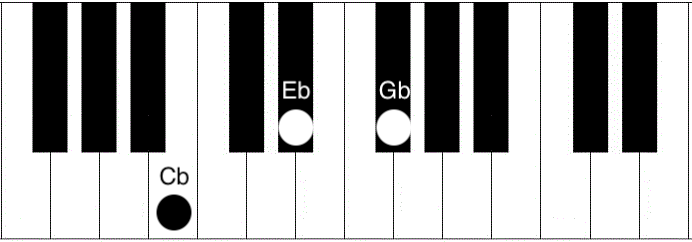
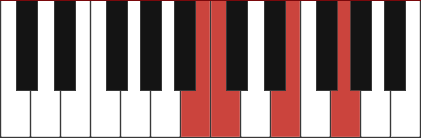
What is cb on piano when it appears in a chord? It is the root or chord tone named C♭. You play the B key for that note, but you keep the C♭ spelling when reading the chord.
For example, a C♭ major chord is spelled:
• C♭ as the root
• E♭ as the major third
• G♭ as the perfect fifth
On the keyboard, these notes use the same keys as B, D♯, and F♯. The chord sounds like B major, but the spelling is different.
You may also encounter:
• C♭ minor: C♭, E𝄫, G♭
• C♭7: C♭, E♭, G♭, B𝄫
• C♭maj7: C♭, E♭, G♭, B♭
These spellings can look complex because double flats may appear. A double flat lowers a note by two half steps. For example, E𝄫 sounds like D natural.
The correct spelling depends on the chord’s function and the key around it.

C♭, B, and Enharmonic Equivalents
What is cb on piano compared with B? The physical key and sound are the same, but the note name and musical role are not always the same.
Here is a simple comparison:
| Written note | Piano key used | Sound |
|---|---|---|
| C♭ | B natural | Same pitch as B |
| B | B natural | Same pitch as C♭ |
| C♯ | C-sharp | Same pitch as D♭ |
| F♭ | E natural | Same pitch as E |
This difference is especially important for musicians who read scores, analyze harmony, or play with other instruments. A pianist can press the correct key while still spelling the note incorrectly in written theory.
In a casual conversation, saying “B” may be enough. In formal notation, however, the written name often carries information about the note’s direction and function.

How to Practice C♭ on Piano
Learning what is cb on piano is easier when you connect theory with physical movement. Use these steps:
-
Find a group of two black keys.
-
Locate the white key immediately to the left. That is C.
-
Move one white key to the left. That is B, which sounds as C♭.
-
Say “C-flat” while playing the B key.
-
Write C♭ on a staff and identify its keyboard position.
-
Practice it inside a scale or chord rather than only as a single note.
You can also practice enharmonic pairs. Play B, then play C♭ while saying both names. Since the pitch does not change, focus on the difference in notation.
A common beginner mistake is to search for a special black key. There is no unique key labeled C♭. Accidentals change the pitch name and sometimes the pitch location, but not every flat note lands on a black key.
Common Mistakes When Reading C♭
What is cb on piano often causes confusion because beginners expect every flat note to use a black key. That rule works often, but not always.
Avoid these mistakes:
• Looking for a black key instead of checking the half-step movement.
• Renaming every C♭ as B without considering the key or chord.
• Forgetting that F♭ is played on E.
• Assuming unusual spelling means the music is incorrect.
• Ignoring the note’s position on the staff.
Another mistake is treating enharmonic notes as completely interchangeable. They are interchangeable on an equal-tempered piano for sound, but not always for theory.
When playing with a digital keyboard, piano, or MIDI instrument, the pitch will normally match. In some string, vocal, or non-equal-tempered settings, performers may adjust pitch slightly based on context. That is one reason notation and musical function remain important beyond the keyboard.
Is C♭ Used Often in Piano Music?
What is cb on piano in real-world music? It is a legitimate note name, but it is less common than B natural. Most beginner books avoid it because C♭ can make the music look harder than the same passage written with B.
You are more likely to see C♭ in:
• Advanced classical scores
• Music with many flat keys
• Modulating passages
• Chord charts based on theoretical spelling
• Arrangements that preserve voice leading
• Contemporary and jazz theory examples
A composer may choose C♭ because the note is moving downward from C. Writing C to C♭ shows that motion more clearly than changing the name to B.
This is similar to spelling a word correctly in a sentence. The letters may sound familiar, but the form helps the reader understand what is happening.
A Practical Example of C♭ Notation
Imagine a passage that moves from C natural down to C♭ and then to B♭. The spelling shows a clear descending line:
C, C♭, B♭
If the middle note were written as B, the line might appear as:
C, B, B♭
The second version can be harder to understand because the same letter repeats with different accidental changes. The first version shows the composer’s intended musical direction.
In a chord progression, the same principle applies. A note may be spelled C♭ because it resolves to B♭, rises to D♭, or forms a specific interval with another note.
When I explain this idea to piano students, I compare note spelling to road signs. The piano key tells you where to go, while the written name tells you why you are going there.
How C♭ Appears on Sheet Music
What is cb on piano when it appears on the staff? The note is written on the staff position used by C, with a flat sign placed before it. The accidental lowers that C by one half step.
The exact staff position depends on the clef:
• In treble clef, C♭ is written on the third ledger line below the staff.
• In bass clef, C♭ is written on the second ledger line above the staff.
The flat symbol applies according to standard notation rules. If it appears in a measure, it usually remains active for the rest of that measure in the same octave unless canceled or changed by another accidental.
A key signature can also establish the flat in advance. In that case, you may not see a flat symbol beside every note.
Does C♭ Have a Different Sound on Other Instruments?
On a piano tuned to equal temperament, C♭ and B have the same pitch. On some other instruments, the exact pitch may depend on tuning, performance style, and musical setting.
For example, singers and string players can slightly adjust notes to fit harmony. A performer may use a pitch that leans toward the chord’s function, even when the piano uses one fixed key for both names.
This does not make the piano spelling unimportant. In an ensemble, the notation still tells each musician how to understand the note and how it relates to the surrounding music.
For most piano learners, the practical rule is simple: play the B key, but read and name the note as C♭ when the score uses C-flat.
Frequently Asked Questions About What Is Cb on Piano
Is C♭ the same as B on piano?
Yes. C♭ and B natural use the same piano key and sound the same in equal temperament. They have different names because they may serve different roles in a scale, chord, or melody.
Is C♭ a black key?
No. C♭ is played on the white B key. Lowering C by one half step takes you to B, not to a black key.
Why would a composer write C♭ instead of B?
A composer may use C♭ to preserve correct scale spelling, show melodic movement, or clarify a chord’s structure. The spelling often explains the note’s function.
What key is C♭ major on the piano?
C♭ major uses the same piano keys as B major, but it is spelled with seven flats. Its notes are C♭, D♭, E♭, F♭, G♭, A♭, and B♭.
What chord is C♭ major?
A C♭ major chord contains C♭, E♭, and G♭. On a piano, these use the same keys as B, D♯, and F♯, so the chord sounds like B major.
Is F♭ also an unusual piano note?
Yes. F♭ sounds like E natural and uses the E key. Like C♭, it is written this way when the musical spelling needs to preserve a scale or chord pattern.
Conclusion
C♭ on piano is the note C lowered by one half step, and it uses the same key as B natural. Although the sound is identical, the spelling can show scale structure, chord function, melodic direction, and harmonic meaning.
The best way to learn C♭ is to practice both parts of the idea: play the correct key and read the correct name. Try finding C♭ in scales, chords, and sheet music this week, then explore more piano theory to strengthen your reading skills.

Senior Music Reviewer
Alex Carter is a seasoned music reviewer with over a decade of experience in the world of sound and instruments. Passionate about helping musicians and enthusiasts make informed choices, he brings sharp insights and in-depth knowledge to every review. From classical instruments to modern gear, Alex combines technical expertise with a love for music to deliver content that resonates with readers.
As a Senior Music Reviewer and expert author on Tuneluma.com, Alex is dedicated to sharing honest evaluations, practical advice, and thoughtful commentary to guide readers in their musical journey.