Introduction
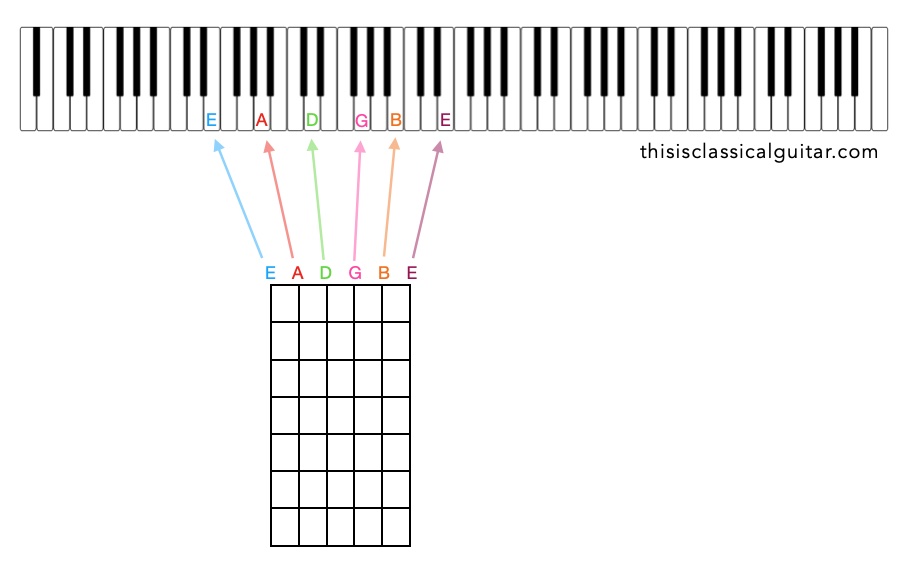
To tune a guitar with a piano, match each open guitar string to the same note on the piano. In standard tuning, the strings are E2, A2, D3, G3, B3, and E4, from the thickest string to the thinnest. Play the matching piano key, then tighten or loosen the guitar string until both notes sound the same.
This method works well for guitar players in the United States who have access to a piano, keyboard, or digital piano. It does not require a clip-on tuner, but the piano must be tuned closely enough to serve as a useful pitch reference.

What You Need Before You Start
You need three things:
- A guitar in playable condition
- A piano or keyboard with the needed notes
- A quiet room where you can hear both instruments clearly
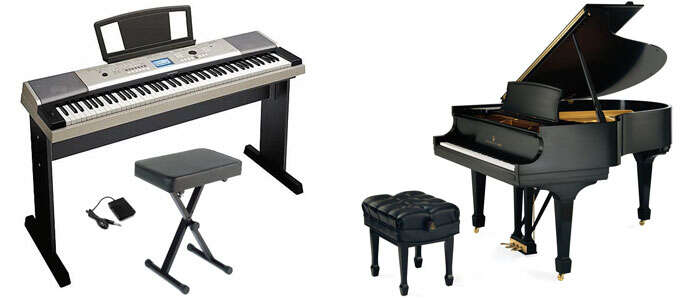
A standard 88-key piano can play all six notes used for standard guitar tuning. Some smaller keyboards may not reach the low E2 required for the sixth guitar string.
The piano should also be reasonably in tune. If it is flat or sharp, your guitar will match the piano but may not match another instrument, tuner, or recording. A piano is a pitch reference, not an automatic guarantee of concert pitch.
Standard guitar tuning notes
| Guitar string | Common name | Piano note | Approximate frequency |
|---|---|---|---|
| 6th, thickest | Low E | E2 | 82.41 Hz |
| 5th | A | A2 | 110.00 Hz |
| 4th | D | D3 | 146.83 Hz |
| 3rd | G | G3 | 196.00 Hz |
| 2nd | B | B3 | 246.94 Hz |
| 1st, thinnest | High E | E4 | 329.63 Hz |
These frequencies use 12-tone equal temperament with A4 set to 440 Hz, the common reference used by many modern tuners and instruments.
How to Find the Correct Piano Keys
Find the note by using the groups of black keys on the piano. The white key immediately to the left of a group of two black keys is C. The white keys then move upward as C, D, E, F, G, A, B before repeating.
Middle C is commonly called C4 in scientific pitch notation. Piano labels can vary on some keyboards, so use the physical position of middle C rather than relying only on a screen label.
From middle C:
- E2 is two octaves below middle C.
- A2 is below middle C.
- D3 is below middle C.
- G3 is below middle C.
- B3 is just below middle C.
- E4 is above middle C.
On a full-size piano, the lowest key is usually A0 and the lowest E is easy to find. On a smaller keyboard, the note labels may use a different octave system. The letter name still matters most for this task.

Step-by-Step: Tune a Guitar With a Piano
1. Put the guitar in a stable position
Hold the guitar in your normal playing position or place it securely on your lap. Keep the neck supported. Avoid pressing hard against the strings or neck because this can change the pitch.
If the guitar has just received new strings, stretch them gently before tuning. New strings often go flat as they settle.
2. Tune the sixth string to low E
Play the piano’s E2 key. Let the note ring, then pluck the open sixth guitar string.
Compare the two sounds:
- If the guitar sounds lower, tighten the tuning peg slowly.
- If the guitar sounds higher, loosen the tuning peg slowly.
- If the notes seem to pulse or “wah-wah” against each other, they are close but not yet matched.
Turn the tuning peg in small movements. Stop plucking the guitar string briefly if it becomes too loud or confusing.
Tune the guitar up to the note when possible. If you pass the correct pitch, loosen the string below the target and then raise it again. This helps reduce slack around the tuning post.
3. Tune the fifth string to A
Play A2 on the piano. Match it to the open fifth guitar string.
The fifth guitar string is the A string. It should sound noticeably higher than the sixth string but lower than the fourth string.
4. Tune the fourth string to D
Play D3 on the piano and compare it with the open fourth guitar string.
The D string should sit between the A string and the G string. Tune slowly, since a small movement of the peg can make a clear difference.
5. Tune the third string to G
Play G3 on the piano. Match the open third guitar string to that note.
This string is often wound on acoustic guitars and unwound on many electric guitars. Its construction does not change the target pitch.
6. Tune the second string to B
Play B3 on the piano and tune the open second guitar string to it.
The B string is the only standard-tuned pair that does not follow a perfect fourth relationship with the next string. This matters when tuning by ear from nearby strings, but it does not affect piano tuning because you are matching the exact piano note.
7. Tune the first string to high E
Play E4 on the piano and match the open first guitar string.
The first and sixth strings are both E, but they are two octaves apart. Do not use the low piano E2 for the thin first string. Use the higher E4.
8. Check all six strings again
Tuning one string can slightly change the tension on the guitar neck. This may cause earlier strings to move a little.
Play the piano notes again in order:
E2 – A2 – D3 – G3 – B3 – E4
Make small corrections until each open string matches its piano key.
How to Tell When the Notes Match
Two notes are in tune when they sound like one steady pitch rather than two separate tones. When the notes are close but not exact, you may hear a repeating pulse. This is called a beat.
The faster the pulse, the farther apart the pitches are. As you adjust the guitar string, the pulse should slow down. When the notes match closely, the pulse nearly disappears.
You can also listen for these signs:
- The sound becomes smooth and stable.
- The pitch no longer seems to rise or fall against the piano note.
- The guitar string does not sound clearly sharp or flat.
- The same note feels centered when you switch between the piano and guitar.
Your hearing may take practice. If you are new to tuning by ear, use a chromatic tuner after tuning with the piano. That gives you a second reference and helps train your ear.
Should You Tune Every String Directly to the Piano?
Yes. Direct matching is the most reliable piano method because each string receives its own reference note.
You can also tune by using the guitar strings as references:
- Tune the fifth string from the sixth string at the fifth fret.
- Tune the fourth string from the fifth string at the fifth fret.
- Tune the third string from the fourth string at the fifth fret.
- Tune the second string from the third string at the fourth fret.
- Tune the first string from the second string at the fifth fret.
This method is useful when you cannot keep replaying the piano keys. However, small errors can build as you move from one string to the next. For the most accurate result, tune all six open strings to the piano first, then use the fret method only as a check.

What If the Piano Does Not Have the Right Notes?
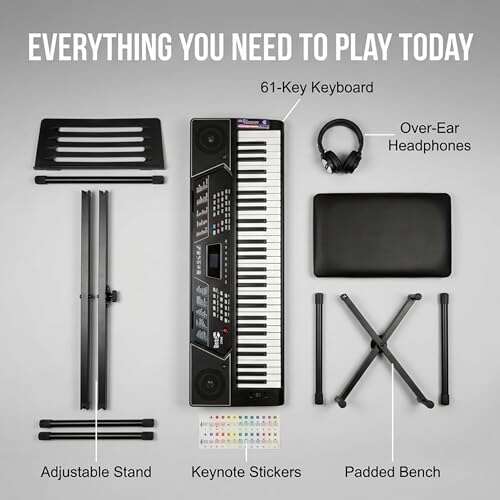
A full-size piano has the full range needed for standard guitar tuning. A smaller keyboard may not include low E2, especially if it has fewer than 61 keys.
If the low E2 is missing, you have several options:
- Use a higher E on the piano and tune the guitar by octave.
- Use the piano’s A, D, G, B, and high E notes, then tune the low E string from the twelfth-fret harmonic or the twelfth fret of the first string.
- Use a chromatic tuner or tuning app for the missing note.
- Tune the sixth string by matching it to the open first string two octaves higher.
When using a higher E, make sure you identify the octave correctly. Matching the low guitar E2 to E3 or E4 without accounting for the octave will produce the wrong result.
Common Problems and How to Fix Them
The guitar string sounds out of tune even after matching the piano
The guitar may have poor intonation, worn strings, or a bridge problem. Check the open string first, then compare the note at the twelfth fret with the same note one octave above the open string.
If the twelfth-fret note is consistently sharp or flat, the guitar may need an intonation adjustment. That adjustment is separate from basic tuning.
The pitch changes while you play
This can happen when:
- The string is new and still stretching.
- The string is not wrapped properly around the tuning post.
- The tuning peg is loose.
- You are pressing too hard while fretting.
- The guitar neck or bridge needs service.
Tune the open string, then play a few chords and check it again. Some movement is normal, but a string that changes pitch quickly may need repair.
The string breaks while tuning
A string can break if it is tuned too high, damaged, corroded, or sharply bent at the nut or bridge. Do not keep tightening when the string has clearly passed its target note.
If a string feels unusually tight before reaching the correct pitch, stop and inspect the guitar. A qualified guitar technician should check sharp contact points or hardware problems.
The piano and guitar do not seem to agree
The piano may be out of tune, or it may use a reference pitch other than A=440 Hz. Some instruments are tuned slightly higher or lower for specific musical settings.
If you must play with other musicians, tune to the pitch source used by the group. A digital chromatic tuner often makes this easier because it shows the target note and whether the pitch is sharp or flat.
Important Limits of Piano Tuning
A piano can help you tune the guitar’s open strings, but it cannot correct every guitar pitch problem.
A guitar’s intonation determines how accurately fretted notes play across the fingerboard. Even when the open strings match the piano, some fretted notes may sound sharp or flat because of string tension, action height, fret placement, or bridge adjustment.
The piano itself may also have tuning differences across its range. Acoustic pianos use a tuning system designed for the instrument’s range and behavior. For ordinary guitar practice, this difference is usually small enough to be useful, but it matters in precise recording or ensemble work.
The practical rule is simple:
- Use the piano to match the guitar’s open strings.
- Use a tuner when you need a portable or exact reference.
- Have the guitar serviced if fretted notes remain noticeably wrong.

Quick Tuning Checklist
Use this order when tuning a guitar with a piano:
- Find the correct piano note.
- Pluck the matching open guitar string.
- Decide whether the guitar note is sharp or flat.
- Turn the tuning peg in small steps.
- Match the note by ear.
- Repeat the process for all six strings.
- Recheck the first strings after tuning the last one.
- Play a few chords and make small final adjustments.
Standard tuning is:
Low to high: E2 – A2 – D3 – G3 – B3 – E4
A correctly tuned guitar should produce a clear E major sound when you play the open strings together, although the open-string notes are spread across several octaves.
FAQs
Can I tune an electric guitar with a piano?
Yes. An electric guitar can be tuned with a piano in the same way as an acoustic guitar. Keep the amplifier off or at a low volume so you can hear the piano clearly.
Do I need to use the piano’s middle C?
No. Middle C helps you locate the piano’s octave, but none of the six open guitar strings is middle C. The guitar notes are E, A, D, G, B, and E.
Which piano key tunes the high E guitar string?
Use E4, the E above middle C. Do not use the low E2 key used for the thickest guitar string.
Can I tune a guitar with an out-of-tune piano?
Yes, if your goal is to play with that piano. The guitar will match the piano’s pitch, even if both instruments are slightly sharp or flat compared with A=440 Hz.
Why does my guitar sound in tune on open strings but wrong when I play chords?
The guitar may need an intonation adjustment, or you may be pressing the strings too hard. Check the twelfth-fret notes and consider having a guitar technician inspect the instrument if the problem continues.
Conclusion
To tune a guitar with a piano, match each open string to its corresponding piano note: E2, A2, D3, G3, B3, and E4. Tune in small steps, listen for a smooth unison, and check all six strings twice.
For the best result, use a piano that is reasonably in tune. If the guitar still sounds wrong when fretted, the problem may be intonation rather than basic tuning.

Senior Music Reviewer
Alex Carter is a seasoned music reviewer with over a decade of experience in the world of sound and instruments. Passionate about helping musicians and enthusiasts make informed choices, he brings sharp insights and in-depth knowledge to every review. From classical instruments to modern gear, Alex combines technical expertise with a love for music to deliver content that resonates with readers.
As a Senior Music Reviewer and expert author on Tuneluma.com, Alex is dedicated to sharing honest evaluations, practical advice, and thoughtful commentary to guide readers in their musical journey.