Introduction
For most piano owners in the United States, tuning a piano is harder than it first appears. The basic idea is simple: adjust the tension of each string until the notes reach the correct pitch. The difficult part is making small, controlled changes while keeping the whole instrument stable and in tune.
A piano has hundreds of strings, many of which carry high tension. A small turn of the tuning pin can change a note sharply. The work also requires a good ear, a proper tuning lever, a way to mute strings, and an understanding of how the piano’s design affects pitch.
A beginner may be able to improve a few notes with care. However, a full, stable tuning usually takes training and practice. For many homes, schools, churches, and music studios in the U.S., hiring a professional piano technician is the safer and more efficient choice.

Quick answer: Is tuning a piano difficult?
Yes, piano tuning can be difficult for a beginner, but it is not impossible to learn.
The challenge depends on what you mean by “tuning”:
- Adjusting one or two slightly sharp or flat notes: possible for a careful beginner.
- Tuning an entire upright piano: moderately difficult and time-consuming.
- Tuning a grand piano: more complex because of its string layout and action.
- Creating a stable, professional tuning: difficult without training and repeated practice.
- Repairing loose pins, broken strings, or structural problems: professional work.
A piano tuner does more than match notes to a digital display. The technician must also account for string groups, unisons, temperament, pitch stability, and the condition of the instrument.

What makes piano tuning hard?
Piano tuning is difficult because the instrument has many interacting parts. Each adjustment affects more than one note or string.
A piano has many strings
Most modern pianos have more than 200 strings. The exact number varies by model. Bass notes often use one or two strings, while middle and high notes commonly use three strings.
The three strings for one note are called a unison. They must sound as one pitch. If one string is even slightly off, the note may sound rough, wide, or like it is vibrating.
A technician must tune each string in the group, not just the note as a whole.
Tuning pins respond to small movements
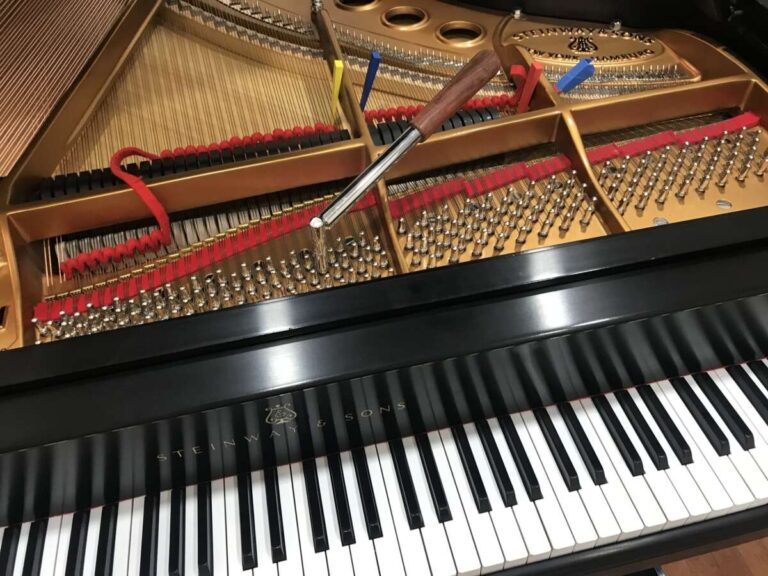
Each string wraps around a tuning pin. The pin sits tightly inside a wooden pinblock. Turning the pin changes string tension and therefore pitch.
The hard part is not simply turning the pin. The technician must move it in a controlled way and leave it settled at the correct pitch. If the pin twists too far or does not settle properly, the note may go flat again soon after tuning.
The strings are under high tension
Piano strings can hold substantial tension. A broken string can move suddenly and may cause injury or damage. This is one reason beginners should avoid forcing stiff tuning pins or working near damaged strings.
Wear eye protection when working near piano strings. Keep your face and hands out of the direct path of a string, and stop if a pin or string behaves unexpectedly.
The piano uses a carefully spaced scale
Most modern pianos use equal temperament. In this system, the octave is divided into 12 equal pitch steps. A tuner usually establishes a central area called the temperament, then uses intervals to place the other notes.
The tuner must also account for inharmonicity. Piano strings do not vibrate as perfectly simple mathematical strings. Their overtones are slightly sharp, especially in the high and low ranges. As a result, the highest and lowest notes may be tuned wider than a strict mathematical scale would suggest.
The instrument may not be at the right pitch
Many pianos are tuned near A4 = 440 Hz, the common reference pitch used in the United States. But a piano that has been neglected may be far below or above that level.
Raising the pitch of an old piano is more demanding than correcting a small drift. A large pitch change can make the piano unstable, so a technician may recommend a pitch raise followed by one or more regular tunings.

What tools are needed to tune a piano?
A basic tuning setup includes more than a phone app.
Essential tools
- Piano tuning lever: Fits the piano’s tuning pins.
- Electronic tuning device or tuning software: Provides pitch references.
- Rubber mutes or temperament strip: Silences selected strings.
- Good lighting: Helps you see strings, pins, and the action.
- Eye protection: Reduces risk from a broken string.
- Padded tools or protective covers: Help prevent scratches and damage.
A phone tuner can show the frequency of a note, but it does not replace a piano tuning system. It may struggle with the complex sound of a piano, especially when several strings ring together.
A standard guitar tuner is also not designed for the full range and behavior of a piano. It may help with basic pitch checks, but it will not teach you how to set temperament or tune clean unisons.
Tools that beginners should avoid
Do not use pliers, adjustable wrenches, or improvised metal tools on tuning pins. They can damage the pin, the pinblock, or the piano’s finish.
Do not spray lubricant, glue, or household products into the tuning-pin area. A loose pin requires diagnosis, not a quick chemical fix.

Can you tune a piano yourself?
You can learn basic piano tuning yourself, but a full DIY tuning has a real risk of poor results or damage.
Self-tuning may make sense when:
- You enjoy careful mechanical work.
- The piano is inexpensive or used for practice.
- You are willing to study before turning any pins.
- The piano is only slightly out of tune.
- You understand that the first attempt may not be stable.
Professional tuning is usually better when:
- The piano is valuable or antique.
- The instrument has not been tuned for many years.
- The pitch is far below normal.
- A tuning pin feels loose or unusually tight.
- A string is broken.
- The piano is used for lessons, performances, recording, or public events.
- You need reliable results without a long learning curve.
The first attempts often take several hours and may still produce an uneven result. A professional technician has learned how much pressure to use, how to control pin movement, and how to identify problems that an app cannot detect.

How to tune a piano: a careful beginner overview
The following outline explains the process. It is not a substitute for hands-on training.
1. Inspect the piano first
Check for:
- Broken strings
- Loose tuning pins
- Cracks or damage near the pinblock
- Missing or damaged strings
- Severe rust
- Sticking keys
- Problems with dampers
- Signs of water or pest damage
Do not begin a full tuning if the piano has major damage. Tuning cannot correct a structural or mechanical fault.
2. Determine the current pitch
Play several notes across the keyboard and compare them with a reliable pitch reference. Check whether the piano is close to the intended pitch level.
If many notes are far below the target, do not force every note directly to pitch without a plan. A large pitch correction can cause the piano to shift again and may place stress on old strings or weak components.
3. Learn the temperament area
The middle range is normally tuned first. This area establishes the relationships that guide the rest of the keyboard.
A beginner should use a documented tuning method or specialized piano-tuning software. Guessing each note separately can create a piano that sounds acceptable on isolated notes but unpleasant in chords.
4. Mute strings when needed
On notes with two or three strings, the technician must isolate individual strings. Rubber mutes or a temperament strip temporarily silence selected strings.
This step is essential. If all strings ring together, it becomes much harder to hear which one is out of tune.
5. Adjust the tuning pin slowly
Fit the tuning lever correctly. Make very small movements and listen after each change.
Do not treat the lever like a wrench that should be turned quickly. The goal is controlled movement, followed by a check that the pitch remains stable.
6. Tune unisons carefully
Once the main pitch is close, remove the mute from one string at a time and compare the sound. A clean unison should have little or no audible beating.
“Beating” is the pulsing sound created when two close pitches interfere with each other. Slow beats can help a trained tuner measure certain intervals, but unwanted beating in a unison usually means the strings are not matched.
7. Check the tuning more than once
After tuning the keyboard, play chords, octaves, and scales across the instrument. Some notes may shift when nearby strings are adjusted.
A second pass often reveals changes that were not obvious during the first pass.

How long does it take to tune a piano?
A professional may complete a routine tuning in about one to two hours, depending on the piano’s condition and the technician’s process. A beginner may need several hours for the same instrument and may still need to redo sections.
Time increases when:
- The piano has not been tuned for years.
- The pitch is far from standard.
- Tuning pins are loose or stiff.
- Strings are rusty.
- The piano has broken strings.
- The instrument has difficult access or unusual construction.
- The owner wants both tuning and regulation or voicing.
Tuning, regulation, and voicing are different services:
- Tuning adjusts pitch.
- Regulation adjusts the movement and alignment of the action.
- Voicing changes the tone by working on the hammers.
A piano can be in tune but still feel uneven or sound harsh if it needs regulation or voicing.

Upright piano vs. grand piano: which is harder to tune?
Both types require skill, but grand pianos can present more complex tuning and maintenance challenges.
| Piano type | General tuning difficulty | Main reason |
|---|---|---|
| Upright piano | Moderate | Compact layout and limited access in some areas |
| Baby grand | Moderate to high | Larger scale and three-string unisons across much of the range |
| Concert grand | High | Long strings, complex scale design, high performance demands |
The quality and condition of the individual piano matter more than the name on the case. A worn upright with loose pins may be harder to tune well than a well-maintained grand.
Grand pianos also require careful attention to the lid, dampers, string layout, and access around the action. A technician who mainly works on uprights may need specific experience before servicing a concert instrument.

How often should a piano be tuned in the United States?
Many piano manufacturers and piano organizations commonly recommend tuning a piano about twice a year, especially when it is played often or kept in a room with seasonal changes.
Actual needs vary. A piano may need more frequent service when:
- It is used daily.
- It belongs to a music school, church, or performance venue.
- The room has large temperature or humidity changes.
- The piano is new.
- The piano has recently been moved.
- The piano has been neglected for a long period.
Climate control matters because wood parts respond to changes in moisture. Keep the piano away from direct sunlight, heating vents, fireplaces, and exterior doors when possible. Do not place drinks, plants, or humidifiers directly on or inside the piano.
Moving a piano does not automatically change its pitch because of the move alone. The change in temperature and humidity, along with the piano’s prior condition, usually matters more. Still, many owners schedule a tuning after a move so the instrument can settle and receive a full check.

Common mistakes when tuning a piano
Turning the pin too far
Large movements make it easy to overshoot the target. They also make it harder to keep the pin stable.
Better approach: Make small adjustments and check the note after each one.
Tuning only what sounds bad
A piano is a system of related intervals. Fixing a few noisy notes may improve the sound, but it does not create a complete tuning.
Better approach: Follow a consistent sequence across the keyboard.
Ignoring unisons
A note can show the correct average pitch on a device and still sound poor if its strings do not match.
Better approach: Tune each string in a unison separately.
Using a phone app as the whole method
An app can provide useful pitch information, but it may not account for temperament, inharmonicity, or the interaction of multiple strings.
Better approach: Use a piano-specific method and treat the app as one tool.
Forcing a stuck tuning pin
A stiff pin may indicate corrosion, damage, or a problem with the pinblock.
Better approach: Stop and ask a piano technician to inspect it.
Raising an old piano to standard pitch in one attempt
A neglected piano may not hold a large pitch correction well.
Better approach: Have a technician assess whether it needs a pitch raise, multiple passes, or repair first.

What does professional piano tuning cost?
The price of piano tuning varies across the United States. Local labor rates, travel distance, piano condition, pitch level, and service type all affect the quote.
A standard tuning is usually less expensive than:
- A pitch raise
- A tuning with multiple broken-string repairs
- Service on a concert grand
- Emergency or event tuning
- Tuning combined with regulation or voicing
When requesting a quote, tell the technician:
- Whether the piano is upright or grand.
- When it was last tuned.
- Whether the piano is far below normal pitch.
- Whether any strings or keys are damaged.
- Your city or ZIP code.
- Whether the piano is needed for an event or recording.
A very low quote may cover only a basic tuning under normal conditions. Ask what the service includes before booking.

Signs that your piano needs more than tuning
A tuning will not fix every piano problem. Contact a qualified piano technician if you notice:
- A tuning pin turns freely.
- A string is broken.
- A key sticks or fails to return.
- Several notes buzz or rattle.
- The pedals do not work correctly.
- The piano has a cracked soundboard or bridge.
- The instrument smells musty or shows water damage.
- The piano cannot hold its pitch.
- The case or frame has visible structural damage.
A technician may recommend repair, regulation, voicing, cleaning, or an evaluation before tuning. Do not assume that a piano is worth repairing—or not worth repairing—without considering its condition, brand, sentimental value, and intended use.

Key takeaways
- Piano tuning is a skilled task, not just a matter of matching notes to an app.
- A beginner can learn basic adjustments, but a full stable tuning takes practice.
- The main challenges are high string tension, tight tuning pins, temperament, unisons, and pitch stability.
- Do not force stuck pins or work on damaged strings.
- A professional is the safer choice for valuable, neglected, badly out-of-tune, or frequently used pianos.
- Regular tuning, stable room conditions, and prompt repairs help the piano stay playable.
Frequently asked questions
Can a beginner tune one piano note?
Yes. A careful beginner may be able to adjust one note, especially with instruction and the correct tools. The risk is higher if the note has multiple strings, the pin is stiff, or the piano is valuable.
Is tuning a piano harder than tuning a guitar?
Usually, yes. A guitar has fewer strings, simpler access, and a more direct tuning process. A piano has hundreds of strings, complex interval relationships, multiple-string unisons, and high tension.
Can I tune a piano with a phone?
A phone can help measure pitch, but it is not enough by itself for a professional piano tuning. The microphone may misread complex piano tones, and the app may not guide temperament or unison work.
How do I know if my piano is too far out of tune for DIY work?
If many notes are noticeably low, the piano has not been tuned for several years, or the pitch is far below the normal reference, treat it as a professional job. A technician can determine whether it needs a pitch raise or more than one tuning.
Can tuning damage a piano?
Improper tuning can damage a tuning pin, string, or other parts, especially when someone forces a stuck pin or makes large adjustments. The greatest practical risk is often a broken string or a tuning that will not hold.
Does moving a piano make it go out of tune?
Moving can be followed by tuning changes, but temperature, humidity, age, and the piano’s prior condition also play major roles. Let the piano settle in its new room, then arrange a tuning if it sounds unstable.
Conclusion
So, is it hard to tune a piano? It can be. The basic task is easy to describe, but accurate and stable tuning requires careful technique, reliable tools, and knowledge of how piano strings and intervals interact.
If you own a common upright and enjoy hands-on learning, you can study the process and practice cautiously. For a valuable instrument, a neglected piano, a large pitch correction, or any piano with damaged parts, hire a trained piano technician. The best next step is to inspect the piano, note when it was last tuned, and request a local evaluation if its condition is uncertain.

Senior Music Reviewer
Alex Carter is a seasoned music reviewer with over a decade of experience in the world of sound and instruments. Passionate about helping musicians and enthusiasts make informed choices, he brings sharp insights and in-depth knowledge to every review. From classical instruments to modern gear, Alex combines technical expertise with a love for music to deliver content that resonates with readers.
As a Senior Music Reviewer and expert author on Tuneluma.com, Alex is dedicated to sharing honest evaluations, practical advice, and thoughtful commentary to guide readers in their musical journey.