Are Drums Easier Than Guitar: The Real Answer
For many beginners, drums feel easier at first, while guitar becomes easier for others over time.
The answer to “are drums easier than guitar” depends on your goals, body coordination, music taste, and patience with practice. Drums offer a clear physical beat, but guitar demands finger strength, chord shapes, and several tasks at once. This guide breaks down the real learning curve so you can choose the instrument that fits you best.

Are drums easier than guitar for beginners?
For many new players, drums seem easier during the first few lessons. You can sit down, strike a drum, and make a sound right away. A basic beat may use only a kick drum, snare drum, and hi-hat.
Guitar often feels less friendly at first. New players must press strings, learn chord shapes, control a pick, and avoid touching the wrong strings. Sore fingertips are also common during the first few weeks.
Still, a simple drum beat is not the same as playing a full song. Drummers must keep steady time, control several limbs, and listen closely to the band. The early stage may feel easy, but advanced drumming becomes highly demanding.
The same is true for guitar. Playing three open chords can be simple, but clean chord changes, scales, bends, rhythm patterns, and solos take time. So, are drums easier than guitar? They may offer a faster start, but neither instrument is easy at an advanced level.
Why drums may feel easier at first
Drums have a low barrier to making a basic sound. You do not need to tune each note or learn a chord before playing a rhythm. This quick reward can help beginners stay motivated.
Drumming also uses large muscle groups. Your hands and feet move in clear patterns, much like walking or dancing. Many students understand a simple beat through their body before they understand musical theory.
A beginner drum pattern may look like this:
• Kick drum on beats 1 and 3
• Snare drum on beats 2 and 4
• Hi-hat playing steady eighth notes
This pattern appears in thousands of rock, pop, country, and worship songs. Once you learn it, you can play along with music almost at once.
Drums can also feel less abstract. On guitar, a chord diagram may look like a puzzle. On drums, you often begin with a direct action: hit the hi-hat, place the snare on beat four, and keep the kick steady.
However, this first success can be misleading. Good drumming requires accurate timing, controlled volume, relaxed motion, and strong listening skills. A player who hits hard is not always a player who keeps good time.

Why guitar may feel harder in the beginning
Guitar asks your hands to perform different jobs. Your fretting hand forms notes, while your picking hand controls rhythm or melody. Both hands must work together with accurate timing.
Finger pain is another early challenge. Steel-string acoustic guitars can feel tough on new fingertips. Most players develop calluses with regular practice, but the adjustment may take several weeks.
Common beginner guitar tasks include:
• Holding the instrument correctly
• Tuning the strings
• Pressing notes with enough force
• Switching between chords
• Strumming in time
• Muting unwanted string noise
Each task is manageable on its own. The challenge comes from combining them. This is one reason people ask, are drums easier than guitar, after their first guitar lesson.
Guitar also exposes small mistakes. One muted string can make a chord sound weak. A late strum can change the feel of a song. These details may frustrate beginners, but they also build useful control.
The good news is that guitar gives fast access to harmony. With a few chords, you can play songs, sing along, write music, and accompany other people. That reward often makes the early struggle worthwhile.

The main skills each instrument requires
The question are drums easier than guitar becomes clearer when you compare the skills behind each instrument.
Core drum skills
Drumming involves more than hitting surfaces. You must build:
• Steady pulse: Keeping the beat at a consistent speed
• Limb independence: Using hands and feet in different patterns
• Coordination: Moving several limbs without tension
• Dynamics: Playing softly, loudly, and with control
• Subdivision: Feeling quarter notes, eighth notes, and sixteenth notes
• Musical listening: Supporting the song instead of covering it
A drummer is the timekeeper of many bands. If the drummer speeds up, the whole group may rush. If the drummer loses the pulse, the song can feel unstable.
Core guitar skills
Guitar players develop a different set of abilities:
• Chord shapes: Pressing several notes at once
• Chord changes: Moving between shapes without stopping
• Rhythm: Strumming with a steady pattern
• Fretboard knowledge: Finding notes across the neck
• Picking control: Playing single notes clearly
• Intonation and tuning: Keeping notes accurate and pleasant
Guitar also combines rhythm, harmony, and melody. One player can provide the chords, bass movement, and vocal support at the same time.
This comparison shows why neither instrument is simply easy. Drums may require more full-body coordination, while guitar often requires more early finger control and harmonic knowledge.
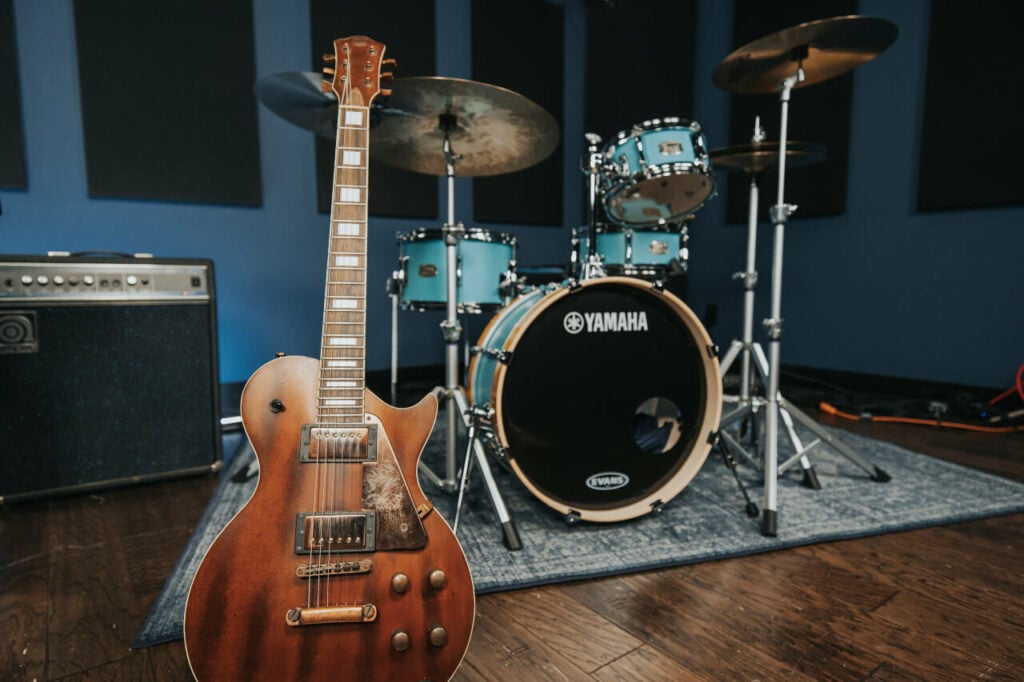
Are drums easier than guitar for playing songs?
Drums may be easier if your goal is to play a basic beat with a song. Many popular tracks use simple patterns that beginners can learn in one practice session.
Guitar may be easier if you want to sing while playing. Three or four chords can support hundreds of songs. A beginner with chords such as G, C, D, and Em can already play many familiar progressions.
Your music taste matters, too.
• Rock and funk fans may connect quickly with drums.
• Folk, country, and singer-songwriter fans may prefer guitar.
• Pop players may enjoy either instrument.
• Metal drummers and guitarists face steep technical demands.
• Jazz musicians need strong theory and listening skills on both instruments.
The easiest instrument is often the one you want to practice. Interest creates patience. Patience creates repetition. Repetition builds skill.
A useful test is to try both instruments for two weeks. Practice each one for 15 minutes a day. Notice which practice session makes you lose track of time.

Comparing the physical learning curve
The physical demands of drums and guitar are different, not higher or lower.
Guitar beginners often deal with:
• Fingertip soreness
• Wrist tension
• Tight shoulders
• Difficulty stretching between frets
• Fatigue from gripping too hard
Drum beginners may experience:
• Tired legs
• Sore wrists
• Shoulder tension
• Poor posture
• Difficulty keeping the hands and feet relaxed
Good setup reduces many of these problems. A guitar should fit your body, and the strap should hold the instrument at a comfortable height. A drum throne should let your hips sit slightly above your knees, with your feet reaching the pedals naturally.
Never treat pain as proof of progress. Mild fingertip tenderness can be normal for a new guitarist. Sharp pain, numbness, or lasting joint pain is a reason to stop and check your technique.
In both instruments, relaxed movement is more useful than force. Tension slows learning and raises the risk of strain.

Practice time: drums vs. guitar
Practice quality matters more than practice length. A focused 20-minute session can beat an unfocused hour.
For beginner drums, a useful session may include:
- Five minutes of single-stroke exercises
- Five minutes of steady hi-hat and snare patterns
- Five minutes with a metronome
- Five minutes playing along with a slow song
For beginner guitar, try:
- Five minutes of finger warmups
- Five minutes practicing two chord changes
- Five minutes of simple strumming
- Five minutes playing a complete song section
A metronome helps both players. It teaches steady timing and reveals rushed or delayed notes. Start slowly. Speed should come after control.
One common mistake is practicing only what feels easy. Repeat the hard transition, but keep the task small. For example, a guitarist can practice changing from G to C for two minutes. A drummer can practice moving from a basic beat to a simple fill.
Small wins create durable progress.

Cost, space, and noise
Practical concerns can decide whether drums or guitar feels easier to learn.
An acoustic guitar is fairly portable. You can practice in a bedroom, travel with it, and play without extra equipment. You may later add a tuner, picks, a capo, and an amplifier.
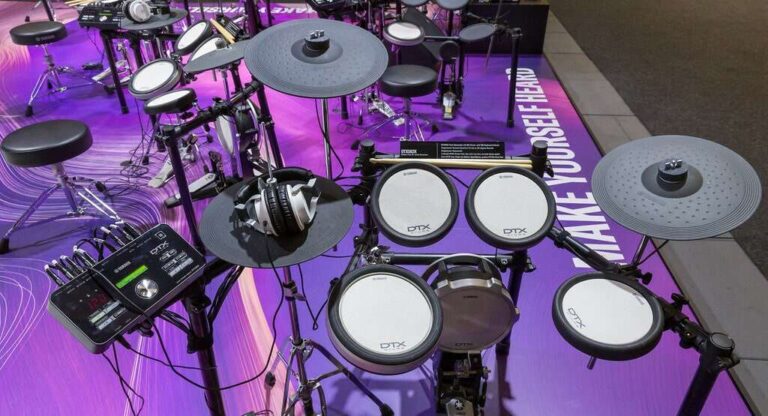
Acoustic drums need more space and produce much more sound. Neighbors, family members, and roommates may not welcome daily practice. Electronic drums reduce the volume, but they still need floor space, headphones, and a suitable setup.
Typical beginner costs can include: