What Is An Interval In Piano: Simple Guide
Introduction
On a standard piano in the United States, an interval is the distance between two notes. You can play the notes together as a chord, or one after the other as a melody. Learning intervals helps you read music, build chords, understand scales, and play by ear.
For example, the distance from C to E is a third. The distance from C to G is a fifth. Each interval has a number and a quality, such as major, minor, perfect, augmented, or diminished.
Once you understand how intervals work, the keyboard becomes easier to see. Instead of viewing 88 separate keys, you can recognize clear patterns and distances.
What Is an Interval in Piano?
An interval in piano is the distance in pitch between two notes. The two notes may be played at the same time or in sequence.
Consider these examples:
- C to D is a second.
- C to E is a third.
- C to F is a fourth.
- C to G is a fifth.
- C to A is a sixth.
- C to B is a seventh.
- C to the next C is an octave.
The first note is called the root, starting note, or lower note, depending on the musical setting. The second note is the upper note when both notes are shown in ascending order.
An interval does not depend only on the physical space between keys. It also depends on the letter names of the notes. For example, C to E and C to D-flat sound different, even though both may cover four half steps on the keyboard in certain situations.
Music theory uses intervals to describe:
- Melody movement
- Chord structure
- Scales
- Harmony
- Sight-reading patterns
- Ear-training exercises
- Transposition
The term “interval” can also describe a break or pause in everyday English. In piano theory, however, it means the pitch distance between two notes.
How Do You Count Intervals on a Piano?
To find the interval number, count the letter names from the first note to the second note, including both notes.
For example, to count from C to E:
- Start on C.
- Count C as 1.
- Count D as 2.
- Count E as 3.
C to E is therefore a third.
This method works even when the notes include sharps or flats:
- C to F is a fourth.
- C to F-sharp is still a fourth.
- C to F-flat is also a fourth.
The accidental changes the interval’s quality, but not its number.


Interval Number Table
| Interval | Letter count | Example |
|---|---|---|
| Unison | 1 | C to C |
| Second | 2 | C to D |
| Third | 3 | C to E |
| Fourth | 4 | C to F |
| Fifth | 5 | C to G |
| Sixth | 6 | C to A |
| Seventh | 7 | C to B |
| Octave | 8 | C to the next C |
A unison means the same pitch name played twice. On a piano, C to the same C is a unison, while C to the next C is an octave.
The interval number tells you how many letter steps separate the notes. It does not tell you the exact number of piano keys or half steps. For that, you must identify the interval’s quality.

What Are Half Steps and Whole Steps?
A half step, also called a semitone, is the smallest distance between two neighboring keys on a standard piano. A whole step contains two half steps.
Examples of half steps include:
- E to F
- B to C
- C to C-sharp
- F to F-sharp
The white keys E and F are next to each other, even though there is no black key between them. The same is true for B and C.
Examples of whole steps include:
- C to D
- D to E
- F to G
- G to A
- A to B
The distance from C to D includes the black key C-sharp, so it contains two half steps.
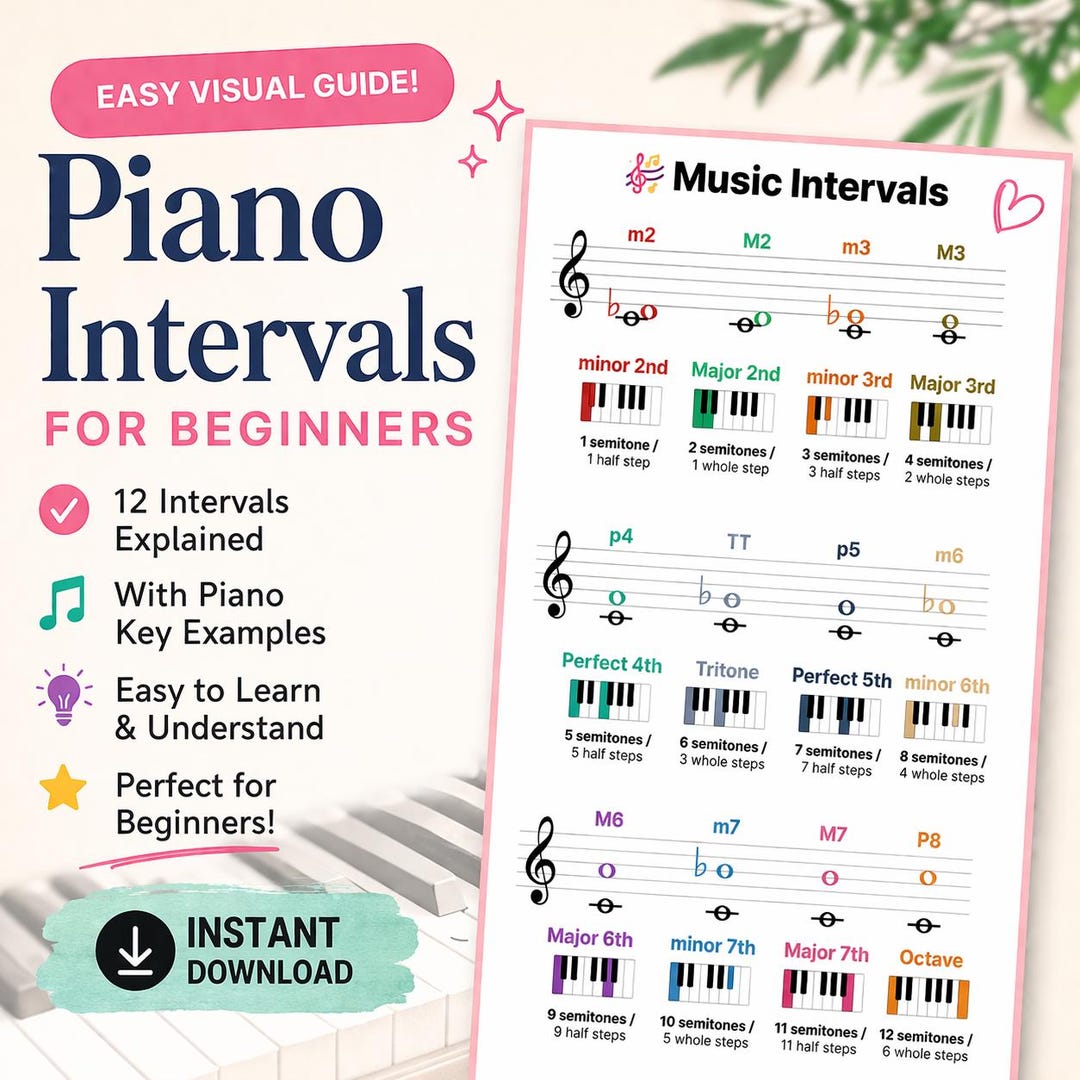
Half-Step Distance of Common Intervals
| Interval | Half steps | Example |
|---|---|---|
| Perfect unison | 0 | C to C |
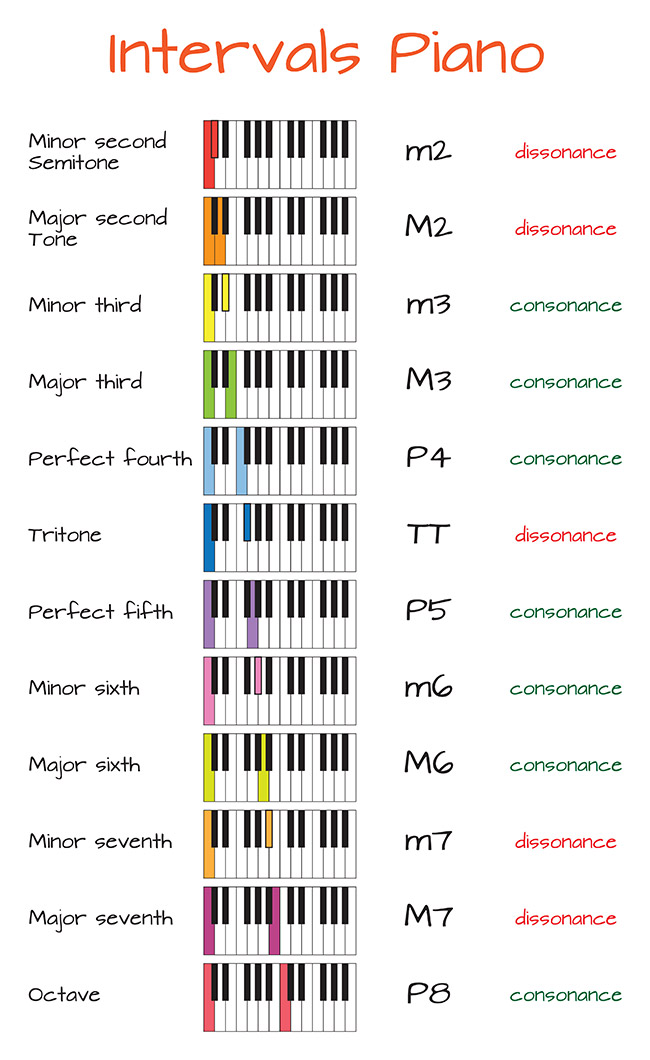
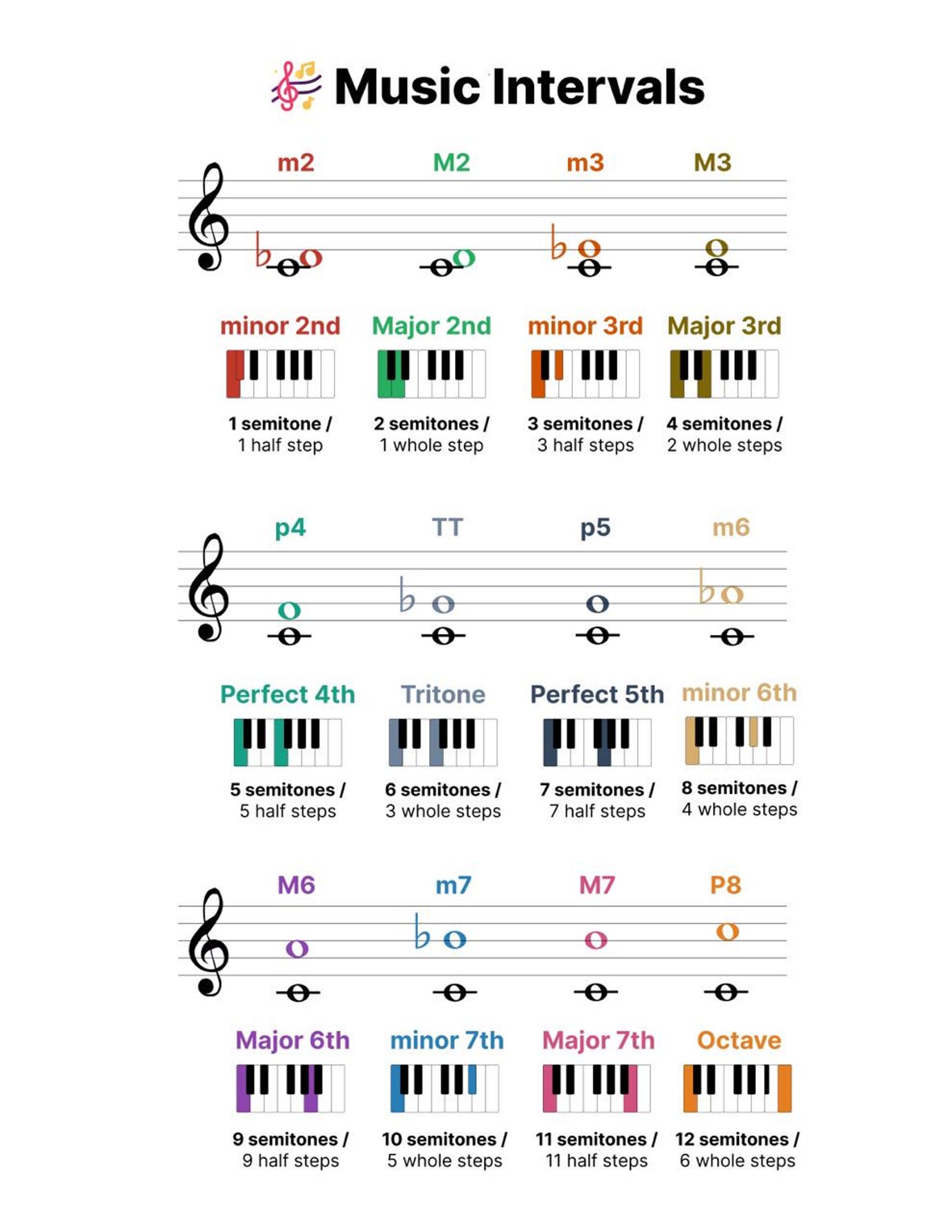
| Minor second | 1 | C to D-flat |
| Major second | 2 | C to D |
| Minor third | 3 | C to E-flat |
| Major third | 4 | C to E |
| Perfect fourth | 5 | C to F |
| Tritone | 6 | C to F-sharp |
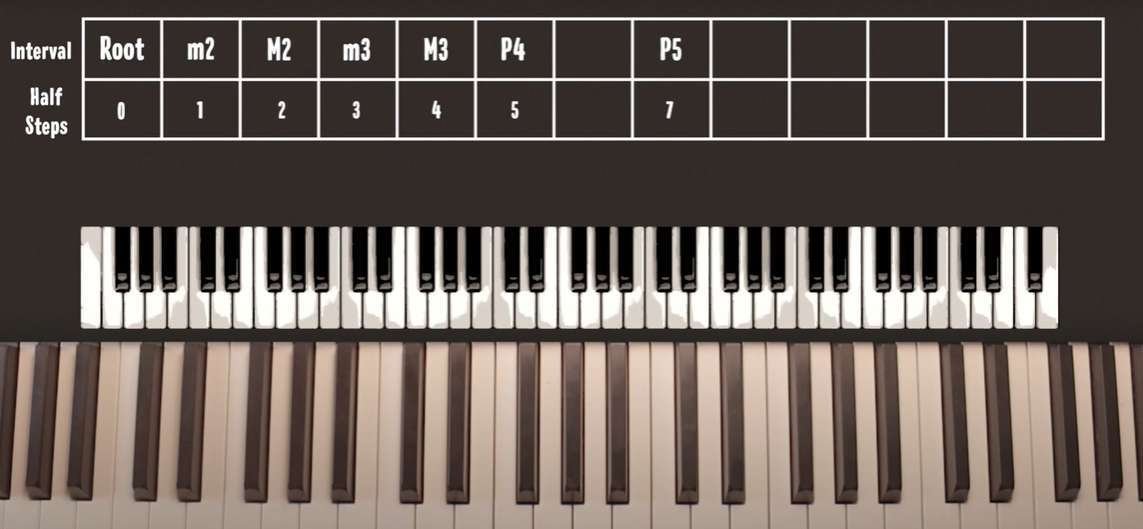
| Perfect fifth | 7 | C to G |
| Minor sixth | 8 | C to A-flat |
| Major sixth | 9 | C to A |
| Minor seventh | 10 | C to B-flat |
| Major seventh | 11 | C to B |
| Perfect octave | 12 | C to the next C |
This table follows the equal-tempered system used by modern pianos. In that system, the octave is divided into 12 equal half-step divisions.
A half-step count is useful, but it should not replace letter-name counting. For example, C to E-flat is three half steps and is a minor third. C to D-sharp also spans three half steps, but it is spelled as an augmented second. The notes sound the same on an equal-tempered piano, but their theoretical names differ.

What Are the Types of Piano Intervals?
Piano intervals have both a number and a quality. The number comes from the letter count. The quality comes from the exact half-step distance.
The main interval qualities are:
- Perfect
- Major
- Minor
- Augmented
- Diminished
Perfect Intervals
The perfect group includes:
- Unisons
- Fourths
- Fifths
- Octaves
Examples:


- C to C is a perfect unison.
- C to F is a perfect fourth.
- C to G is a perfect fifth.
- C to the next C is a perfect octave.
These intervals are called “perfect” because of their strong mathematical and acoustic relationships. Perfect fifths and octaves often sound stable and open.
Major and Minor Intervals
The major and minor group includes:
- Seconds
- Thirds
- Sixths
- Sevenths
A minor interval is one half step smaller than a major interval with the same letter count.
Examples:
- C to D is a major second.
- C to D-flat is a minor second.
- C to E is a major third.
- C to E-flat is a minor third.
- C to A is a major sixth.
- C to A-flat is a minor sixth.
Major intervals often sound bright or open. Minor intervals often sound darker or more tense. These descriptions are useful starting points, but the musical setting can change how an interval feels.
Augmented and Diminished Intervals
An augmented interval is one half step larger than a major or perfect interval.
Examples:
- C to F-sharp is an augmented fourth.
- C to D-sharp is an augmented second.
A diminished interval is one half step smaller than a minor or perfect interval.
Examples:
- C to G-flat is a diminished fifth.
- C to E-double-flat is a diminished third.
Augmented and diminished intervals often create strong tension. They appear in chromatic melodies, altered chords, and harmonic movement.
The Tritone
A tritone spans six half steps. It may be written as:
- An augmented fourth, such as C to F-sharp
- A diminished fifth, such as C to G-flat
On a piano, these two spellings use the same keys in equal temperament. Their names differ because the letter relationships differ.
The tritone sits exactly halfway between a note and its octave. It often sounds unsettled and may move toward a more stable interval.

How Do You Find an Interval on the Piano?
Use this four-step method when you need to name an interval.


Step 1: Name the two notes
Identify the lower and upper notes. Include all accidentals.
For example, you may be given A-flat and F.
Step 2: Count the letter names
Count from the first letter to the second, including both:
A–B–C–D–E–F
That gives you a sixth.
Step 3: Count the half steps
On the piano, A-flat to F covers nine half steps.
Step 4: Match the number and distance
A sixth that spans nine half steps is a major sixth.
So, A-flat to F is a major sixth.
Worked Examples
Example 1: D to F
- Letter count: D–E–F = third
- Half-step count: three
- Answer: minor third
Example 2: D to F-sharp
- Letter count: D–E–F = third
- Half-step count: four
- Answer: major third
Example 3: G to C
- Letter count: G–A–B–C = fourth
- Half-step count: five
- Answer: perfect fourth
Example 4: B to F
- Letter count: B–C–D–E–F = fifth
- Half-step count: six
- Answer: diminished fifth
This two-part method prevents a common error: naming an interval only by counting physical keys. Always count letter names first, then use half steps to determine quality.

What Is the Difference Between Melodic and Harmonic Intervals?
A melodic interval occurs when you play two notes one after the other. A harmonic interval occurs when you play them at the same time.
For example:
- Playing C and E in sequence creates a melodic third.
- Playing C and E together creates a harmonic third.
The interval name stays the same. The sound and musical use change.
Melodic intervals help describe:
- Vocal lines
- Piano melodies
- Scales
- Musical themes
- Jumps between notes
Harmonic intervals help describe:


- Chords
- Two-note accompaniments
- Counterpoint
- Bass and melody relationships
- Musical tension and release
Melodic intervals are often easier for beginners to hear because each pitch is clear. Harmonic intervals can sound more complex because both notes ring at once.
When practicing, play an interval both ways. First play it separately. Then play it as a pair. This helps connect the visual shape of the keys with the sound.

What Are Interval Inversions?
An interval inversion happens when the lower note moves up an octave or the upper note moves down an octave.
For example:
- C up to E is a major third.
- E up to the next C is a minor sixth.
The two intervals are inversions of each other.
Interval Inversion Rules
| Original interval | Inverted interval |
|---|---|
| Unison | Octave |
| Second | Seventh |
| Third | Sixth |
| Fourth | Fifth |
| Major | Minor |
| Minor | Major |
| Perfect | Perfect |
| Augmented | Diminished |
| Diminished | Augmented |
The numbers of an interval and its inversion add up to nine:
- Third plus sixth equals nine.
- Fourth plus fifth equals nine.
- Second plus seventh equals nine.
The quality changes in a predictable way. A major third becomes a minor sixth, while a perfect fourth becomes a perfect fifth.
Inversions matter when you study chord voicings. A C major chord contains C, E, and G. Changing the order of these notes changes the chord’s position, but the same interval relationships remain present.
How Intervals Build Piano Chords
Intervals are the basic parts of chords. A chord is not just a group of notes; it is a group of notes related by specific intervals.
A major triad contains:
- A root
- A major third above the root
- A perfect fifth above the root
For example, C major contains:
- C
- E
- G
A minor triad contains:
- A root
- A minor third
- A perfect fifth
C minor contains:
- C
- E-flat
- G
The difference between C major and C minor is the third. Lowering E to E-flat changes the major third into a minor third.
Seventh chords add another interval above the triad. A C dominant seventh chord contains C, E, G, and B-flat. The added note forms a minor seventh above C.
This is why interval knowledge helps with chord reading. Instead of memorizing every chord as a separate shape, you can understand how its notes relate.

How to Practice Piano Intervals
Start with simple intervals and use both your eyes and ears.
1. Practice from one starting note
Use C first. Play each interval above it:
- C to D
- C to E
- C to F
- C to G
- C to A
- C to B
- C to the next C
Say each interval name aloud.
2. Add the accidentals
Next, compare major and minor forms:
- C to D and C to D-flat
- C to E and C to E-flat
- C to A and C to A-flat
- C to B and C to B-flat
Listen to how lowering the upper note by one half step changes the quality.
3. Practice descending intervals
Do not practice only from low to high. Try:
- E down to C
- G down to C
- A down to F
- B down to C
You can still name the interval by counting the letter names, but you may need to think about the interval’s simple ascending form.
4. Use songs as memory aids
Some musicians connect intervals to the opening notes of familiar melodies. This can help with ear training, but the best song depends on your musical background and the version you know.
Use songs as a listening aid, not as the only method. Also practice singing or imagining the distance without relying on a tune.
5. Test yourself away from the keyboard
Write two notes on staff paper and name the interval. Then check it on the piano.
This builds reading skill and reduces dependence on counting keys.
Signs that your practice is working include:
- You recognize common intervals without counting every key.
- You can name both the number and quality.
- You hear the difference between major and minor forms.
- You can find the interval in different octaves.
- You can identify intervals in simple melodies and chords.
Common Mistakes When Naming Piano Intervals
Counting keys instead of letter names
A piano key count can show half steps, but it cannot identify the interval number by itself. Count the note letters first.
Ignoring accidentals
C to E and C to E-flat are both thirds, but one is major and the other is minor. Accidentals affect quality.
Forgetting E–F and B–C
These pairs are natural half steps. There is no black key between them.
Confusing an octave with a unison
The same note at the same pitch is a unison. The same note at a higher or lower pitch is an octave.
Naming only “three keys apart”
That description is incomplete. Say “minor third” or “major third,” not just “three half steps.”
Treating enharmonic spellings as identical in theory
F-sharp and G-flat use the same piano key in equal temperament, but they do not always have the same musical name. Spelling matters in scales, chords, and written harmony.
Practicing only visually
Two intervals may look similar on the keyboard but sound different. Listen, sing, and play them in several keys.

Why Are Intervals Important for Piano Players?
Intervals help you understand music at several levels.
For beginners, they make note reading less dependent on memorizing each key. You begin to recognize shapes, skips, steps, and repeated patterns.
For intermediate players, intervals help with:
- Chord construction
- Scale patterns
- Sight-reading
- Transposing songs
- Reading melodies
- Playing accompaniment patterns
For advanced players, intervals support:
- Improvisation
- Voicing
- Counterpoint
- Harmonic analysis
- Ear training
- Arranging and composition
Intervals also improve musical memory. A melody is easier to remember when you hear it as a pattern of steps and leaps rather than as unrelated notes.
The most useful habit is to connect three things at once:
- The written notes
- The piano keys
- The sound of the interval
That connection turns interval theory into a practical piano skill.
Frequently Asked Questions About Piano Intervals
Is an interval the same as a chord?
No. An interval contains two notes. A chord usually contains three or more notes played together, although some basic music lessons may use two-note shapes as simplified chord forms.
What is the easiest interval to recognize?
The octave is often easy to recognize because the two notes share the same letter name. The perfect fifth is also common and has a clear, open sound.
How many intervals are there on a piano?
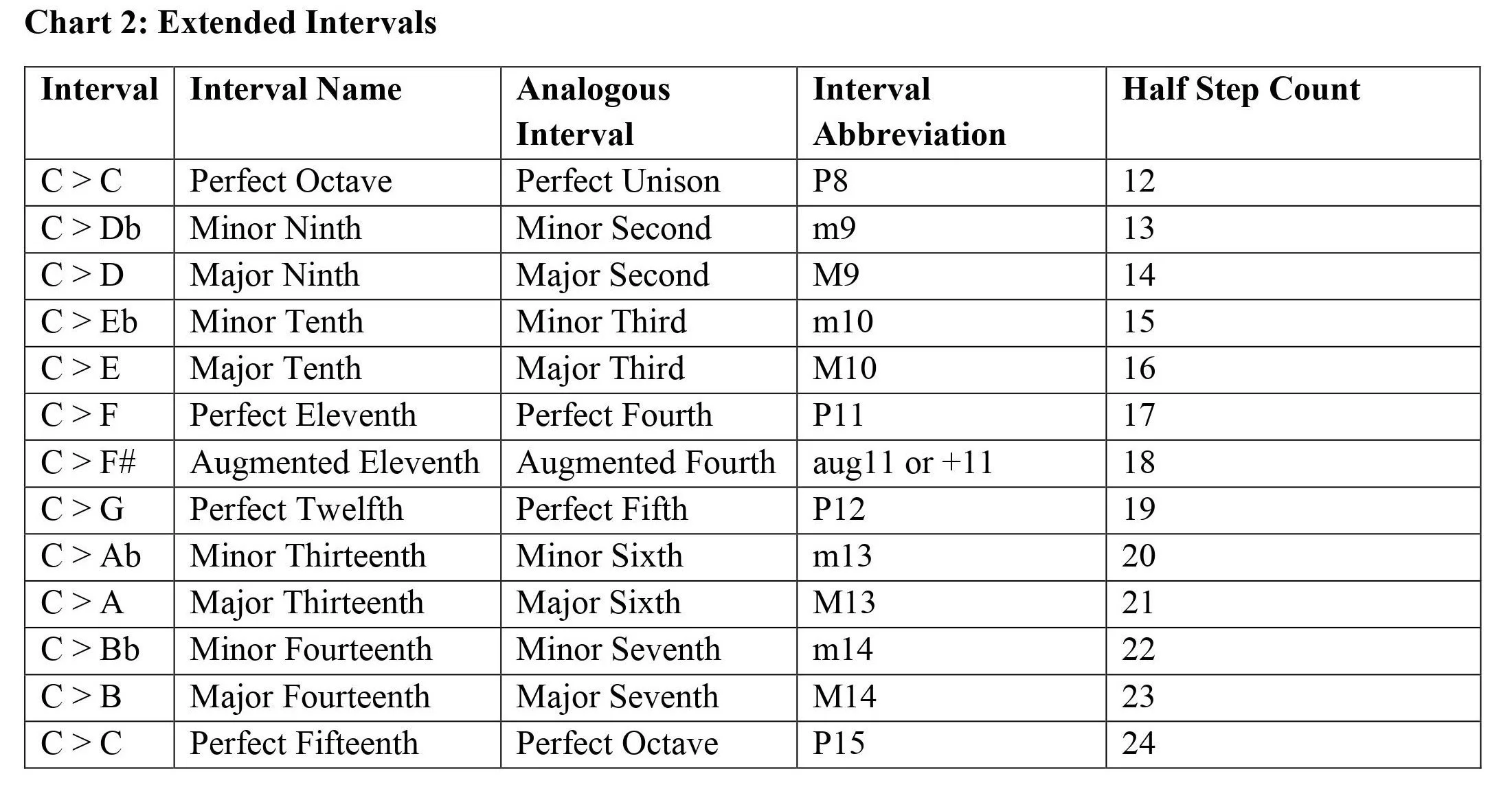
Within one octave, there are 12 half-step distances. When theory names are included, those distances can have different spellings and interval qualities.
Do intervals work the same way on digital pianos?
Yes, if the digital piano uses the standard 12-tone equal-tempered tuning. Some digital instruments may offer alternate tunings, which can change the exact sound and measurement of intervals.
Should I learn intervals by sight or by ear?
Use both. Sight helps you read and calculate intervals. Ear training helps you recognize their sound in melodies, chords, and real music.
Key Takeaways
- An interval is the distance between two piano notes.
- Count letter names to find the interval number.
- Count half steps to find the interval quality.
- Seconds, thirds, sixths, and sevenths may be major or minor.
- Unisons, fourths, fifths, and octaves may be perfect.
- Augmented and diminished intervals are altered by one half step.
- Melodic intervals are played in sequence; harmonic intervals are played together.
- Intervals form the structure of scales, chords, and melodies.
Conclusion
An interval in piano is the measured distance between two notes. To name one correctly, count the letter names first and then check the half-step distance.
Begin with simple intervals from C. Compare major and minor forms, practice both directions, and listen as you play. With regular practice, intervals will become quick patterns that help you read music, build chords, and understand what you hear.
The best next step is simple: choose one starting note, play intervals from a unison through an octave, and say each name aloud.

Senior Music Reviewer
Alex Carter is a seasoned music reviewer with over a decade of experience in the world of sound and instruments. Passionate about helping musicians and enthusiasts make informed choices, he brings sharp insights and in-depth knowledge to every review. From classical instruments to modern gear, Alex combines technical expertise with a love for music to deliver content that resonates with readers.
As a Senior Music Reviewer and expert author on Tuneluma.com, Alex is dedicated to sharing honest evaluations, practical advice, and thoughtful commentary to guide readers in their musical journey.