For most people in the United States, learning the drums is easy to start but takes steady practice to play well. You can learn a basic beat in your first lesson. Building good timing, control, coordination, and stamina takes longer.
The good news is that you do not need natural talent, strong muscles, or years of music training. You need a quiet practice plan, a basic setup, and regular practice. Even 15 to 20 minutes a day can help you improve if you use that time well.
Your progress will depend on your goal. Playing a simple rock beat at home may take a few weeks. Playing with a school band, church group, jazz combo, or local band requires more control and listening skill.

What Makes Drums Easy or Hard to Learn?
Drums are easy to begin because the first skills are direct. You strike a surface, count a beat, and repeat a pattern. Unlike some melodic instruments, you do not need to learn chords or read complex notes before making a useful sound.
Drums become harder as you add more parts. You may need to:
- Keep a steady pulse
- Move each limb in a different pattern
- Read drum notation
- Control volume
- Play fills without losing the beat
- Listen to other musicians
- Stay relaxed during longer songs
This is called limb independence. It means your hands and feet can perform different actions at the same time. It develops through repeated practice. It is not a fixed gift that only some people have.
The main skills you need
| Skill | What it means | Why it matters |
|---|---|---|
| Timing | Playing notes at the right moment | Keeps the band together |
| Coordination | Using hands and feet in planned ways | Lets you play complete beats |
| Dynamics | Controlling loud and soft sounds | Makes your playing musical |
| Technique | Using efficient stick and pedal motion | Reduces strain and improves control |
| Listening | Hearing the beat and other players | Helps you react in real time |
| Reading | Understanding rhythm symbols | Helps you learn songs and exercises |
A beginner often feels that the hands and feet “will not listen.” That feeling is normal. Your brain is building new movement patterns. Slow practice gives it time to build those patterns correctly.
Is drumming harder than other instruments?
There is no fair way to rank all instruments by difficulty. Each one presents different challenges.
Drums may feel easier at first than guitar or piano because you can make a beat right away. They may feel harder later because you must coordinate several limbs and maintain time without speeding up or slowing down.
The deciding factor is your goal. Learning a simple drum groove is easier than learning advanced guitar solos, but playing drums in a live band demands strong timing and focus.
How Long Does It Take to Learn Drums?
Most beginners can learn a basic beat within a few lessons. Reaching a comfortable level often takes several months of regular practice. Becoming a strong, flexible drummer can take years.
These time frames are estimates, not guarantees. They assume focused practice rather than simply sitting at the kit and playing random patterns.
| Goal | Common practice path |
|---|---|
| Play a basic rock beat | A few lessons to several weeks |
| Play simple songs | One to three months |
| Read basic drum notation | Several weeks to a few months |
| Play with a beginner group | A few months of steady practice |
| Perform with confidence | Often six months to two years |
| Build advanced technique | Several years of focused work |
A learner who practices 20 minutes on five days each week may improve faster than someone who practices for two hours once every two weeks. Motor skills respond well to frequent repetition.
What changes the learning speed?
Your progress may be faster when you have:
- A teacher who corrects mistakes early
- A practice pad or quiet electronic kit at home
- A metronome
- A clear song or skill goal
- Short, regular practice sessions
- A way to record and review your playing
- A supportive group to play with
Progress may be slower when you:
- Practice only when you feel motivated
- Start with songs that are far above your level
- Play too fast
- Ignore timing
- Use too much force
- Change exercises every few minutes
- Avoid practicing with a metronome
The American Music Therapy Association and music education research support the value of active music making, but these sources do not prove that every person will learn at the same speed. Individual results vary with practice quality, instruction, age, access, and goals.

A Simple Plan for Learning Drums
A good beginner plan should build timing first, then coordination, then song skills. Do not begin with the most complex fill you can find online.
Step 1: Learn your basic setup
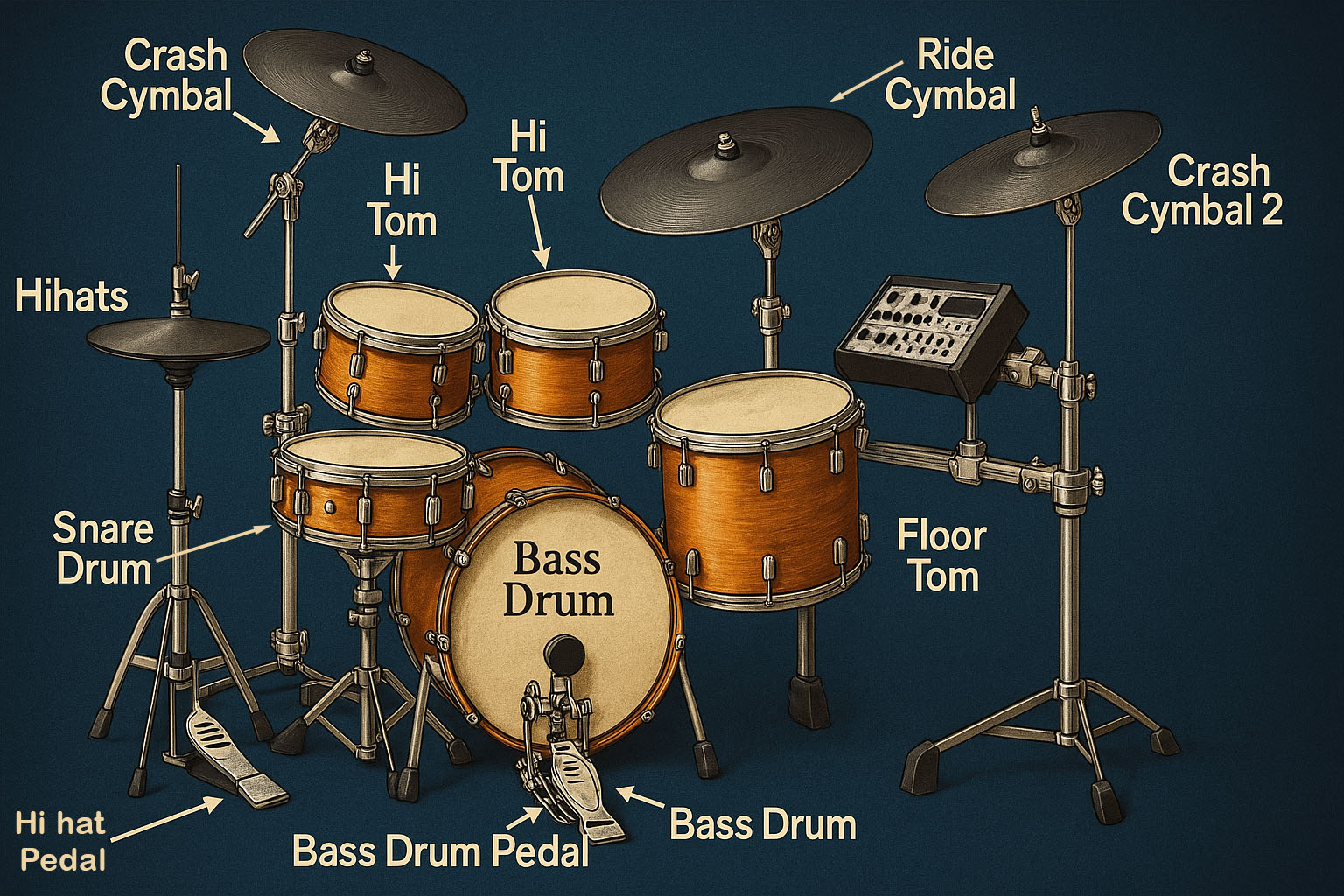
A standard acoustic drum set often includes:
- Bass drum
- Snare drum
- Hi-hat
- One or more toms
- A crash cymbal
- A ride cymbal
- Bass drum pedal
- Drum throne
- Drumsticks
You do not need a full kit to begin. A practice pad and a pair of sticks can help you learn grip, sticking, and rhythm. An electronic kit can reduce sound in an apartment, but its noise level still depends on the pads, floor, pedals, and room.
Sit with your back relaxed. Keep your shoulders loose. Adjust the throne so your knees are slightly below or near hip level. If your body feels tense, lower the speed before you change the exercise.
Step 2: Learn to count time
Start by counting:
1, 2, 3, 4
Then count eighth notes:
1 and 2 and 3 and 4 and
A metronome gives you a steady reference. Begin at a speed where you can play without rushing. For many beginners, 60 to 80 beats per minute is a useful starting range, but the right speed is the fastest one you can play with control.
Step 3: Play a basic rock beat
A common beginner pattern is:
- Bass drum on beats 1 and 3
- Snare drum on beats 2 and 4
- Hi-hat on each counted beat
Count:
1 and 2 and 3 and 4 and
Keep the hi-hat even. Make the snare clear. Do not add a fill until the basic pattern feels stable.
Step 4: Add one change at a time
Once the basic beat feels steady, try:
- More hi-hat notes
- A bass drum on an “and”
- A simple one-bar fill
- A crash cymbal at the start of a section
- A change from verse to chorus
This order helps you see which skill causes a problem. If you add many changes at once, you may not know what went wrong.
Step 5: Practice with music
Choose a song with a clear beat and a moderate tempo. Start with a song that has simple sections and few changes. Play along at a slower speed if needed.
The goal is not to copy every sound at once. First, stay with the pulse. Then match the snare, bass drum, and major song changes.
Step 6: Record short practice clips
A phone recording can reveal problems that feel hard to notice while playing. Listen for:
- Speeding up
- Slowing down
- Uneven hi-hat notes
- Weak backbeats
- Loud fills
- Tension in your playing
You do not need expensive recording gear. A short audio clip is enough to check timing and balance.
A useful 20-minute practice routine
| Time | Task |
|---|---|
| 3 minutes | Warm up with slow, even strokes |
| 5 minutes | Practice one sticking or coordination exercise |
| 5 minutes | Play a basic beat with a metronome |
| 5 minutes | Work on one song section |
| 2 minutes | Record or review your playing |
Stop if you feel sharp pain, numbness, or tingling. Mild fatigue is different from pain. Pain can signal poor setup, excess force, or an injury that needs attention.

What Equipment Does a Beginner Need?
You can start learning drums without buying a large acoustic kit. The best setup depends on your home, budget, noise limits, and practice goals.
Practice pad
A practice pad is the lowest-cost way to work on stick control and rhythm. It is quiet and easy to store. It cannot fully teach bass drum technique, cymbal control, or the sound balance of a full kit.
Electronic drum set
An electronic kit is useful when you need lower volume or practice in a shared home. Headphones can reduce airborne sound, but the kick pedal and pad strikes may still transmit vibration through the floor.
Check the product manual for headphone use, module features, pad compatibility, and warranty terms. Models and features change, so confirm current details before buying.
Acoustic drum set
An acoustic kit gives you the most natural response and sound. It also creates the most noise. You may need permission from a landlord, housemates, or neighbors, especially in an apartment or townhouse.
A used kit can work well if the shells are sound and the hardware holds its position. Ask a teacher or experienced player to inspect it when possible. Worn heads and cymbals can add repair costs.
Do you need private lessons?
No, but lessons can shorten the learning curve. A teacher can spot problems with grip, posture, timing, and foot technique before they become habits.
Online lessons can work for motivated learners. They offer flexibility, but they may not provide live correction. A strong option is to use online material for daily practice and take occasional lessons for feedback.
Common Beginner Problems and Fixes
Most early problems have a practical cause. Slow the exercise down before adding more force or complexity.
“I cannot use my hands and feet together.”
Likely cause: You are starting too fast or using a pattern with too many changes.
Fix: Remove the feet and clap the hand rhythm. Then add one foot part at a time. Practice each layer slowly before combining them.
“I keep speeding up.”
Likely cause: Excitement, tension, or difficulty feeling the spaces between notes.
Fix: Use a metronome at a slower speed. Count aloud. Focus on playing behind the beat only if your teacher gives you that instruction; beginners should first aim for a steady pulse.
“My fills sound messy.”
Likely cause: The fill is too long or too fast.
Fix: Start with four even notes on the snare. Return to the main beat on beat 1. A short, clean fill is more useful than a complex fill that disrupts the song.
“My hands hurt.”
Likely cause: Excess grip, poor stick angle, awkward setup, or too much practice without rest.
Fix: Relax your grip, lower the volume of your strokes, check your seat and drum height, and take a break. Persistent pain, weakness, numbness, or swelling deserves evaluation by a qualified health professional.
“I feel stuck.”
Likely cause: Your practice goal is too broad.
Fix: Choose one measurable task. For example: “Play the basic beat for two minutes at 70 beats per minute without speeding up.” Small wins make progress easier to see.

Is Learning Drums Safe for Your Hearing and Body?
Drums can be loud enough to harm hearing. The National Institute for Occupational Safety and Health recommends controlling exposure to loud noise, and the Occupational Safety and Health Administration provides workplace noise guidance. Those rules are not a personal medical test, but they show why repeated loud exposure deserves care.
Use hearing protection during acoustic drum practice. Musicians’ earplugs can reduce sound while preserving more of the music’s balance than basic foam plugs, but any protection is better than none when sound levels are high.
Practical steps include:
- Wear hearing protection near acoustic drums
- Take quiet breaks
- Keep practice volume as low as practical
- Avoid turning electronic kit headphones up to block outside noise
- Stop if you notice ringing, muffled hearing, or ear pain
- Keep wrists neutral and shoulders relaxed
- Warm up without forcing the joints
Ringing or muffled hearing after practice is a warning sign, not proof that your ears have “adjusted.” If symptoms continue, seek advice from a licensed medical professional or hearing specialist.
Children and teens need extra care because they may spend more time around loud school, marching, or rehearsal settings. Parents can ask the band director about sound levels, hearing protection, and quiet breaks.

Who Is Most Likely to Enjoy Learning Drums?
Drums may suit you if you enjoy rhythm, movement, repetition, and group music. They can also suit people who have never played an instrument.
You do not need to be naturally coordinated. Coordination improves when you practice one movement at a time and repeat it at a manageable speed.
Adults often worry that they started too late. Age can affect stamina, hearing, joint comfort, or available practice time, but it does not create a simple “too old to learn” limit. Adults may also bring useful focus and patience.
Drums may be less convenient if you have strict noise limits, limited space, or pain that makes repeated movement difficult. In those cases, a practice pad, quiet electronic setup, or supervised lesson may be a better starting point.

Frequently Asked Questions
Can I teach myself drums?
Yes. Many people begin with books, videos, a metronome, and regular practice. Self-study works best when you track progress and record yourself. A teacher is useful when you cannot identify why your timing or technique is not improving.
Is it easier to learn drums than piano?
Not always. Drums may feel easier at the start because you can play a beat quickly. Piano may feel more organized because the notes are laid out in a fixed pattern. The easier instrument is usually the one that fits your goals and keeps you practicing.
How often should a beginner practice drums?
Aim for short, regular sessions. Fifteen to 30 minutes on most days is a practical starting point. Rest when you feel pain or unusual fatigue. Consistency matters more than one long session each week.
Can I learn drums without owning a drum set?
Yes. A practice pad can teach counting, stick control, and many hand exercises. You will eventually need access to a full or electronic kit to learn bass drum, cymbal, and complete coordination skills.
Do I need to read music to play drums?
No. You can learn by ear, video, or chord and beat charts. Reading drum notation becomes useful when you want to learn structured exercises, communicate with other musicians, or prepare for school, studio, or professional work.
Conclusion: Are Drums Easy to Learn?
Drums are easy to start but not effortless to master. A beginner can learn a simple beat quickly, but steady timing and full coordination require regular practice.
Start with a pad or basic kit, use a metronome, protect your hearing, and practice one small goal at a time. If you practice for 15 to 20 focused minutes most days, you can build a useful foundation without waiting for natural talent to appear.
Your best next step is simple: learn one basic beat, play it slowly for two minutes, and record the result. Then listen for one thing to improve in your next session.

Senior Music Reviewer
Alex Carter is a seasoned music reviewer with over a decade of experience in the world of sound and instruments. Passionate about helping musicians and enthusiasts make informed choices, he brings sharp insights and in-depth knowledge to every review. From classical instruments to modern gear, Alex combines technical expertise with a love for music to deliver content that resonates with readers.
As a Senior Music Reviewer and expert author on Tuneluma.com, Alex is dedicated to sharing honest evaluations, practical advice, and thoughtful commentary to guide readers in their musical journey.