How To Eq Kick Drum: Pro Tips For Punchy Low-End
Use tight low-end cuts, gentle boosts at the fundamental, and add click with a high shelf.
I’ve spent years mixing drums in studios and live rooms. I’ll show you exactly how to eq kick drum so it sits tight in the mix and hits where you want it to. This guide walks through tools, frequencies, step-by-step workflows, genre tips, and real-world mistakes I’ve learned from. Read on and you’ll finish with clear, punchy, and musical kick EQ skills you can use immediately.
Why EQ matters for the kick drum
The kick drum anchors the rhythm and low end. A bad kick EQ makes a mix sound muddy or weak. Good EQ gives the kick weight, punch, and clarity without stealing space from bass or other instruments.
Understanding how to eq kick drum is about balance. You shape the body, the beater click, and the tail. That control defines groove and clarity.

Essential tools and setup for EQing a kick
Use good monitors or tight headphones. Small speakers hide low-end nuance. Room treatment helps you hear true low frequencies.
Use a good parametric EQ. A spectrum analyzer is useful for spotting fundamentals. Add a linear-phase EQ or phase tool when aligning mic layers.
Set a clean signal chain. Put EQs where they make sense. For example, corrective EQ before compression and character EQ after compression is a solid rule for how to eq kick drum.

Step-by-step guide: how to eq kick drum
-
Listen in context
- Play the whole mix, not just the soloed kick. Context shows clashes with bass and guitars. Listen for what the kick needs: more weight, more click, or less boom.
-
Identify the fundamental
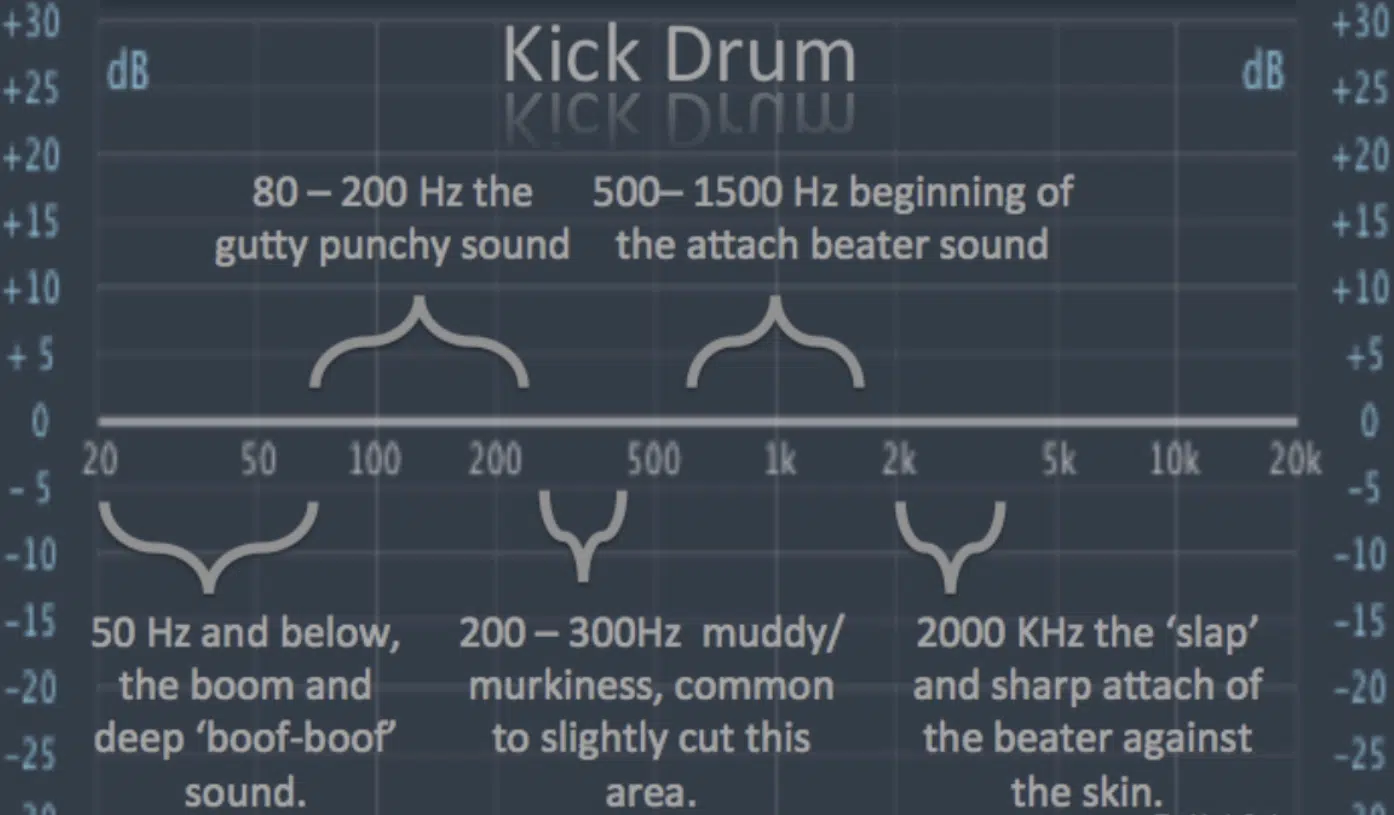
- Sweep with a bell filter. Boost around 40–100 Hz to find the body. Use a medium Q and small boost to let the ear judge.
-
Control sub rumble
- High-pass only if needed. Cut below 20–30 Hz with a gentle slope to remove inaudible rumble. This keeps the low end tight without thinning the kick.
-
Shape the punch
- Boost gently around 60–120 Hz for weight. Boost with a moderate Q for focus. If you need punch, try 80–100 Hz with 1.5–3 dB of boost.
-
Tighten the beater click
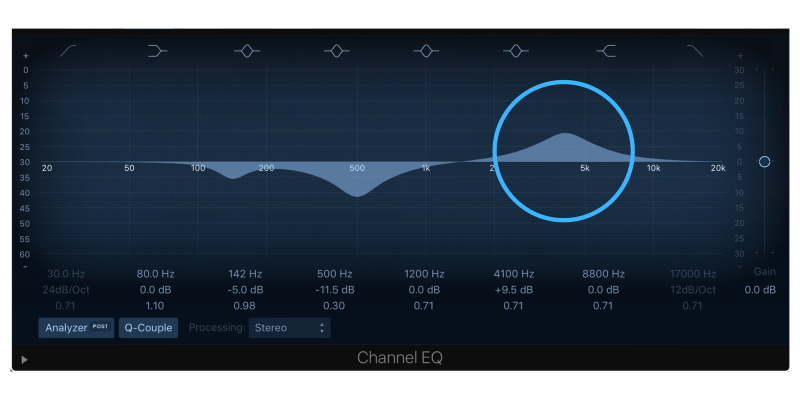
- Boost 2–4 kHz to add attack and presence. Use a narrow Q and small boost. This helps the kick cut through dense mixes and works well when the bass sits low.
-
Remove boxiness
- Cut around 200–400 Hz if the kick sounds muddy. Use a narrow Q and reduce a few dB. This clears space for guitars and vocals.
-
Add character if needed
- Gentle shelf boost above 8 kHz can add air. Use small gains to avoid harshness. Often a touch of saturation can also enhance character.
-
Use surgical cuts sparingly
- Notch resonances with narrow Q. Remove ringing between 300–1k Hz if the mic picked up room tone. Small cuts do big jobs.
-
Parallel processing
- Send the kick to a parallel bus for heavy compression or distortion. Blend back for thickness without losing transient clarity. This is a staple method for how to eq kick drum in modern mixes.
-
Check phase and polarity
- If you use multiple mics, flip polarity and nudge phase. Comb filtering ruins low end. Align transients so the kick hits coherently.
-
Final check in context
- Listen on different systems. Adjust EQ in the full mix. Small tweaks after context listening often yield the best results.
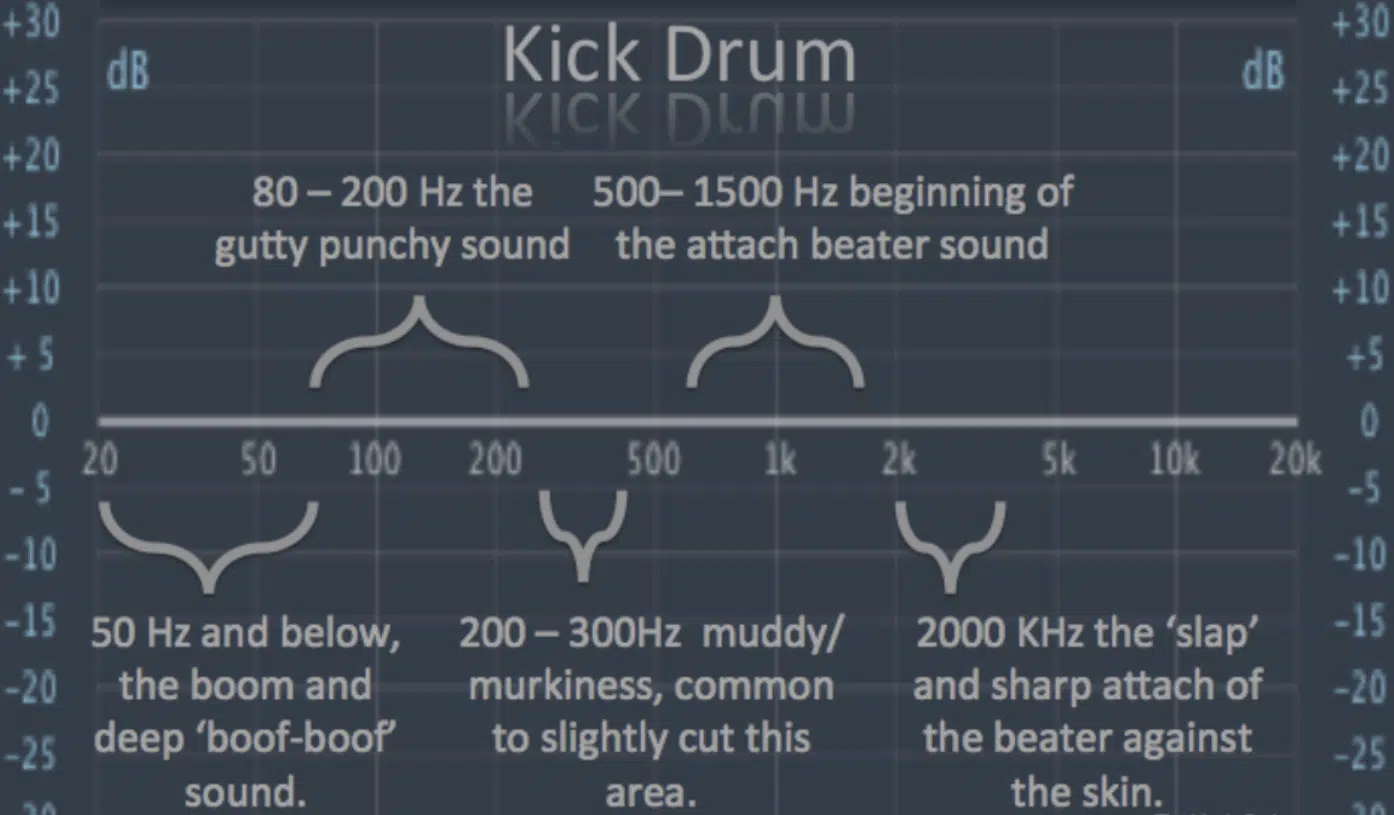
Frequency cheat sheet for the kick drum
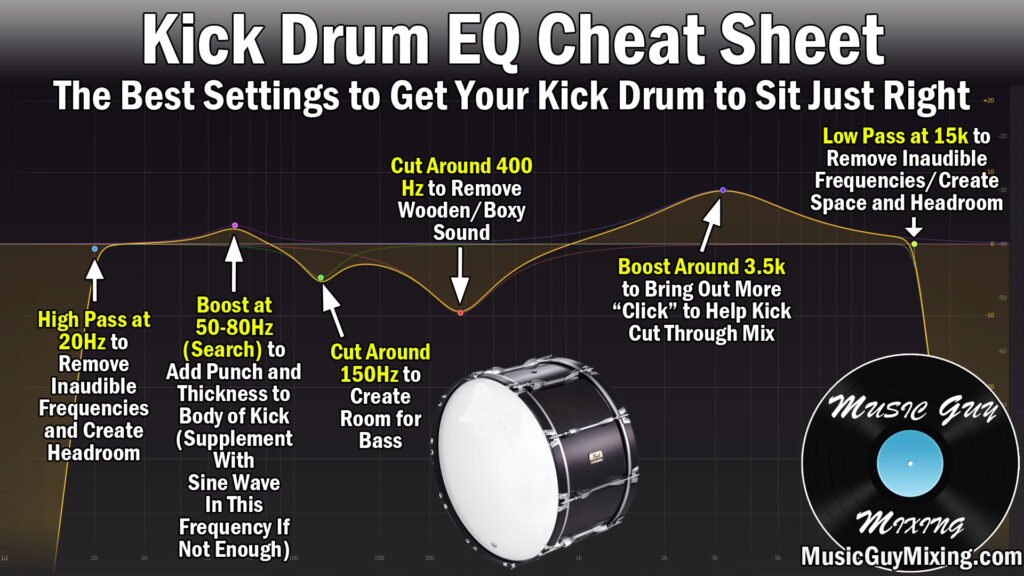
- Sub bass 20–40 Hz
- Adds deep weight. Use only if the system reproduces it.
- Body/fundamental 40–100 Hz
- Core power lives here. Boost gently for fullness.
- Low punch 80–200 Hz
- Adds thump and presence. Tighten with medium Q for punch.
- Boxiness 200–400 Hz
- Cut narrow to reduce muddiness and make room.
- Beater/attack 2–4 kHz
- Adds click and cut through the mix.
- Presence 4–8 kHz
- Brings definition and transient edge.
- Air 8–15 kHz
- Small shelf for sparkle. Use sparingly.
Use these ranges as starting points. Every kick and mix is different. Tweak by ear while keeping the mix in mind.
Genre-specific tips for how to eq kick drum
-
EDM and electronic
- Emphasize sub 30–60 Hz for weight. Use a tight boosted fundamental and a pronounced click. Sidechain the bass to the kick for clarity.
-
Rock
- Give more 80–120 Hz body and some 2–4 kHz click for beater. Keep midrange presence for kit definition. Avoid too much sub to prevent muddiness.
-
Pop
- Balance low weight and beater clarity. Clean the 200–400 Hz area and add a subtle high shelf for air. Make the kick sit with the vocal.
-
Hip-hop
- Heavy low-end focus around 30–60 Hz is common. Use parallel compression or saturation for solidity. Keep the click tight so the beat feels sharp on small speakers.
Adapting how to eq kick drum per genre helps the kick serve the song. Use reference tracks to match tone and balance.

Common mistakes and how to fix them
-
Overboosting low end
- Too much boost makes the mix muddy. Fix by cutting elsewhere or using a tighter Q and less gain.
-
EQ before diagnosing the problem
- Don’t apply random boosts. Listen first, then act. A small cut often fixes issues faster.
-
Ignoring phase with multi-mic setups
- Phase issues destroy low end. Flip polarity and nudge mic timing until lows sum properly.
-
Using extreme Qs and wide boosts
- Wide boosts can push other instruments out. Use narrow boosts for targeted work and wide shelves sparingly.
-
Forgetting playback checks
- Mix on one system only, and trouble emerges. Check on earbuds, phone, and monitors.
These mistakes are common when learning how to eq kick drum. Correct them early and your mixes improve quickly.

My workflow and real-life examples
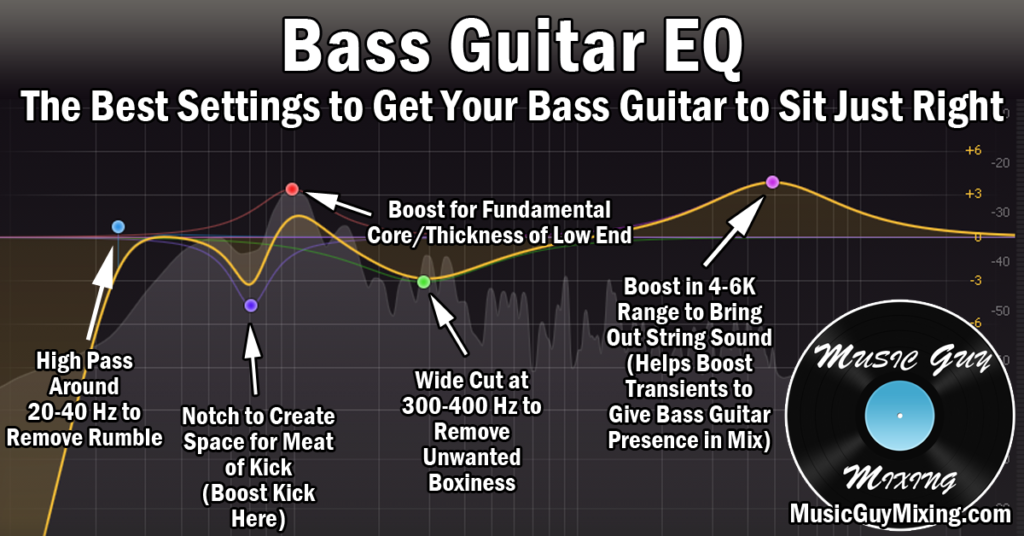
I track kicks with a mic inside the drum and a room mic. For samples, I layer a sample under the mic to add click or sub. I start with corrective EQ, then compress, and finish with character EQ.
One session I had a boomy rock kick. A 4 dB cut at 300 Hz fixed it. Then I boosted 90 Hz by 2 dB and added a 3 kHz boost of 2 dB for attack. The kick sat in the band mix without clashing with bass.
Lesson learned: small moves often beat drastic ones. Trust your ears. Use reference tracks and return to the mix with fresh ears.
Quick answer-style questions (PAA-style)
How loud should the kick be in a mix?
The kick should support the groove and not overpower vocals. Set levels so the kick drives the low end but the vocal remains clear.
Should I EQ kick before or after compression?
Start with corrective EQ before compression and shape tonal character after compression. This order keeps the dynamics sane and lets compression respond to a cleaner tone.
Is boosting low EQ always better than layering samples?
Not always. Boosting can clutter low frequencies. Layering a controlled sample with a recorded kick often gives better control and clarity.
Frequently Asked Questions of how to eq kick drum
What frequency makes a kick drum punchy?
Punch often lives around 60–120 Hz. Boost gently with a medium Q to find the sweet spot for your kick and mix.
How much should I boost the kick drum?
Small boosts work best. Aim for 1–4 dB increments and listen in context. Bigger boosts can create imbalance and mask other instruments.
Should I high-pass a kick drum?
Only when you need to remove inaudible rumble. Set a gentle high-pass at 20–30 Hz if the system produces or if competition for headroom is high.
How do I make the kick cut through a dense mix?
Enhance the 2–4 kHz beater click and tighten low mids by cutting around 200–400 Hz. Use parallel compression to add body without losing transient attack.
Can EQ fix a badly recorded kick?
EQ helps, but it has limits. If the recording is poor, consider layering samples, using transient designers, or re-recording when possible.
Conclusion
You now have a clear roadmap for how to eq kick drum. Start with listening, apply small surgical moves, and work in context. Use the frequency cheat sheet and genre tips to guide your choices.
Take action: open a mix, try the step-by-step method, and compare before and after. Keep practicing and use reference tracks to refine your ear. If this helped, leave a comment or share your results — I’d love to hear how your kick drums improved.

Senior Music Reviewer
Alex Carter is a seasoned music reviewer with over a decade of experience in the world of sound and instruments. Passionate about helping musicians and enthusiasts make informed choices, he brings sharp insights and in-depth knowledge to every review. From classical instruments to modern gear, Alex combines technical expertise with a love for music to deliver content that resonates with readers.
As a Senior Music Reviewer and expert author on Tuneluma.com, Alex is dedicated to sharing honest evaluations, practical advice, and thoughtful commentary to guide readers in their musical journey.