Introduction
If you are learning guitar in the United States, the Cadd9 chord is one of the most useful ways to make a basic C chord sound fuller. You will hear it in folk, country, rock, pop, worship, and acoustic singer-songwriter music across the U.S.
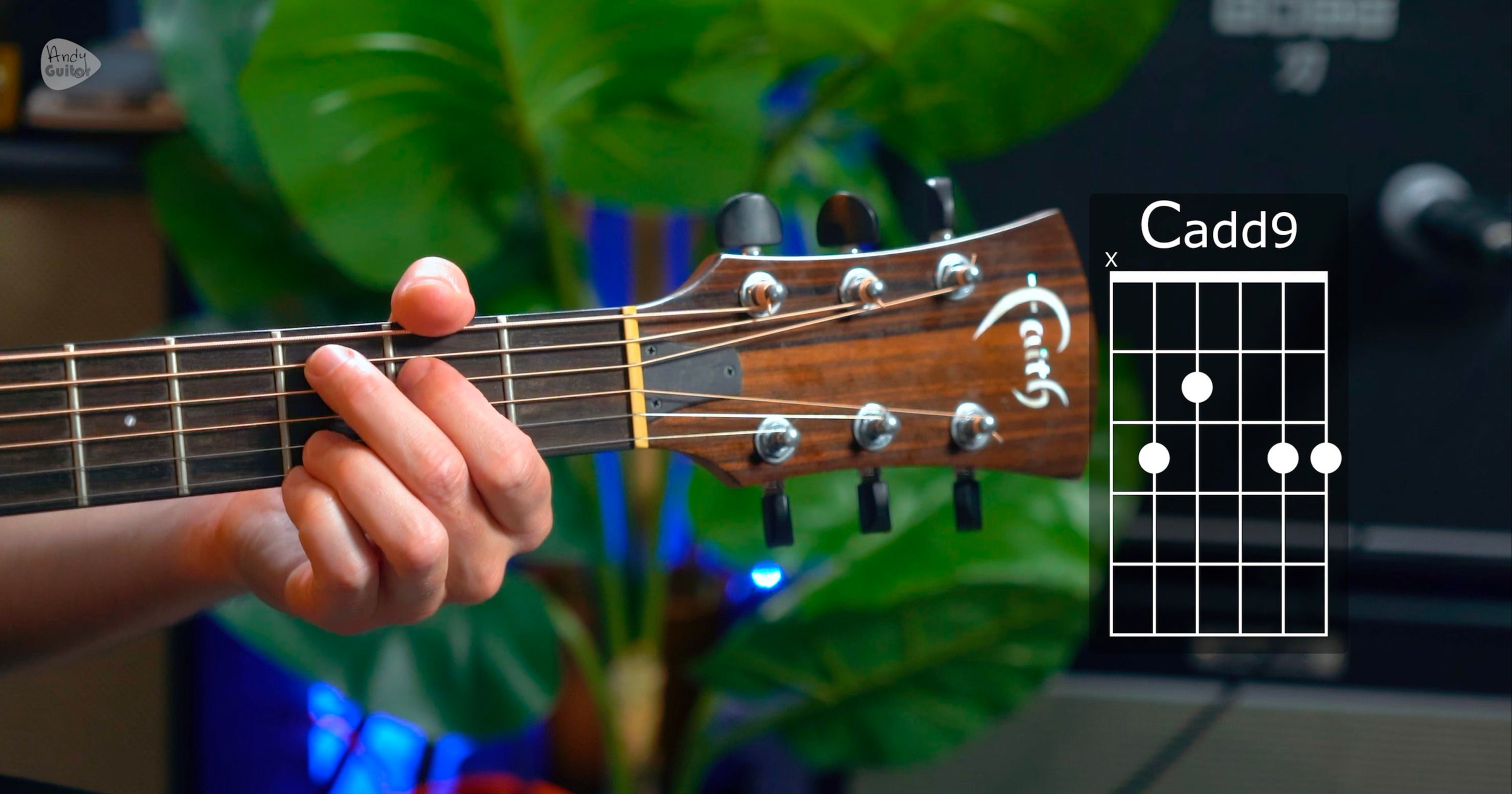
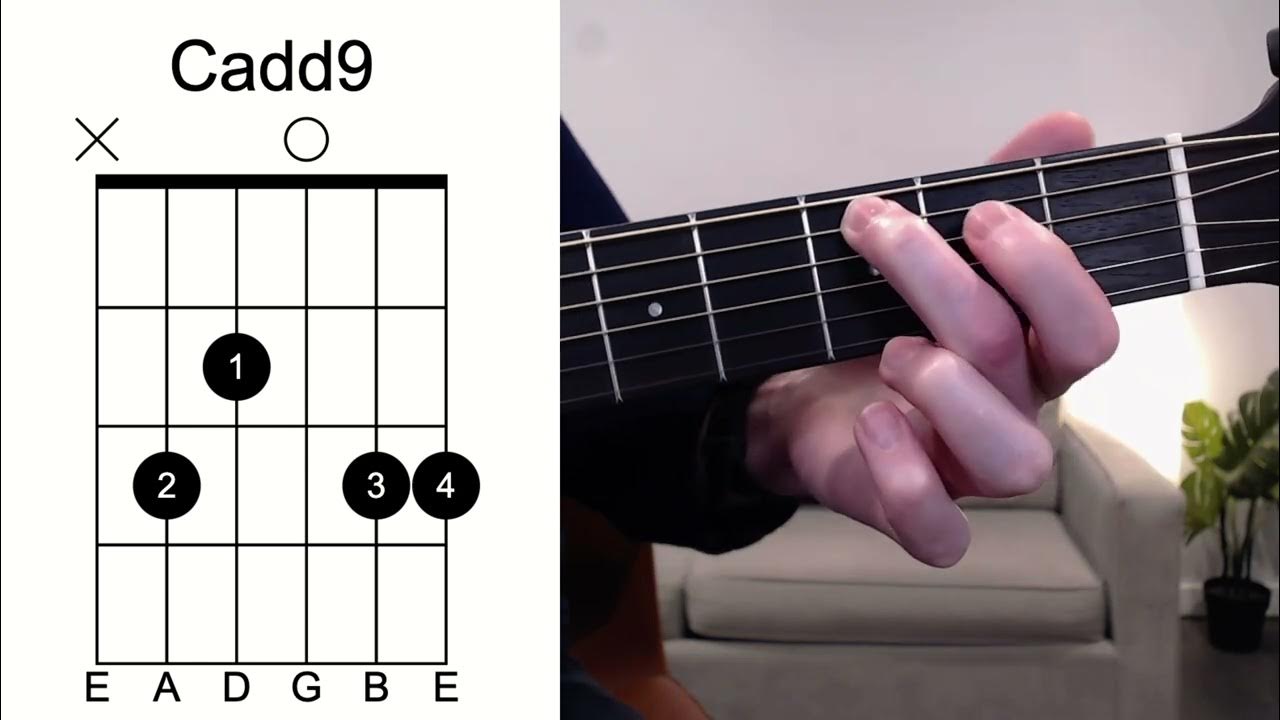
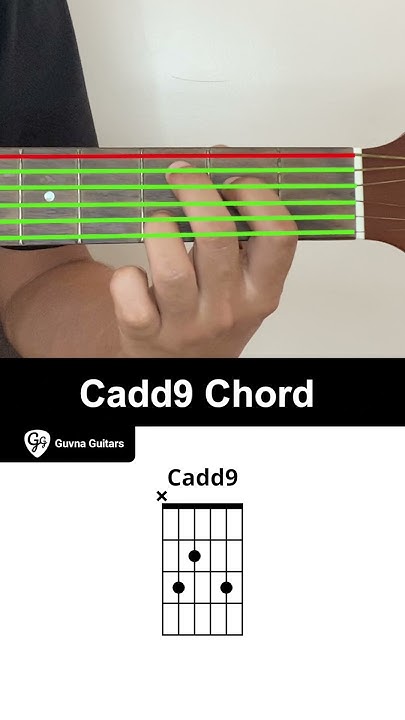
The easiest Cadd9 guitar chord uses the shape x32033. Place your fingers as follows:
- A string, 3rd fret: ring finger
- D string, 2nd fret: index finger
- G string, open: no finger
- B string, 3rd fret: middle finger
- High E string, 3rd fret: pinky
- Low E string: do not play
Strum from the A string down. The result is a bright, open chord with the notes C, E, G, and D.


The easiest Cadd9 guitar chord shape
The standard open Cadd9 shape is:
Cadd9: x32033

e|---3---|  pinky
B|---3---|  middle or ring finger
G|---0---|  open
D|---2---|  index finger
A|---3---|  ring finger
E|---x---|  muted
The x means you should not play that string. The 0 means the string is open.
A common fingering is:
e|---3---|  pinky
B|---3---|  ring finger
G|---0---|
D|---2---|  index finger
A|---3---|  middle finger
E|---x---|
You can also use your ring finger on the B string and your pinky on the high E string. Choose the fingering that lets your fingers stay relaxed and keeps the open G string clear.
Step-by-step instructions
- Place your ring or middle finger on the A string at the 3rd fret.
- Place your index finger on the D string at the 2nd fret.
- Leave the G string open.
- Place a finger on the B string at the 3rd fret.
- Place your pinky on the high E string at the 3rd fret.
- Avoid the low E string.
- Strum slowly from the A string to the high E string.
The chord should sound clear and bright. If one note buzzes, play each string separately to find the problem.

What notes are in a Cadd9 chord?
Cadd9 contains four different notes:
- C: the root
- E: the major third
- G: the perfect fifth
- D: the added ninth
The “add9” name means that the ninth note of the C major scale has been added to a regular C major chord.
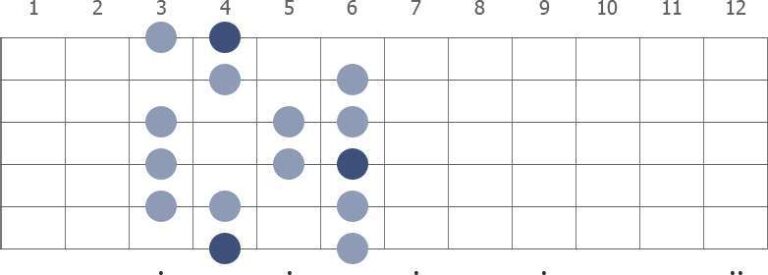
The C major scale is:
C – D – E – F – G – A – B
If you continue counting after B, the next C is the octave. Therefore:
- C is 1
- D is 2, or 9 when counted above the octave
- E is 3
- G is 5
A regular C major chord contains C, E, and G. Adding D creates Cadd9.


The chord’s notes in the common x32033 shape are:
A string, 3rd fret: C
D string, 2nd fret: E
G string, open:     G
B string, 3rd fret: D
High E, 3rd fret:   G
The repeated G is normal. Guitar chords often use the same note more than once.

Cadd9 versus C9: What is the difference?
Cadd9 and C9 are different chords.
Cadd9
Cadd9 contains:
C – E – G – D
It is a C major chord with an added ninth. The major third, E, remains in the chord.
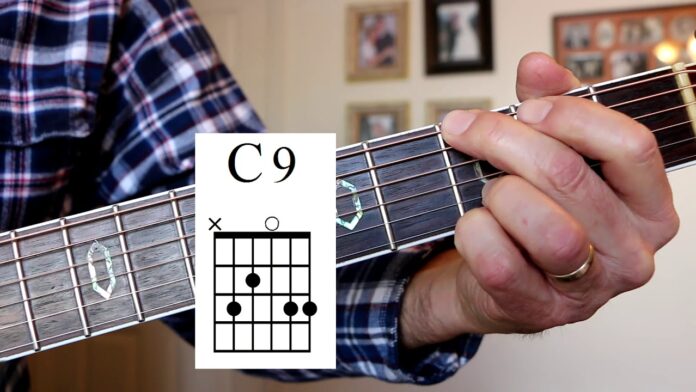
C9
A dominant C9 chord contains:
C – E – G – Bb – D
C9 adds both the ninth, D, and a minor seventh, Bb. That extra note gives C9 a stronger tension and blues or jazz sound.
The chord names look similar, but the sounds and uses differ:
| Chord | Main notes | General sound |
|---|---|---|
| C major | C, E, G | Simple and stable |
| Cadd9 | C, E, G, D | Bright and open |
| C9 | C, E, G, Bb, D | Tense, bluesy, and dominant |
For most beginner acoustic guitar songs, Cadd9 means the open shape x32033 unless the song chart gives a different voicing.

How to switch to Cadd9 from other chords
Cadd9 is especially easy to use with G and Em because several fingers can stay in place.
From G to Cadd9
A common G chord is:
320033
The Cadd9 chord is:
x32033
To move from G to Cadd9:


- Keep your fingers on the B and high E strings at the 3rd fret.
- Move the finger on the low E string away.
- Place a finger on the A string at the 3rd fret.
- Place your index finger on the D string at the 2nd fret.
- Strum from the A string.
The shared notes make this change smooth.
From Em to Cadd9
A basic Em chord is:
022000
To move to Cadd9:
- Keep your hand close to the fretboard.
- Place a finger on the A string at the 3rd fret.
- Move or add a finger to the D string at the 2nd fret.
- Add the 3rd-fret notes on the B and high E strings.
- Leave the G string open.
Practice the change without strumming at first. Form Em, release it, form Cadd9, and repeat. Then add one slow downstroke after each change.
Useful chord progressions
Try these progressions:
G – Cadd9 – Em – Cadd9
G – D – Cadd9 – Em
Cadd9 – G – D – Em
Use four slow downstrokes per chord. When the changes feel steady, try:
Down – Down – Up – Up – Down – Up
How to make Cadd9 sound clean
A clean Cadd9 depends more on finger position than on hand strength.
Keep your fingers near the frets
Place each finger just behind its fret, not in the middle of the space. This reduces the pressure needed and helps prevent buzzing.
Keep the open G string clear
The G string must ring open. If a finger touches it, the chord may sound dull or muted. Curve your fingers so the fingertips contact only the strings they need to hold.
Do not squeeze too hard
Too much pressure can make your hand tired and may pull the strings sharp. Use only enough force for each note to ring clearly.
Check each string separately
Pick the strings one at a time:
A – D – G – B – high E
Listen for:
- A muted sound
- A buzzing fret
- A string touched by another finger
- A note that does not sound at all
Fix the problem before practicing faster changes.
Keep the low E string quiet
The low E string is not part of the basic x32033 voicing. You can mute it by lightly touching it with the underside of the finger fretting the A string, or simply aim your pick at the A string.


Alternative Cadd9 shapes
The x32033 shape is the best starting point, but other voicings can be useful.
Easier three-finger version: x32030
Cadd9: x32030

e|---0---|
B|---3---|
G|---0---|
D|---2---|
A|---3---|
E|---x---|
This version uses an open high E string instead of the 3rd-fret G. It still contains the notes C, E, G, and D:
- A string: C
- D string: E
- G string: G
- B string: D
- high E string: E
It sounds lighter and is often easier for a beginner.
Cadd9 with a G bass: 3×0233
3x0233
This shape places G in the bass. It can sound useful when moving between G-based chords, but it is not always the best choice if a song specifically needs C as the lowest note.
Higher movable shape: x35533
x35533
This shape uses:
- A string, 3rd fret: C
- D string, 5th fret: G
- G string, 5th fret: C
- B string, 3rd fret: D
- high E string, 3rd fret: G
It is less comfortable for many beginners, but it can be moved up the neck to create other add9 chords.
The key difference between these shapes is the lowest note, finger layout, and tone. Use the open x32033 shape for most beginner songs.
Common Cadd9 mistakes
Playing the low E string
The low E string can make the chord sound muddy because it adds a bass note outside the standard voicing. Start your strum on the A string.
Confusing Cadd9 with C major
A basic open C major chord is usually:
x32010
Cadd9 is:
x32033
The key change is on the B and high E strings. Cadd9 places both at the 3rd fret, while the common C major shape uses the B string at the 1st fret and the high E string open.
Muting the open G string
The open G string is part of the chord. If it is muted, the chord may lose some of its open, ringing sound.
Flattening the fingers
If one finger lies too flat, it may touch nearby strings. Use the tips of your fingers and keep your thumb behind the neck for support.


Switching too soon
Many players try to strum at full speed before the chord change is ready. Practice slowly and pause between shapes if needed. Accuracy comes before speed.
A simple Cadd9 practice routine
Use this short routine for five minutes:
- Form Cadd9.
- Pick each string from A to high E.
- Correct any muted or buzzing note.
- Release the chord.
- Form it again.
- Repeat the process 10 times.
- Switch between G and Cadd9.
- Switch between Em and Cadd9.
- Play a four-chord progression at a slow tempo.
- Increase speed only when every chord rings clearly.
A metronome can help keep your timing even. Start around 60 beats per minute and play one chord for four beats. The exact tempo is less important than relaxed, clean changes.
A sign of progress is being able to change chords without looking at every finger. Another sign is that the rhythm continues even when the change is not perfect.
Frequently asked questions
Is Cadd9 easier than C major?
For some beginners, yes. The Cadd9 shape keeps the fingers on the B and high E strings at the 3rd fret, which can make it easier to move between G and Em. It may feel harder at first because it uses the pinky.
Can I play Cadd9 without using my pinky?
Yes. Use x32030. This version has the same basic Cadd9 notes, but the high E string stays open. It is a practical option for new players.
Which strings should I strum for Cadd9?
Strum the A, D, G, B, and high E strings. Avoid the low E string. If you accidentally touch the low E, lightly mute it.
Why does my Cadd9 chord buzz?
Buzzing usually comes from a finger that is too far from the fret, too little pressure, or a finger touching an adjacent string. Pick each string separately and adjust one finger at a time.
Can I use Cadd9 instead of C major?
Sometimes. Cadd9 has the same main C major notes plus D, so it can work as a colorful replacement. However, the added note changes the song’s sound. Follow the chord chart when the original voicing matters.
Conclusion
The standard Cadd9 guitar chord is x32033:
x32033
Do not play the low E string. Hold the A string at the 3rd fret, the D string at the 2nd fret, and the B and high E strings at the 3rd fret. Let the G string ring open.
Start by making each note sound clean. Then practice moving between Cadd9, G, Em, and D. Once the shape feels natural, use it in a slow chord progression and add your preferred strumming pattern.

Senior Music Reviewer


Alex Carter is a seasoned music reviewer with over a decade of experience in the world of sound and instruments. Passionate about helping musicians and enthusiasts make informed choices, he brings sharp insights and in-depth knowledge to every review. From classical instruments to modern gear, Alex combines technical expertise with a love for music to deliver content that resonates with readers.
As a Senior Music Reviewer and expert author on Tuneluma.com, Alex is dedicated to sharing honest evaluations, practical advice, and thoughtful commentary to guide readers in their musical journey.