Who Created The Bass Guitar: The True Origin Story
Paul Tutmarc created the first electric bass guitar, while Leo Fender made the modern bass widely popular.
The question “who created the bass guitar” has more than one correct answer. Paul Tutmarc built the earliest known electric bass in the 1930s, but Leo Fender shaped the full-size, mass-produced bass that changed popular music. Understanding both men reveals how the bass moved from an upright orchestral instrument to a powerful tool for rock, jazz, country, funk, and pop.
Who Created the Bass Guitar?
The most accurate answer depends on what you mean by “bass guitar.”
Paul Tutmarc created an early electric bass guitar in Seattle during the 1930s. His instrument was smaller than a double bass, used frets, and could be played in a guitar-like position. It was known as the Audiovox Model 736 Bass Fiddle.
Leo Fender later developed the Fender Precision Bass, which became the first widely successful solid-body electric bass. Fender introduced it in 1951. This model helped define the shape, sound, and role of the modern bass guitar.
So, who created the bass guitar? Paul Tutmarc created the early electric version, while Leo Fender created the commercially successful design most players recognize today.

Paul Tutmarc and the First Electric Bass
Paul Tutmarc was a musician, teacher, and instrument maker based in Seattle, Washington. He saw a practical problem with the double bass. The instrument was large, hard to move, difficult to amplify, and challenging for many traveling musicians.
Tutmarc responded by building a smaller electric bass. His design had several features that made it different from a traditional upright bass:
• It was held across the body like a guitar.
• It had frets that helped players find exact notes.
• It used an electric pickup for amplification.
• It had a shorter body and neck than a double bass.
• It was easier to transport and store.
Tutmarc’s Model 736 appeared around 1936. Historical records and surviving advertisements show that Audiovox produced and sold this instrument in limited numbers. It was not a major commercial success, but its design was decades ahead of its time.
When people ask who created the bass guitar, Tutmarc deserves credit because he solved the basic design problem first. He made the bass smaller, fretted, electric, and suitable for guitar-style playing.

What Was the Audiovox Model 736 Bass Fiddle?
The Audiovox Model 736 was an early electric bass guitar designed by Paul Tutmarc. It had a solid body and a pickup, which allowed it to produce a stronger signal than an acoustic upright bass.
The instrument was often called a “bass fiddle,” a common term for the double bass at the time. It reportedly used a guitar-like scale and was played horizontally. This approach made it more familiar to guitarists and easier to use on crowded stages.
The Model 736 also had a significant limitation. It was produced in small numbers and did not receive the broad marketing or dealer support needed to reach a large audience. Many musicians never saw one, and the wider industry did not immediately adopt its design.
That limitation explains why the answer to who created the bass guitar cannot stop with Tutmarc. creating an instrument is one achievement. Making it practical, affordable, reliable, and widely available is another.

Leo Fender and the Modern Electric Bass
Leo Fender did not invent the first electric bass, but he created the instrument that made the concept commercially powerful. Working with George Fullerton and other members of his company, Fender developed the Precision Bass in the early 1950s.
The Precision Bass solved several problems faced by working musicians:
• Its solid body reduced feedback.
• Its frets made accurate intonation easier.
• Its smaller body was easier to carry.
• Its magnetic pickup worked well with amplifiers.
• Its bolt-on neck made repairs and replacement simpler.
• Its design fit the growing electric band format.
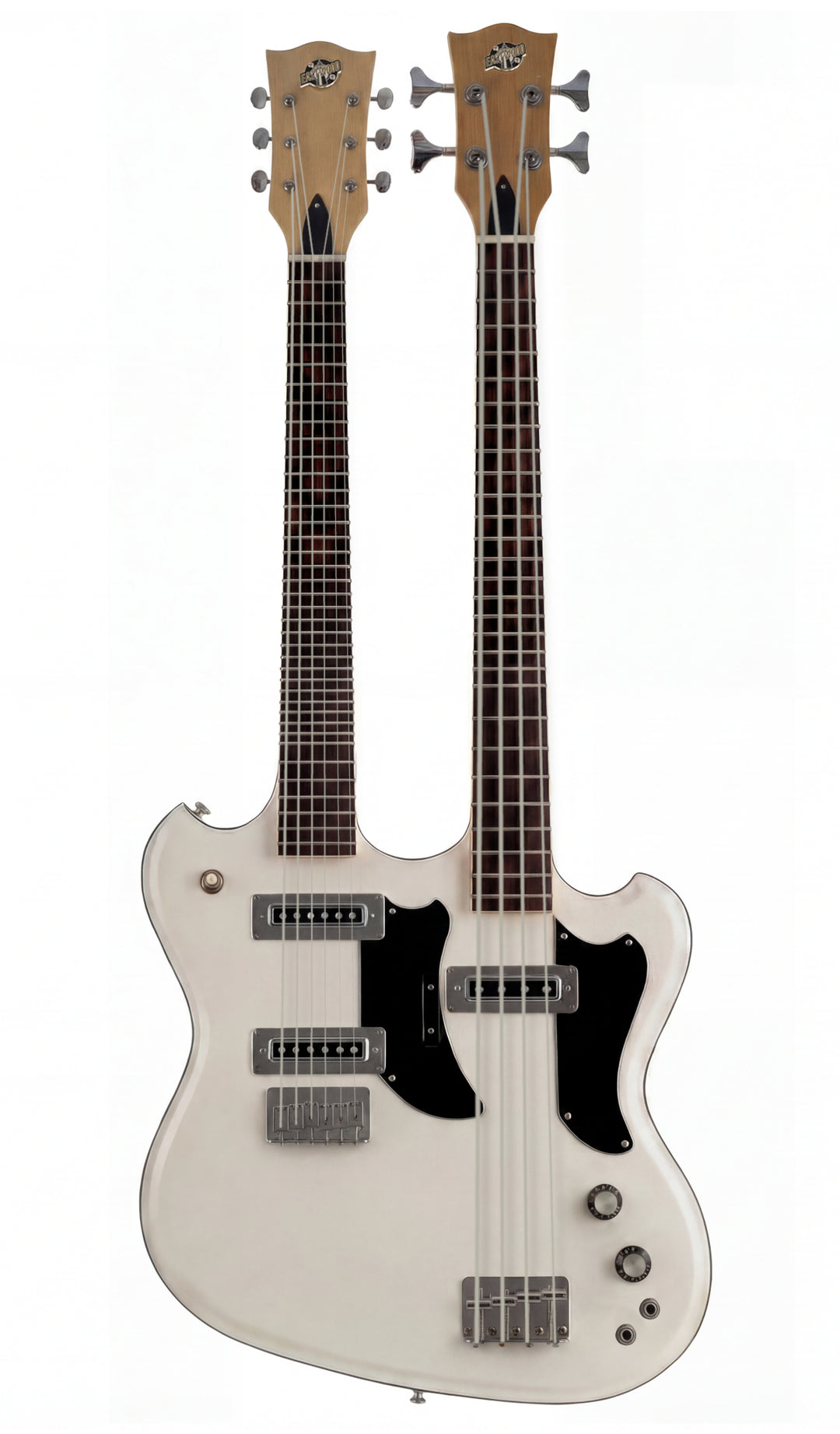
Fender released the Precision Bass in 1951. The instrument had a shape inspired partly by the Telecaster guitar, but it was built for the lower pitch and heavier strings of a bass.
The name “Precision” referred to the frets. A player could place a finger behind a fret and produce a more consistent note than on a fretless upright bass. This feature made the instrument approachable for guitarists who were moving into bass playing.
Therefore, if someone asks who created the bass guitar used in most modern bands, Leo Fender is often the expected answer. His Precision Bass established the template for the electric bass industry.
Why the Precision Bass Changed Music
Before the Precision Bass, many popular bands relied on upright bass players. The upright bass had a warm and rich tone, but it could disappear under loud drums, amplified guitars, and brass instruments.
The Precision Bass offered more volume and control. It also produced a tighter attack that worked well with dance music and early rock and roll.
The instrument became especially useful in:
• Rock and roll
• Country music
• Rhythm and blues
• Jazz
• Gospel
• Surf music
• Funk
• Pop
The bass guitar also changed stage movement. Players could stand, travel more easily, and perform in louder groups without placing a large upright instrument between themselves and the audience.
This is one reason the history of who created the bass guitar matters. The invention was not just a new instrument. It changed how bands arranged music, how performers moved on stage, and how low notes supported rhythm.

Who Created the Bass Guitar Before Leo Fender?
Several earlier instruments helped lead to the modern bass guitar. The double bass had existed for centuries, and electric pickup experiments appeared before Tutmarc’s work.
In the 1920s and 1930s, instrument makers explored ways to amplify string instruments. Some designs placed pickups on traditional basses. Others tried to reduce the size of the instrument.
The key difference is that Paul Tutmarc combined several ideas into one dedicated product:
-
A smaller bass body
-
A fretted neck
-
An electric pickup
-
A horizontal playing position
-
A design aimed at guitar-style performers
This combination makes Tutmarc the strongest candidate for creating the first recognizable electric bass guitar. Still, invention is often a chain rather than a single moment. Earlier makers supplied ideas, Tutmarc built an important early model, and Fender turned the concept into an industry standard.
The Difference Between an Upright Bass and a Bass Guitar
The upright bass and bass guitar perform a similar musical job, but they feel and sound different.
An upright bass is large and usually stands on the floor. It often has an acoustic body, although electric upright basses also exist. Players normally stand or sit behind it and use a longer, vertical scale.