Don’t Stop Me Now Piano Sheet Music: Easy Guide
Licensed “Don’t Stop Me Now” piano sheet music helps you play Queen’s upbeat classic with the right notes, rhythm, and structure.
“Don’t Stop Me Now” is one of Queen’s most exciting songs to play on piano. Its bright chords, fast pulse, and rising energy make it a favorite for new players, skilled performers, and fans of Freddie Mercury. The best “Don’t Stop Me Now” piano sheet music does more than show the notes. It helps you understand the song’s form, dynamics, chord movement, and famous vocal lines. This guide explains how to choose the right arrangement, read it with confidence, avoid common mistakes, and practice the song in a practical way.
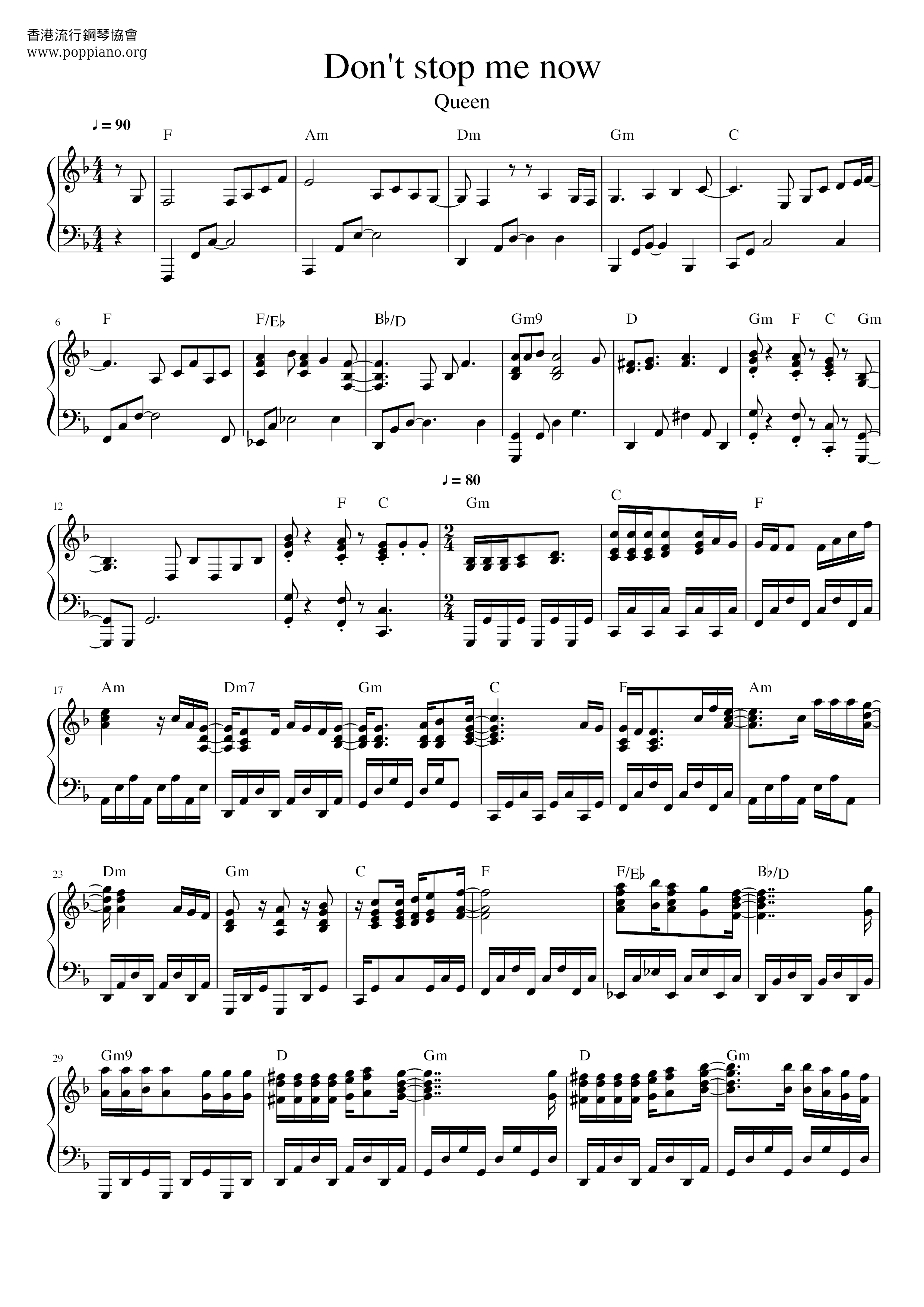
What makes “Don’t Stop Me Now” piano sheet music special?
“Don’t Stop Me Now” was written by Freddie Mercury and released by Queen in 1979 on the album Jazz. The song has a lively piano part, a strong bass foundation, layered vocals, and a fast rock feel. A good piano arrangement captures these features while making the music playable for one person.
The original recording is not just a simple piano song. It uses piano, bass, drums, guitar, and stacked vocal parts. For that reason, sheet music may be arranged in different ways:
• A basic solo version focuses on melody and simple chords.
• An intermediate version adds left-hand bass notes, fuller chords, and rhythmic detail.
• An advanced arrangement tries to recreate more of the recording with wide chords, quick movement, and layered textures.
The right “Don’t Stop Me Now” piano sheet music depends on your skill level and your goal. A beginner may need a simplified score, while an experienced player may want a fuller concert arrangement.
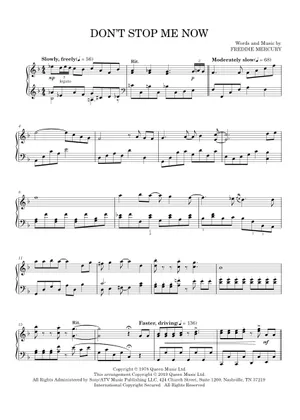
Choosing the right piano sheet music arrangement
Before buying or downloading music, check the arrangement details. Sheet music labeled only with the song title may still vary widely in difficulty, key, page count, and musical content.
Look for these details:
• Skill level: Choose beginner, easy, intermediate, or advanced based on your current ability.
• Instrument format: Confirm that the score is for solo piano rather than piano and vocal accompaniment only.
• Melody line: A clear melody helps you play the vocal tune with your right hand.
• Chord symbols: Chords make it easier to understand the harmony and adapt the piece.
• Key signature: Some versions stay close to the original key. Others transpose the song for easier playing or singing.
• Page layout: Clean spacing and clear notation reduce reading errors.
• Legal status: Use sheet music from a licensed publisher or an authorized music platform.
For most players, an intermediate arrangement offers the best balance. It can sound full without copying every part of the original recording. If you are still learning rhythm and chord changes, start with an easy version and move up later.
Do not judge a score by its page count alone. A short arrangement can be difficult if it uses large jumps, quick sixteenth notes, or complex chord voicings.

Is “Don’t Stop Me Now” difficult to play on piano?
The song is usually moderate to difficult for beginners because of its speed and energy. The notes may not look impossible, but the rhythm must stay steady. The left hand also needs to support the beat without becoming tense.
The main challenges include:
• Keeping a steady fast tempo
• Coordinating bass notes and right-hand chords
• Playing repeated patterns without rushing
• Managing large changes in volume
• Moving between chord shapes quickly
• Keeping the melody clear inside a busy texture
Many learners make the same mistake. They try to play at the original speed on the first day. This often causes uneven rhythm, missed notes, and stiff hands. Slow practice is not a lesser version of the song. It is the safest path to a strong performance.
Start at about half speed. Use a metronome and increase the tempo by small steps. If you can play a section three times in a row without an error, raise the speed slightly.

Understanding the key, tempo, and song structure
Many arrangements of “Don’t Stop Me Now” are written in F major, although some versions use a different key. The key may change to suit the arrangement or a singer’s range. Always check the key signature on your own copy instead of assuming every version is identical.
The recording has a quick, driving feel. Some published scores show a tempo near 156 beats per minute, but you do not need to begin there. The correct practice tempo is the fastest speed at which you can play evenly and comfortably.
The song follows a clear pop structure. Exact labels can vary by arrangement, but you will usually see sections such as:
• Intro
• Verse
• Pre-chorus or build-up
• Chorus
• Instrumental or transitional passage
• Return to the main sections
• Ending
Mark each section in pencil on your score. This turns a large piece into smaller tasks. It also helps you see where the energy rises and where the texture changes.
Think of the song as a roller coaster. The verse begins the ride, the build-up climbs, and the chorus reaches the peak. Your playing should show that shape through volume, attack, and timing.
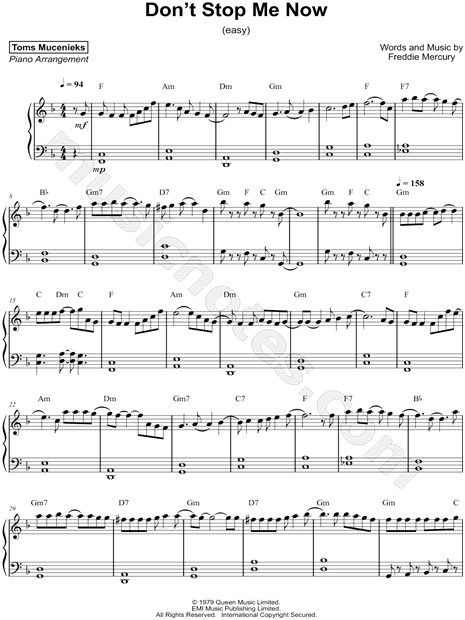
How to practice “Don’t Stop Me Now” piano sheet music
A structured practice plan is more useful than repeating the entire song without a goal. Use short sessions and focus on one skill at a time.
Step 1: Study the score
Look through the whole arrangement before playing. Find the key signature, time signature, repeated patterns, accidentals, dynamic marks, and difficult page turns.
Circle sections that repeat. Learning one pattern may help you learn several parts of the song.
Step 2: Practice each hand alone
Play the right hand slowly until the melody and chords feel familiar. Then practice the left hand on its own. The left hand must feel steady, almost like a drummer keeping time.
Do not move on just because you can play the notes once. Repeat each hand until the movement feels relaxed.
Step 3: Combine small sections
Join only two or four measures at first. When that feels easy, add the next small group. This method helps your memory and limits frustration.
If a transition causes trouble, practice the last measure before it and the first measure after it. Many mistakes happen at the joins between phrases.
Step 4: Add the correct rhythm
Use a metronome at a slow setting. Count aloud if needed. A simple count such as “one and two and” can help you place chords correctly.
The song should feel energetic, but energy does not mean rushing. A stable beat makes the performance sound confident.
Step 5: Add dynamics and style
Once the notes are secure, shape the music. Play softer in lighter sections and build toward the chorus. Use a firm attack, but keep your wrists loose.
Listen to the original recording for phrasing and mood. However, do not try to copy every studio detail. A solo piano arrangement needs its own balance.
Step 6: Increase the tempo
Raise the metronome by five beats per minute at a time. If your playing becomes tense or uneven, return to the previous setting.
This approach may feel slow, but it saves time. In my experience helping learners work through fast pop arrangements, the biggest improvement often comes from fixing rhythm before adding speed.