Introduction
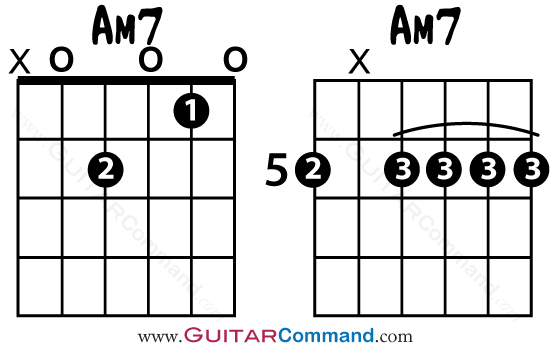
For guitar players in the United States, the easiest way to play Am7, or A minor 7, is the open chord shape x02010. Place your fingers on the second fret of the D string and the first fret of the B string. Strum from the open A string down to the high E string.
The chord sounds warm, soft, and slightly sad. It works well in blues, jazz, folk, pop, rock, and R&B.

The Am7 Guitar Chord Shape
The basic open Am7 chord uses this pattern:


Am7: x02010
Read the pattern from left to right. It shows the strings from the low E string to the high E string.
| String | Low to high | What to do |
|---|---|---|
| 6th string | Low E | Do not play |
| 5th string | A | Play open |
| 4th string | D | Fret at the 2nd fret |
| 3rd string | G | Play open |
| 2nd string | B | Fret at the 1st fret |
| 1st string | High E | Play open |
The x means mute or skip the string. The 0 means play the string open.
Finger placement
Use this fingering:
- Index finger: 1st fret of the B string
- Middle finger: 2nd fret of the D string
- Open strings: A, G, and high E
- Muted string: Low E
Your other fingers should stay relaxed. Keep your thumb behind the neck. This helps your fingers reach the frets without strain.
Am7 chord diagram
e|---0---
B|---1---  index finger
G|---0---
D|---2---  middle finger
A|---0---
E|---x---
The open A string gives the chord its root note. The other notes add the minor and seventh sounds.

How to Play Am7 Step by Step
Follow these steps to form a clear Am7 chord.
1. Tune your guitar
Use standard tuning:
E A D G B E
A poorly tuned guitar can make a correct chord sound wrong. Tune each string before you practice.
2. Place your index finger
Put your index finger on the 1st fret of the B string.
Press near the fret wire, not in the middle of the fret. Use only enough pressure to make the note ring.


3. Place your middle finger
Put your middle finger on the 2nd fret of the D string.
Keep the finger curved. A flat finger may touch the nearby G string and stop it from ringing.
4. Check the open strings
Make sure these strings remain open:
- A string
- G string
- High E string
Do not press them with your unused fingers.
5. Mute the low E string
The low E string is not part of the basic open Am7 shape. You can mute it by touching it lightly with the side of your index finger.
You can also avoid the low E string when you strum.
6. Strum slowly
Strum the A string down through the high E string. Play each string one at a time if you hear a problem.
A clean Am7 should contain these notes:
A C E G
The chord may contain more than one copy of some notes. That is normal on guitar.

How Am7 Sounds and Why It Works
Am7 is a minor seventh chord. Its notes are:
- A: root
- C: minor third
- E: perfect fifth
- G: minor seventh
the minor third, C, gives Am7 its darker sound. The seventh, G, adds a smooth and open quality.
You may see the chord written in several ways:
- Am7
- A minor 7
- A min7
- Amin7
These names mean the same chord.
Am7 is not the same as these chords:


| Chord | Notes | Main difference |
|---|---|---|
| A major | A, C#, E | Has a major third |
| Am | A, C, E | Does not include the seventh |
| A7 | A, C#, E, G | Has a major third |
| Am7 | A, C, E, G | Has a minor third and minor seventh |
| AmMaj7 | A, C, E, G# | Uses a major seventh |
The most common mistake is confusing Am7 with A7. Am7 uses C, while A7 uses C#. That one note changes the chord’s mood.

How to Strum Am7 Clearly
Start with a slow downstroke. Aim for the A string, not the low E string.
Try this simple pattern:
Down – Down – Down – Down
Once the chord rings clearly, try:
Down – Down-Up – Up-Down-Up
Count it as:
1 2-and 3-and-4-and
Do not rush the pattern. Clear notes matter more than speed.
Use a string-by-string check
Pluck the strings in this order:
A – D – G – B – high E
Listen for these problems:
- A dull sound may mean a finger is touching the string.
- A buzzing sound may mean you need more pressure or a better finger angle.
- A muted A string may mean your thumb or palm is touching it.
- An extra low note may mean you played the low E string.
A clean chord should sound full but gentle. Think of it as a soft color rather than a heavy block of sound.

Common Am7 Guitar Chord Problems
Most Am7 problems come from finger angle, excess pressure, or poor string control.
The B string sounds muted
Your index finger may be too flat. Curve it so the fingertip presses the B string while the rest of the finger stays clear of the high E string.
The D string buzzes
Move your middle finger closer to the second fret. Press straight down with the fingertip. Do not place the finger directly on top of the fret wire.
The low E string sounds muddy
Skip the low E string. If you strum with a pick, begin on the A string. If you fingerpick, use your thumb on the A string and your fingers on the higher strings.


The chord sounds too bright
Check the B string. If it is not fretted at the first fret, you may be playing an A minor or an incomplete shape instead of Am7.
Your hand feels tense
Relax your thumb and wrist. You do not need to squeeze the neck hard. Use the smallest amount of pressure that makes each note ring.
If pain continues, stop playing and rest. Normal practice may cause mild fingertip tenderness, but sharp pain in the wrist, hand, or fingers is a reason to pause and review your position.

Other Ways to Play Am7
The open shape is the best starting point, but other positions are useful when you move around the neck.
Movable Am7 shape at the fifth fret
A common movable shape is:
Am7: 575555
This means:
- 6th string, 5th fret
- 5th string, 7th fret
- 4th string, 5th fret
- 3rd string, 5th fret
- 2nd string, 5th fret
- 1st string, 5th fret
This shape uses a partial or full barre at the fifth fret. It may feel harder than the open shape because your index finger must cover several strings.
The lowest note is A on the sixth string, fifth fret. That makes the shape easy to move. For example, moving the same shape two frets higher produces Bm7.
Higher voicings
You can also play Am7 with smaller shapes on the middle and high strings. These shapes are useful for:
- Jazz rhythm
- R&B
- Chord melody
- Smooth transitions
- Playing with another guitarist
The best shape depends on the chord before and after Am7. Choose the position that keeps your fingers close to the next chord.

Am7 Chord Changes and Progressions
Am7 often appears in chord progressions that use the key of C major. It shares the same notes as the C major scale.
Try this progression:
Am7 – Dm7 – G7 – Cmaj7
This is a common minor-to-major movement. Practice each chord for four beats.


You can also try:
Am7 – Fmaj7 – C – G
This progression works well for pop, folk, and acoustic guitar.
For a simple two-chord exercise, switch between:
Am7 – C
The open A, G, and high E strings help the change feel smooth. You only need to move the fingers on the D and B strings.
Another easy change is:
Am7 – Em
Both chords use open strings. Focus on keeping the sound even while your fingers move.
Practice plan
Use this short routine:
- Form Am7.
- Pick each string from A to high E.
- Fix any muted or buzzing note.
- Strum four slow downstrokes.
- Switch to another chord.
- Return to Am7 without stopping.
- Repeat for five minutes.
A slow, clean change is more useful than a fast, messy one.
When Should You Use Am7 Instead of Am?
Use Am7 when you want a softer, smoother, or more open sound. Use Am when you want a plain minor chord with less color.
| Use Am7 when you want | Use Am when you want |
|---|---|
| A relaxed sound | A direct minor sound |
| Jazz or soul color | Simple folk rhythm |
| A smooth chord change | A stronger minor feel |
| More harmonic detail | Fewer notes |
Am7 can sound less final than Am. The added G creates movement. This makes Am7 useful in verses, bridges, and progressions that lead to another chord.
The choice is musical, not a rule. Play both chords and listen to which one fits the song.

Frequently Asked Questions
Is Am7 easy for beginners?
Yes. The open Am7 shape uses only two fretted notes. The other notes are open strings. It is often easier than a full A minor barre chord.
Do I play all six strings for Am7?
No. For the standard open shape, skip the low E string. Start strumming on the open A string.


What is the easiest Am7 guitar chord?
The easiest common shape is:
x02010
It needs only the first fret of the B string and the second fret of the D string.
Can I use Am7 in place of Am?
Sometimes. Both chords share A, C, and E. Am7 also has G, so it may sound more colorful or less settled. Test both chords against the melody.
Why does my Am7 chord buzz?
A finger may be too far from the fret, too flat, or not pressing firmly enough. Check each string one at a time. Move your finger close to the fret and use only enough pressure to make the note clear.
Key Takeaways
- The easiest Am7 guitar chord is x02010.
- Skip the low E string.
- Fret the D string at the second fret.
- Fret the B string at the first fret.
- Let the A, G, and high E strings ring open.
- The chord contains A, C, E, and G.
- Practice it slowly with single-string checks and simple chord changes.
Conclusion
To play Am7 on guitar, use the open shape x02010. Place your middle finger on the second fret of the D string and your index finger on the first fret of the B string. Play from the A string to the high E string.
Start with clean notes and slow strums. Once the shape feels easy, practice moving between Am7, C, Em, Dm7, and Fmaj7. With steady practice, Am7 becomes a useful chord for acoustic songs, jazz progressions, blues, and modern pop.

Senior Music Reviewer
Alex Carter is a seasoned music reviewer with over a decade of experience in the world of sound and instruments. Passionate about helping musicians and enthusiasts make informed choices, he brings sharp insights and in-depth knowledge to every review. From classical instruments to modern gear, Alex combines technical expertise with a love for music to deliver content that resonates with readers.
As a Senior Music Reviewer and expert author on Tuneluma.com, Alex is dedicated to sharing honest evaluations, practical advice, and thoughtful commentary to guide readers in their musical journey.