A Minor 9 Guitar Chord: Easy Guide To Rich Voicings
The A minor 9 guitar chord combines a warm minor sound with a bright ninth for rich, modern color.
The a minor 9 guitar chord is a beautiful choice when a basic Am chord feels too plain. It adds depth to jazz, soul, R&B, neo-soul, blues, and fingerstyle music without losing the emotional pull of a minor chord. This guide explains the chord formula, useful shapes, easy practice methods, common mistakes, and musical ways to use it.

What Is the A Minor 9 Guitar Chord?
The a minor 9 guitar chord is usually written as Am9. It contains five notes:
• A, the root
• C, the minor third
• E, the perfect fifth
• G, the minor seventh
• B, the major ninth
Its formula is:
1 ♭3 5 ♭7 9
The minor third gives the chord its sad or thoughtful quality. The minor seventh adds a smooth, relaxed sound. The ninth adds a bright note above the basic chord, almost like a small ray of light inside a dark color.
That mix makes the a minor 9 guitar chord more colorful than Am, Am7, or Am(add9). It can sound calm, rich, tense, romantic, or slightly mysterious, depending on the voicing and the surrounding chords.
An important detail is that a true minor 9 chord includes both the minor seventh and the ninth. An Am(add9) chord has A, C, E, and B, but it does not always include G. That difference matters when you want the full Am9 sound.
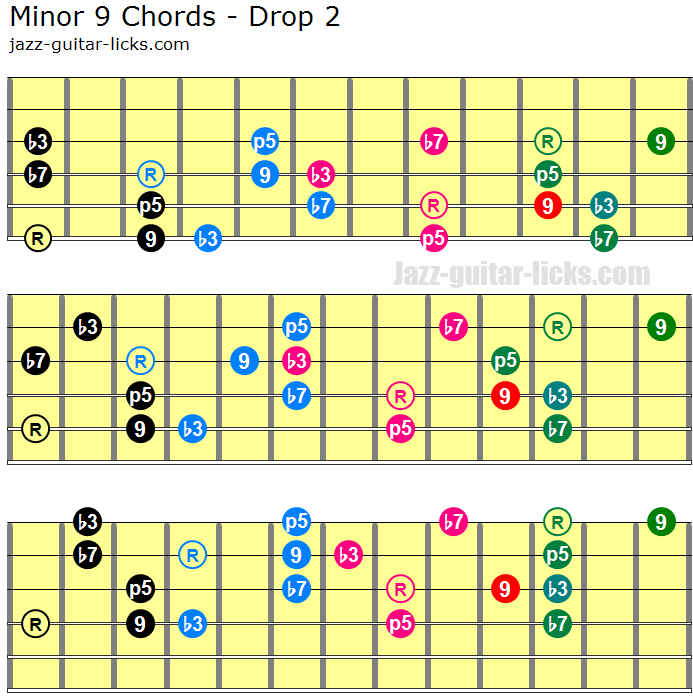
A Minor 9 Guitar Chord Shapes
You do not need to play all five notes in every voicing. Guitarists often remove the fifth or root to make a shape easier or to create a cleaner sound.
The numbers below show strings from the sixth string to the first string:
6 5 4 3 2 1
Movable Am9 barre shape
e|---7---
B|---5---
G|---5---
D|---5---
A|---5---
E|---x---
Use your first finger across the fifth fret from the fifth string to the second string. Place your fourth finger on the seventh fret of the high E string.
This shape gives you:
A C G C E B
Some notes are doubled, which is normal on guitar. The important chord tones are present, including the root, minor third, minor seventh, and ninth.
This is one of the most useful a minor 9 guitar chord shapes because it moves easily up and down the neck. Move it two frets higher, and you have Bm9. Move it three frets lower, and you have Gm9.
Higher Am9 voicing
e|---12---
B|---12---
G|---12---
D|---10---
A|---12---
E|----x---
This shape gives you a clear, open-sounding Am9 with a higher register. It works well for intros, chord melodies, and slow rhythm parts.
The shape may feel less comfortable at first because the frets are spread out. Play it slowly and make sure each note rings without noise.
Compact four-note voicing
e|---12---
B|---12---
G|---12---
D|---10---
A|----x---
E|----x---
This smaller shape is useful when another instrument, such as a bass guitar or piano, already plays the low A. It leaves more space in the mix and avoids a muddy low end.
In a band, smaller chord shapes often sound better than large shapes. The goal is not to play every possible note. The goal is to support the song.

How to Play the A Minor 9 Guitar Chord Clearly
A beautiful chord shape is only useful if it sounds clean. Use this process when learning the a minor 9 guitar chord:
- Place each finger slowly.
- Pick one string at a time.
- Listen for muted or buzzing notes.
- Adjust your thumb and wrist.
- Strum only after every note rings clearly.
Keep your thumb near the middle of the back of the neck. This gives your fingers more room to reach the higher frets.
Do not squeeze the neck harder than needed. Excess pressure can make your hand tired and can even pull notes sharp. Use just enough pressure to produce a clean tone.
If the barre feels difficult, practice only the top three or four strings. Many professional players use partial chords during real performances. A partial Am9 still delivers the character of the chord.
One mistake I often see is trying to strum all six strings when the shape begins on the fifth string. The low E string should be muted or skipped. A stray low E can change the bass note and make the chord sound unclear.

A Minor 9 Guitar Chord vs. Related Chords
Understanding nearby chord types helps you hear what makes Am9 special.
Am
The A minor chord contains:
A C E
It is simple, direct, and stable. It works in almost any beginner chord progression, but it has less color than Am9.
Am7
The A minor seventh chord contains:
A C E G
Am7 sounds softer and more relaxed than Am. It is common in funk, soul, blues, and jazz.
Am(add9)
The A minor add9 chord contains:
A C E B
It has a bright, open sound but does not necessarily contain the minor seventh, G.
Am9
The a minor 9 guitar chord contains:
A C E G B
It combines the emotional quality of Am7 with the spacious color of the ninth. That is why it often sounds more sophisticated and full.
Am11
An A minor 11 chord usually contains:
A C E G B D
The eleventh, D, adds another layer of color. Am11 can sound wider and more suspended than Am9, but it may also create more tension.

Why Use an A Minor 9 Guitar Chord?
The a minor 9 guitar chord offers several musical benefits.
• It adds emotion without sounding overly dramatic.
• It gives simple progressions a more mature sound.
• It works well under vocals because its color is rich but smooth.
• It creates movement in jazz and neo-soul chord progressions.
• It can replace a plain Am7 when you want more space and brightness.
• It sounds full even when played with only four or five strings.
This chord is especially useful when a song needs a reflective mood. Think of a quiet night drive, a late-night soul track, or a film scene where the character is thinking rather than speaking.
The ninth is not a loud note. It sits above the basic chord and adds air. That makes the chord feel detailed without becoming harsh.
Still, the chord is not right for every situation. A simple triad may work better in fast rock music, folk songs, or parts where a strong, clear rhythm matters more than harmonic color.

Chord Progressions With Am9
Try these progressions to hear how the a minor 9 guitar chord behaves.
Am9 to Dm9
| Am9 | Dm9 |
This creates a smooth minor movement. Both chords share a dark, soulful quality, so the progression works well with slow strumming or fingerpicking.
Am9 to Fmaj7
| Am9 | Fmaj7 |
This progression shifts from a rich minor sound to a warm major seventh sound. Let the notes ring together for a gentle, cinematic effect.
Am9 to G13
| Am9 | G13 |
This pairing has a strong R&B and jazz flavor. The Am9 creates a relaxed minor center, while G13 adds forward motion.
Am9 to Cmaj7
| Am9 | Cmaj7 |
This is an easy progression for beginners. The two chords share several notes, so the change can feel smooth with little finger movement.
Am9 to E7
| Am9 | E7 |
This creates tension because E7 strongly points toward A. Try resolving back to Am9 after E7 for a classic minor-key sound.