A Minor Pentatonic Scale For Guitar: Easy Soloing Guide
The A minor pentatonic scale for guitar uses five notes to create simple, strong, expressive riffs and solos.
The a minor pentatonic scale for guitar is one of the best starting points for rock, blues, pop, country, and metal. Its five-note design removes two tense notes from the natural minor scale, so your phrases sound musical even when you are still learning to improvise. This guide explains the notes, patterns, fretboard shapes, chord connections, practice methods, and common mistakes that can hold your playing back.

What Is the A Minor Pentatonic Scale for Guitar?
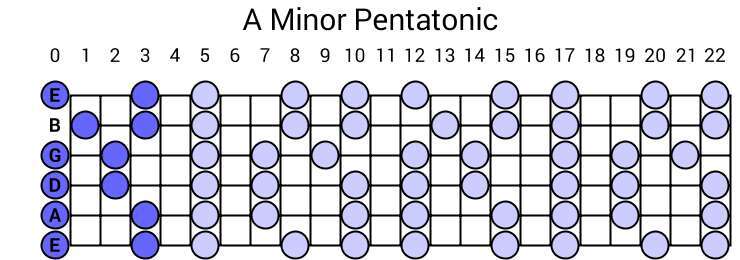
The a minor pentatonic scale for guitar contains five notes:
• A, the root
• C, the minor third
• D, the perfect fourth
• E, the perfect fifth
• G, the minor seventh
The word “pentatonic” means “five tones.” Compared with the natural A minor scale, the pentatonic scale removes B and F. Those two notes can create more tension, while the remaining five notes are stable and easy to use.
The scale formula is:
- Root
- Minor third
- Perfect fourth
- Perfect fifth
- Minor seventh
In A, that formula gives A, C, D, E, and G. The notes repeat in higher and lower octaves across the guitar neck.
The a minor pentatonic scale for guitar works especially well over A minor, A5, A7, and many blues progressions. It can also sound effective over C major because A minor pentatonic and C major share the same notes.

A Minor Pentatonic Scale Notes and Intervals
Understanding the notes helps you move beyond memorizing a shape. Each note has a role, much like each player in a band has a job.
A is the root. It sounds settled and complete. When you end a phrase on A, the listener often feels that the musical thought has come home.
C is the minor third. This note gives the scale its minor color. In blues, players often bend C slightly toward C sharp for a sound that sits between major and minor.
D is the perfect fourth. It adds movement and works well as a passing or connecting note.
E is the perfect fifth. It is strong and stable, especially over an A5 chord or an A minor chord.
G is the minor seventh. This note adds a blues and rock flavor. It sounds especially natural over A7 and many dominant-style blues chords.
Here is a simple note map:
| Degree | Note | Common role |
|---|---|---|
| 1 | A | Root and tonal center |
| ♭3 | C | Minor color |
| 4 | D | Movement and suspension |
| 5 | E | Strong supporting tone |
| ♭7 | G | Blues and rock color |
The a minor pentatonic scale for guitar is not only a group of notes. It is a map of musical tension and release. Start with A, explore the other notes, and return to A when you want a clear resolution.

A Minor Pentatonic Scale for Guitar: The Five Box Patterns
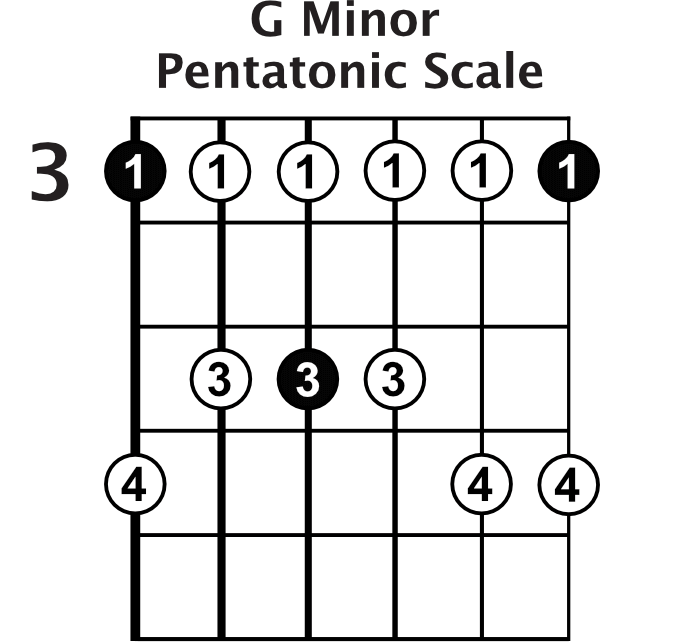
Most guitarists learn the scale through five connected “box” patterns. These shapes cover the full neck and repeat in every key. The first shape is the most famous, but the other four are essential for fluid solos.
Box 1: The classic fifth-fret shape
The first box begins around the fifth fret. It is the shape most players learn first because it places the root notes on the sixth and first strings.
A simple tab pattern is:
e|----------------5--8--|
B|------------5--8------|
G|--------5--7----------|
D|----5--7--------------|
A|----5--7--------------|
E|5--8------------------|
The notes on the sixth and first strings are A and C. Play the pattern slowly in both directions. Then pause on each A and listen to how it feels more settled than the other notes.
Box 2: Above the first position
The second box begins near the eighth fret. It connects naturally to Box 1 and gives you access to higher A, C, and E notes.
This shape is useful for extending short licks. Instead of stopping at the eighth fret, move into this area and continue your phrase. That small shift can make a familiar solo sound wider.
Box 3: The middle-neck position
The third box sits around the tenth fret. It can feel less familiar at first because the pattern does not look as obvious as Box 1. Focus on locating the root notes before trying to play it quickly.
This position often produces smooth melodic lines. It is also a good place to practice slides between connected notes.
Box 4: The upper-middle position
The fourth box lies around the twelfth fret. Since the twelfth fret repeats the open-string notes one octave higher, many players find the root notes easier to recognize here.
Try playing a phrase in Box 1, then repeat the same rhythm in Box 4. The notes may have a similar function, but the higher register gives the idea more intensity.
Box 5: The neck connection
The fifth box links the upper part of the neck back to Box 1. It completes the cycle and helps you avoid getting trapped in one position.
The goal is not to memorize all five shapes in one day. Learn one shape, connect it to a second shape, and then add the next position. This method builds a usable fretboard map instead of a collection of disconnected diagrams.

How to Play the Scale Across the Fretboard
A scale pattern becomes useful when you can move through it without losing the root. Start by finding every A in one position. On a standard-tuned guitar, the open fifth string, the fifth fret on the low E string, the seventh fret on the D string, the second fret on the G string, and the tenth fret on the B string are helpful reference points.
Use this practice sequence:
- Play Box 1 from low to high.
- Say each note name as you play it.
- Stop on every A.
- Return through the pattern from high to low.
- Move into Box 2 without stopping.
- Repeat the exercise with a metronome.
Do not rush this process. A slow, clean connection between two shapes is more valuable than a fast run that loses time and tone.
A useful exercise is to play three notes per string, then shift to the next position. Another is to play the scale in groups of three:
A, C, D
C, D, E
D, E, G
E, G, A
These small groups help your fingers and ears learn the sound together. The a minor pentatonic scale for guitar should become something you hear, not only something you see in a diagram.
Using the Scale Over Chords and Backing Tracks
The best way to understand the a minor pentatonic scale for guitar is to play it over real harmony. Start with a slow A minor backing track. Let the chord ring, then play short phrases that end on A, C, or E.
Over an A minor chord, the scale gives you the notes A, C, D, E, and G. Each note can work, but the emotional effect changes:
• A sounds resolved.
• C sounds clearly minor.
• D sounds open and slightly suspended.
• E sounds strong and bright within the minor setting.
• G adds a relaxed blues color.
The scale also works over a basic blues in A:
| A7 | A7 | A7 | A7 |
| D7 | D7 | A7 | A7 |
| E7 | D7 | A7 | E7 |
This is where the a minor pentatonic scale for guitar becomes especially interesting. The C note creates a minor third against the A7 chord, while the chord itself contains C sharp. That clash is a major part of the blues sound.
You can make the tension more controlled by bending C toward C sharp. Do not force the bend too far at first. Use your ear, match the pitch, and release it with control.
The scale is not equally suitable for every chord. Over a complex progression, the same five notes may produce unwanted clashes. Listen to the chord changes, and adjust your target notes when the harmony moves away from A.

Essential Licks and Phrasing Ideas
Many new players know the scale but sound like they are running an exercise. The solution is phrasing. Music needs space, rhythm, and direction.
Try these ideas with the a minor pentatonic scale for guitar:
• Bend the seventh fret on the G string toward the pitch of the ninth fret.
• Slide from the fifth fret to the seventh fret on the D or G string.
• Repeat a short two-note idea, then change its ending.
• Play three notes, rest for one beat, and answer yourself.
• End a phrase on A, then begin the next phrase on C or G.
• Use vibrato after a bend instead of adding many extra notes.
A classic minor pentatonic phrase might use the fifth fret on the high E string, the eighth fret, and then the fifth fret on the B string. The exact notes matter less than the rhythm and articulation.
One lesson I have seen repeatedly while helping players is that they often add notes before they improve their timing. A simple four-note phrase with a strong bend can sound more professional than a fast sixteenth-note run with weak rhythm.
Treat each lick like a sentence. The first notes make a statement, the pause creates space, and the final note provides an answer.

Practice Routine for Faster Progress
A focused routine can make the a minor pentatonic scale for guitar feel natural within a few weeks of regular practice. You do not need a long session. Ten to fifteen minutes of careful work can be enough when you practice with purpose.
Try this routine:
- Warm up with slow alternate picking for two minutes.
- Play Box 1 with a metronome for three minutes.
- Name the notes while playing for two minutes.
- Connect Box 1 and Box 2 for three minutes.
- Improvise with only three notes for two minutes.
- Record a short solo and listen back.
Start at a tempo where every note sounds clear. Increase the metronome by a small amount only when your timing remains steady. Clean playing builds speed more reliably than tense, rushed repetition.
Use different rhythms. Play quarter notes, eighth notes, triplets, and rests. Rhythm training makes the scale sound like music instead of a mechanical pattern.
Also practice from high to low. Many guitarists always begin on the lowest note, which creates a habit that does not match real improvisation. Starting from different points makes your fretboard knowledge more flexible.