How Do You Play G Minor On Guitar: Easy Chord Guide
To play G minor on guitar, use a Gm chord shape built from the notes G, B-flat, and D.
Learning how do you play g minor on guitar gives you a rich, moody chord for rock, blues, pop, and classical music. The best approach is to start with an easy shape, then build toward the full barre chord as your hand grows stronger. This guide explains each method, shows where your fingers go, and helps you avoid the most common mistakes.
What Is the G Minor Chord?
G minor is written as Gm. It contains three notes:
• G, the root note
• B-flat, the minor third
• D, the perfect fifth
The B-flat gives the chord its dark and emotional sound. If you change B-flat to B natural, the chord becomes G major instead.
When people ask how do you play g minor on guitar, they usually mean the common full barre chord. However, you do not need to begin with the hardest shape. Several useful versions sound musical and are easier for new players.

How Do You Play G Minor on Guitar With the Full Barre Chord?
The most common G minor guitar chord uses an E minor barre shape at the third fret. The chord diagram is:
Gm: 355333
Read the numbers from the thickest string to the thinnest string:
Low E   A   D   G   B   High E
  3     5   5   3   3     3
Place your fingers like this:
- Use your index finger to press all six strings at the third fret.
- Place your ring finger on the fifth fret of the A string.
- Place your pinky on the fifth fret of the D string.
- Strum all six strings.
This shape is movable. Keep the same finger pattern and slide it to another fret to play other minor chords. For example, move it to the fifth fret and you have A minor.
The main challenge is pressing the index finger evenly. Keep it close to the fret wire without placing it directly on top of the metal fret. A relaxed thumb behind the neck will help your hand create steady pressure.
A Simple Finger Check
Play each string one at a time:
6th string: clear
5th string: clear
4th string: clear
3rd string: clear
2nd string: clear
1st string: clear
If one string buzzes, do not squeeze harder at once. First, check whether your finger is touching a nearby string or sitting too far from the fret.
How Do You Play G Minor on Guitar With an Easier Shape?
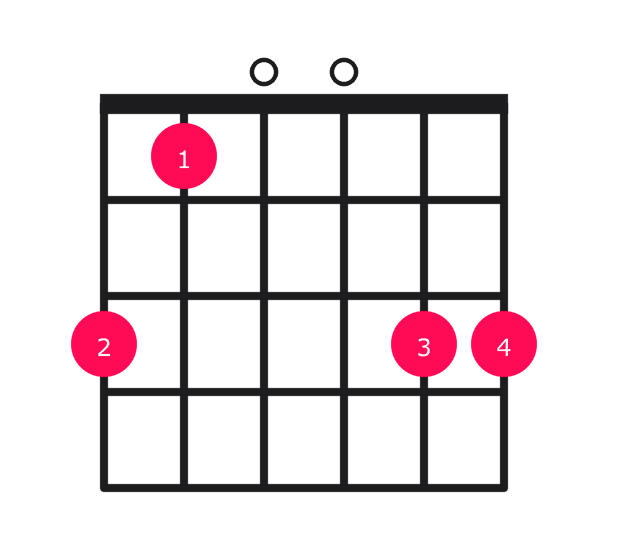
A simpler version of G minor is:
Gm: xx5333
This means:
Low E   A   D   G   B   High E
  x     x   5   3   3     3
The two X marks mean you do not play the low E or A strings.
Use this fingering:
- Place your index finger across the G, B, and high E strings at the third fret.
- Place your ring finger on the D string at the fifth fret.
- Mute the low E and A strings.
- Strum from the D string down.
This shape contains the notes G, D, B-flat, and G. It has the important notes of G minor but sounds lighter than the full six-string version.
This is often the best answer for beginners asking how do you play g minor on guitar. It lets you use the chord in songs before your full barre chord feels comfortable.
An Easy Open-Position Version
You can also try:
Gm: 3x0333
Here, play the low E string at the third fret, mute the A string, play the open D string, and use the third fret on the G, B, and high E strings.
This shape is:
Low E   A   D   G   B   High E
  3     x   0   3   3     3
It is not as balanced as the full barre chord, but it works well for practice and some song arrangements. Listen closely to the open D string. Its sound may not fit every musical setting.

How Do You Play G Minor on Guitar With an A-Shape Barre?
Another useful G minor chord is based on the A minor shape:
Gm: x 10 12 12 11 10
The low E string is muted. The A string at the tenth fret provides the root G.
Use your fingers in this way:
- Mute the low E string with the side of your index finger.
- Barre the A, D, G, B, and high E strings at the tenth fret.
- Add the twelfth fret on the D and G strings.
- Play the B string at the eleventh fret.
- Strum from the A string down.
This shape may feel difficult because it sits high on the neck. It is useful when you want a brighter sound or need to move smoothly from nearby chords.
The E-shape Gm chord at the third fret is usually easier to hear and control. The A-shape version is a valuable second option once you understand movable chord forms.

Step-by-Step Practice for the G Minor Guitar Chord
Practice slowly. Chord changes improve through clean repetition, not force.
- Form the easy shape,
xx5333. - Pick each string from the D string to the high E string.
- Fix any muted or buzzing note.
- Release your hand.
- Form the chord again.
- Repeat this ten times.
- Strum four slow downstrokes.
- Rest, then repeat.
Next, practice changing between G minor and nearby chords:
• Gm to E-flat major
• Gm to F major
• Gm to B-flat major
• Gm to C minor
Use a metronome at 50 to 60 beats per minute. Change chords every four beats. Increase the speed only when every note sounds clear.
When I practice a new barre chord, I focus on short sets rather than long sessions. Five careful minutes often teaches the hand more than twenty minutes of tense playing.

Common Problems When Playing G Minor
Buzzing Strings
Buzzing often means a finger is not close enough to the fret. Move the finger slightly forward and test the string again.
Your index finger may also be lying too flat. Roll it slightly toward its bony side. This can create a cleaner barre without extra pressure.
Muted Strings
A muted string may be touching another finger. Lift each finger one at a time and check the problem string.
For the easy G minor shape, watch the index finger. It should cover the G, B, and high E strings without touching the D string at the fifth fret.
Hand Pain
Mild fatigue is normal when learning barre chords. Sharp pain is not. Stop, shake out your hand, and take a break.
Keep your wrist fairly straight. Pulling the neck too hard toward your body can create tension in your thumb, wrist, and forearm.
The Chord Sounds Like G Major
Check the note on the B string. In G minor, the B string must play B-flat, which is the third fret in the common shape. If you accidentally play an open B string, the chord may sound major.
The Low Strings Sound Too Heavy
Try the smaller shape, xx5333. It removes the low E and A strings and creates a tighter sound. This works well when the full Gm chord sounds muddy.

Strumming Patterns for G Minor
Start with simple downstrokes:
1   2   3   4
D   D   D   D
Once the chord is clear, try:
1 and 2 and 3 and 4 and
D   D U   U D U
Keep your strumming hand moving in a steady eighth-note motion. Even when you miss the strings, keep the hand moving. This helps your rhythm stay stable.
You can also use a gentle pattern for a ballad:
Bass note, G string, B string, high E string
For the full Gm chord, begin with the low E string. Then pick the G, B, and high E strings. This creates a soft broken-chord sound.
A useful lesson from teaching and playing this chord is that rhythm often matters more than speed. A slow, even G minor chord sounds better than a fast chord with buzzing strings.

Songs and Chord Progressions Using G Minor
G minor often appears in music with a dramatic or reflective mood. Try these progressions:
Progression One
Gm | E-flat | B-flat | F
This progression is common in pop, rock, and cinematic music. Play four beats for each chord.
Progression Two
Gm | F | E-flat | D
This has a strong descending feel. The D major chord adds tension before returning to G minor.
Progression Three
Gm | C minor | D | Gm
This pattern gives you a clear minor-key sound. The D chord pulls strongly back toward Gm.
Start with one downstroke per beat. Then add a steady eighth-note pattern. Keep the chord changes slow until your fretting hand can move without stopping the beat.