How Many Piano Chords Are There: A Complete Guide
There is no single total, but pianists use hundreds of named chords and nearly endless voicings.
So, how many piano chords are there? The best answer depends on how you count them. If you count basic chord types, the number is manageable. If you include inversions, extensions, altered notes, and different piano voicings, the number becomes enormous. This guide breaks down the math, music theory, and practical answer so you can understand chords without feeling overwhelmed.
The short answer: how many piano chords are there?
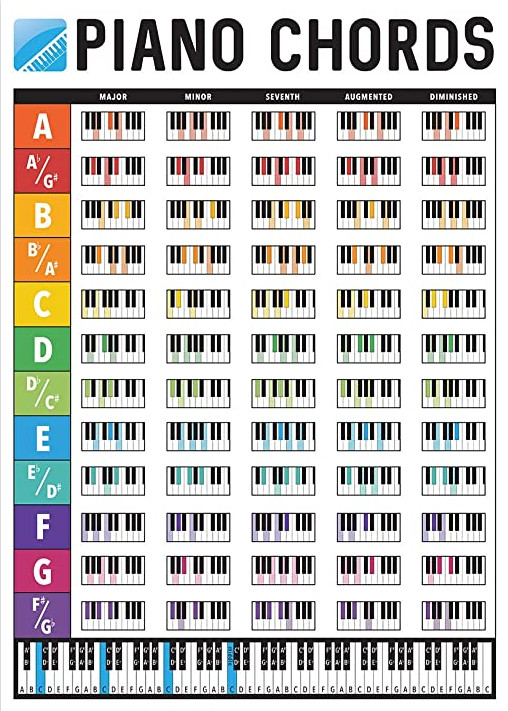
There are 12 notes in Western music. Each note can act as the root of a chord. This creates 12 major chords, 12 minor chords, 12 diminished chords, and many other chord families.
For a beginner, the most useful answer is this:
• There are 24 basic major and minor piano chords.
• There are 36 common triads when you include diminished chords.
• There are hundreds of named chord types when you add seventh chords, suspended chords, sixth chords, ninth chords, and altered chords.
• There are thousands of possible chord shapes when you include inversions and voicings.
• There is no final limit in practical music because chords can include added tones, doubled notes, and different spacing.
For example, C major is made from C, E, and G. You can play those notes in many orders and at many octaves. They are still C major, but each version has a different sound and feel.
That is why the answer to how many piano chords are there changes based on your definition of a chord.
What counts as a piano chord?
A chord is usually a group of three or more different notes played together. The notes often relate to one root note and follow a musical pattern called an interval structure.
For example, a C major chord contains:
• C, the root
• E, the major third
• G, the perfect fifth
The same chord can sound bright in one position and smooth or rich in another. The notes do not need to appear in root position. They can be moved, doubled, or spread across the keyboard.
Some musicians also call two notes played together a chord. In strict music theory, two notes form an interval rather than a full chord. In pop, rock, and piano accompaniment, however, a two-note power chord may be treated like a chord.
This difference explains why chord counts are not always the same in books, apps, and online lessons. Some count only standard chord symbols. Others count every possible group of notes.
Chords, chord shapes, and voicings
These three terms are related but not identical.
• A chord type describes the note pattern, such as major, minor, or dominant seventh.
• A chord shape describes how the notes are placed under your fingers.
• A voicing describes the exact order, spacing, and octave placement of the notes.
A C major chord in root position is C–E–G. Its first inversion is E–G–C. Its second inversion is G–C–E. These are three shapes of the same chord, not three completely different chord types.

How many basic piano chords are there?
The 12 notes of the chromatic scale can each serve as a root. The most common basic chord groups are major, minor, diminished, and augmented triads.
Major chords
A major triad has a root, major third, and perfect fifth. It often sounds bright, stable, or confident.
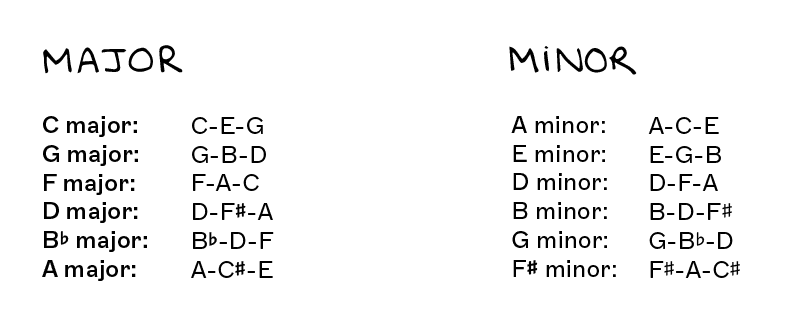
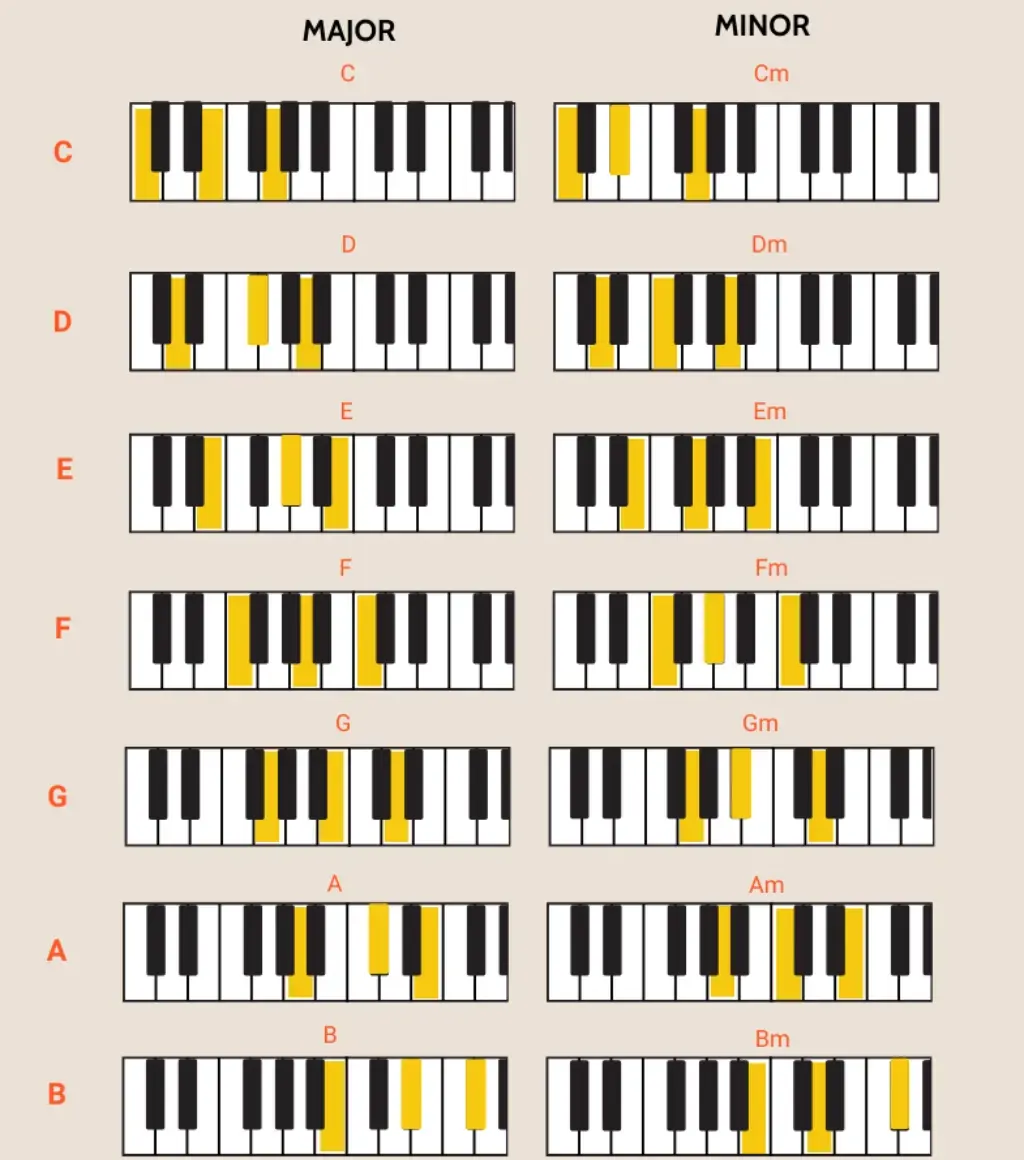
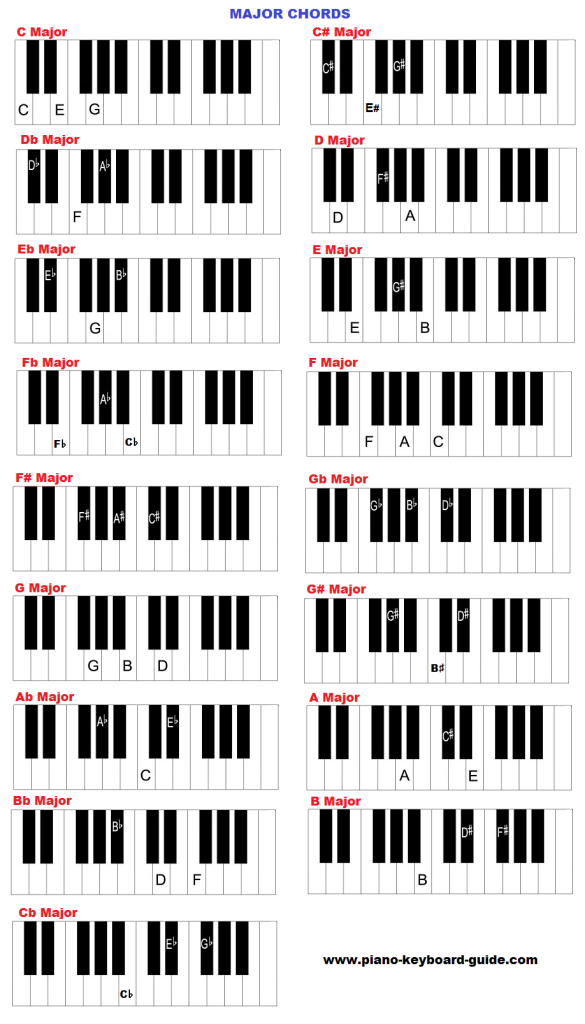
The 12 major chords are:
• C major
• C-sharp or D-flat major
• D major
• D-sharp or E-flat major
• E major
• F major
• F-sharp or G-flat major
• G major
• G-sharp or A-flat major
• A major
• A-sharp or B-flat major
• B major
Minor chords
A minor triad has a root, minor third, and perfect fifth. It often sounds darker, softer, or more reflective.
There are also 12 minor chords:
• C minor
• C-sharp or D-flat minor
• D minor
• D-sharp or E-flat minor
• E minor
• F minor
• F-sharp or G-flat minor
• G minor
• G-sharp or A-flat minor
• A minor
• A-sharp or B-flat minor
• B minor
Together, the major and minor groups give you 24 basic triads.
Diminished and augmented chords
A diminished triad contains a minor third and a diminished fifth. It often creates tension and wants to move to another chord.
An augmented triad contains a major third and an augmented fifth. It has a wide, floating sound and is common in film music, jazz, and older pop styles.
If you count all four common triad qualities across 12 roots, you get:
12 major chords × 4 triad qualities = 48 theoretical triads
That number includes major, minor, diminished, and augmented forms. Some of these chords are used far more often than others.
How many seventh chords are there?
Seventh chords add a fourth note to a triad. They are common in jazz, blues, gospel, classical music, pop, and worship music.
The most common seventh chord types include:
• Major seventh, such as Cmaj7
• Dominant seventh, such as C7
• Minor seventh, such as Cm7
• Minor major seventh, such as CmMaj7
• Half-diminished seventh, such as Cm7♭5
• Fully diminished seventh, such as Cdim7
If you use six common seventh chord qualities in all 12 keys, you get:
6 chord qualities × 12 roots = 72 seventh chords
This is not a complete list. Music theory also recognizes other seventh chord forms, such as augmented major seventh and augmented seventh chords.
For practical playing, the major seventh, dominant seventh, and minor seventh are the most important starting points. They appear in thousands of songs and are useful for accompaniment, songwriting, and improvisation.
For example:
• Cmaj7 contains C, E, G, and B.
• C7 contains C, E, G, and B-flat.
• Cm7 contains C, E-flat, G, and B-flat.
Changing only one note can change the mood of the entire chord. That small change is one reason piano harmony is so expressive.

Extended chords make the number much larger
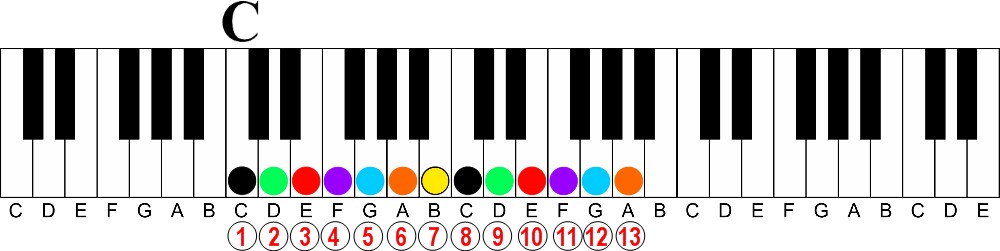
Extended chords add notes beyond the seventh. Common examples include ninth, eleventh, and thirteenth chords.
A C9 chord usually contains:
• C, the root
• E, the major third
• G, the fifth
• B-flat, the minor seventh
• D, the ninth
A C13 chord may include C, E, G, B-flat, D, and A. In real piano playing, musicians often leave out some notes because the hand cannot comfortably play every tone, or because certain notes matter more than others.
Common extended chord types include:
• Major ninth
• Minor ninth
• Dominant ninth
• Minor eleventh
• Dominant eleventh
• Major thirteenth
• Dominant thirteenth
• Minor thirteenth
Extensions do not always mean you must play every note. A skilled pianist may remove the root when a bass player is present. In a dominant chord, the third and seventh often carry the most important information because they define the chord’s quality and direction.
This leads to a useful point about how many piano chords are there: the number of chord names grows quickly, but practical playing often uses a smaller group of essential notes.
Suspended, added, and altered piano chords
Not all chords fit neatly into major, minor, or seventh categories. Many common chords use suspended notes, added tones, or altered intervals.
Suspended chords
A suspended chord replaces the third with another note.
• Csus2 contains C, D, and G.
• Csus4 contains C, F, and G.
Suspended chords sound open because they do not clearly identify the chord as major or minor. The suspended note often resolves to the third.
Added-note chords
An added-note chord includes an extra note without following the full seventh chord structure.
• Cadd9 contains C, E, G, and D.
• C6 contains C, E, G, and A.
• Cm6 contains C, E-flat, G, and A.
These chords are common in folk, pop, singer-songwriter music, and film scores. The added note gives a simple triad more color without making it too tense.
Altered chords
Altered chords change one or more notes. Common symbols include:
• C7♭5
• C7♯5
• C7♭9
• C7♯9
• C7♯11
Altered chords are especially common in jazz and modern harmony. They can sound tense, spicy, or dramatic. The famous “Hendrix chord,” often written E7♯9, is a well-known example of an altered dominant chord.
Why inversions create thousands of piano chord shapes
An inversion changes which chord note sits at the bottom.
For a three-note chord, there are three basic positions:
-
Root position places the root at the bottom.
-
First inversion places the third at the bottom.
-
Second inversion places the fifth at the bottom.
A seventh chord has four basic positions because it contains four different notes. A ninth chord can have five basic note positions, although real piano voicings offer far more choices.
You can also move notes into different octaves. For example, C–E–G can become:
• C–G–E
• C–E–G one octave higher
• G–C–E
• C–G–C–E
• C–E–G–C
These versions may all represent C major. Yet they do not sound the same. A close voicing sounds compact. An open voicing sounds wider and often works better for the left hand.
When people ask how many piano chords are there, they may actually be asking how many hand positions exist. The answer to that question is much larger than the number of chord names.
The mathematical answer to how many piano chords are there
Music theory gives more than one mathematical answer.
If you focus on the 12 pitch classes in Western music, every note can either be included or excluded from a group. That creates:
2¹² = 4,096 possible note collections
If you exclude the empty collection, there are 4,095 nonempty pitch-class sets.
However, this does not mean there are 4,095 useful or recognized piano chords. Many sets are not named chords. Some contain only one or two notes. Others create unusual clusters that have no common function in traditional harmony.
If you focus on the 88 keys of a standard piano, every key can technically be included or excluded. That creates:
2⁸⁸ possible key combinations
This number is extremely large. It is not a useful count of musical chords because many combinations repeat the same pitch classes in different octaves. It also includes random groups of notes that musicians would not normally call chords.
The practical answer to how many piano chords are there must therefore separate mathematical combinations from recognized musical structures.

Does a piano have more chords than other instruments?
A piano does not have a special fixed list of chords that other instruments lack. Chord theory is based on musical notes and intervals, not on the instrument itself.
A guitar, piano, organ, and orchestra can all play a C major chord. The sound changes because each instrument has a different range, tone, and method of producing sound.
The piano does offer special advantages:
• It can play many notes at once.
• It shows the layout of harmony clearly.
• It allows wide bass and treble voicings.
• It can play melody and chords together.
• It makes inversions easy to see and compare.
A guitarist may use one familiar hand shape for a chord. A pianist may use several voicings for the same chord based on the melody, bass line, and musical style.
So, how many piano chords are there compared with guitar chords? The basic chord types are mostly the same. The main difference is how each instrument plays and voices them.
The most useful piano chords for beginners
You do not need to learn hundreds of chords at once. A small set of major, minor, and seventh chords can help you play many songs.
Start with these easy piano chords:
• C major: C–E–G
• G major: G–B–D
• F major: F–A–C
• A minor: A–C–E
• E minor: E–G–B
• D minor: D–F–A
These chords appear together in many songs in and around the key of C major. They also help you learn common chord progressions.
A useful beginner progression is:
C – G – Am – F
This progression appears in many pop songs. Practice it slowly with your right hand first. Then add simple bass notes with your left hand.
After that, learn:
• Cmaj7
• C7
• Am7
• Dm7
• G7
These seventh chords add color without requiring advanced theory. They are also excellent for blues, jazz, soul, and gospel styles.
In my experience with beginner practice methods, the biggest mistake is chasing a long chord chart before learning smooth changes. Four chords played in time are more useful than 40 chords played with pauses.
A simple way to learn more piano chords
Use a step-by-step plan instead of memorizing random chord names.
-
Learn all 12 major triads.
-
Learn all 12 minor triads.
-
Practice each chord in root position.
-
Add the first and second inversions.
-
Learn major seventh, minor seventh, and dominant seventh chords.
-
Practice common chord progressions in several keys.
-
Add suspended, sixth, ninth, and altered chords.
-
Use songs to test what you know.
Try to recognize each chord by its sound and shape. Theory is useful, but your hands and ears also need practice.
A good daily session can take only 15 minutes:
• Spend five minutes reviewing chord shapes.
• Spend five minutes changing between inversions.
• Spend five minutes playing a real progression or song.
Avoid pressing every note with equal force. Relax your wrist and keep your fingers curved. Tension makes chord changes slower and can lead to hand pain.
Another common mistake is using the same voicing for every song. If the melody moves near middle C, choose a chord position that keeps the melody clear. If your left hand sounds muddy, move the chord higher or remove extra low notes.
How professionals think about chord numbers
Professional pianists rarely count every possible chord. They think in terms of chord families, functions, and voicings.
For example, a pianist may see G7 and immediately understand that it often leads to C. This is called a dominant-to-tonic movement. The pianist may then choose a simple G7, a G7♭9, or a rootless G7 voicing based on the style.
The chord symbol is only a starting point. The final sound depends on:
• The key
• The melody
• The bass note
• The rhythm
• The musical style
• The singer’s range
• The notes played by other instruments
This is why two pianists can read the same chord chart and produce very different results. One may use simple block chords. Another may use rich jazz voicings with passing chords and altered tones.
When considering how many piano chords are there, it helps to think like a musician rather than a calculator. The goal is not to collect every possible shape. The goal is to choose the right sound at the right moment.
Common mistakes when learning piano chords
Chord study becomes easier when you avoid a few common problems.
Trying to memorize every chord name
There are too many possible chord labels to memorize at once. Learn the pattern behind each chord type instead.
For example, every major triad uses:
Root + major third + perfect fifth
Once you know that pattern, you can build the chord from any note.
Ignoring inversions
Playing every chord in root position can create large jumps. Inversions help your hand stay near the same area of the keyboard.
For C–G–Am–F, try using nearby positions instead of jumping back to the root each time. Smooth movement will make your playing sound more polished.
Playing too many notes
More notes do not always create a better chord. Low notes placed close together can sound muddy. Start with three or four notes, then add color with care.
Learning names without listening
A chord is more than a label. Listen for its mood, tension, and movement. Play C major, then C minor, and notice how one changed note alters the emotional color.
Practicing without rhythm
A chord played at the wrong time does not support a song well. Use a metronome or a simple backing track. Even slow, steady practice builds useful control.
Frequently Asked Questions About How Many Piano Chords Are There
How many piano chords are there for beginners?
Beginners usually start with 24 basic chords: 12 major and 12 minor triads. Learning these chords gives you a strong base for many songs and chord progressions.
How many chords are there in all 12 keys?
The answer depends on the chord family. There are 12 major triads, 12 minor triads, 12 diminished triads, and 12 augmented triads, giving 48 common triads in all 12 keys.
Are there more than 100 piano chords?
Yes. Once you include seventh chords, suspended chords, sixth chords, ninth chords, eleventh chords, thirteenth chords, and altered chords, there are well over 100 named chord types across all 12 roots.
What are the 24 basic piano chords?
The 24 basic piano chords are the 12 major chords and 12 minor chords. Each of the 12 musical notes can serve as the root of one major chord and one minor chord.
Do inversions count as different piano chords?
Inversions are different positions of the same chord. For example, C–E–G, E–G–C, and G–C–E are all C major, but they use different bass notes and create different musical effects.
Can a piano play every possible chord?
A piano can play a huge number of note combinations, but not every combination has a standard chord name. Some groups of notes are better described as clusters, intervals, or experimental sounds.
What is the hardest piano chord to play?
There is no single hardest chord because difficulty depends on hand size, speed, voicing, and context. Wide tenth chords, dense jazz voicings, and fast altered chords can be challenging for many players.
Conclusion
So, how many piano chords are there? You can count 24 basic major and minor chords, 48 common triads across four qualities, or hundreds of named chords when you include seventh chords and extensions. Add inversions, octaves, and creative voicings, and the practical number becomes nearly endless.
Do not let the large number discourage you. Start with major and minor triads, learn smooth inversions, and use real songs to build skill. Explore a few new chord types each week, and share your favorite progression or continue learning through a trusted piano resource.

Senior Music Reviewer
Alex Carter is a seasoned music reviewer with over a decade of experience in the world of sound and instruments. Passionate about helping musicians and enthusiasts make informed choices, he brings sharp insights and in-depth knowledge to every review. From classical instruments to modern gear, Alex combines technical expertise with a love for music to deliver content that resonates with readers.
As a Senior Music Reviewer and expert author on Tuneluma.com, Alex is dedicated to sharing honest evaluations, practical advice, and thoughtful commentary to guide readers in their musical journey.