Introduction
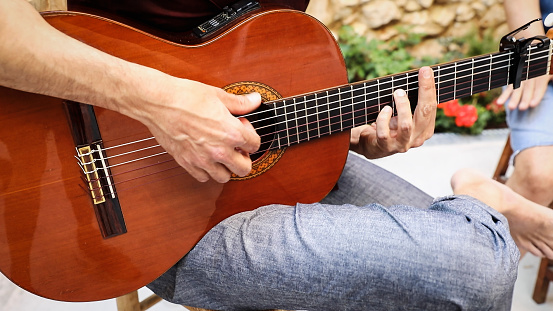
For people in the United States who are learning Spanish, the most natural translation of “Do you like playing the guitar?” is ¿Te gusta tocar la guitarra? This phrase works well in casual talk with a friend, classmate, or family member.
Use ¿Le gusta tocar la guitarra? when speaking formally to one person. Spanish uses a different structure from English, so the phrase is closer to “Does playing the guitar please you?” The meaning, however, is simply “Do you like playing the guitar?”
The Correct Spanish Translation
The standard translation is:
¿Te gusta tocar la guitarra?
Do you like playing the guitar?
Here is the phrase word by word:
| Spanish | English | Function |
|---|---|---|
| ¿Te | to you | Shows who has the feeling |
| gusta | is pleasing | Comes from gustar |
| tocar | to play | Infinitive verb |
| la guitarra | the guitar | The instrument |
The verb gustar does not work exactly like the English verb “to like.” In Spanish, the activity is the thing that is pleasing. That is why the verb is gusta, not a form that directly means “you like.”
The phrase tocar la guitarra means “to play the guitar.” Spanish normally uses the article la before a musical instrument.
How to Pronounce the Phrase
A simple pronunciation guide for American English speakers is:
teh GOOS-tah toh-KAHR lah gee-TAHR-rah
The exact sound may vary by region. In much of Latin America, the g in guitarra sounds like the English g in “go.” In Spain and some other areas, the r and rr may sound different from American English.
Break the sentence into four parts:
- ¿Te? — “teh”
- gusta — “GOOS-tah”
- tocar — “toh-KAHR”
- la guitarra — “lah gee-TAHR-rah”
The stress usually falls on GOOS, KAHR, and TAHR. Spanish vowels stay fairly steady, so each vowel should sound clear and short.

Casual and Formal Ways to Ask
The correct form depends on whom you are speaking to.
| Situation | Spanish | English |
|---|---|---|
| Casual, one person | ¿Te gusta tocar la guitarra? | Do you like playing the guitar? |
| Formal, one person | ¿Le gusta tocar la guitarra? | Do you like playing the guitar? |
| Several people | ¿Les gusta tocar la guitarra? | Do you all like playing the guitar? |
| Casual in Spain, several people | ¿Os gusta tocar la guitarra? | Do you all like playing the guitar? |
Use te with someone you know well or someone close to your age. Use le in formal situations, such as when speaking with a stranger, an older person, or someone who prefers formal address.
In most of Latin America, ustedes is used for “you all,” so ¿Les gusta tocar la guitarra? is the common plural form. In Spain, speakers often use vosotros informally, which gives ¿Os gusta tocar la guitarra?
Useful Answers in Spanish
You can answer with a short phrase or a full sentence.
Positive answers
-
Sí, me gusta tocar la guitarra.
Yes, I like playing the guitar. -
Sí, me encanta tocar la guitarra.
Yes, I love playing the guitar. -
Sí, me gusta mucho.
Yes, I like it a lot. -
Sí, toco la guitarra desde hace cinco años.
Yes, I have played guitar for five years.
Negative answers
-
No, no me gusta tocar la guitarra.
No, I do not like playing the guitar. -
No mucho.
Not much. -
Prefiero escuchar música.
I prefer listening to music. -
No sé tocar la guitarra.
I do not know how to play the guitar.
The phrase me gusta means “I like it” or “I like [the activity].” The word me changes according to the person who likes something:
| Person | Spanish example | English |
|---|---|---|
| I | Me gusta tocar la guitarra. | I like playing the guitar. |
| You, casual | Te gusta tocar la guitarra. | You like playing the guitar. |
| He, she, or formal you | Le gusta tocar la guitarra. | He, she, or you formally like playing guitar. |
| We | Nos gusta tocar la guitarra. | We like playing the guitar. |
| They or you all | Les gusta tocar la guitarra. | They or you all like playing guitar. |

“Do You Like Playing Guitar?” vs. Related Questions
English speakers may use several similar questions, but Spanish uses different verbs for different meanings.
Do you enjoy playing guitar?
¿Te gusta tocar la guitarra?
This asks about enjoyment or preference.
Can you play guitar?
¿Sabes tocar la guitarra?
This asks whether someone knows how to play. The verb saber means “to know,” and saber + infinitive can mean “to know how to do something.”
Do you play guitar?
¿Tocas la guitarra?
This asks whether someone plays the instrument, often as a hobby or skill. It does not focus as directly on enjoyment.
Are you playing guitar right now?
¿Estás tocando la guitarra?
This asks about an action happening now. It uses estar + -ando, the Spanish equivalent of “are playing.”
Would you like to play guitar?
¿Te gustaría tocar la guitarra?
This asks about a wish or possibility. It is more like “Would you like to play the guitar?”
Choosing the right question matters. ¿Te gusta tocar la guitarra? asks about a preference, while ¿Sabes tocar la guitarra? asks about ability.
Why Spanish Uses “Gusta” Instead of “Gustas”
The verb gustar follows a special pattern. The thing someone likes acts as the grammatical subject.
In this sentence:
Me gusta tocar la guitarra.
The activity tocar la guitarra is singular, so Spanish uses gusta.
When the liked thing is plural, use gustan:
Me gustan las guitarras.
I like guitars.
Me gustan las canciones de guitarra.
I like guitar songs.
For the question about playing guitar, the activity is one singular idea. Therefore, the correct form is:
¿Te gusta tocar la guitarra?
Not:
¿Te gustas tocar la guitarra?
The form te gustas would mean “you like yourself,” which is a different idea.
Regional Variations in Spanish
Spanish speakers in different countries may phrase the idea in slightly different ways.
The form ¿Te gusta tocar la guitarra? is broadly understood across the Spanish-speaking world. It is a safe choice for learners in the United States.
Some speakers may say:
¿Te gusta tocar guitarra?
This version leaves out la. It can sound natural in parts of Latin America, but learners should use tocar la guitarra as the standard, widely accepted form.
You may also hear vos instead of tú in places such as Argentina, Uruguay, and parts of Central America. In those regions, the question may be:
¿Te gusta tocar la guitarra?
The pronoun often remains te, even when the speaker uses vos in other situations. Regional grammar can vary, but the main sentence remains easy to understand.
Common Mistakes to Avoid
Using “jugar” for a musical instrument
Do not normally say:
¿Te gusta jugar la guitarra?
The verb jugar means “to play” games or sports. For musical instruments, use tocar:
¿Te gusta tocar la guitarra?
Forgetting the question marks
Spanish questions use an opening question mark and a closing question mark:
¿Te gusta tocar la guitarra?
The opening mark tells the reader where the question begins.
Using “gusto” instead of “gusta”
The correct sentence is:
¿Te gusta tocar la guitarra?
The activity is singular, so use gusta.
Saying “la guitarra” incorrectly
The word guitarra is feminine. Use la, not el:
la guitarra
Confusing preference with ability
Use gustar for enjoyment:
¿Te gusta tocar la guitarra?
Use saber for ability:
¿Sabes tocar la guitarra?
These questions may lead to different answers.

A Simple Practice Dialogue
Use this short dialogue to practice the question and answer.
Ana: ¿Te gusta tocar la guitarra?
Do you like playing the guitar?
Luis: Sí, me gusta mucho.
Yes, I like it a lot.
Ana: ¿Sabes tocar canciones de rock?
Do you know how to play rock songs?
Luis: Sí, pero todavía estoy aprendiendo.
Yes, but I am still learning.
Ana: ¿Practicas todos los días?
Do you practice every day?
Luis: No, practico tres veces por semana.
No, I practice three times a week.
This dialogue shows the difference between gustar, which expresses enjoyment, and saber, which expresses ability.

Quick Reference
| English | Spanish |
|---|---|
| Do you like playing the guitar? | ¿Te gusta tocar la guitarra? |
| Do you like playing guitar? Formal | ¿Le gusta tocar la guitarra? |
| Do you all like playing guitar? | ¿Les gusta tocar la guitarra? |
| Can you play guitar? | ¿Sabes tocar la guitarra? |
| Do you play guitar? | ¿Tocas la guitarra? |
| Are you playing guitar? | ¿Estás tocando la guitarra? |
| Would you like to play guitar? | ¿Te gustaría tocar la guitarra? |
| I like playing guitar. | Me gusta tocar la guitarra. |
| I love playing guitar. | Me encanta tocar la guitarra. |
| I do not like playing guitar. | No me gusta tocar la guitarra. |

FAQs
What does “¿Te gusta tocar la guitarra?” mean?
It means “Do you like playing the guitar?” It asks whether someone enjoys playing the instrument.
Is “¿Te gusta tocar guitarra?” also correct?
It may be heard in some Spanish-speaking regions, but ¿Te gusta tocar la guitarra? is the safest standard form for learners. Spanish commonly uses la before a musical instrument.
How do you say “I like playing guitar” in Spanish?
Say:
Me gusta tocar la guitarra.
You can also say Me encanta tocar la guitarra for “I love playing guitar.”
How do you ask a woman if she likes playing guitar?
Use:
¿Te gusta tocar la guitarra?
The sentence does not change based on the listener’s gender. Use ¿Le gusta tocar la guitarra? if you are speaking formally.
How do you say “I do not know how to play guitar”?
Say:
No sé tocar la guitarra.
This means that you do not know how to play the instrument. It does not necessarily mean that you dislike it.
Conclusion
The best general translation of “Do you like playing the guitar?” is:
¿Te gusta tocar la guitarra?
Use tocar, not jugar, for a musical instrument. Use gusta because the activity is treated as one singular idea. If you want to ask about ability instead of enjoyment, say ¿Sabes tocar la guitarra?
Start by practicing the question with three answers: Sí, me gusta, No mucho, and No sé tocar la guitarra. This gives you a useful, natural exchange in Spanish.

Senior Music Reviewer
Alex Carter is a seasoned music reviewer with over a decade of experience in the world of sound and instruments. Passionate about helping musicians and enthusiasts make informed choices, he brings sharp insights and in-depth knowledge to every review. From classical instruments to modern gear, Alex combines technical expertise with a love for music to deliver content that resonates with readers.
As a Senior Music Reviewer and expert author on Tuneluma.com, Alex is dedicated to sharing honest evaluations, practical advice, and thoughtful commentary to guide readers in their musical journey.