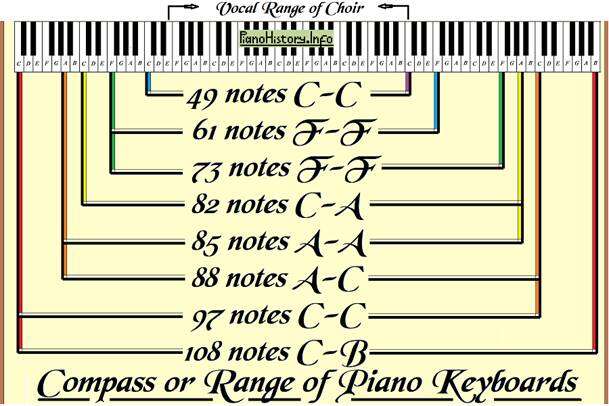
In the United States, a full-size piano keyboard has 88 keys: 52 white keys and 36 black keys. This is the standard size for acoustic pianos and most full-size digital pianos.
Some electronic keyboards have fewer keys. Common sizes include 25, 49, 61, and 76 keys. The right choice depends on whether you want to learn classical piano, play chords, make music, or save space.
Introduction
The phrase “keyboard piano” can mean two different things in the U.S.:
- A digital piano, built to copy the size, feel, and sound of an acoustic piano
- An electronic keyboard, which may have fewer keys and extra sounds, rhythms, and features
If you want the same note range as a standard acoustic piano, choose an 88-key model. If you mainly need a portable instrument for pop, worship, music production, or basic lessons, a 61-key keyboard may be enough.


How Many Keys Does a Standard Piano Have?
A standard modern piano has 88 keys. The keyboard spans from A0, the lowest note, to C8, the highest note.
Those 88 keys include:
| Key type | Number of keys |
|---|---|
| White keys | 52 |
| Black keys | 36 |
| Total keys | 88 |
The black keys are arranged in groups of two and three. This pattern repeats across the keyboard and helps players find notes and build scales.
An 88-key piano covers a little more than seven octaves. An octave is the distance between one note and the next note with the same letter name, such as C to the next C.
Why are there 88 keys?
The 88-key layout gives players the full range used in most piano music. It includes:
- Deep bass notes for the left hand
- Middle-range notes for chords and melodies
- High notes for treble parts and musical color
Earlier pianos had different key counts. Some historical instruments had fewer keys, while some modern concert instruments may use special designs. However, 88 keys is the standard for full-size pianos today.
Are all 88-key keyboards the same?
No. Two keyboards can both have 88 keys but feel very different.
Important features include:
- Weighted keys: Keys use resistance to imitate an acoustic piano.
- Hammer action: The key system copies the movement of piano hammers.
- Touch sensitivity: The sound changes when you play with more or less force.
- Key size: Full-size keys match the usual acoustic piano layout.
- Pedal support: A sustain pedal helps create longer, connected notes.
An 88-key keyboard without weighted action may have the right range but may not feel like a traditional piano.


Common Keyboard Sizes and Their Uses
The best keyboard size depends on the music you want to play and how much space you have.
| Keyboard size | Typical range | Best for |
|---|---|---|
| 25 keys | About 2 octaves | Music production and portable setups |
| 32 keys | About 2½ octaves | Compact controllers and simple parts |
| 49 keys | About 4 octaves | Beginners, synth parts, and home studios |
| 61 keys | About 5 octaves | General playing, chords, and pop music |
| 76 keys | About 6⅓ octaves | Players who need more range but want less size |
| 88 keys | More than 7 octaves | Piano study, classical music, and full-range playing |
These ranges can vary by model. Some keyboards use octave-shift buttons, so a 49-key keyboard can play higher or lower notes than its physical keys suggest. It still cannot play the full range at the same time.
Is a 61-key keyboard enough for beginners?
A 61-key keyboard is enough for many beginners. It gives you room to play:
- Basic scales
- Chords
- Simple melodies
- Pop and worship songs
- Many beginner lesson exercises
A 61-key model is often lighter and cheaper than an 88-key digital piano. It may also include useful features such as built-in rhythms, speakers, recording, and many instrument sounds.
The main limit appears when you play music that uses both very low and very high notes at once. You may need to shift octaves or leave out notes.
When should you choose 88 keys?
Choose an 88-key keyboard if you plan to:
- Study classical piano
- Follow a traditional piano method
- Play advanced sheet music
- Practice two-hand pieces across a wide range
- Build proper hand and pedal habits
- Replace an acoustic piano
For serious piano study, 88 weighted keys are usually the safest long-term choice. A smaller keyboard may work at first, but you may outgrow it.

88 Keys vs. 61 Keys: Which One Is Better?
Neither size is always better. The better option depends on your goal, space, budget, and need for realistic piano technique.
| Need | Better choice | Reason |
|---|---|---|
| Classical piano study | 88 keys | Provides the full range and usually better action |
| Small apartment | 61 keys | Takes less space and is easier to move |
| Music production | 25 or 49 keys | Works well for computer-based tracks |
| Pop and chord playing | 61 keys | Offers enough range for many songs |
| Long-term piano learning | 88 keys | Reduces the need to upgrade later |
| Young beginner with limited space | 61 or 76 keys | Easier to fit and use |
| Piano performance | 88 keys | Supports full-range pieces |
An 88-key keyboard is not automatically better for every player. It can be heavy, wide, and more expensive. A 61-key keyboard may be the more practical choice if you need portability or plan to use the instrument with a computer.
The key difference is often action, not just key count
Key count tells you the range. It does not tell you how the instrument feels.
A 61-key keyboard with light, springy keys may be useful for synthesis and simple chords. An 88-key digital piano with weighted hammer action is closer to an acoustic piano.
If your main goal is to learn piano technique, compare:
- Number of keys
- Key weight
- Touch response
- Pedal support
- Sound quality
- Available space
- Total cost

How to Count the Keys on a Piano Keyboard
You can count piano keys by checking the full repeating pattern of white and black keys.


A standard 88-key piano has:
- 52 white keys
- 36 black keys
- Seven complete octaves plus a few extra notes
The white keys use the letters:
A, B, C, D, E, F, and G
The black keys represent sharp or flat notes. For example, the black key between C and D may be called C-sharp or D-flat, depending on the musical context.
A simple way to identify the keyboard size
Look at the far left and far right ends of the keyboard.
- A full-size model usually has 88 keys.
- A common portable keyboard has 61 keys.
- A smaller controller often has 25, 32, or 49 keys.
- A 76-key model sits between a standard keyboard and a 61-key keyboard.
You can also count the white keys. A standard 88-key piano has 52 white keys, but counting them one by one can be slower than checking the product label or manual.
Do the first and last notes always match?
No. Keyboard manufacturers may choose different starting and ending notes.
For example, one 61-key keyboard may run from C to C, while another may use a different range. Octave-shift buttons can also change the notes produced by the physical keys.
Check the manufacturer’s specifications for the exact note range. Do not judge the range by key count alone.

What Is the Difference Between a Keyboard and a Digital Piano?
A digital piano is designed mainly to reproduce the playing experience of an acoustic piano. An electronic keyboard is usually designed to offer flexibility, portability, and multiple sounds.
Digital piano
A digital piano commonly includes:
- 88 keys
- Weighted or hammer-action keys
- Piano-focused sounds
- Sustain pedal support
- Fewer automatic rhythms
- A cabinet or stand on some models
Digital pianos are often better for structured piano practice.
Electronic keyboard
An electronic keyboard commonly includes:
- 25, 49, 61, or 76 keys
- Lighter keys
- Many instrument sounds
- Rhythms and accompaniment
- Recording functions
- USB or MIDI connections
- A portable design
Electronic keyboards are often useful for song writing, live performance, and music production.


The terms overlap. Some 88-key keyboards include many sounds and production tools, while some compact keyboards offer piano-style key action. Read the specifications instead of relying only on the product name.

Common Mistakes When Choosing a Keyboard Piano
The most common mistake is buying based only on the number of keys. Key count matters, but it is only one part of the instrument.
Mistake 1: Choosing a small keyboard for serious piano study
A 49-key or 61-key keyboard may feel limiting when lessons begin using a wider range. You may need to move your hands with octave buttons or skip notes.
Mistake 2: Assuming every 88-key model feels like an acoustic piano
Some 88-key keyboards have semi-weighted or unweighted keys. If realistic piano technique matters, look for weighted hammer action and touch sensitivity.
Mistake 3: Ignoring the stand and pedal
An 88-key digital piano needs a stable setup. Check whether the package includes:
- A stand
- A sustain pedal
- A music rest
- A power supply
- A bench
A pedal may be included, sold separately, or built into a piano-style cabinet.
Mistake 4: Forgetting room and transport needs
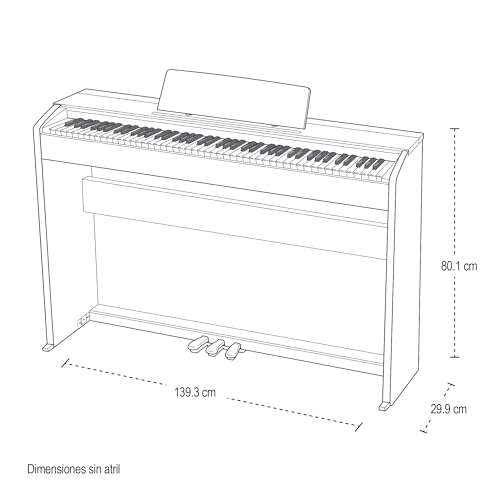
Measure the space before buying. An 88-key instrument is much wider than a 25-key controller. Also check the weight if you need to carry it to lessons or performances.
Mistake 5: Confusing MIDI with a full piano range
MIDI sends performance data to another device. It does not add physical keys. A 49-key MIDI controller can control a wide software instrument range through octave buttons, but it still offers only 49 keys at one time.
How Many Keys Should a Beginner Buy?
For a beginner learning piano in the United States, an 88-key weighted digital piano is the most complete choice if space and budget allow it.
Choose a 61-key keyboard when:
- You need a lighter instrument
- You have limited room
- You mainly play simple songs and chords
- You want extra sounds and rhythms
- You are not sure whether you will continue with piano
Choose a 76-key keyboard when you want more range than 61 keys but less size than 88 keys.
Choose a 25- or 49-key controller when your main goal is producing music with a computer. These sizes are less suitable for traditional piano study.
The practical rule is simple: buy enough keys for the music you plan to play, not just the smallest instrument that fits your room.


Frequently Asked Questions
Is 88 keys the full piano range?
Yes. An 88-key piano normally covers the range from A0 to C8. This is the standard full range of a modern acoustic piano.
Is a 61-key keyboard good for piano lessons?
It can be good for early lessons, basic songs, and general keyboard practice. However, students who plan to study classical piano may eventually need 88 weighted keys.
Are black keys counted in the total?
Yes. When a keyboard is advertised as having 88 keys, that number includes both white and black keys. The standard total is 52 white keys and 36 black keys.
Can I learn piano on a 49-key keyboard?
You can learn basic notes, chords, rhythm, and simple songs on a 49-key keyboard. It may become restrictive for advanced pieces and two-hand playing across a wide range.
What is the smallest keyboard for making music?
A 25-key MIDI controller is a common small option for music production. It works well for short melodies, bass lines, and software instruments, but it does not offer the range or feel of a full piano.
Do I need weighted keys as a beginner?
Not always. Weighted keys are more useful when your goal is traditional piano technique. If you mainly want to create beats, play synth sounds, or control music software, light keys may be more practical.
Key Takeaways
- A standard piano has 88 keys.
- It contains 52 white keys and 36 black keys.
- Full-size digital pianos usually also have 88 keys.
- Common smaller sizes are 25, 49, 61, and 76 keys.
- A 61-key keyboard suits many beginners and casual players.
- An 88-key weighted model is usually better for classical study and long-term piano learning.
- Key count does not tell you how realistic the key action feels.
- Always check the exact note range, key action, pedals, size, and included accessories.
Conclusion
The short answer to “how many keys are in a keyboard piano?” is 88 keys for a full-size piano. Smaller keyboards may have 25, 49, 61, or 76 keys, depending on their purpose.
If you want to learn piano seriously, choose 88 weighted keys when possible. If you need portability, extra sounds, or a lower-cost setup, a 61-key keyboard can be a sensible starting point.

Senior Music Reviewer
Alex Carter is a seasoned music reviewer with over a decade of experience in the world of sound and instruments. Passionate about helping musicians and enthusiasts make informed choices, he brings sharp insights and in-depth knowledge to every review. From classical instruments to modern gear, Alex combines technical expertise with a love for music to deliver content that resonates with readers.
As a Senior Music Reviewer and expert author on Tuneluma.com, Alex is dedicated to sharing honest evaluations, practical advice, and thoughtful commentary to guide readers in their musical journey.