What Was I Made For Piano Chords: Easy Guide
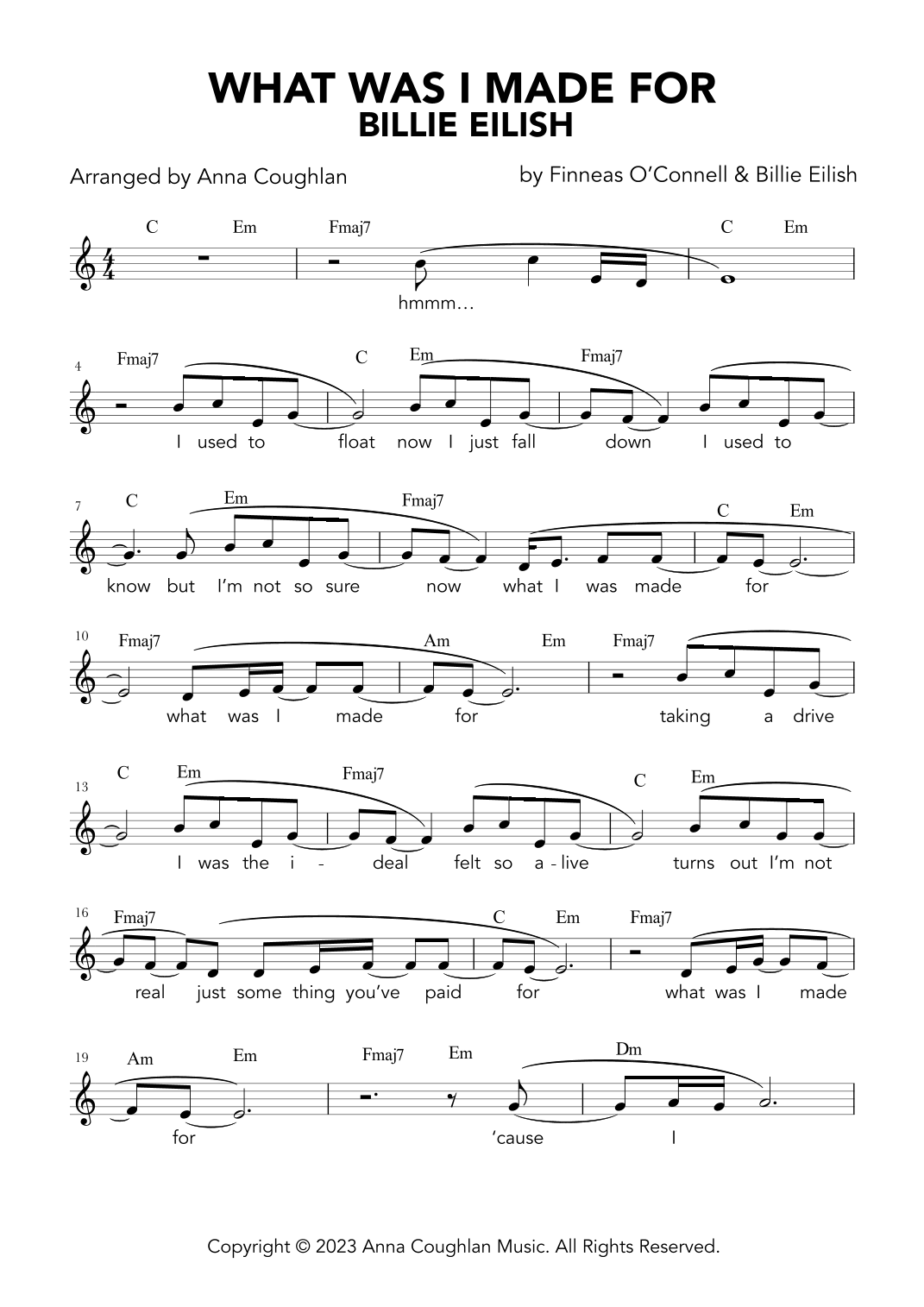
What Was I Made For piano chords are commonly played as C, Am, F, and G, with gentle seventh chords for a closer sound.
Billie Eilish and Finneas made “What Was I Made For?” feel simple, open, and deeply emotional. The right piano chords can capture that mood without complex theory. This guide explains the main chord progression, easy voicings, rhythm, melody tips, and practice steps for learning “What Was I Made For” piano chords with confidence.
What Key Is “What Was I Made For?” In?
“What Was I Made For?” is commonly arranged in C major. This key works well for beginners because it uses familiar white-key notes and avoids difficult key signatures.
The song has a soft piano style. Its harmony is not difficult, but the timing and touch matter. Play each chord slowly, let the notes ring, and leave space between phrases.
Many chord charts use slightly different versions of the same harmony. Some show basic triads, while others use major seventh, minor seventh, or suspended chords to match the recording more closely.
“What Was I Made For?” Piano Chords
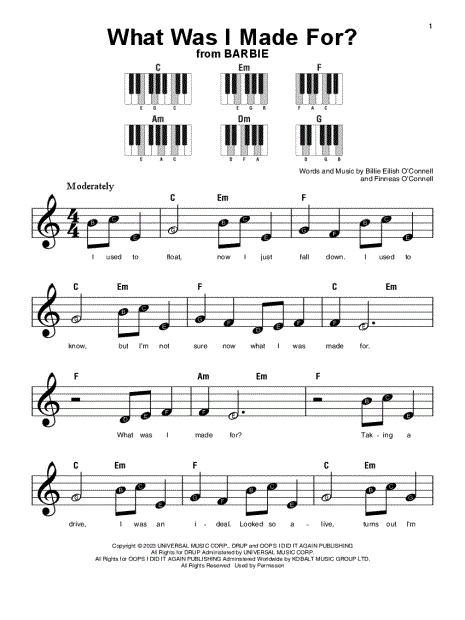
Here is a simple chord chart for the main progression:
| Chord | Notes |
|---|---|
| C | C, E, G |
| Am | A, C, E |
| F | F, A, C |
| G | G, B, D |
A common progression is:
C | Am | F | G
This four-chord pattern forms the basic structure used in many beginner arrangements of “What Was I Made For” piano chords. It is easy to play, but it can sound rich when you use a calm tempo and smooth chord changes.
For a fuller sound, try these extended chords:
| Basic chord | Fuller piano chord |
|---|---|
| C | Cmaj7 |
| Am | Am7 |
| F | Fmaj7 |
| G | Gsus4 or G7 |
The added notes create the gentle, reflective color heard in many piano arrangements. If you are new to piano, begin with the basic triads. Add the seventh notes only after the chord changes feel comfortable.
Easy Chord Shapes for Beginners
The easiest way to play “What Was I Made For” piano chords is to keep your hand near middle C. This reduces movement and helps you focus on timing.
Try these right-hand shapes:
- C major: C, E, G
- A minor: A, C, E
- F major: F, A, C
- G major: G, B, D
You can play the chords with your right hand while your left hand plays one bass note. For example, play C in the left hand with a C major chord in the right hand.
A simple left-hand pattern is:
• Left hand: Play the root note once.
• Right hand: Play the full chord softly.
• Repeat: Change chords only when the harmony changes.
This approach is useful for beginners because it keeps the arrangement clear. It also prevents the common mistake of playing too many notes too soon.
Smooth Chord Inversions
Chord inversions help your hand move less. They also make the progression sound connected.
Try these shapes:
• C major: C, E, G
• A minor: C, E, A
• F major: C, F, A
• G major: B, D, G
These voicings keep several notes close together. The result feels smoother than jumping between root-position chords.
When I work through a soft ballad arrangement, I usually look for the smallest movement between chords first. That habit saves time and makes the piano sound more polished.

A More Accurate Chord Version
If you want a sound closer to a modern piano arrangement, use seventh chords:
• Cmaj7: C, E, G, B
• Am7: A, C, E, G
• Fmaj7: F, A, C, E
• G7: G, B, D, F
You do not need to use every note at once. A simple version can place the root in the left hand and the remaining chord tones in the right hand.
For example:
• Left hand: C
• Right hand: E, G, B
This creates Cmaj7 without making the chord feel crowded.
The Fmaj7 chord is especially useful for this song’s emotional tone. The E note adds a soft lift above the F major chord. Use it gently, since a heavy touch can make the harmony sound too bright.
The G chord may work as G, Gsus4, or G7, depending on the arrangement. A suspended chord delays the third and creates a mild sense of tension before returning to C.

How to Play the Rhythm
The emotional effect of “What Was I Made For” piano chords comes from restraint. You do not need a busy rhythm. A slow broken-chord pattern often works best.
Start with this basic pattern:
- Play the bass note on beat one.
- Play the right-hand chord on beat two.
- Play the chord again on beat three.
- Let the sound fade on beat four.
You can also try an arpeggio:
• Play the lowest note.
• Play the middle note.
• Play the highest note.
• Return to the middle note.
Count slowly:
“One, two, three, four.”
Keep your wrist loose. Let the sustain pedal connect the chords, but lift it each time the harmony changes. Holding the pedal too long can blur the progression.
A useful practice method is to play without the pedal first. When every chord change is clean, add a small amount of pedal. This teaches control instead of hiding uneven changes.

How to Match the Song’s Emotional Style
Correct chords are only part of the performance. The song also depends on tone, silence, and control.
Use these techniques:
• Play softly, around piano or mezzo-piano volume.
• Keep the melody louder than the accompaniment.
• Leave small spaces between vocal phrases.
• Avoid sharp accents unless the arrangement calls for them.
• Use the sustain pedal with care.
• Slow down slightly at the end of important lines.
Think of the chords as a soft background rather than the main event. The piano should support the melody in the same way a quiet conversation supports a serious thought.
One mistake beginners make is playing every chord with equal force. That can make the song sound flat. Instead, allow some chords to breathe more than others.

Chord Progression Practice Exercise
Use this five-minute practice plan to learn “What Was I Made For” piano chords:
Minute 1: Learn the shapes
Play C, Am, F, and G as blocked chords. Do not worry about rhythm yet.
Minute 2: Practice transitions
Move between C and Am, then Am and F, then F and G. Keep your fingers close to the keys.
Minute 3: Add the left hand
Play the root note in the left hand. Use a slow count of four.
Minute 4: Add a rhythm
Try one bass note followed by three gentle chord touches.
Minute 5: Add the melody
Play or hum the vocal line while keeping the accompaniment quiet. This helps you hear whether the chords support the tune.
Record yourself if possible. A phone recording can reveal uneven timing, loud chord changes, or too much pedal. This simple check often improves a performance faster than repeating the same passage without listening back.
Common Mistakes to Avoid
Learning “What Was I Made For” piano chords should feel calm, but a few errors can slow your progress.
Playing too fast
The song needs space. Practice below the recording speed at first, then increase the tempo in small steps.
Using too much pedal
The sustain pedal can make simple chords sound beautiful. It can also turn them into a muddy wash. Change the pedal with each new chord.
Ignoring inversions
Large jumps between chords can create gaps. Use nearby inversions to keep the harmony connected.
Playing too loudly
A soft song loses its character when every note is forceful. Use relaxed fingers and a light touch.
Adding complex chords too early
Cmaj7 and Am7 sound attractive, but they are not required for a good beginner version. Learn the basic progression first.
These lessons apply to many pop piano songs. Good playing is often less about adding notes and more about choosing the right notes at the right volume.
Transposing “What Was I Made For?” Piano Chords
If C major does not suit your voice, you can transpose the chords. Transposing means moving every chord by the same number of half steps.
For example, the progression C, Am, F, and G can move up two half steps:
• C becomes D
• Am becomes Bm
• F becomes G
• G becomes A
The new progression is:
D | Bm | G | A
You can also use a digital keyboard’s transpose button. However, learning the new chord names is better if you want to build lasting piano skills.
If you sing along, choose a key that feels relaxed. The best key is not always the original key. It is the key that lets you sing without straining or forcing the high notes.
Using a Sustain Pedal
The sustain pedal is important for creating a smooth piano sound. Press it after playing the chord, then release and replace it when the next chord begins.
A simple pedal pattern is:
- Play the chord.
- Press the sustain pedal.
- Let the chord ring.
- Release the pedal as you play the next chord.
- Press it again.
This method keeps the harmony connected while preventing unwanted overlap.
If your piano has a half-pedal feature, use a light amount. Digital keyboards may respond differently from acoustic pianos, so adjust your touch to the instrument.
The recording may also contain production effects that a home piano cannot copy exactly. That is normal. Aim for a clean, expressive arrangement rather than a perfect copy of the studio sound.
Recommended Arrangement Levels
You can choose an arrangement based on your skill level.
Beginner arrangement
Use C, Am, F, and G in root position. Play one bass note and one right-hand chord per measure.
Early intermediate arrangement
Use chord inversions and a broken-chord pattern. Add a gentle melody in the top note.
Intermediate arrangement
Use Cmaj7, Am7, Fmaj7, and Gsus4. Add passing notes and a steady left-hand pattern.
Advanced arrangement
Create your own voicings, inner movement, and dynamic changes. You can also combine the vocal melody with a fuller accompaniment.
Each level uses the same harmonic foundation. The difference is in voicing, rhythm, dynamics, and control.
Are These the Official Chords?
Online chord charts are often simplified. They may not show every passing chord, inversion, bass movement, or production detail from the original recording.
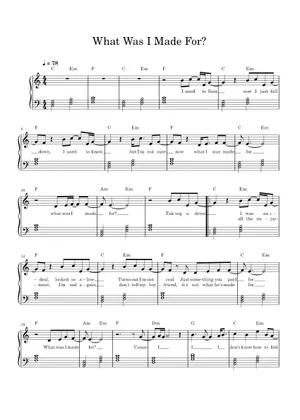
The basic C, Am, F, and G pattern is useful for learning and accompanying the song. A licensed sheet music arrangement may include more precise details, such as extended chords, rhythmic changes, and melody notes.
Use a trusted score when exact accuracy matters. For casual playing, songwriting practice, or singing at home, a simple chord chart is often enough.
This distinction matters because “correct” can mean two different things. A chart can be musically useful without reproducing every note from the recording.
Frequently Asked Questions About “What Was I Made For?” Piano Chords
What are the basic “What Was I Made For” piano chords?
The most common beginner chords are C, Am, F, and G. These chords can support much of the song in a simple piano arrangement.
What key is “What Was I Made For?” played in?
The song is commonly arranged in C major. Some charts or performances may use another key, especially when the song is transposed for a singer.
Is “What Was I Made For?” easy to play on piano?
Yes, the basic chord progression is beginner-friendly. The main challenge is controlling the soft rhythm, melody balance, and sustain pedal.
What chords make the song sound more emotional?
Try Cmaj7, Am7, and Fmaj7 instead of plain major and minor triads. These seventh chords add a softer and more reflective color.
Do I need a sustain pedal to play the song?
No, you can learn the chords without one. A sustain pedal can make the arrangement smoother, but it should be changed with each chord to avoid muddy sound.
Can I play the song with only my right hand?
Yes, you can play the chord shapes with your right hand alone. Adding single bass notes with the left hand will make the arrangement sound fuller.
How can I sing while playing the chords?
Practice the chord pattern until it feels automatic. Then add the melody slowly, keeping the piano softer than your voice.
Conclusion
“What Was I Made For” piano chords are accessible because the main harmony uses a simple C, Am, F, and G progression. With smooth inversions, gentle seventh chords, careful pedal use, and a slow touch, you can create a sound that feels warm and expressive.
Start with the basic chords. Practice each transition without rushing. Then add the left-hand bass, melody, dynamics, and richer voicings one step at a time.
Try the progression today, record your playing, and adjust the rhythm and volume until it feels natural. Explore more piano chord guides and share your arrangement with other players.

Senior Music Reviewer
Alex Carter is a seasoned music reviewer with over a decade of experience in the world of sound and instruments. Passionate about helping musicians and enthusiasts make informed choices, he brings sharp insights and in-depth knowledge to every review. From classical instruments to modern gear, Alex combines technical expertise with a love for music to deliver content that resonates with readers.
As a Senior Music Reviewer and expert author on Tuneluma.com, Alex is dedicated to sharing honest evaluations, practical advice, and thoughtful commentary to guide readers in their musical journey.