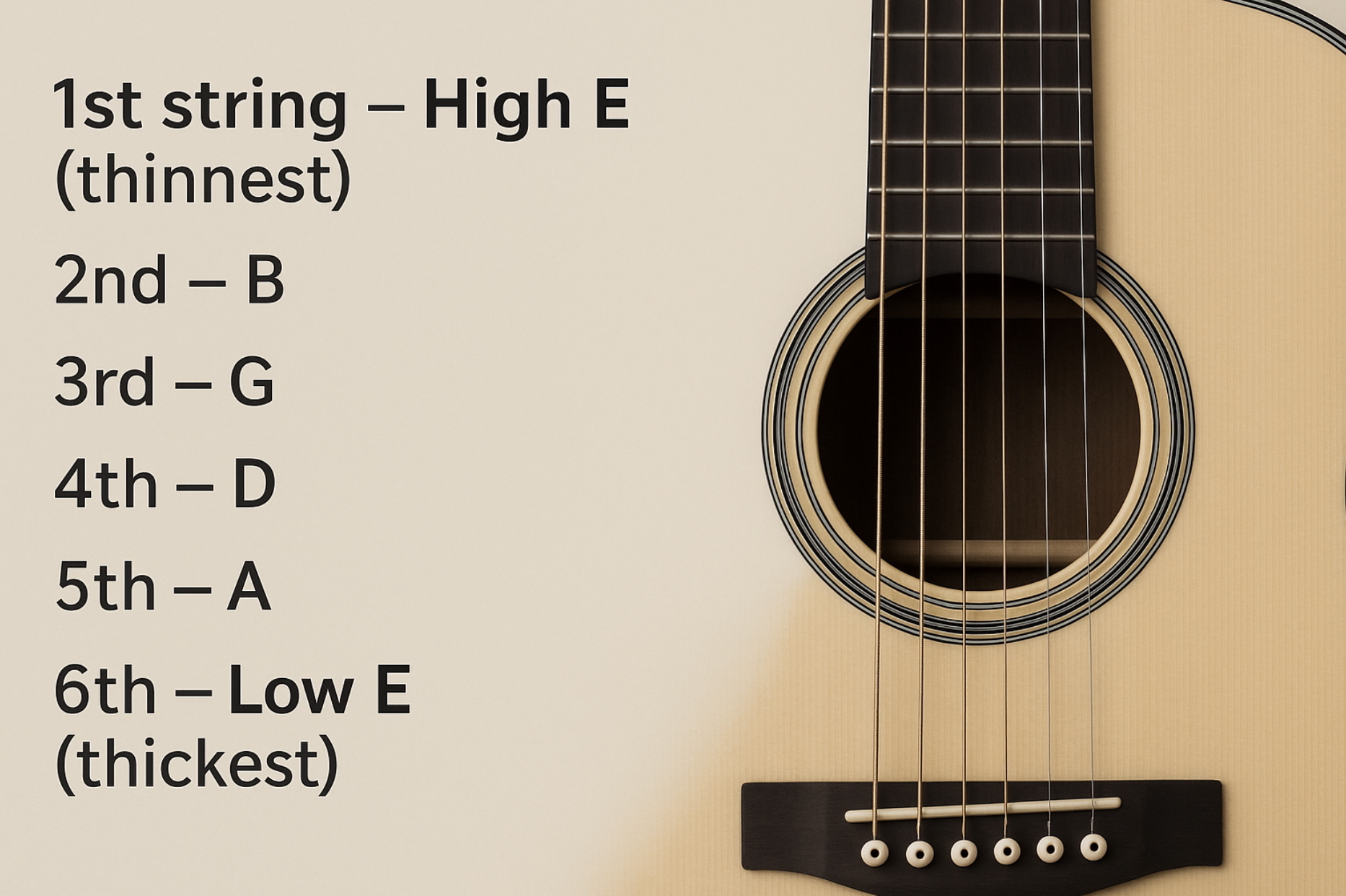
In the United States, guitar strings are usually numbered from 1 to 6. String 1 is the thinnest, highest-pitched string, and string 6 is the thickest, lowest-pitched string. On a standard six-string guitar, the order is:
1st string: high E
2nd string: B
3rd string: G
4th string: D
5th string: A
6th string: low E
This numbering stays the same whether you play acoustic guitar, electric guitar, or classical guitar. The key is to number the strings by their usual pitch, not by which string sits closest to your face or hands.


Guitar String Numbers and Names
Guitar strings have both a number and a note name. The number tells you which string to use. The note name tells you the pitch of that string when it is tuned to standard tuning.
| String number | Common name | Standard tuning note | Typical string |
|---|---|---|---|
| 1 | High E | E4 | Thinnest |
| 2 | B string | B3 | Second thinnest |
| 3 | G string | G3 | Middle |
| 4 | D string | D3 | Fourth |
| 5 | A string | A2 | Second thickest |
| 6 | Low E | E2 | Thickest |
The number comes first in many guitar instructions. For example:
- “Play the open 1st string” means play the high E string without pressing a fret.
- “Tune the 5th string to A” means adjust the A string.
- “Bend the 2nd string at the 10th fret” means use the B string at fret 10.
The high E string and low E string share the same letter name, but they are two octaves apart. Calling them the high E and low E prevents confusion.

Which Guitar String Is Number 1?
The 1st string is the high E string. It is the thinnest string on a standard six-string guitar and produces the highest open-string pitch.
When you hold a right-handed guitar in playing position, the 1st string is usually the string closest to the floor. The 6th string is closest to the ceiling.
That physical position can confuse new players. The string closest to the floor is not called the sixth string. It is called the first string because it has the highest standard pitch.
A quick way to remember the order is:
1 is high, 6 is low.
From high to low, the strings are:
1–2–3–4–5–6
E–B–G–D–A–E


The same numbering applies to left-handed guitars. The instrument may be reversed physically, but string numbers still follow pitch order.
How Guitar String Numbers Work in Standard Tuning
Standard tuning is written from the 6th string to the 1st string as:
E–A–D–G–B–E
This is the order most guitarists learn because it follows the strings from the lowest pitch to the highest pitch.
The same tuning written by string number is:
- 6th string: E
- 5th string: A
- 4th string: D
- 3rd string: G
- 2nd string: B
- 1st string: E
Many charts show tuning from the 6th string to the 1st string. Many lessons and chord diagrams refer to strings by number. Learning both formats helps you read guitar material without reversing the order.
A standard tuning memory phrase
A common phrase for the open strings from the 6th string to the 1st string is:
Eddie Ate Dynamite, Good Bye Eddie
The first letters represent:
- E = 6th string
- A = 5th string
- D = 4th string
- G = 3rd string
- B = 2nd string
- E = 1st string
You can also remember the order from the 1st string to the 6th string:
E B G D A E
The first method matches the way many tuners and guitar lessons list the strings. The second method starts with the high E string.

Do String Numbers Match String Thickness?
String numbers often match thickness, but the number does not directly mean a string’s gauge.


On a typical guitar:
- The 1st string is the thinnest.
- The 6th string is the thickest.
- The strings become thicker as the number rises.
However, string gauge varies by guitar type and string set. A light electric-guitar set may use different gauges from a light acoustic set. Classical guitar strings also use nylon or composite materials rather than the steel construction used on most acoustic and electric guitars.
String gauge is measured in inches. A package labeled .010–.046 may contain a .010-inch high E string and a .046-inch low E string. The first number refers to the 1st string, while the last number refers to the 6th string.
This means:
- String number identifies the string’s position and pitch.
- String gauge identifies its approximate thickness.
- String tension describes how tightly the string pulls when tuned.
Do not use the string number as a replacement for gauge. If a guitar maker or string package calls for a .012 high E, you need to check the gauge, not just buy any 1st string.

How to Identify Guitar Strings Without Memorizing Them
You can identify most guitar strings by combining their position, thickness, and pitch.
1. Find the thinnest string
The thinnest string is normally the 1st string, or high E. It may feel delicate and produces a bright, high sound.
2. Find the thickest string
The thickest string is normally the 6th string, or low E. It produces the lowest open-string sound.
3. Check the middle strings
From thin to thick, the standard order is:
1st, 2nd, 3rd, 4th, 5th, 6th
The 3rd string is the G string. On many steel-string guitars, it may be either plain or wound, depending on the set and gauge.
4. Use a tuner
A chromatic tuner can show the note being played. In standard tuning, the open strings should read:
- E for the 1st string
- B for the 2nd string
- G for the 3rd string
- D for the 4th string
- A for the 5th string
- E for the 6th string
A tuner may show the octave or a scientific pitch label, such as E2 or E4. That does not change the string number.
5. Check the string package
Most complete string sets list gauges in order from the 1st string to the 6th string. A package may show:


.010 .013 .017 .026 .036 .046
In this example, .010 is the 1st string and .046 is the 6th string.

How String Numbers Appear in Guitar Tabs
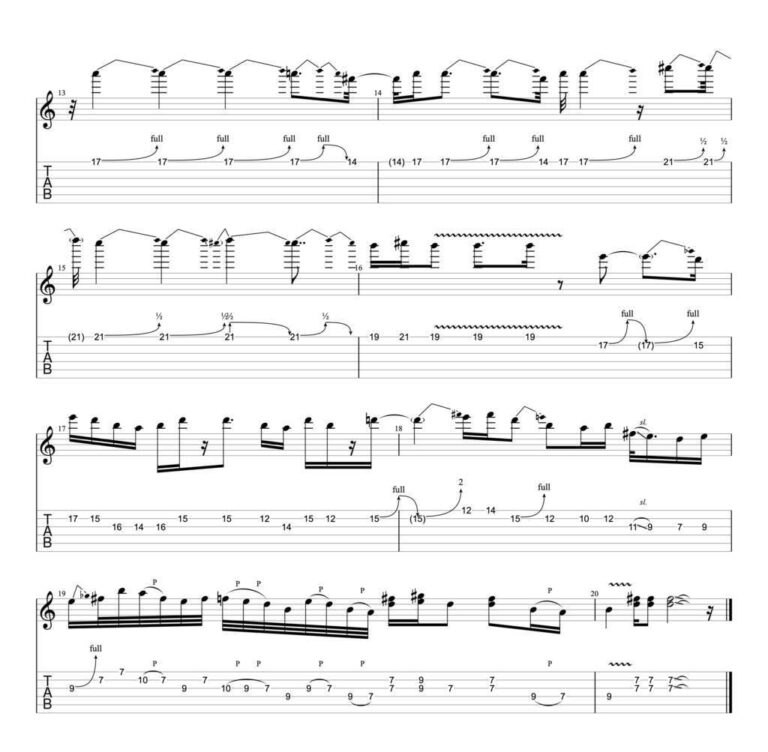
Guitar tablature, or tab, uses six horizontal lines for a standard six-string guitar. The top line represents the 1st string, and the bottom line represents the 6th string.
This is different from the way tuning is often listed. Tab reads from the player’s highest-pitched string at the top to the lowest-pitched string at the bottom.
A basic tab example looks like this:
e|---0---|
B|---1---|
G|---0---|
D|---2---|
A|---3---|
E|-------|
The lowercase and uppercase letters at the left label the strings:
- Top line: 1st string, high E
- Second line: 2nd string, B
- Third line: 3rd string, G
- Fourth line: 4th string, D
- Fifth line: 5th string, A
- Bottom line: 6th string, low E
The numbers on the lines are fret numbers, not string numbers. A zero means to play the string open.
For example, a number 3 on the bottom line means play the 6th string at the 3rd fret. A number 3 on the top line means play the 1st string at the 3rd fret.

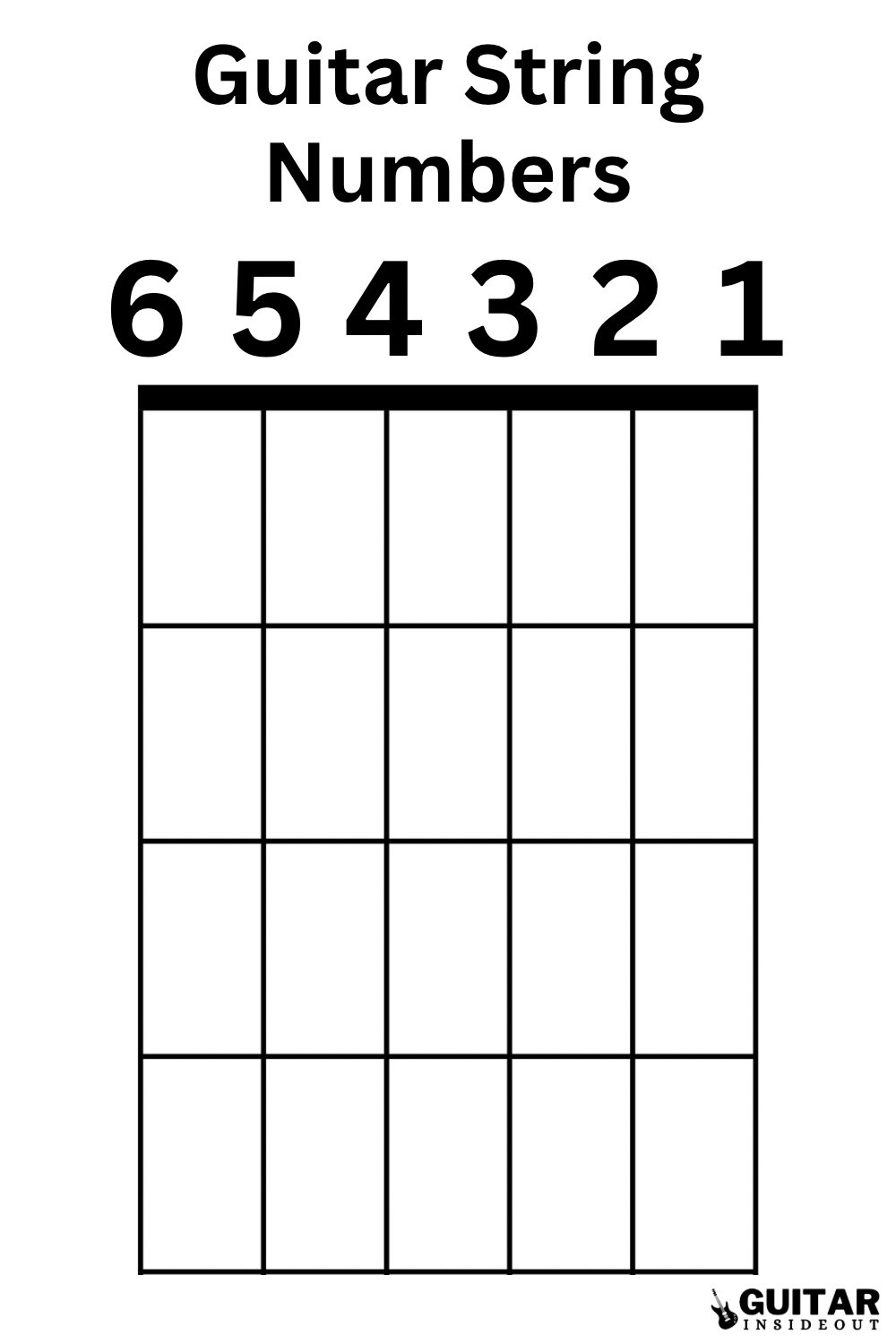
How String Numbers Appear in Chord Diagrams
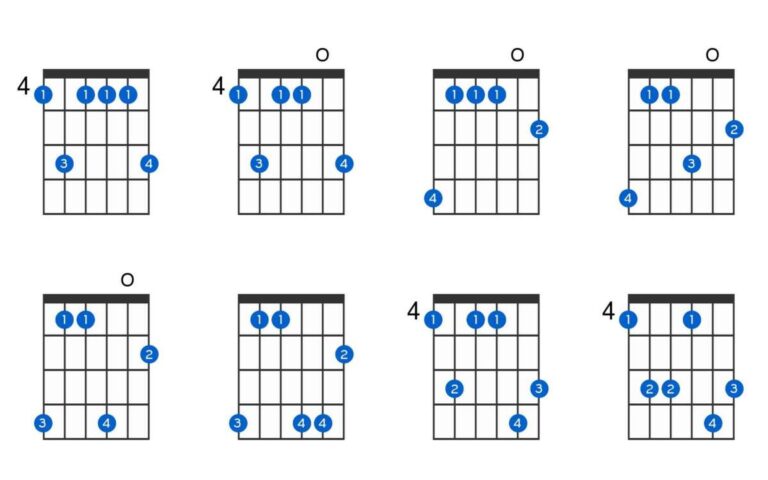
Chord diagrams usually show the guitar neck as if you are looking directly at it. The vertical lines represent strings, and the horizontal lines represent frets.
Most chord diagrams place the:
- 6th string on the left
- 1st string on the right
This can seem backward when compared with tablature. It is not a change in string numbering. The diagram is simply using a different visual viewpoint.
A chord diagram may also use these symbols:
- O means play the string open.
- X means do not play the string.
- A dot shows where to place a finger.
- A number may identify the suggested fretting finger.
For example, a chord chart with an X over the 6th string means you should avoid the low E string. It does not mean the 6th string has become the 1st string.


Always check the diagram’s labels before playing. Some charts are drawn for left-handed players or use a nut-up orientation, which changes the picture but not the actual string numbers.

How String Numbering Changes on Other Guitars
The usual numbering system expands to guitars with more than six strings.
Seven-string guitar
A seven-string guitar usually adds a lower string. In the common layout:
- 1st string: high E
- 2nd string: B
- 3rd string: G
- 4th string: D
- 5th string: A
- 6th string: low E
- 7th string: lower B
The 7th string is normally the thickest and lowest string.
Some seven-string guitars use other tunings. The string number still follows the instrument’s standard high-to-low layout, but the note may change.
Eight-string guitar
An eight-string guitar may add a lower bass string, a higher treble string, or doubled courses. Because designs differ, check the maker’s tuning chart before replacing strings or reading tab.
Twelve-string guitar
A 12-string guitar has six courses, with two strings in each course. The courses are normally numbered from the highest-pitched course to the lowest-pitched course:
- 1st course: high E pair
- 2nd course: B pair
- 3rd course: G pair
- 4th course: D pair
- 5th course: A pair
- 6th course: low E pair
The two strings in the lower four courses are often tuned an octave apart. The two strings in the highest two courses are usually tuned to the same note.
Some players call each individual string a string number, while others refer to the paired course. When buying replacements, use the manufacturer’s course and gauge information.
Four-string bass guitar
A standard four-string bass is usually numbered from high to low:
- 1st string: G
- 2nd string: D
- 3rd string: A
- 4th string: E
This follows the same basic rule: the 1st string is the highest-pitched string, and the highest number is the lowest-pitched string.

Common Mistakes With Guitar String Numbers
Mistake 1: Counting from the low E
Some beginners call the low E the 1st string because it is the first string they see when looking at a guitar from above. In standard guitar language, it is the 6th string.
Mistake 2: Confusing string number with fret number
“Play the 2nd string at the 5th fret” contains two separate instructions:


- 2nd string = the B string
- 5th fret = the position on the neck
Do not read “2nd” as the fret.
Mistake 3: Reading tab upside down
The top line of standard tab is the 1st string. The bottom line is the 6th string. Turning the tab around can make every note sound wrong.
Mistake 4: Assuming every guitar uses standard tuning
Drop D, open G, half-step-down, DADGAD, and other tunings change the notes. They do not normally change the string numbers.
Mistake 5: Replacing a string by number alone
A replacement string must also match the guitar’s type, scale, tuning, material, and gauge. The correct 1st string for a steel-string acoustic guitar may not be suitable for a classical guitar.
Quick Reference: Guitar String Numbers
| If someone says… | Use this string |
|---|---|
| 1st string | High E |
| 2nd string | B |
| 3rd string | G |
| 4th string | D |
| 5th string | A |
| 6th string | Low E |
For standard tuning, remember:
High to low: E, B, G, D, A, E
Low to high: E, A, D, G, B, E
If you are reading tab, the top line is the 1st string. If you are reading a chord diagram, the left side is often the 6th string.

Frequently Asked Questions
Are guitar strings numbered from the top or bottom?
They are numbered by pitch, not simply by physical position. The 1st string is the highest-pitched string, usually the high E. The 6th string is the lowest-pitched string, usually the low E.
Is the thickest guitar string number 1?
No. On a standard six-string guitar, the thickest string is the 6th string. It is usually the low E string.
What is the thinnest guitar string called?
The thinnest string is usually the 1st string, also called the high E string. Its exact gauge depends on the string set.
Does string numbering change with alternate tuning?
Usually, no. Alternate tuning changes the note of a string, but not its number. For example, in Drop D, the 6th string changes from E to D but remains the 6th string.
Are acoustic and electric guitar strings numbered the same way?
Yes. Both normally use 1st through 6th string numbering, with the 1st string as the highest and the 6th string as the lowest. Their materials, gauges, and tensions can differ.
Conclusion
Standard guitar strings are numbered from 1 to 6, moving from the highest-pitched string to the lowest-pitched string. The 1st string is high E, and the 6th string is low E.
Use this order when reading tabs, chord charts, lessons, tuner instructions, and string packages. When the guitar has more or fewer strings, check its tuning chart, but the basic rule remains: the lowest number usually identifies the highest-pitched string.
For your next practice session, point to each string and say its number and note aloud: 1-E, 2-B, 3-G, 4-D, 5-A, 6-E. That small exercise makes guitar charts much easier to read.

Senior Music Reviewer
Alex Carter is a seasoned music reviewer with over a decade of experience in the world of sound and instruments. Passionate about helping musicians and enthusiasts make informed choices, he brings sharp insights and in-depth knowledge to every review. From classical instruments to modern gear, Alex combines technical expertise with a love for music to deliver content that resonates with readers.
As a Senior Music Reviewer and expert author on Tuneluma.com, Alex is dedicated to sharing honest evaluations, practical advice, and thoughtful commentary to guide readers in their musical journey.