Introduction
On drum sets, marching drums, and concert percussion instruments across the United States, a flam is a drum stroke made from two notes played almost together. The first note is a soft grace note. The second is the louder main note. Together, they create the wide, full sound often written or spoken as “FLAM.”
A flam is not two equal hits. It is one clear main stroke with a quiet note just before it. Once you learn the timing, the flam becomes a key part of many drum rudiments, fills, grooves, and marching patterns.

What Is a Flam in Drumming?
A flam is a grace note followed immediately by a main note, usually played with opposite hands.
For example:
- Left grace note, right main note: L-R
- Right grace note, left main note: R-L
The grace note should be soft and close to the drumhead. The main note should be louder and higher. Your ears should hear one broad sound rather than two separate taps.
The Percussive Arts Society lists the flam as one of the standard 40 International Drum Rudiments. These rudiments form a common technical base for drum set players, marching percussionists, and concert percussionists in the United States and many other countries.
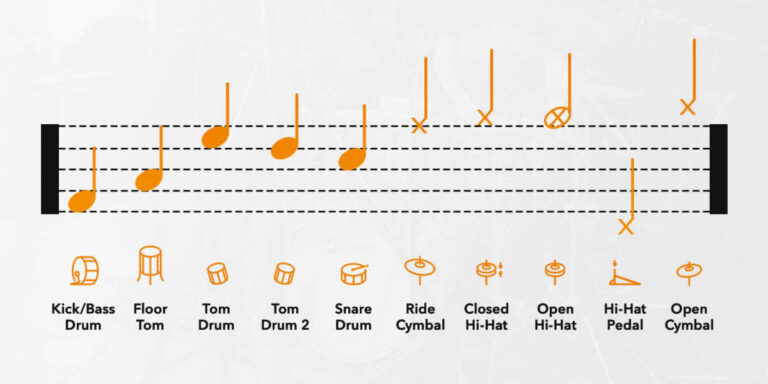
Basic flam notation
In written music, the grace note appears as a small note placed just before a full-size note. It may have a slash through its stem, depending on the notation system.
A simple text version looks like this:
small grace note + full-size main note
        L                 R
You may see the pattern written as:
lR rL
Lowercase letters show the soft grace notes. Uppercase letters show the louder main notes.
The exact spacing is not fixed by a strict number of milliseconds. The two notes should be close enough to sound like one combined stroke, but clear enough that the main note still speaks.

How Does a Flam Sound?
A clean flam sounds like a short “flahm” or a small burst of sound. The grace note gives the stroke width and texture. The main note provides the focus and volume.
A flam has three key sound features:
- The grace note is quiet.
- The main note is strong and clear.
- The two notes are very close together.
If the notes are too far apart, the flam sounds like two separate hits. If they are too close or equal in volume, the flam may sound like a weak double stroke or an accidental rim click.
The main note should be easy to identify. If a listener cannot tell which note is the main note, the dynamic difference is probably too small.
Flam versus double stroke
A flam and a double stroke both use two hits, but they work in different ways.
| Technique | First note | Second note | Main purpose |
|---|---|---|---|
| Flam | Soft grace note | Loud main note | Creates a wide, accented sound |
| Double stroke | Usually similar volume | Usually similar volume | Creates two even notes |
| Drag or ruff | Often several soft notes | Main note follows | Creates a denser ornament |
A flam is based on contrast. A double stroke is based on evenness.

How to Play a Flam Correctly
Start slowly. A flam is easier to learn when you focus on hand position and sound before adding speed.
1. Choose the main hand
Decide whether your right or left hand will play the main note.
For a right-hand flam:
- Left hand plays the quiet grace note.
- Right hand plays the loud main note.
The sticking is:
lR
For a left-hand flam:
rL
2. Set the stick heights
Raise the stick for the main note. Keep the grace-note stick low.
A useful starting position is:
- Grace-note stick: about 1 inch above the drumhead
- Main-note stick: about 6 to 12 inches above the drumhead
These are practice guidelines, not fixed rules. The exact height will change with your instrument, style, volume, and tempo.
The important point is the difference between the two hands. The main hand needs more height and energy.
3. Place the grace note first
Let the grace-note stick fall just before the main stroke. Do not lift it high or strike it with force.
Think of the grace note as a small pickup into the main note. It should prepare the sound, not compete with it.
4. Play the main note
The main note should come from the higher stick. It should have a clear attack and a larger sound.
Avoid squeezing the stick. A relaxed grip lets the stick rebound and helps both hands stay close to the drumhead.
5. Check the sound
Ask yourself:
- Can I hear one main note?
- Is the grace note softer?
- Are the notes close together?
- Do both sticks finish at similar heights?
- Does the motion feel relaxed?
If the flam sounds like “tap—TAP,” the gap is likely too large. If it sounds like “TAP-TAP,” the grace note may be too loud.

A Simple Flam Exercise
Use a metronome at a slow speed, such as 50 to 60 beats per minute. Play one flam on each click.
Start with alternating main hands:
lR rL lR rL
Then reverse the order:
rL lR rL lR
Next, play four flams with the right hand as the main hand, followed by four with the left:
lR lR lR lR | rL rL rL rL
Keep the beat steady. Do not speed up when the pattern feels comfortable.
Add subdivisions
When the basic flam is controlled, place flams on eighth notes:
1 & 2 & 3 & 4 &
lR rL lR rL lR rL lR rL
Then try sixteenth notes:
1 e & a 2 e & a
lR rL lR rL lR rL lR rL
The goal is not maximum speed. The goal is consistent spacing and a clear main note.
Practice on different surfaces
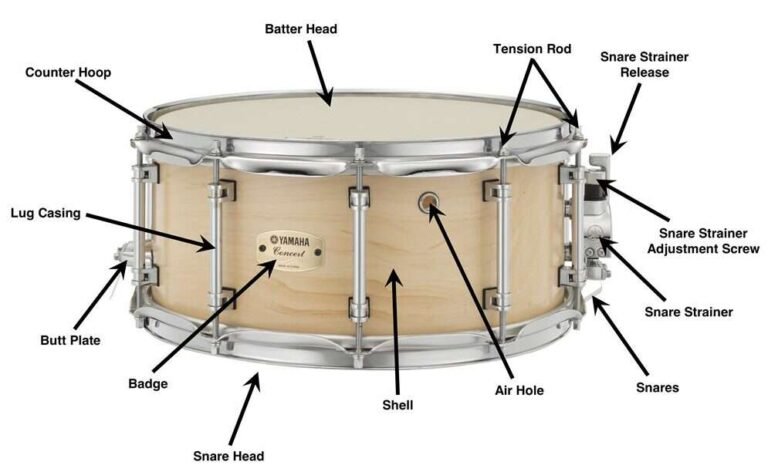
A practice pad gives a clean rebound and helps you hear timing. A drum gives a more musical tone. A marching snare may expose uneven grace-note height because its response can feel more direct and controlled.
Practice on a pad first if your hands are tense. Move to the drum when you can keep the motion relaxed.

Common Flam Mistakes
Most flam problems come from poor spacing, equal dynamics, or excess hand motion.
The grace note is too loud
This makes the flam sound like two strong notes. Lower the grace-note stick and use less force.
The main note should remain the loudest part of the sound.
The notes are too far apart
A large gap turns the flam into two separate strokes. Practice at a slower tempo and bring the grace note closer to the main note.
Do not solve this by rushing both notes. The hands need better timing, not more speed.
The two notes are too close
If both sticks strike at nearly the exact same moment, the grace note may disappear. Move the grace-note hand slightly earlier.
Use very slow practice. At a low speed, you can feel the order of the two notes.
Both sticks are the same height
Equal stick heights often produce equal volume. Keep the grace-note stick low and the main-note stick high.
The height difference may become smaller at fast tempos, but the dynamic difference should remain audible.
The main hand does not lead
A flam is defined by the main note. If the grace hand feels stronger, switch to slow single flams and exaggerate the height difference.
The hands become tense
Tension often appears when players try to force volume or speed. Reduce the tempo, loosen the grip, and use the rebound of the stick.
Stop if you feel pain. Normal practice may create fatigue, but sharp pain, numbness, or persistent discomfort is a reason to rest and seek advice from a qualified medical professional.

Flam Rudiments and Patterns
The basic flam is used inside many other rudiments. Learning the simple flam first makes these patterns easier to understand.
Flam accent
A flam accent combines a flam with additional unaccented notes. A common sticking idea is:
lR L R | rL R L
The flam acts as the accented first note of each group.
Flam tap
A flam tap places a tap after each flam:
lR L | rL R
The tap should be quieter than the flam. Keep the hands relaxed so the accent does not cause the next note to become too loud.
Flam paradiddle
A flam paradiddle combines a flam with the sticking shape of a paradiddle:
lR L L R | rL R R L
Different books may show different sticking layouts or groupings. Follow the notation used by your teacher, school, drumline, or method book.
Pataflafla
A pataflafla is a longer flam pattern that uses repeated flam figures and alternating strokes. It can improve hand control, but it should come after the basic flam is stable.
The names and exact stickings of advanced rudiments may vary by teaching system. The core idea stays the same: a soft grace note comes immediately before a stronger main note.

How Flams Are Used in Drum Set Playing
On a drum set, flams add weight and shape to fills, backbeats, and accents.
A drummer may use a flam:
- Before a snare backbeat
- At the start of a fill
- To add force to a crash
- In funk, rock, marching, and orchestral phrases
- To make a single accent sound broader
- As part of a linear drum fill
For example, a snare flam before a crash can make the crash entrance feel larger. A flam on the snare can also add a sharp, spoken quality to a groove.
The best placement depends on the style. A wide, open flam may suit a marching or concert setting. A tighter flam may work better in a fast drum-set fill where space is limited.
Do not add flams to every accent. Their effect comes from contrast. If every note has a flam, the pattern may lose its shape.

How Flams Work in Marching and Concert Percussion
Marching percussion often requires very controlled flam spacing. The group must make many players sound like one ensemble.
In a marching setting, instructors may specify:
- Grace-note height
- Main-note height
- Flam spacing
- Playing zone
- Stick angle
- Dynamic level
- Whether the flam is open, closed, or compressed
A field performance may use a wider flam spacing so the sound carries clearly. A fast indoor passage may use a tighter spacing.
Concert percussionists also use flams, but the desired sound depends on the instrument. A snare drum, tom, bass drum, and timpani each respond differently. The player must adjust touch and spacing while keeping the main note clear.
This is why a flam is not just a fixed hand motion. It is a relationship between timing, dynamics, instrument response, and musical context.
Flam Timing: Open, Closed, and Compressed Flams
Teachers often describe flams by how much space exists between the two notes.
| Flam type | Spacing | Sound |
|---|---|---|
| Open flam | More space | Clear and broad |
| Closed flam | Less space | Tight and compact |
| Compressed flam | Very little space | Almost simultaneous |
These terms are useful, but they do not always have one universal measurement. A teacher, drumline, or method book may define them in its own way.
Use the sound as your guide. The flam should remain clear, and the main note should still lead.
A slow exercise can use open flams. As the tempo rises, the hands naturally move closer together. Do not force a closed flam before you can control an open one.
How Long Does It Take to Learn a Flam?
Many beginners can produce a basic flam in one practice session. A consistent flam usually takes longer.
Progress depends on:
- Prior stick control
- Hand relaxation
- Practice time
- Sense of rhythm
- Rebound control
- The style of music
- The required tempo and volume
A short daily session is often more useful than one long session each week. Practice five minutes of slow flams, then stop or change exercises before tension builds.
Record yourself from above or from the side. Listen for:
- Even volume from right and left hands
- A soft grace note
- A clear main note
- Similar spacing on both sides
- No extra taps
A teacher can also help identify timing problems that are hard to hear while playing.
Flam vs. Ruff: What Is the Difference?
A flam uses one grace note before the main note. A ruff or drag usually uses two or more grace notes before the main note.
Simple comparison:
Flam:  grace + main
Ruff:  grace + grace + main
Terminology can vary between drum traditions. Some teachers use “drag” and “ruff” in slightly different ways, especially when discussing exact note counts or open and closed execution.
If your method book gives a specific definition, use that system for practice and notation. The practical difference is the number of soft notes leading into the main stroke.
Frequently Asked Questions
Is a flam one note or two notes?
A flam contains two physical strokes: one grace note and one main note. Musically, it is often heard as one combined accent.
Which hand plays first in a flam?
The hand that plays the grace note comes first. The opposite hand plays the main note. For a right-hand flam, the left hand plays first.
Should the grace note be louder than the main note?
No. The grace note should normally be much softer than the main note. The main note gives the flam its accent and direction.
Can you play flams with one hand?
A standard flam uses two hands. Some advanced players create one-handed flam-like effects through finger control, rim techniques, or specialized strokes, but those are not the basic two-hand flam rudiment.
Are flams only used on snare drums?
No. Flams can be played on drum set drums, marching snares, concert snares, toms, and other percussion instruments. The technique and spacing may change with the instrument.
Why does my flam sound like a double stroke?
The grace note may be too loud, or the two notes may be too far apart. Lower the grace-note stick, slow down, and make the main note clearly stronger.
Key Takeaways
- A flam is a soft grace note followed by a louder main note.
- The two notes use opposite hands.
- The grace note stays low and quiet.
- The main note stays higher and stronger.
- Start slowly with
lRandrL. - A clean flam sounds like one broad accent, not two separate hits.
- Flams form the basis of flam accents, flam taps, flam paradiddles, and other rudiments.
- Relaxed hands and steady timing matter more than speed.
Conclusion
A flam in drumming is a small grace note placed just before a stronger main note. Its sound comes from the mix of close timing and clear dynamic contrast.
Begin with slow alternating flams. Keep the grace note low, let the main note lead, and listen for one wide sound. Once that basic motion feels natural, use it in flam taps, flam accents, drum fills, and musical phrases.
For standard rudiment names and notation, compare your exercises with the Percussive Arts Society’s 40 International Drum Rudiments. Your next step is simple: play five relaxed minutes of lR rL at a slow tempo, then listen back for spacing and volume.

Senior Music Reviewer
Alex Carter is a seasoned music reviewer with over a decade of experience in the world of sound and instruments. Passionate about helping musicians and enthusiasts make informed choices, he brings sharp insights and in-depth knowledge to every review. From classical instruments to modern gear, Alex combines technical expertise with a love for music to deliver content that resonates with readers.
As a Senior Music Reviewer and expert author on Tuneluma.com, Alex is dedicated to sharing honest evaluations, practical advice, and thoughtful commentary to guide readers in their musical journey.