
What Are The Best Violins For Beginners: Buying Guide
The best violins for beginners offer easy playability, reliable setup, good tone, and room to grow.
Choosing a first violin can feel confusing. Many instruments look alike online, yet build quality, setup, size, and comfort can differ a lot. After helping new players compare student violins, I have found that a well-set-up instrument often matters more than a famous brand name. This guide explains what are the best violins for beginners, which models deserve attention, what to avoid, and how to choose with confidence.

What makes a violin good for a beginner?
The best beginner violin should make learning easier, not harder. A poor instrument may have high strings, rough fingerboard edges, weak tuning pegs, or a bridge that does not fit well. These problems can make a new player think they lack talent when the real issue is the instrument.
A good starter violin should offer:
• Comfortable string height for easy fingering
• Smooth tuning pegs that hold their pitch
• A properly shaped bridge
• A straight fingerboard
• A clear, balanced tone
• A strong case with useful protection
• A decent bow that responds well
• Replacement strings that are easy to find
A violin does not need to be expensive to work well. However, very cheap factory instruments often need repairs that cost more than the violin itself. This is why setup is one of the most important factors when deciding what are the best violins for beginners.
A beginner violin is usually made from maple and spruce, with ebony fittings on better student models. Some low-cost instruments use soft wood or painted parts that look like ebony. These may work for a short time, but they often wear down quickly.
Why setup matters more than price
Setup means preparing the violin so it can be played safely and comfortably. A violin shop may adjust the bridge, sound post, nut, pegs, fingerboard, and strings.
Two violins from the same brand can feel very different if one has received professional setup and the other has not. In my experience, a modest violin with a careful setup often feels better than a more expensive violin shipped straight from a factory.
Best violins for beginners at different budgets
There is no single perfect violin for every new player. The right choice depends on your budget, age, practice goals, and access to a violin shop. The models below are common options, but availability and setup quality can vary by seller.
Yamaha V3 series
the Yamaha V3 is one of the safest choices for a new student who wants a dependable instrument from a well-known maker. It usually has a more consistent build than many low-cost online violins.
The tone is clear and controlled rather than overly bright. That makes it useful for lessons, school orchestra, and early solo practice.
Good points include:
• Consistent construction
• Comfortable student design
• Reliable tuning hardware
• Good resale and trade-in potential
• Strong support from music retailers
The Yamaha V3 can cost more than entry-level starter kits. Still, its consistency makes it one of the strongest answers to what are the best violins for beginners.
Yamaha V5 Series
The Yamaha V5 is a step above many basic student instruments. It often includes better materials and more careful finishing than the lowest-priced models.
This violin suits students who plan to practice often or continue beyond the first year. It may also appeal to parents who want to avoid buying several upgrades in a short period.
The V5 is not required for a beginner. A well-set-up V3 can serve a new player very well. The V5 becomes more attractive when the student already shows strong interest and needs a violin with more tonal range.
Eastman VL80
The Eastman VL80 is another respected student violin. It is often sold through violin shops, where a technician can check and adjust it before purchase.
Many players like its warm and focused sound. It may respond well to a beginner’s bow, which helps the student produce a cleaner tone.
The Eastman VL80 is often a better choice when you can try the violin in person. Individual instruments can sound slightly different, even within the same model line.
Stentor 1500
The Stentor 1500 is a popular student violin in many markets. It provides a practical entry point for children, teens, and adults who need a complete starter outfit.
Its main benefit is value. A typical package may include a case and bow, which helps keep the first purchase simple.
Before buying, check the bridge, pegs, and string height. Some Stentor violins play much better after a professional setup. This model can be one of the best violins for beginners when purchased from a seller who checks each instrument.
Cecilio CVN-300
The Cecilio CVN-300 is often chosen by beginners who need a low-cost outfit. It may include a case, bow, rosin, and extra strings.
Its low price makes it appealing for casual learners. It can also be useful for a child who is not yet sure whether violin lessons will become a long-term activity.
The main limitation is quality control. Some examples play well after adjustment, while others may need work. Buy from a seller with a clear return policy, and budget for a setup if needed.
Mendini student violins
Mendini violins are common online and often come in colorful finishes. They usually target first-time players who want a complete kit at a low price.
These instruments can work for basic practice, but they are less consistent than many shop-sold violins. A bright finish should not be the main reason to choose one.
If you select a Mendini violin, inspect the bridge, tuning pegs, bow hair, and strings as soon as it arrives. A local teacher or violin technician can quickly identify problems.
Renting from a violin shop
For many families, renting is one of the best options. A good rental program may include maintenance, size exchanges, and credit toward a future purchase.
This matters because children often need a quarter-size, half-size, or three-quarter-size violin before moving to a full-size model. Buying every size can become expensive.
A rental is also useful when you are unsure whether the student will continue. It lowers the risk and gives the player time to develop a real preference.

Beginner violin sizes
The correct size depends mainly on the player’s arm length and hand reach. Age can provide a rough guide, but it should not decide the purchase by itself.
Common violin sizes include:
• 1/16 size for very young children
• 1/10 size for small children
• 1/8 size for young players
• 1/4 size for children with longer reach
• 1/2 size for growing students
• 3/4 size for older children
• 4/4 full size for most teens and adults
A teacher or violin shop should measure the student. One common method is to place the violin under the player’s chin and extend the left arm beneath the instrument. The hand should reach around the scroll without strain.
An instrument that is too large can cause tension in the shoulder, wrist, and fingers. A violin that is too small may feel cramped and limit progress. Proper size is a major part of choosing what are the best violins for beginners.
Adults almost always use a full-size violin. Smaller adults may still prefer a full-size instrument, but comfort should guide the final decision.
Acoustic violin or electric violin for a beginner?
Most beginners should start with an acoustic violin. An acoustic instrument teaches the player how to create sound through bow speed, pressure, contact point, and finger placement.
An electric violin can be useful for quiet practice with headphones. It may also suit performers who need effects or amplification. However, many electric models feel and respond differently from traditional violins.
Some low-cost electric violins have poor balance or weak response. They can be frustrating as a first instrument. Unless silent practice is your main concern, an acoustic violin is usually the better learning tool.
A student who lives in an apartment may choose an acoustic violin with a practice mute. A mute reduces volume, although it can also change the instrument’s feel and tone.

What should come with a beginner violin?
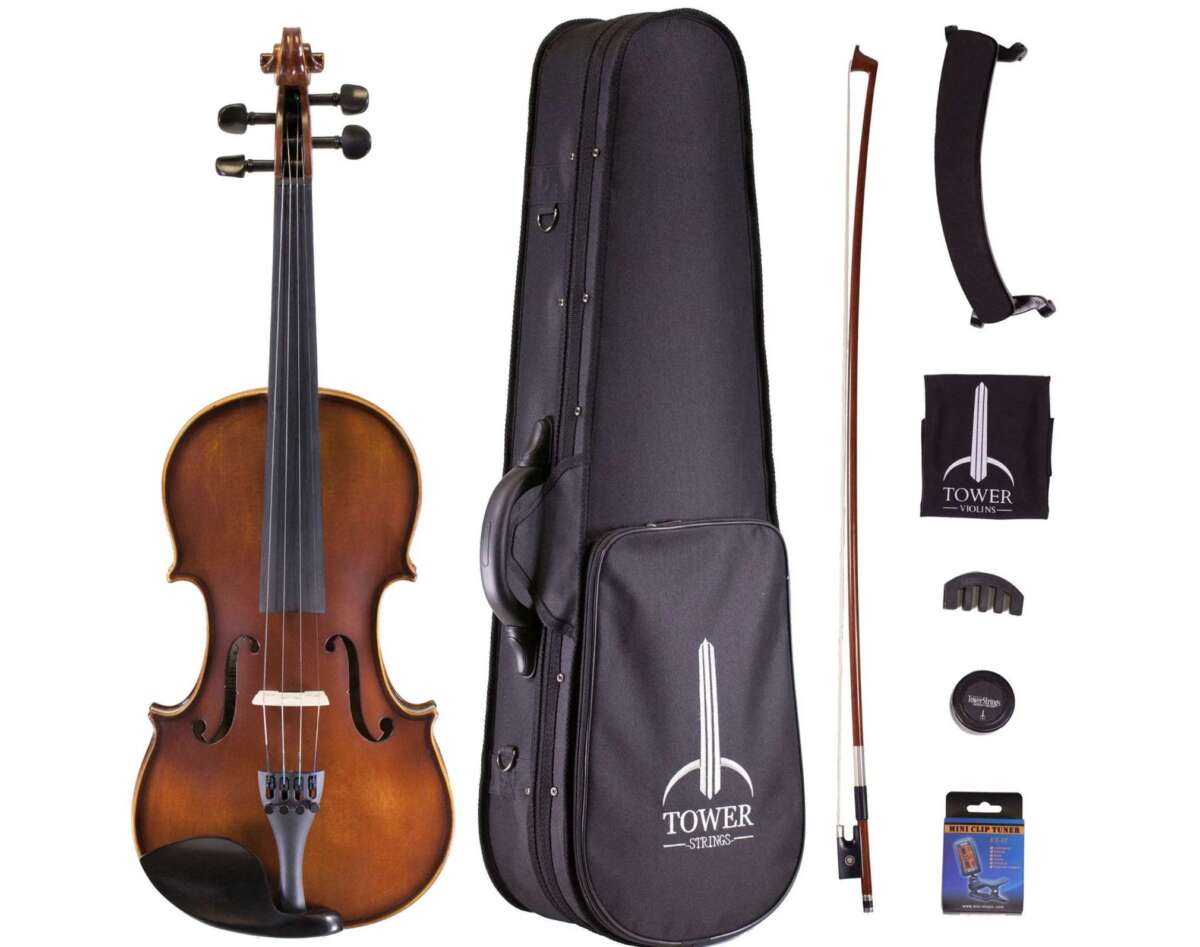
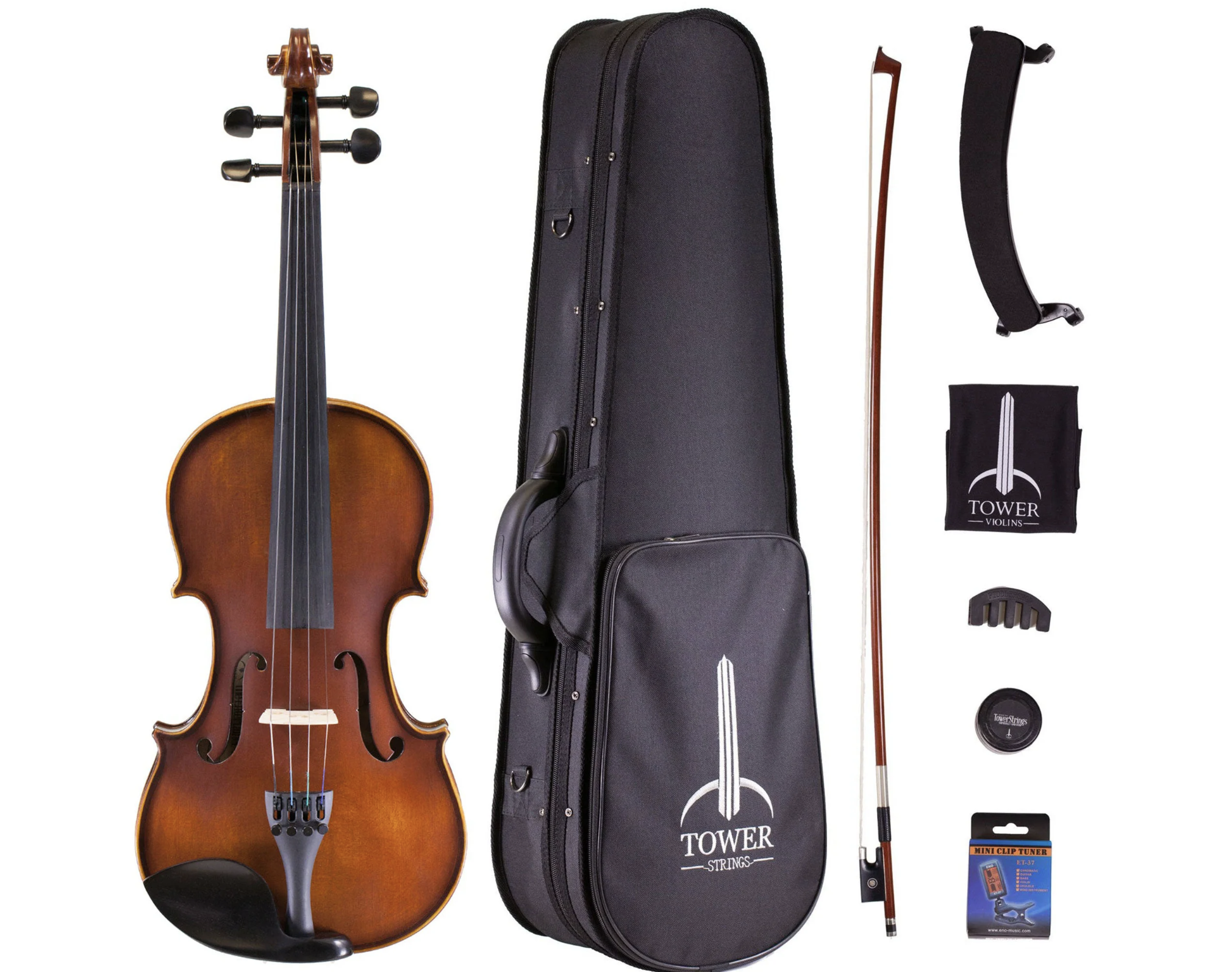
A complete violin outfit often includes the instrument, bow, case, and rosin. Some packages also include an extra set of strings, a shoulder rest, and a polishing cloth.
Check each part before you buy.
The bow
A beginner bow should have straight wood or a stable carbon fiber stick. The hair should be even and properly tensioned. A damaged bow can make it hard to produce a steady sound.
Carbon fiber bows can offer good durability for students. A quality pernambuco or Brazilwood bow may provide a more refined response, but it is not necessary for every beginner.
The case
The case should hold the violin firmly. It should also protect the bridge and keep the bow secure.
Look for:
• Strong outer material
• A padded interior
• Secure fasteners
• Space for rosin and accessories
• Shoulder straps for safe carrying
Rosin
Rosin helps the bow hair grip the strings. Without enough rosin, the bow may slide and produce a weak sound.
Too much rosin creates dust and a harsh tone. A beginner usually needs only a few slow swipes across the bow hair.
The shoulder rest
A shoulder rest is not required for every player, but many students find it helpful. It should support the violin without forcing the shoulder upward.
A teacher can help adjust the height and position. Comfort should come first.

New violin or used violin?
A used violin can be an excellent choice. Older instruments sometimes offer a pleasing tone at a lower price. However, age alone does not prove quality.
Inspect a used violin for:
• Open seams
• Cracks near the bridge or sound post
• A warped neck
• Loose tuning pegs
• A damaged fingerboard
• A bridge that leans or has deep string grooves
• Missing purfling
• Signs of water or heat damage
Small repairs may be affordable. Structural repairs can be costly. If you do not know what to look for, take the instrument to a violin shop before paying.
A used student violin from a respected shop is often safer than a new, unbranded violin from a marketplace. The shop may have repaired, adjusted, and tested it.
This is an important lesson I have seen many new players learn the hard way: a bargain is not a bargain if the violin cannot stay in tune or produce a stable tone.

How much should you spend on a beginner violin?
Prices change by country, seller, materials, and setup. In the United States, a practical starting point may look like this:
• Under $150: Basic outfits with uneven quality and a higher chance of setup problems
• $150 to $400: Usable student outfits, especially from established brands
• $400 to $800: More consistent student violins with better materials and response
• Above $800: Advanced student instruments and better shop-selected outfits
These ranges are general, not strict rules. A $250 violin with a good setup may outperform a $500 violin that has been poorly stored or adjusted.
Remember to include the cost of lessons, strings, rosin, a shoulder rest, and possible repairs. The violin is only one part of learning.
For many families, renting is the most cost-effective way to begin. It also allows the player to change sizes without buying a new instrument each time.
Common mistakes when buying a beginner violin
New players often focus on appearance or price. Those details matter, but they should come after playability and fit.
Avoid these common mistakes:
• Buying a violin without checking its size
• Choosing the cheapest listing without reading return terms
• Assuming every violin in one model line feels identical
• Ignoring professional setup
• Buying a decorative violin with a poor bow
• Using old or low-quality strings for too long
• Ordering from a seller that cannot answer basic questions
• Choosing a violin only because it comes with many accessories
A violin should not have to fight the student. If tuning pegs slip, strings sit too high, or the bridge is badly shaped, ask a technician for help.
Do not judge a beginner’s progress by the first sound. Every new violinist produces squeaks at first. A good instrument will not remove the learning curve, but it will make that curve fairer.
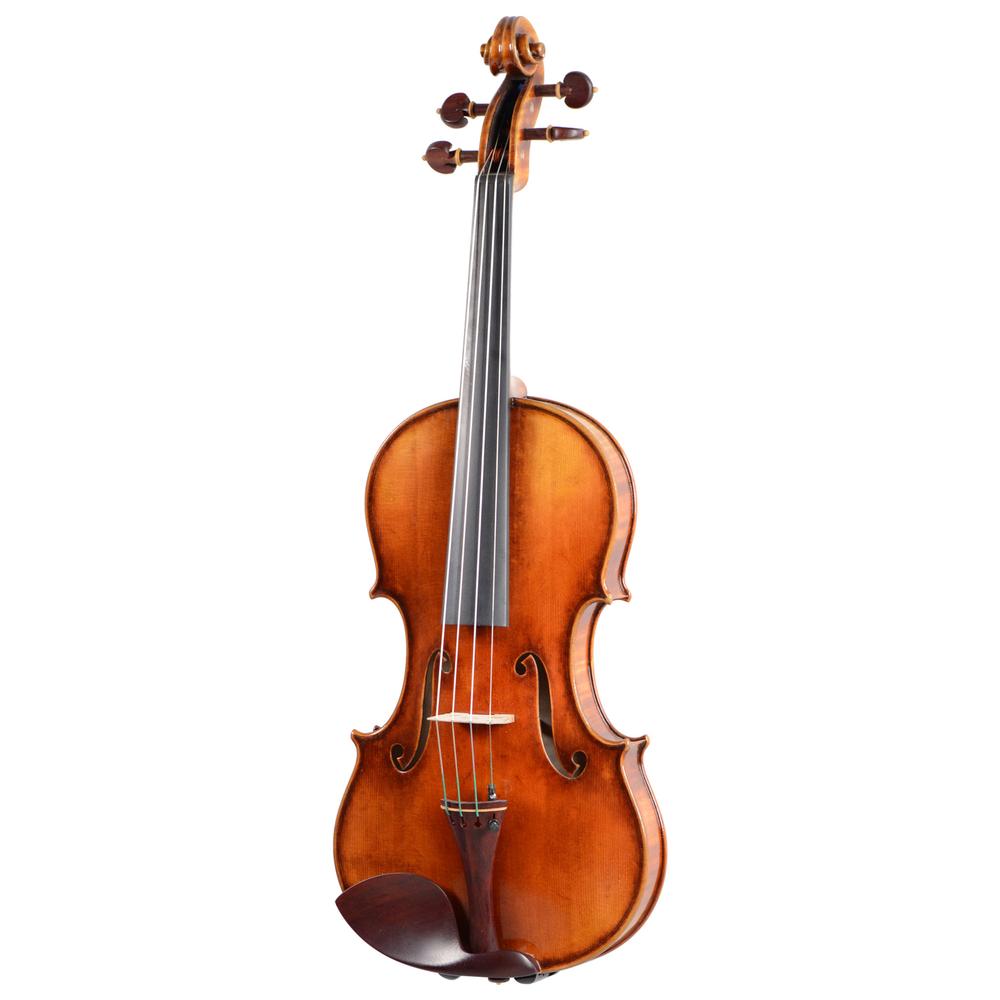
How to test a beginner violin
Testing a violin in person is ideal. If you are new to the instrument, bring a teacher or experienced player.
Use this simple process:
-
Check that the body has no major cracks or open seams.
-
Turn each tuning peg and make sure it moves smoothly.
-
Look at the bridge from the side. It should stand upright, not lean sharply.
-
Check that the fingerboard looks straight.
-
Play open strings and listen for buzzing.
-
Test a few simple notes in first position.
-
Check whether the bow feels balanced.
-
Confirm that the shop offers adjustments or returns.
The violin should feel comfortable under the chin. The left hand should not need to squeeze hard. The bow should move across the strings without constant slipping.
If you shop online, ask whether the instrument receives a professional setup before shipping. Also confirm the return window and who pays return shipping.
Beginner violin care and maintenance
A violin can last for decades with basic care. Keep it away from rapid changes in heat and humidity. Do not leave it in a hot car, near a heater, or in direct sunlight.
After each practice session:
• Wipe rosin dust from the strings and body
• Loosen the bow hair
• Place the violin in its case
• Close the case before carrying it
• Check for loose parts or damage
Use a soft, dry cloth. Do not apply furniture polish or household cleaner to the varnish.
Change strings when they sound dull, feel rough, or will not stay in tune. A teacher or technician can recommend suitable strings for the instrument.
The bow should always be loosened after playing. Leaving the hair tight can weaken the stick over time.
Can a beginner learn on a cheap violin?
A cheap violin can support early learning if it is correctly sized and properly adjusted. The problem is not always the price. The problem is poor construction or poor setup.
Some low-cost violins have bridges that are too thick, pegs that slip, or strings that sit too high. These issues make basic skills much harder.
If your budget is limited, consider a rental or a used violin from a local shop. Spending a little more on setup may improve the playing experience more than buying a larger accessory package.
Are expensive violins better for beginners?
More expensive violins often use better wood, fittings, varnish, and craftsmanship. They may offer a wider tonal range and smoother response.
However, expensive does not always mean better for a new player. A violin must match the player’s size, technique, and musical goals.
A student does not need a professional-level instrument to learn scales, songs, posture, and bow control. Choose a reliable student violin first, then upgrade when the player can explain what they need from a better instrument.
What are the best violins for beginners?
The best violins for beginners are usually well-set-up student models from Yamaha, Eastman, Stentor, or similar established makers. A rental from a reputable violin shop can be even better for a growing child.
Is Yamaha a good beginner violin brand?
Yes. Yamaha student violins are known for consistent construction and dependable quality control. The V3 is a practical choice, while the V5 suits students who want a more advanced starter instrument.
Is a 4/4 violin suitable for every beginner?
A 4/4 violin is suitable for most teens and adults, but young children usually need a smaller size. A teacher or violin shop should measure the player before purchase.
Should I rent or buy a beginner violin?
Renting is often best for children who may change sizes or may not continue lessons. Buying can make sense for an adult or committed student who has found a comfortable, well-set-up instrument.
How much does a beginner violin cost?
A usable beginner outfit may cost around $150 to $800 in the United States, depending on the brand and setup. Very cheap instruments may need repairs, so include maintenance in your budget.
Do beginner violins need professional setup?
Most beginner violins benefit from professional setup. Proper bridge shape, string height, peg fit, and fingerboard alignment can make the instrument much easier to play.
Can I buy a beginner violin online?
Yes, but choose a seller with strong reviews, setup service, and a clear return policy. If possible, have a teacher or violin technician inspect the instrument after delivery.
Conclusion
The best violins for beginners are not always the cheapest or most attractive models. They are instruments that fit the player, stay in tune, respond well to the bow, and receive a careful setup.
For many students, the Yamaha V3, Yamaha V5, Eastman VL80, Stentor 1500, or a well-adjusted Cecilio can be a sound starting point. A reputable rental program is also a smart choice, especially for children who are still growing.
Take your time, ask a teacher or violin shop for advice, and test the instrument before committing. With the right violin in hand, steady practice becomes more rewarding. Explore local rental programs, compare trusted student models, and choose the instrument that makes you want to play again tomorrow.

Senior Music Reviewer
Alex Carter is a seasoned music reviewer with over a decade of experience in the world of sound and instruments. Passionate about helping musicians and enthusiasts make informed choices, he brings sharp insights and in-depth knowledge to every review. From classical instruments to modern gear, Alex combines technical expertise with a love for music to deliver content that resonates with readers.
As a Senior Music Reviewer and expert author on Tuneluma.com, Alex is dedicated to sharing honest evaluations, practical advice, and thoughtful commentary to guide readers in their musical journey.