Best Digital Piano For Composing: Top Picks For Musicians
The Yamaha P71 is the best digital piano for composing because its weighted keys, clean tone, and simple MIDI workflow inspire ideas.
You sit down with a melody in your head, but your old keyboard feels thin, noisy, or too small for real two-hand work. A good digital piano fixes that gap. It gives you a full range, better key control, headphone practice, and a direct path into recording software. I tested these options by focusing on the things that matter most to composers: touch, sound, USB or MIDI support, pedal control, comfort, and value. Whether you write film music, pop songs, classical pieces, or simple demos, the right piano should feel like a trusted sketchbook.
Digital Piano 88-Key Semi-Weighted Set

This 88-key digital piano set aims to give new players a complete composing station in one box. The semi-weighted keyboard offers more resistance than a light synth action, so chords and bass notes feel more controlled. Its built-in speakers let you play without extra gear, while the included stand helps create a stable home setup. For a beginner, that matters because a ready-to-play instrument removes many small barriers.
The Bluetooth, MIDI, USB, and MP3 features add useful ways to create. I like the option to connect a phone for backing tracks or pair the keyboard with a computer for simple music production. The sustain pedal also helps shape longer notes and soft piano lines. It will not feel as refined as a premium hammer-action piano, but it gives a new composer room to learn without a large first investment.
Pros:
- Full 88-key range supports two-hand composition
- Includes a stand for a more complete setup
- Bluetooth helps with lessons and backing tracks
- USB and MIDI connections support computer recording
- Built-in speakers make quick practice easy
- Includes a sustain pedal for expressive playing
Cons:
- Semi-weighted keys may feel light to advanced pianists
- Sound detail may not match established piano brands
- The larger set takes more room than a compact controller
My Recommendation
I recommend this model for beginners, casual songwriters, and home creators who want many useful features at a low entry cost. It works well when your main goal is to capture ideas, practice chord shapes, and learn basic arranging. The full keyboard gives you enough space for piano parts, while USB and MIDI make it useful beyond the first lesson. For someone searching for the best digital piano for composing on a budget, this set offers strong convenience.
| Best for | Why |
|---|---|
| First-time composers | It includes the basic pieces needed to start playing right away. |
| Home recording beginners | USB, MIDI, Bluetooth, and MP3 functions support simple studio work. |
| Value shoppers | The stand, pedal, speakers, and keyboard come as one practical package. |
Yamaha P71 Weighted Action Piano

The Yamaha P71 remains one of the safest choices for a composer who wants a focused piano rather than a crowded feature list. Its 88 weighted keys use Yamaha’s Graded Hammer Standard action, with a heavier feel in the low range and a lighter feel in the high range. That design gives scales, repeated notes, and left-hand patterns a more natural response. It also encourages good finger control from the start.
Yamaha keeps the control panel simple, which I see as a strength during writing sessions. The instrument offers a respected acoustic piano sound, built-in speakers, a sustain pedal, and a compact shape that fits many rooms. It does not include a large collection of arranger tools, Bluetooth functions, or onboard recording features. Still, a composer who works with a computer can use the P71 as a reliable keyboard source and focus on the music rather than menu settings.
Pros:
- Weighted 88-key action feels closer to an acoustic piano
- Graded resistance supports natural hand development
- Yamaha piano tone suits classical, pop, and film writing
- Simple controls keep the creative process clear
- Compact body fits small studios and apartments
- Includes a sustain pedal and power supply
Cons:
- Limited sounds and creative functions
- No built-in Bluetooth audio connection
- The basic sustain pedal feels less solid than a three-pedal unit
My Recommendation
The Yamaha P71 is best for serious beginners, piano students, and composers who value key feel above extras. I would choose it for someone who plans to practice often and wants an instrument that will not feel like a toy after a few months. Its clean layout also suits writers who already use a DAW for drums, strings, and effects. In my view, it is the best digital piano for composing when natural piano technique and dependable tone matter most.
| Best for | Why |
|---|---|
| Piano-led composers | The weighted action gives melodies and chords more physical control. |
| Small rooms | The slim design provides a full range without a bulky cabinet. |
| Long-term learners | Yamaha’s familiar action helps build habits that transfer to acoustic piano. |
Donner DEP-20 Weighted Piano with Stand

The Donner DEP-20 is built for players who want a full-size weighted keyboard with a furniture-style presentation. Its 88 keys give a composer the full piano range, and the weighted action adds useful resistance for chord work. The included stand and three-pedal unit create a more traditional playing position than a keyboard placed on a folding X stand. That stable feel can make long writing sessions more comfortable.
This model also gives beginners more sounds and functions than a plain digital piano. I find that helpful when a new songwriter wants to compare piano, electric piano, organ, and other tones without opening a computer. The controls are not as direct as those on a professional stage piano, so first-time users may need a little practice. Even so, the DEP-20 offers a generous feature set for home composition and basic learning.
Pros:
- Weighted 88-key keyboard supports full piano technique
- Furniture stand gives the instrument a stable home position
- Three-pedal unit improves sustain and soft-pedal control
- Multiple tones help with early songwriting experiments
- Suitable for lessons, practice, and home demos
- Full-size layout leaves enough room for wide chords
Cons:
- Furniture-style setup is less portable
- Some players may find the action less refined than Yamaha’s
- Built-in sounds are more useful than deeply detailed
My Recommendation
I would point this Donner toward a beginner who wants the look and feel of a home piano without paying for a traditional acoustic instrument. It is especially useful for families, students, and songwriters who want three pedals and a permanent setup. The extra sounds can also help a new composer explore different moods before buying software instruments. If you want the best digital piano for composing in a home practice space, the DEP-20 is a well-equipped choice.
| Best for | Why |
|---|---|
| Home learners | The stand and pedal unit create a familiar piano-style station. |
| Chord-based songwriters | Weighted keys and 88 notes support broad voicings and bass lines. |
| Families | Its range of sounds gives several players room to explore. |
UISCOM 88-Key Semi-Weighted Keyboard

The UISCOM 88-key semi-weighted keyboard targets beginners who want a broad range and a light, approachable playing feel. Semi-weighted keys sit between a springy controller and a heavy hammer-action piano. That makes them comfortable for simple melodies, chord progressions, and basic accompaniment. A new composer may also appreciate that the keys do not demand as much finger strength during long practice sessions.
This type of keyboard can serve as a flexible idea tool. You can play through a chord loop, test a melody, and connect the instrument to a computer when the sketch becomes a full track. Its compact approach suits bedrooms, desks, and small creative corners. I would not buy it as a replacement for acoustic-piano training, but it can be a friendly first step into songwriting and digital music.
Pros:
- Full 88-key range covers standard piano parts
- Semi-weighted action feels easy for new players
- Useful for simple chord and melody writing
- More comfortable than a narrow 61-key board for piano music
- Works well in a compact home practice area
- Lower resistance can reduce fatigue for casual sessions
Cons:
- Does not reproduce the feel of true hammer action
- Advanced pianists may want more key resistance
- Feature and sound quality may vary by software connection
My Recommendation
This UISCOM model is best suited to a beginner composer who values ease, space, and a full keyboard more than concert-level touch. It makes sense for a teenager, a casual songwriter, or a producer who mainly uses virtual instruments in a computer. I also like it for players who find heavy keys tiring. As a low-cost way to begin searching for the best digital piano for composing, it covers the core needs without making the learning curve feel steep.
| Best for | Why |
|---|---|
| Casual songwriters | The lighter action makes quick idea sessions feel easy. |
| Bedroom producers | The full range supports piano parts while taking less space. |
| New learners | Semi-weighted keys offer a gentle bridge into keyboard playing. |
Vediya 88-Key Semi-Weighted Digital Piano

The Vediya 88-key digital piano focuses on giving beginners a familiar full-size layout without the weight of a traditional piano. Its semi-weighted keys offer some resistance, which can make basic practice feel more controlled than an unweighted keyboard. The 88-note range is valuable for composers because it leaves room for low bass notes and high melody notes at the same time. That freedom helps when an idea grows beyond a simple four-chord loop.
For early composing, I prefer an instrument that is easy to turn on and easy to understand. This Vediya keyboard fits that role and can support daily practice, simple demos, and music lessons. Its lighter action favors quick playing and repeated idea testing rather than strict classical training. Buyers should check the current listing for the exact included accessories, dimensions, and connection details before ordering, since package contents can change.
Pros:
- 88 keys provide complete piano note coverage
- Semi-weighted action is approachable for beginners
- Good fit for chord sketches and melody writing
- Useful choice for small home music spaces
- Full keyboard feels more versatile than a short controller
- Simple design keeps attention on composition
Cons:
- Not the ideal choice for advanced classical technique
- Accessory details should be confirmed before purchase
- Brand support may not match larger piano makers
My Recommendation
I see the Vediya as a practical starter for a composer who wants 88 keys at an accessible price. It suits beginners who write at a desk, practice after work, or need a second keyboard for a small studio. The semi-weighted action gives a little more control while staying friendly to new hands. For shoppers comparing affordable options for the best digital piano for composing, this model deserves attention when the current package meets your needs.
| Best for | Why |
|---|---|
| Budget beginners | It offers a full-size layout without a premium piano price. |
| Small creative spaces | The lighter design is easier to place than a cabinet piano. |
| Basic demos | It provides enough range for chords, bass, and melody ideas. |
88-Key Semi-Weighted Piano Bundle

This 88-key piano bundle is designed for a buyer who wants more than a keyboard alone. The package includes a stand, carrying case, headphones, power supply, and sustain pedal, so it can move from an unboxing session to a real practice session quickly. Its semi-weighted keys give new players a little resistance without the heavier feel of a full hammer-action instrument. That balance works well for pop writing, worship music, lessons, and basic home recording.
The carrying case is a major practical benefit if you need to move between rooms, lessons, or small performances. Headphones also let you work late without disturbing other people, which can turn quiet hours into productive writing time. USB-MIDI compatibility gives the keyboard a useful link to modern music software. The main compromise is touch realism, but the bundle makes up for that with flexibility and helpful extras.
Pros:
- Includes stand, case, headphones, pedal, and power supply
- 88 keys support full-range composition
- USB-MIDI works with compatible music software
- Headphones enable quiet practice and late-night writing
- Carrying case makes transport easier
- Semi-weighted action suits beginners and casual players
Cons:
- Semi-weighted keys are not equal to acoustic piano action
- The bundled headphones may be basic
- A complete bundle can take more storage space
My Recommendation
I recommend this package to beginners who need a mobile, all-in-one setup. It is especially helpful for students, apartment dwellers, and songwriters who do not yet own a stand or headphones. The case gives it an edge over bare keyboard deals, while USB-MIDI keeps the instrument useful as your computer skills grow. If convenience is central to your search for the best digital piano for composing, this bundle offers excellent starter value.
| Best for | Why |
|---|---|
| Mobile beginners | The case and included accessories make moving the keyboard simple. |
| Apartment practice | Headphones support private playing at almost any hour. |
| Starter studios | USB-MIDI adds an easy path into DAW-based composition. |
UISCOM 88-Key Weighted Home Piano

The UISCOM weighted home digital piano takes a more furniture-like approach to composing. Its wooden desk design can make the instrument feel like a permanent part of a room rather than a temporary keyboard on a table. The 88 weighted keys give a stronger piano response for writers who use both hands and care about dynamics. A triple-pedal setup adds more control for sustained chords, half-pedal style work, and classical pieces, depending on the instrument’s pedal response.
This style of piano can help a composer build a steady routine. The instrument stays ready in one place, and the cabinet gives the setup a clean look for a living room or practice area. It may not be the best choice for a producer who needs to carry a keyboard to every session. I would also check the current product information for exact sound, connectivity, dimensions, and assembly details before buying.
Pros:
- Weighted 88-key action supports expressive piano writing
- Triple pedals provide more traditional control
- Wooden desk design suits a permanent home setup
- Full range works for classical and modern composition
- Stable position helps during longer sessions
- More polished appearance than a bare stage keyboard
Cons:
- Less portable than a lightweight keyboard
- Assembly and room placement require extra planning
- Exact features should be confirmed on the current listing
My Recommendation
This UISCOM is best for a home composer who wants a dedicated piano corner and a more classic playing experience. It makes sense for adult learners, families, and writers who plan to leave the instrument in one room. The weighted keys and triple pedal unit offer a stronger foundation for expressive parts than most semi-weighted starter boards. For a home-focused buyer, it could be the best digital piano for composing when comfort and presentation matter as much as portability.
| Best for | Why |
|---|---|
| Dedicated home studios | The desk design creates a stable, ready-to-use writing station. |
| Classical learners | Weighted keys and three pedals support more detailed piano work. |
| Room decor | The cabinet look blends more easily with a living space. |
KUMENG 88-Key Weighted Desk Piano

The KUMENG 88-key weighted desk piano is aimed at players who want the shape of a home piano and the flexibility of a digital instrument. Weighted keys help the player feel the difference between a gentle touch and a firm attack. That control is valuable when composing a quiet verse, a large film chord, or a melody that needs clear accents. The full keyboard also prevents the cramped feel that often comes with shorter beginner boards.
A desk-style piano can be a good creative anchor. When the instrument looks inviting and remains in position, it becomes easier to sit down for ten minutes and follow an idea. It is less suited to frequent travel, and the sound and connection features should be checked against your planned setup. Still, it offers the core traits I want in an affordable composing piano: full range, weighted response, and a comfortable home format.
Pros:
- Weighted 88-key action gives better dynamic control
- Desk format supports a stable writing position
- Full range handles low patterns and high melodies
- Suitable for practice and home songwriting
- More substantial feel than many portable keyboards
- Permanent setup encourages regular creative work
Cons:
- Not the easiest option to carry or store
- May need more room than a slim stage piano
- Buyers should verify software and connection compatibility
My Recommendation
I would choose the KUMENG for a home user who wants weighted keys but does not need a portable stage instrument. It fits a composer who writes at a desk, teaches at home, or wants a piano that looks settled in the room. The weighted response gives your hands more feedback than a basic semi-weighted board. It is a strong candidate for the best digital piano for composing if a stable home setup is your first priority.
| Best for | Why |
|---|---|
| Home songwriters | The desk design makes it easy to keep a regular writing habit. |
| Expressive chord work | Weighted keys respond better to changes in playing force. |
| Permanent setups | It suits a dedicated room more than a travel-based workflow. |
Donner DEP-20 Portable Weighted Piano

This version of the Donner DEP-20 focuses on the keyboard itself, with a sustain pedal and power supply included. The portable design gives composers more freedom to place the instrument on a desk, stand, or studio table. Its 88 weighted keys provide a proper range for piano-based writing and help the player practice with more resistance. That combination works well for students who need one piano for lessons, practice, and early recording.
The DEP-20 also gives a new player access to more than one basic piano voice. That can spark ideas when a bright electric piano or organ tone suggests a different song direction. Because it lacks the full furniture-style package of the other DEP-20 listing, it may be easier to move and simpler to fit into a developing studio. The action and speaker system remain aimed at the affordable beginner market, so experienced pianists may want a more polished instrument.
Pros:
- Weighted 88-key design supports piano-style practice
- Portable format works in changing studio spaces
- Includes sustain pedal and power supply
- Multiple sounds encourage arrangement experiments
- Useful for lessons, practice, and demo recording
- Full range supports advanced chord spacing
Cons:
- Does not include the larger furniture stand package
- Weighted action may not satisfy professional pianists
- Portable body still needs a suitable stand or table
My Recommendation
This Donner is best for a beginner or intermediate learner who wants weighted keys without committing to a cabinet piano. It suits a composer who moves gear between rooms or plans to add a studio stand later. I like its balance of piano range, useful tones, and simple portability. For buyers who want the best digital piano for composing and practicing in more than one location, this DEP-20 is a sensible value pick.
| Best for | Why |
|---|---|
| Portable home studios | The keyboard can move as your room or recording setup changes. |
| Students | Weighted keys provide useful resistance for daily practice. |
| Growing producers | Its sounds can support early demos before a larger software setup. |
How I Choose the Best Digital Piano for Composing
Composing places different demands on a digital piano than casual background playing. A good writing instrument must let you hear an idea quickly and play it with enough control to shape the emotion. I start with the key action because the hands are the first link between imagination and sound. A keyboard can have many features, but poor touch can make every melody feel like a rough draft.
I also look at the full range. An 88-key piano gives you the same broad note span used in standard piano music. You can place a deep bass note under a high melody without shifting octaves. A 61-key keyboard can work for many pop parts, but an 88-key instrument gives a composer more freedom and reduces the need to transpose while exploring.
Weighted Versus Semi-Weighted Keys
Weighted keys use more resistance to imitate the feel of an acoustic piano. Many affordable digital pianos use hammer-action systems, though the exact design differs by brand and model. Semi-weighted keys use a lighter response and often feel faster under the fingers. Neither type is automatically right for every writer.
If you plan to study classical music, play with strong dynamics, or record exposed piano parts, weighted keys usually make more sense. If you mainly use the keyboard to enter chords into a DAW, semi-weighted keys may feel quick and comfortable. The Yamaha P71 stands out here because its weighted action offers a known starting point for piano technique. The lower-cost semi-weighted models win on ease and package value.
Why MIDI and USB Matter
MIDI sends performance data rather than recorded audio. When you press a key, the computer receives information about the note, timing, velocity, and sometimes pedal movement. A DAW can then play that data through a piano, string, synth, or orchestral plug-in. This makes MIDI one of the most useful tools for modern composition.
USB-MIDI can simplify the connection between a digital piano and a computer. Some instruments use a USB port for MIDI, while others may use traditional five-pin MIDI or a different connection method. Always check the manual and current listing before buying cables. A keyboard with a direct workflow can save time when inspiration arrives like a bird at the window.
Sound Quality and Polyphony
The built-in piano sound matters even if you plan to use software instruments. A convincing tone helps you judge harmony, melody, and rhythm without opening a computer. Listen for a clear attack, a smooth decay, and a tone that remains pleasant at both soft and loud settings. Speakers should sound clean enough for practice, though headphones or studio monitors will give a better view of a finished track.
Polyphony describes how many notes an instrument can produce at once. Higher polyphony helps when you use the sustain pedal, layer sounds, or play complex arrangements. Product pages do not always present this detail in a clear way. If a listing does not show the number, I would not guess. Check the maker’s manual or support page before treating it as a key buying factor.
Pedal Control for Composers
A sustain pedal can change a basic chord into a flowing musical phrase. It lets notes continue after your fingers leave the keys, which helps with slow pads, piano ballads, and cinematic harmony. A three-pedal unit may add soft and sostenuto functions, but the value depends on how well the piano supports them. Beginners can start with one sustain pedal and add more control later.
The included pedal also affects value. A keyboard that includes a stand, pedal, and headphones may cost more than the bare instrument but save money overall. I always compare the full package rather than looking only at the headline price. Accessories that sit unused are not useful, but the right extras can remove a real obstacle.
Speakers, Headphones, and Room Use
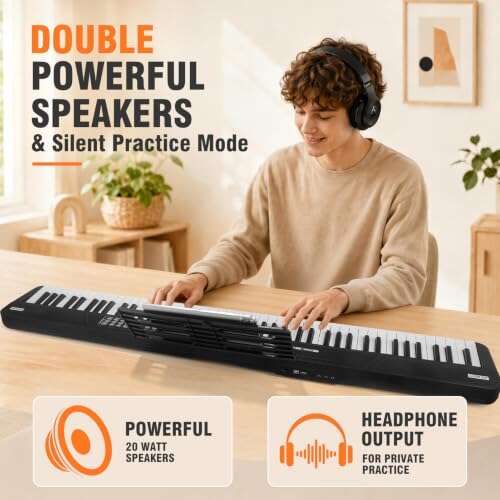
Built-in speakers make an instrument friendly for daily practice. You can turn it on and sketch a song without connecting an audio interface or monitor pair. Headphone output matters just as much for apartment living, late-night work, and focused listening. A good composing setup should support both quick speaker play and private headphone sessions.
Room size also affects your choice. A cabinet or desk piano can look beautiful, but it needs a fixed place. A portable weighted keyboard gives you more freedom, though you may need to buy a stand. Measure your room, doorways, and desk before ordering. I have seen buyers focus on tone and forget that the instrument must actually fit the creative space.
Best Digital Piano for Composing: Key Buying Tips
Start by asking how you write. If you sit at the piano and build full arrangements by hand, prioritize weighted action, an 88-key range, and a reliable sustain pedal. If you build tracks in a DAW and use the keyboard to enter notes, prioritize USB-MIDI, comfortable action, and low setup friction. This simple question can prevent you from paying for features that will not help.
Next, decide whether the piano will stay in one room. A furniture-style model can make a home studio feel complete and encourage regular practice. A portable model is better when you move often or share space with other activities. Neither choice is more professional by itself. The best digital piano for composing is the one that you will use often enough to finish songs.
Finally, set a realistic budget for the complete system. Include a stand, bench, headphones, cables, and possibly a computer interface. A low-priced keyboard may become less affordable after you add every missing item. On the other hand, an expensive piano may not provide the MIDI or audio features you need. Read the current Amazon listing and the manufacturer’s specifications before placing an order, since accessories and revisions can change over time.
FAQs Of best digital piano for composing
What is the best digital piano for composing?
For most piano-focused writers, I recommend the Yamaha P71 because its weighted action, full 88-key range, and clear piano tone support both composing and long-term practice. Beginners who want more accessories may prefer a bundled semi-weighted model.
Are weighted keys better for music composition?
Weighted keys are better when you want acoustic-style control, expressive dynamics, and strong piano technique. Semi-weighted keys can be better for quick MIDI entry, pop sketches, and players who prefer a lighter touch.
Do I need 88 keys to compose music?
No. Many songs can be written on 61 keys. However, 88 keys give you more room for low bass notes, high melodies, wide chords, and classical pieces without moving the octave range.
Is MIDI important on a digital piano?
Yes, if you plan to use a computer or DAW. MIDI lets you edit notes, change instrument sounds, correct timing, and build full arrangements after recording your performance.
Should I buy a digital piano with built-in speakers?
Built-in speakers are useful for quick practice and idea sessions. I still suggest choosing a model with a headphone output, especially if you live with family or neighbors and compose at night.
Final Verdict: Which Should You Buy?
The Yamaha P71 is my top pick for the best digital piano for composing because its weighted action and dependable piano tone support real growth. Choose a bundled model if you need a stand, headphones, or portability from day one.
Compare touch, range, MIDI access, pedals, and room fit before buying. The right digital piano turns a small musical idea into a finished song.

Senior Music Reviewer
Alex Carter is a seasoned music reviewer with over a decade of experience in the world of sound and instruments. Passionate about helping musicians and enthusiasts make informed choices, he brings sharp insights and in-depth knowledge to every review. From classical instruments to modern gear, Alex combines technical expertise with a love for music to deliver content that resonates with readers.
As a Senior Music Reviewer and expert author on Tuneluma.com, Alex is dedicated to sharing honest evaluations, practical advice, and thoughtful commentary to guide readers in their musical journey.