How Long Are Piano Keys: Standard Length Explained
Most standard piano keys are about 9.5 inches long, while the full 88-key keyboard spans about 48 inches.
The question “how long are piano keys” sounds simple, but the answer depends on what you measure. A visible keytop, the full wooden key lever, a black key, and the entire keyboard each have different dimensions. This guide explains standard piano key sizes, key spacing, keyboard width, and what these measurements mean when you buy, move, repair, or build a piano.
How long are piano keys?
A standard piano key has two useful measurements: its visible length and its total internal length.
The part you see and press is usually about 9 to 10 inches long for a white key. Inside the piano, the wooden key may extend much farther. In a grand piano, the full key lever can measure about 22 to 24 inches from the front of the key to the back of the action.
Here is a simple guide:
| Piano part | Typical measurement |
|---|---|
| Visible white key length | About 9 to 10 inches |
| Full white key lever | About 22 to 24 inches in a grand piano |
| Visible black key length | About 3.5 to 4 inches |
| White key width | About 0.88 to 0.93 inches |
| Full 88-key keyboard width | About 48 to 49 inches |
These figures are common ranges, not fixed rules. The exact size changes by brand, piano type, key shape, and manufacturing era.
When people ask how long are piano keys, they often mean the visible white keys. However, technicians usually care about the full key length because it affects leverage, touch, and control.
How long are standard white piano keys?
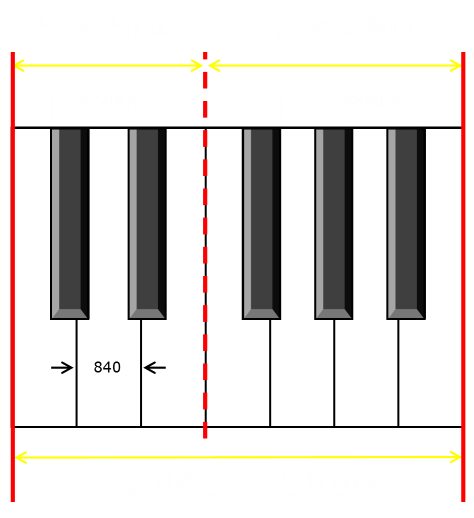
Standard white piano keys are usually close to 9.5 inches long from the front edge to the back of the visible keytop. Their width is often around 0.9 inches, or roughly 23 millimeters.
The 52 white keys in a full-size piano sit side by side. Their width creates the familiar keyboard span of about 48.5 inches. Small differences in key width can change the total width by an inch or more.
White keys are not simple blocks. Each key has several parts:
- The keytop is the visible surface covered with plastic, acrylic, wood, or another material.
- The wooden key stick runs beneath the keytop.
- The balance rail pin supports the key near its center.
- The front rail pin keeps the key moving in the correct path.
- The back of the key connects with the piano action.
On an acoustic piano, the key works like a lever. Pressing the front makes the rear rise. That movement activates the action, which then sends a hammer toward the string.
This is why two keys with similar visible sizes may feel different. A longer key lever can give the player more control, especially when playing near the back of the key.

How long are black piano keys?
Black piano keys are commonly about 3.5 to 4 inches long in the visible playing area. They are shorter than white keys and sit higher above them.
Their raised position helps players quickly see and feel the pattern of the keyboard. The groups of two and three black keys also help you find notes without looking down.
Black keys are often about 0.55 to 0.6 inches wide at the front. Their shape may taper slightly toward the back. This design leaves enough room for the white keys while giving the fingers a clear target.
The black keys play sharps and flats. For example:
- The black key between C and D is C-sharp or D-flat.
- The black key between D and E is D-sharp or E-flat.
- There is no black key between E and F.
- There is no black key between B and C.
When measuring black keys, be careful. The exposed keytop is not the same as the full wooden part below it. The hidden section may extend farther into the piano.
How wide is a full piano keyboard?
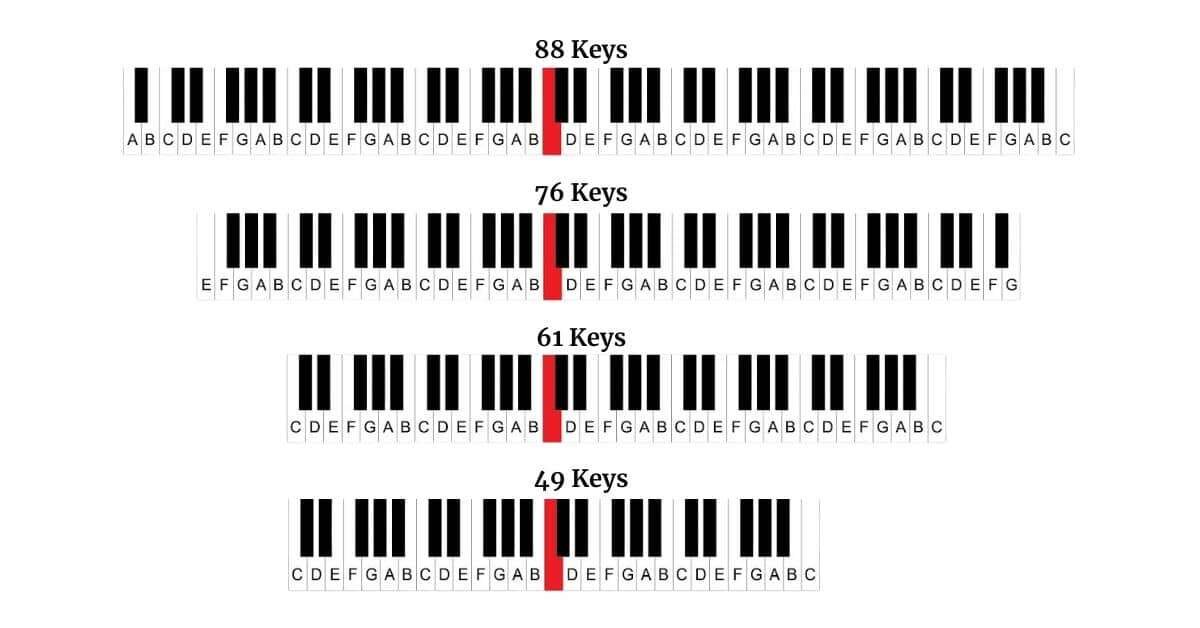
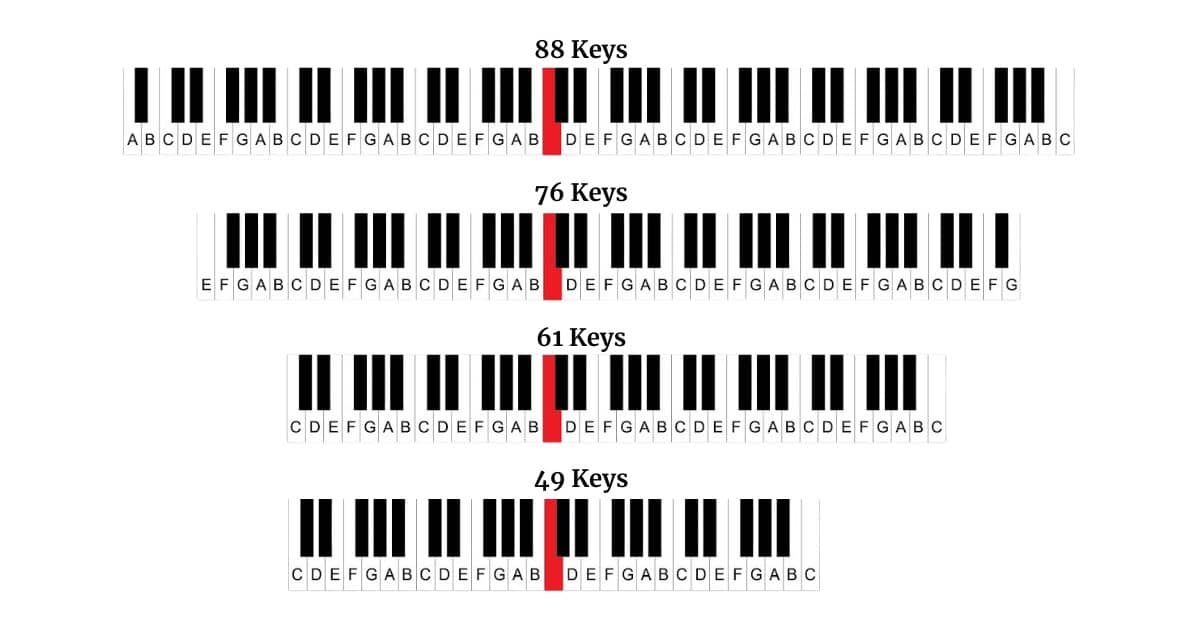
A full 88-key piano keyboard is usually about 48 to 49 inches wide. Some models are slightly narrower or wider.
A standard piano has:
- 52 white keys
- 36 black keys
- 88 keys in total
- 7¼ octaves of range
A full keyboard starts at A0 and ends at C8. This range is used by concert grands, upright pianos, and most full-size digital pianos.
The width comes mainly from the white keys. If each white key is about 0.93 inches wide, 52 keys create a span close to 48.4 inches. The black keys do not add much to the total width because they sit above the gaps between white keys.
For moving or fitting a piano, measure more than the keys. The case, side cheeks, control panel, music desk, and end blocks can all add width. A digital piano with 88 standard-size keys may need about 50 inches of desk space once its side panels are included.

Does every piano use the same key size?
No. Most full-size pianos use similar key spacing, but they are not all identical.
Acoustic pianos tend to follow long-standing industry standards. Digital pianos have more freedom in their design. Some use full-size keys, while others use compact keys to save space.
You may see these types:
Standard-size keys
Standard-size keys match the spacing found on most acoustic pianos. They are best for players who want a familiar feel and a smooth transition between instruments.
Compact keys
Compact keys are slightly narrower. They allow a keyboard to fit in a smaller room, but the finger spacing feels different. This can matter when playing chords, octaves, and fast passages.
Slim or mini keys
Mini keys are much smaller and are common on portable keyboards made for children, beginners, or music production. They are not ideal for building traditional piano technique.
Before buying a digital piano, check the stated key width. “88 keys” does not always mean “88 full-size keys.”
Why piano key length affects the playing feel
Key length affects leverage. Think of a piano key as a seesaw. Your finger presses one end, and the action moves at the other end.
A longer key can make it easier to control notes when your finger lands farther back. This area is close to the fallboard, where the keys meet the case. On a short key, playing near the back can feel heavier because the lever gives you less mechanical advantage.
Key length can influence:
- Touch control
- Repetition speed
- Soft playing
- Chord comfort
- Control near the back of the keyboard
- The overall feel of a digital piano
The keytop length alone does not tell you how good a piano feels. The action design, hammer weight, spring balance, key pivot point, and sensor system also matter.
This is a common mistake when comparing instruments. A longer key does not automatically mean a better piano. It is one part of a larger system.

Grand piano keys versus upright piano keys
Grand piano keys are often longer than upright piano keys. A grand piano has room for a longer action that extends behind the keyboard. An upright piano must fit its action into a tall, narrow cabinet.
A grand key may measure roughly 22 to 24 inches in total length. An upright key may be shorter, often around 18 to 21 inches, though designs vary.
The visible keytops can look almost the same on both instruments. The difference is mostly hidden inside the case.
A grand piano also lets the action move in a more direct way. The hammers move upward toward the strings. In an upright piano, the hammers move forward toward the strings. This changes the action design and contributes to a different playing feel.
A skilled player can adapt to both. Still, if you compare a concert grand with a small upright, you will likely notice differences in repetition, control, and response.

How long are digital piano keys?
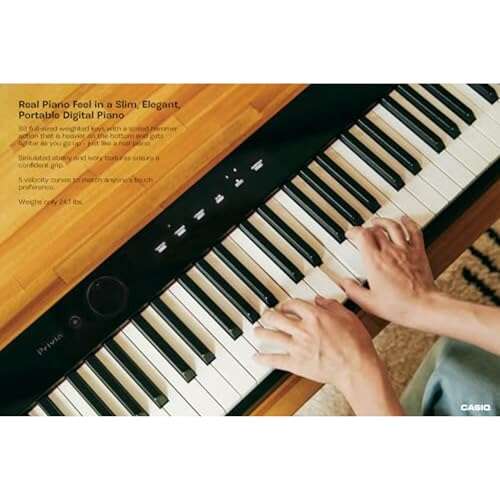
Digital piano keys often have visible dimensions close to acoustic piano keys. A full-size digital piano usually uses keys that are about 9 to 10 inches long on top and about 0.9 inches wide.
The internal design is different. Instead of lifting hammers and activating strings, digital keys press sensors. Those sensors measure timing, speed, or pressure and send the data to the sound system.
Digital piano key length varies more than acoustic piano key length. Some models use a long key mechanism that feels closer to a grand piano. Others use a short plastic lever to keep the instrument thin and light.
When testing a digital piano, check these features:
- Full-size key spacing
- Weighted or semi-weighted action
- Touch sensitivity
- Escapement or simulated let-off
- Key movement and return speed
- Noise from the key mechanism
- Comfort during chords and scales
For serious study, full-size weighted keys are usually the safest choice. For travel or casual practice, compact keys may be more practical.

How to measure piano keys correctly
Measuring piano keys is easy if you define the measurement first. Use a ruler or tape measure and keep it parallel to the key.
Follow these steps:
- Measure the visible white key from its front edge to the point where it meets the fallboard.
- Measure the width at the front of the key.
- Measure a black key from its front edge to its rear end.
- Count the white keys if you need to confirm the keyboard size.
- Measure the full keyboard from the outside edge of one end block to the other.
Do not measure only one key if you need a replacement. Piano keys may have different shapes at the bass, middle, and treble ends. A replacement must match the correct note and position.
For a keyboard stand or furniture project, measure the complete instrument. The outside case is usually wider than the keybed.
My practical tip is to measure twice before ordering a cover, desk, or replacement part. A small error can leave the ends exposed or prevent the instrument from fitting.

What changes piano key dimensions?
Several design choices can change how long piano keys are.
Piano size
A concert grand has more room for long keys and a large action. A compact upright has less internal space.