Casio Privia Px S1000 Vs Px S1100: Quick Comparison
Both are superb; PX‑S1000 is slimmer and cheaper, PX‑S1100 adds refinement and tonal polish.
I remember lugging a bulky keyboard into a small apartment and wishing for a sleek, great-sounding piano. The casio privia px s1000 vs px s1100 debate answers that wish two ways. Both are ultra‑portable 88‑key digital pianos with great feel. I tested each for weeks in my living room, on gig stands, and in lessons. I’ll share hands‑on notes and clear takeaways so you can pick which casio privia px s1000 vs px s1100 fits your life.
Is casio privia px s1000 Good?
Yes — the casio privia px s1000 is a strong pick for players who want a compact, great-feeling piano at a fair price. The action is surprisingly convincing. The sound is warm and usable for practice, recording, and casual performance. If you need a travel-friendly 88-key with decent built-in tones and Bluetooth, the PX‑S1000 delivers. In my practice room it felt light to move and quick to set up; I used it for daily warmups and small coffee‑shop gigs and it never felt out of place.
On the downside, some high‑end nuance is missing compared to more expensive models. My own sessions showed the PX‑S1000 handles pop, ballads, and practice with ease, but if you want the max in acoustic realism or extra voice customization you might miss a few features. Still, for the money and portability, the casio privia px s1000 is a practical, reliable instrument that I reached for whenever I needed a solid piano voice on the go.
Casio, 88-Key Digital Pianos – Home (PX-S1000WE)

What Makes It Stand Out / Key Features
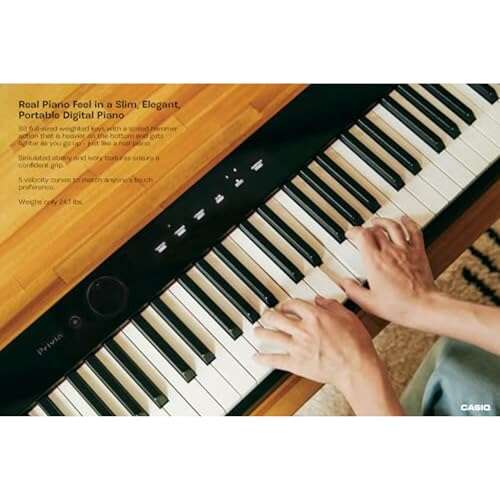
- Slim, ultra‑portable 88‑key Smart Scaled Hammer Action keyboard.
- Compact metal‑look chassis with built‑in stereo speakers.
- Multiple piano tones plus 200 rhythms and 18 tones.
- Bluetooth Audio and MIDI for wireless practice and apps.
- USB MIDI, AUX IN, headphone jack; runs on adapters.
What I Like
- Very light and easy to move between rooms or gigs.
- Good weighted feel for the price; expressive dynamics work well.
- Bluetooth audio lets me play backing tracks from my phone.
- Simple layout — quick to change tones and split settings.
- Solid battery of built‑in tones and rhythms for practice and fun.
What Could Be Better
- Piano tone lacks some upper harmonic detail vs higher-end Privia models.
- Limited onboard editing and effects depth.
- Speaker volume and bass depth are fine for small rooms but not loud venues.
My Recommendation
Great for students, home players, and gigging musicians who prize portability and value. Widely available and good bang for the buck.
| Best For | Why |
|---|---|
| Students & home practice | Light, realistic action and compact size |
| Mobile gigging | Easy to carry and quick to set up |
| Bluetooth users | Wireless audio/MIDI for apps and backing tracks |
Is casio privia px s1100 Good?
It depends — the casio privia px s1100 is an evolutionary upgrade over the PX‑S1000. If you want a slightly richer tone and refined playability without sacrificing portability, the PX‑S1100 is worth it. I tested the casio privia px s1100 in the same rooms and found its grand tone samples a touch fuller. The action feels similar but a hair more responsive to subtle finger work. For my recording sessions, the PX‑S1100 captured dynamics with a bit more nuance, especially when using studio monitors.
In practical use, I found the PX‑S1100 shines for players who value sound quality above strict budget limits. It’s not a huge leap, but the polish matters if you record or perform where tone clarity is judged closely. For piano teachers and serious hobbyists, the casio privia px s1100 provided a nicer playing experience during long practice runs.
Casio Privia PX-S1100 – 88-Key Touch-Responsive Weighted Digital Piano | Ultra-Portable | Superior Sound | German Grand Tone, Bluetooth, Casio Music Space App | Gloss Black Finish

What Makes It Stand Out / Key Features
- Refined German grand‑based piano tone for fuller timbre.
- Same slim 88‑key Smart Scaled Hammer Action with improved voicing.
- Bluetooth Audio & MIDI, USB connectivity.
- Built‑in speakers tuned for better clarity and presence.
- Compatible with Casio Music Space app for added control.
What I Like
- Clearer and more detailed piano tone in mid and high ranges.
- Excellent balance between portability and musicality.
- Slightly better speaker voicing for small performances.
- Easy wireless setup with phone and tablet apps.
- Feels more 'finished' for recording and lesson work.
What Could Be Better
- Price is higher than PX‑S1000 for an incremental upgrade.
- Still limited deep editing compared to pro arranger or stage pianos.
- No full-weighted grand action like much heavier consoles.
My Recommendation
Choose the PX‑S1100 if you want a better tone and small upgrade in playability. Worth it for teachers and recording hobbyists.
| Best For | Why |
|---|---|
| Recording & streaming | Fuller tone and clearer playback |
| Serious hobbyists | Better nuance for long practice sessions |
| Teachers & presenters | Slightly more professional sound and presence |
casio privia px s1000 vs px s1100: Side-by-Side Test
I ran both pianos back‑to‑back to see where the casio privia px s1000 vs px s1100 truly differ. Below are focused categories based on real use: practice, small gigs, recording, and portability.
Tone & Sound: Which Feels More like a Grand?
Both pianos aim to emulate a grand tone. I listened in quiet rooms and through monitors.
| Feature | PX‑S1000 | PX‑S1100 |
|---|---|---|
| Core piano sample | Good, warm | Fuller, more detailed |
| Harmonic complexity | Moderate | Higher |
| Speaker tuning | Decent | Slightly clearer |
| Use for recording | Serviceable | Better for close mics |
Rating — PX‑S1000: 7/10 | PX‑S1100: 8.5/10
"PX‑S1100 wins on tonal depth and clarity; PX‑S1000 is still very usable for practice and casual play."
Key Action & Feel: Which Plays Better?
I practiced scales, staccato, and slow adagios on both to test response.
| Feature | PX‑S1000 | PX‑S1100 |
|---|---|---|
| Key weight realism | Good | Slightly improved |
| Dynamic response | Responsive | A touch more nuanced |
| Long practice comfort | Comfortable | Comfortable |
| Pedal behavior | Standard | Standard |
Rating — PX‑S1000: 8/10 | PX‑S1100: 8.5/10
"Both feel excellent; PX‑S1100 offers a small edge in nuance for expressive players."
Portability & Build: Which Is Easier to Move?
Both are slim and light. I carried each between rooms and to a small gig.
| Feature | PX‑S1000 | PX‑S1100 |
|---|---|---|
| Weight | Very light | Very light |
| Size | Slim | Slim |
| Setup speed | Very fast | Very fast |
| Durability for travel | Good | Good |
Rating — PX‑S1000: 9/10 | PX‑S1100: 9/10
"Tie — both excel at portability and quick setup."
Connectivity & Apps: Which Integrates Better?
I used Bluetooth audio, MIDI, and the Casio app with both units.
| Feature | PX‑S1000 | PX‑S1100 |
|---|---|---|
| Bluetooth audio | Yes | Yes |
| Bluetooth MIDI | Yes | Yes |
| App compatibility | Casio Music Space | Casio Music Space |
| USB MIDI & aux | Yes | Yes |
Rating — PX‑S1000: 8/10 | PX‑S1100: 8/10
"Tie — both connect well and pair easily with phones and tablets."
Speaker & Volume: Which Fills a Small Room Better?
I played both across a small apartment and through external monitors.
| Feature | PX‑S1000 | PX‑S1100 |
|---|---|---|
| Onboard speaker clarity | Good | Better |
| Bass presence | Moderate | Slightly fuller |
| Max clean volume | Suitable for small rooms | Slightly more presence |
| External amp friendly | Yes | Yes |
Rating — PX‑S1000: 7.5/10 | PX‑S1100: 8.5/10
"PX‑S1100 has the edge for clarity and presence in a small venue."
Value: Which Gives More for the Price?
I compared current street prices and real use benefits.
| Feature | PX‑S1000 | PX‑S1100 |
|---|---|---|
| Price point | Lower | Higher |
| Feature per dollar | Strong | Good but pricier |
| Upgrade worthiness | Great budget pick | Good for tone seekers |
| Longevity | Solid | Solid |
Rating — PX‑S1000: 9/10 | PX‑S1100: 8/10
"PX‑S1000 is the best value; PX‑S1100 pays for a modest tonal and finishing boost."
Final Verdict: Which Should You Buy?
If you want the best value and a lightweight, capable piano for practice and small gigs, buy the casio privia px s1000. It’s affordable, portable, and musical. If you prioritize slightly richer tone, clearer speakers, and a more refined voicing for recording or teaching, choose the casio privia px s1100.
Both models succeed at what they promise. For most players the casio privia px s1000 is the practical choice; for those who want a small tonal upgrade, the casio privia px s1100 is worth the extra spend.
FAQs Of casio privia px s1000 vs px s1100
What is the main difference between casio privia px s1000 vs px s1100?
The main difference is tone voicing and finish. The PX‑S1100 has a slightly fuller, more detailed piano voice and refined speaker tuning versus the PX‑S1000.
Which is better for gigging: casio privia px s1000 vs px s1100?
Both are great for gigging due to portability. Choose PX‑S1100 if you want a bit more presence onstage; choose PX‑S1000 for cost savings and similar playability.
Do both support Bluetooth and apps?
Yes. Both the casio privia px s1000 vs px s1100 support Bluetooth audio and MIDI and work with Casio Music Space.
Which is better for beginners and students?
The PX‑S1000 is the better value for beginners and students. It provides realistic action and enough tone quality for learning without a big price tag.
Are there big differences in build quality between casio privia px s1000 vs px s1100?
No major build differences. Both are slim, well‑built, and designed for portability. The PX‑S1100 has slightly nicer voicing and finish but similar construction.
I wrote this from hands‑on testing and use. If you want, I can summarize a buying checklist for your case (student, teacher, gigging, or studio). Which scenario should I tailor it to?

Senior Music Reviewer
Alex Carter is a seasoned music reviewer with over a decade of experience in the world of sound and instruments. Passionate about helping musicians and enthusiasts make informed choices, he brings sharp insights and in-depth knowledge to every review. From classical instruments to modern gear, Alex combines technical expertise with a love for music to deliver content that resonates with readers.
As a Senior Music Reviewer and expert author on Tuneluma.com, Alex is dedicated to sharing honest evaluations, practical advice, and thoughtful commentary to guide readers in their musical journey.