A Sus 7 Chord Guitar: Easy Shapes And Uses
The A sus 7 chord guitar shape blends a suspended fourth with a dominant seventh for a tense, colorful sound.
The a sus 7 chord guitar voicing is a useful shape for blues, rock, pop, worship, and jazz. It sounds open and unresolved, yet it is easy to play and usually wants to move to A or A7. This guide explains the chord’s notes, shapes, theory, common mistakes, and musical uses so you can add it to real songs with confidence.

What Is the A Sus 7 Chord on Guitar?
The A sus 7 chord is usually written as A7sus4, Asus7, or A sus 7. These names can look different, but guitar players often use them for a similar sound.
The chord contains four main notes:
• A: The root note
• D: The suspended fourth
• E: The perfect fifth
• G: The minor seventh
The note C-sharp is missing. C-sharp is the major third of A, and the suspended fourth, D, takes its place.
That missing third gives the a sus 7 chord guitar sound its special character. It feels neither clearly major nor minor. Think of it as a musical question that wants an answer.
In standard chord theory, “sus” means “suspended.” A suspended chord replaces the third with another note, most often the fourth. The “7” means the chord also includes a minor seventh above the root.
For A:
• A to D is a perfect fourth
• A to E is a perfect fifth
• A to G is a minor seventh
The most common full spelling is A–D–E–G.

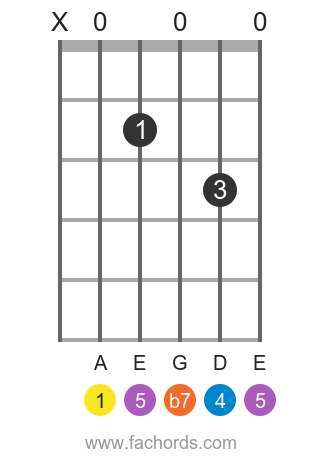
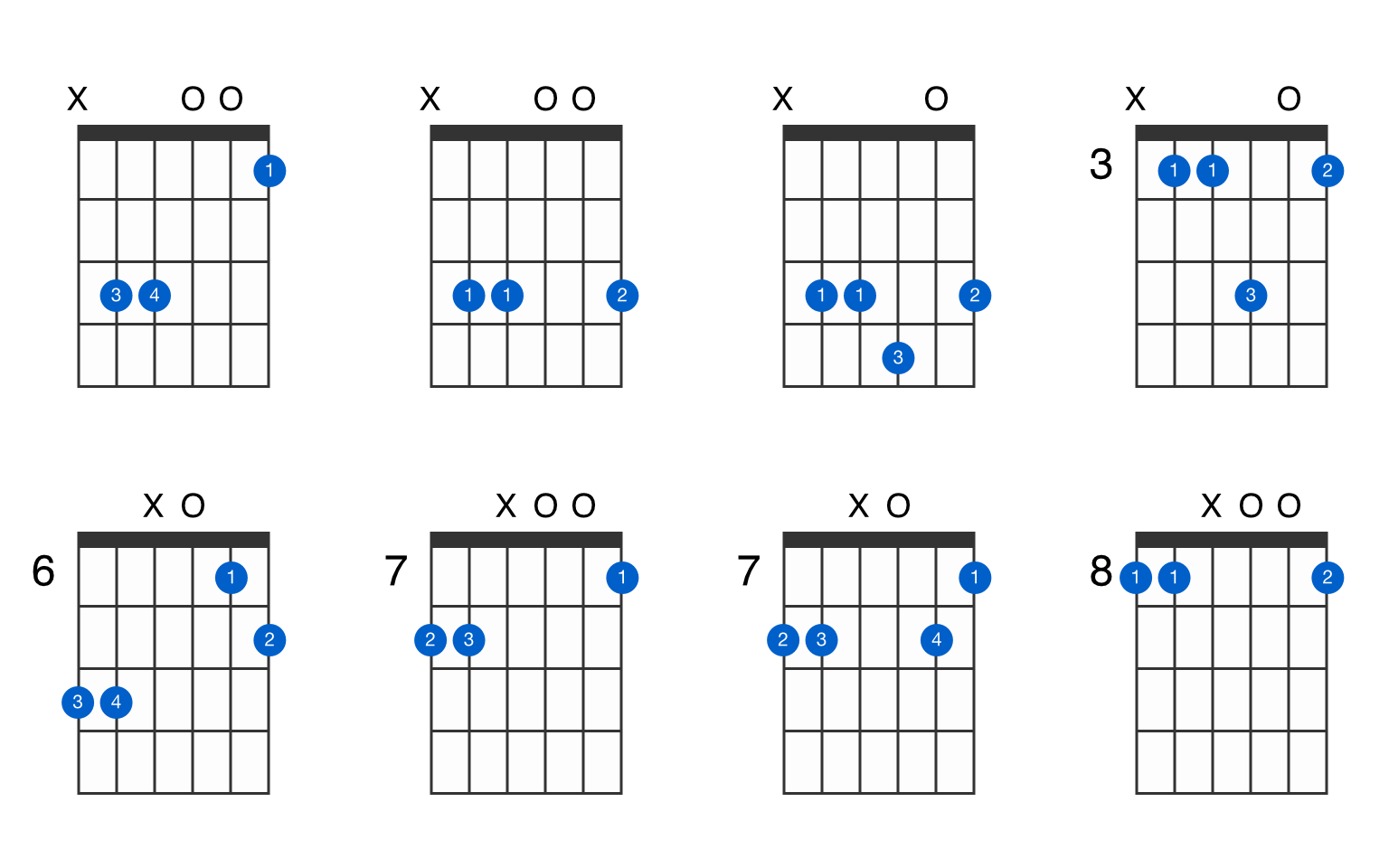
The Easiest A Sus 7 Chord Guitar Shape
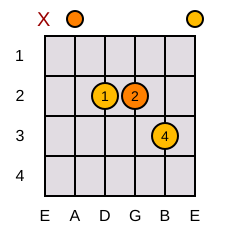
The most useful beginner shape is:
A7sus4: x02030
Read the shape from the sixth string to the first string:
e|---0---
B|---3---
G|---0---
D|---2---
A|---0---
E|---x---
Place your fingers like this:
• Index finger on the second fret of the D string
• Ring finger on the third fret of the B string
• Leave the A, G, and high E strings open
• Do not play the low E string
This shape produces these notes:
A – E – G – D – E
The notes repeat, but the chord still clearly contains A, D, E, and G.
To play the a sus 7 chord guitar shape cleanly, keep your fingers curved. Let the open strings ring, but avoid touching the G or high E strings with your fretting hand.
Start with a slow downstroke. Then try a light strumming pattern:
Down – Down – Up – Up – Down – Up
If the chord sounds dull, check the open strings. Beginners often touch the G string by accident while placing the index finger on the D string.
Other A Sus 7 Guitar Chord Shapes
The open shape is ideal for beginners, but other voicings can give the a sus 7 chord guitar sound more depth or a different position on the neck.
A7sus4 at the Fifth Position
Try this compact voicing:
A7sus4: 5x0500
The strings are:
e|---0---
B|---0---
G|---5---
D|---0---
A|---5---
E|---x---
This shape gives you:
A – D – G – E – E
It has a wide, open sound. The fifth-fret A on the fifth string acts as the bass note, so the chord remains clear even when you avoid the low E string.
Use your index finger to fret the fifth fret of the A string and your ring finger on the fifth fret of the G string. The open D, B, and high E strings should ring freely.
A7sus4 as a moveable Barre Shape
A moveable version can be built from the dominant seventh family. One practical voicing is:
A7sus4: 5x558x
This shape is less comfortable for many beginners, and it may require careful muting. It contains the important chord tones but does not always sound as full as the open position.
When using moveable shapes, focus on the bass note and the seventh. You do not need to play every possible chord tone for the harmony to work.
A7sus4 Higher on the Neck
Higher voicings are useful when another guitarist is playing open chords. They help you avoid a crowded sound.
You can use partial shapes on the top four strings. For example, a small voicing around the tenth and twelfth frets can highlight D, G, and A without adding a thick bass note.
This is common in worship guitar, studio work, and acoustic duets. One guitar plays the low A while the other adds a bright a sus 7 chord guitar voicing higher up.
How to Finger the A7sus4 Chord Cleanly
A clean chord is more important than a fast chord change. Use this simple practice method:
- Fret the chord without strumming.
- Play each string one at a time.
- Listen for buzzing, muted strings, or unwanted noise.
- Adjust your fingers before strumming.
- Repeat the test at a slow pace.
Your thumb should rest near the middle of the guitar neck. Do not squeeze the neck too hard. Excess pressure can make your hand tired and can pull notes sharp.
Keep the fingertip close to the fret wire. You do not need to press in the center of the fret space. A position close to the metal fret often gives a cleaner note with less effort.
A common mistake is to fret the third fret of the B string with the index finger while also trying to keep the D string clear. This can work, but many players find the ring finger more comfortable.
Another common mistake is playing the low E string. The open low E is not part of the standard A7sus4 voicing and can make the chord sound muddy. Use the thumb or the picking hand to mute it.

How to Resolve A Sus 7 to A7
The most important movement is from A7sus4 to A7:
A7sus4: x02030
A7:     x02020
Only one note changes. The D on the second string moves down to C-sharp.
B string: 3rd fret → 2nd fret
D        → C-sharp
That small movement creates a strong sense of release. The suspended chord holds the tension, and the A7 chord provides the answer.
Try this exercise:
| A7sus4 | A7 | A7sus4 | A7 |
Strum four slow beats on each chord. Listen closely to the second string. You should hear the suspended D fall to C-sharp.
You can also resolve A7sus4 directly to A major:
A7sus4: x02030
A:      x02220
In this case, the D moves down to C-sharp, while the G moves down to A or is removed from the voicing. The result is warmer and less bluesy than the dominant A7 resolution.
This is one reason the a sus 7 chord guitar shape appears so often in songs. It creates movement without requiring a large chord change.
A Sus 7 Chord Progressions to Practice
Practice the chord in short progressions before using it in a full song. These examples help your fingers learn both the sound and the movement.
A7sus4 to A7
| A7sus4 | A7 | A7sus4 | A7 |
This is the basic suspension exercise. Keep your strumming steady and move only the B-string note.
D to A7sus4 to A
| D | A7sus4 | A |
This progression sounds natural because A is the dominant chord of D. The A7sus4 adds tension before the music settles.
A7sus4 to D
| A7sus4 | D |
This has a blues and folk feel. Try a slow shuffle or a strong backbeat.
E to A7sus4 to D
| E | A7sus4 | D |
This progression works well for rock and roots music. Let the open strings ring for a broad acoustic sound.
A7sus4 to G to D
| A7sus4 | G | D |
This pattern has a familiar folk-rock color. It sounds especially good with a light pick and a steady eighth-note rhythm.

How the A Sus 7 Chord Sounds in Different Styles
The a sus 7 chord guitar sound changes with rhythm, tone, and voicing. The notes stay the same, but the musical role can feel very different.
Blues
In blues, A7sus4 can act as a brief tension chord before A7. Use a short, sharp strum or a muted shuffle pattern.
Try alternating between the suspended and dominant forms. The movement from D to C-sharp creates a classic blues pull.
Rock
Rock guitarists often use suspended chords to make simple progressions feel larger. Use a strong pick attack and let the open strings ring.
A7sus4 can also work as a passing chord between A and D. Avoid overplaying it. One or two beats may be enough.
Folk and Acoustic Music
The open strings make this chord useful for acoustic guitar. It can add color without making a progression sound too complex.
Use fingerpicking to bring out the individual notes. Pluck the bass A first, then the D, G, B, and high E strings.
Worship and Contemporary Pop
Suspended chords are common in modern worship and pop because they create lift and emotional motion. A7sus4 can sit under a vocal line without sounding as final as A major.
Use a slow build, such as soft picking followed by full strumming. The chord works well when the arrangement needs movement but not a dramatic harmonic change.
Jazz and Soul
In jazz, the chord may appear as A7sus4, A13sus, or another extended dominant-sus chord. These forms add notes such as F-sharp or B for extra color.
A basic A7sus4 is a good starting point. Learn the simple shape first, then explore richer voicings when your ear can identify the added tones.
A Sus 7 Versus A7 and Asus4
These chords are related, but they are not identical.
A7sus4
Notes:
A – D – E – G
The third is replaced by the fourth. It sounds tense and open.
A7
Notes:
A – C-sharp – E – G
This chord has a major third and a minor seventh. It sounds more direct and dominant.
Asus4
Notes:
A – D – E
This chord has the suspended fourth but no seventh. It often resolves to A major.
The key difference is the G. The G turns Asus4 into a seventh chord. That note adds a bluesy and dominant quality.
When reading chord charts, check the exact symbol. “Asus4” does not automatically include G. “A7sus4” does.
Common Mistakes With the A Sus 7 Chord Guitar Shape
Many players can form the shape but still struggle to make it sound musical. These fixes help.
• Playing the low E string: Mute it or aim your pick from the A string downward.
• Muting the open G string: Keep the finger on the D string upright and close to the fret.
• Forgetting the suspended note: If you play x02020, you are playing A7, not A7sus4.
• Holding too much tension: Relax your thumb and wrist between chord changes.
• Strumming too hard: A suspended chord can sound harsh when hit with too much force.
• Ignoring the resolution: Practice moving from A7sus4 to A7 so your ear understands its purpose.
• Using the wrong name: Asus4 and A7sus4 are different chords because only the latter includes the seventh.
In my own playing, the biggest improvement came from practicing the chord change without a rhythm pattern first. I placed the A7sus4 shape, moved the B-string finger down one fret, and repeated that motion for several minutes. The movement became automatic much faster than when I tried to play it inside a full song.
Picking Patterns for A7sus4
The a sus 7 chord guitar shape sounds especially clear when picked one string at a time.
Try this simple pattern:
A string → D string → G string → B string → high E string
Use the open-position shape and let every note ring. This highlights the chord’s suspended quality.
For a fingerstyle pattern, try:
Thumb: A string
Index: G string
Middle: B string
Ring: high E string
Play the bass note with your thumb, then pluck the upper strings together. Keep the motion gentle.
You can also use alternating bass:
A bass → D string → A bass → G string
This pattern works well in folk and country settings. It gives the chord a steady pulse without requiring complex theory.
If the sound becomes too bright, reduce the force in your fingers. Open strings can create plenty of volume on their own.
When Not to Use A7sus4
The chord is useful, but it does not fit every musical moment. Avoid holding it for too long when the song needs a clear major or minor quality.
Because A7sus4 has no third, it does not clearly tell the listener whether the harmony is major or minor. That ambiguity is helpful for tension, but it can feel incomplete if the chord never resolves.
Also, be careful when another instrument plays C-sharp at the same time. The combination of C-sharp and D can create a close clash. This may sound intentional in jazz or modern music, but it can sound messy in a simple acoustic arrangement.
The a sus 7 chord guitar voicing also needs care in dense band settings. Open strings can compete with keyboards, bass, or another guitar. A smaller voicing may work better than the full open shape.
Practice Plan for Beginners
Use this short routine for seven days:
- Form x02030 and hold it for ten seconds.
- Pick each string slowly.
- Strum four beats.
- Move to A7, using x02020.
- Return to A7sus4.
- Repeat the change ten times.
- Add the chord to a two- or three-chord progression.
On the first few days, focus on clean notes. On later days, work on timing.
Use a metronome at about 60 beats per minute. Change chords every four beats, then try every two beats when the movement feels easy.
Record yourself on a phone. This reveals muted strings and uneven timing that may be hard to notice while playing.
The goal is not simply to memorize the a sus 7 chord guitar shape. The goal is to hear its tension, control its release, and use it at the right musical moment.
Frequently Asked Questions About the A Sus 7 Chord Guitar
What is the easiest A sus 7 chord guitar shape?
The easiest shape is usually x02030 in standard tuning. It uses open strings and only two fretted notes.
Is A sus 7 the same as A7sus4?
In most guitar charts, yes. Both names usually describe the notes A, D, E, and G, although chord naming can vary between musicians and publishers.
What is the difference between Asus4 and A7sus4?
Asus4 contains A, D, and E. A7sus4 adds G, the minor seventh, which gives the chord a stronger dominant and blues sound.
Where does A7sus4 usually resolve?
It often resolves to A7 or A major. The suspended D commonly moves down to C-sharp, creating a smooth and easy resolution.
Can beginners play the A sus 7 chord on guitar?
Yes. The open shape x02030 is beginner-friendly because it uses open strings and requires only two fretted notes. The main challenge is muting the low E string and keeping the open strings clear.
Why does my A7sus4 chord sound muted?
Your fingers may be touching the open G or high E strings. Check each string separately, keep your fretting fingers curved, and place them close to the fret wire.
Can I use A7sus4 in a minor song?
Yes, but use it with care. Since the chord has no third, it can add tension without clearly declaring major or minor, but its dominant sound may clash with some minor harmonies.
Conclusion
The a sus 7 chord guitar shape is simple, but it offers a wide range of musical color. Its notes, A, D, E, and G, create an open sound that naturally leads toward A7 or A major.
Start with x02030, check each string, and practice the move to x02020. Then try the chord in blues, rock, folk, pop, and worship progressions.
Spend a few minutes today practicing the suspension and its release. Once the movement feels natural, add the a sus 7 chord guitar voicing to a song you already know, and share your favorite progression or playing tip with other guitarists.

Senior Music Reviewer
Alex Carter is a seasoned music reviewer with over a decade of experience in the world of sound and instruments. Passionate about helping musicians and enthusiasts make informed choices, he brings sharp insights and in-depth knowledge to every review. From classical instruments to modern gear, Alex combines technical expertise with a love for music to deliver content that resonates with readers.
As a Senior Music Reviewer and expert author on Tuneluma.com, Alex is dedicated to sharing honest evaluations, practical advice, and thoughtful commentary to guide readers in their musical journey.