A guitar power chord uses a root note, perfect fifth, and sometimes octave to create a strong, flexible sound.
If you have heard the huge guitar sounds in rock, punk, metal, or alternative music, you have heard power chords. Learning what is a guitar power chord gives you a simple path to playing riffs, writing songs, and moving around the fretboard with confidence. This guide explains the theory, shapes, techniques, common mistakes, and practical uses in a clear way.
What Is a Guitar Power Chord?
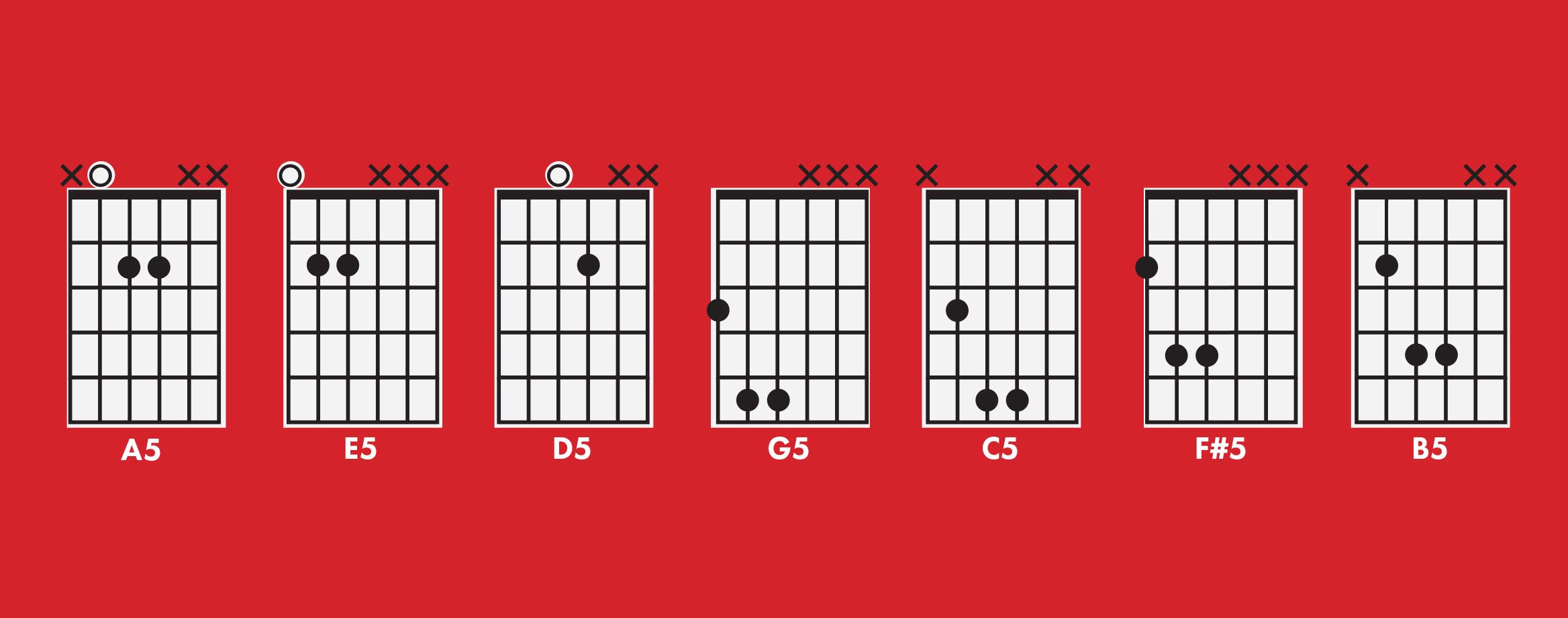
A guitar power chord is a two-note or three-note chord built from a root note and a perfect fifth. Many players add the root note one octave higher, but the chord still works without it.


Unlike a major or minor chord, a power chord usually has no third. The third tells us whether a chord sounds major or minor. By leaving it out, a power chord keeps a neutral, forceful sound.
A basic power chord includes:
• Root note: The note that names the chord
• Perfect fifth: A note seven half steps above the root
• Optional octave: The same root note played 12 half steps higher
For example, an E5 power chord contains:
• E as the root
• B as the perfect fifth
• E as the octave
The “5” in a chord name, such as E5 or A5, refers to the perfect fifth. It does not mean the chord uses five notes.
A guitar power chord is often called a “fifth chord” because its main interval is the perfect fifth. In music theory, it can also be described as a root and fifth dyad, or a root, fifth, and octave voicing.

Why Do Power Chords Sound So Powerful?
Power chords sound strong because the root and fifth blend well. The perfect fifth is one of the most stable intervals in Western music. It creates a wide, open sound without the tension that often comes from major or minor chords.
Distortion also helps power chords sound large. When a clean guitar signal becomes heavily distorted, extra harmonics appear. A simple two-note shape can then fill the sound with energy.
This is why a guitar power chord works so well in loud music. It is like using a thick black line in a drawing. The shape is simple, but it makes a clear statement.


Power chords also avoid the clash that can happen when a distorted major or minor third is played with too much gain. The missing third keeps the sound clean and focused, even when the amplifier is pushed hard.
Common styles that use power chords include:
• Rock
• Punk
• Heavy metal
• Grunge
• Hard rock
• Alternative rock
• Pop rock
• Blues rock
A power chord does not always need distortion. Played cleanly, it can sound open and direct. With overdrive, it becomes gritty. With heavy distortion, it can sound massive.

The Basic Guitar Power Chord Shapes
Most beginners start with two movable shapes. These shapes use the low E string or the A string as the root.
The E-string power chord shape
Place your index finger on the low E string. Then place your ring finger two frets higher on the A string.
For example, play this shape at the third fret:
e|----------------
B|----------------
G|----------------
D|--5-------------
A|--5-------------
E|--3-------------
This is G5. The root is on the third fret of the low E string, which is G.
To add the octave, place your pinky on the third fret of the D string:
e|----------------
B|----------------
G|----------------
D|--5-------------
A|--5-------------
E|--3-------------
The diagram above shows the same three-note shape because the D string is two frets above the root. Your ring finger can cover the A and D strings, or you can use your ring finger and pinky separately.
The A-string power chord shape
Place your index finger on the A string. Then place your ring finger two frets higher on the D string. Add your pinky two frets higher on the G string.
For example:
e|----------------
B|----------------
G|--2-------------
D|--2-------------
A|--0-------------
E|----------------
This is A5. The open A string is the root.
Move the whole shape up two frets, and you get B5:


e|----------------
B|----------------
G|--4-------------
D|--4-------------
A|--2-------------
E|----------------
The shape stays the same. Only the root changes.
Common power chord examples
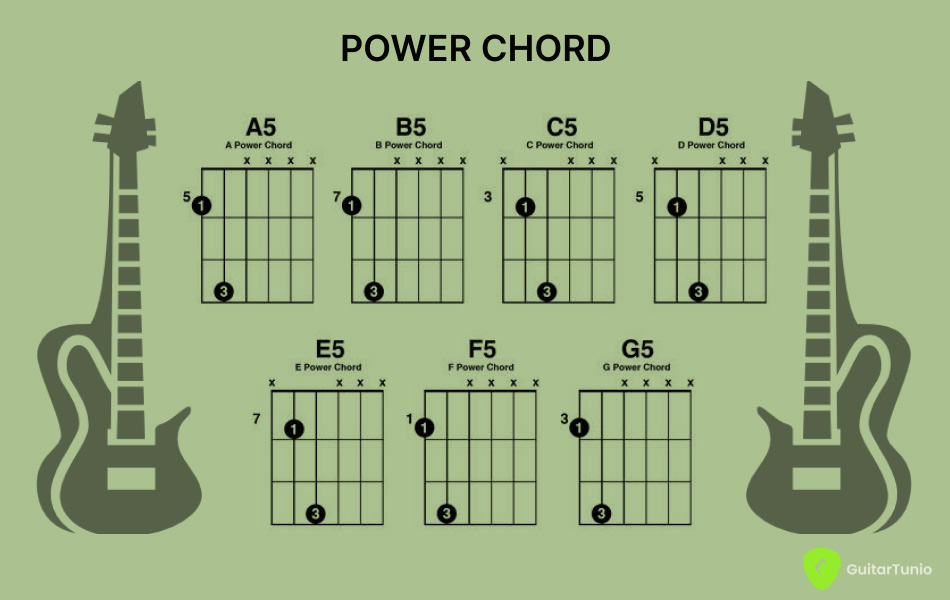
• E5: 022xxx
• F5: 133xxx
• G5: 355xxx
• A5: x022xx
• B5: x244xx
• C5: x355xx
• D5: x577xx
The “x” means you should not play that string. Muting unused strings is an important part of playing a clean guitar power chord.

How to Find Any Power Chord on the Fretboard
The easiest way to find a guitar power chord is to locate its root note first. The low E and A strings are the best starting points because their notes are easy to learn and their shapes move across the neck.
The open strings are:
E A D G B E
On the low E string, each fret moves up one half step:
• Open: E
• First fret: F
• Third fret: G
• Fifth fret: A
• Seventh fret: B
• Eighth fret: C
• Tenth fret: D
• Twelfth fret: E
On the A string:
• Open: A
• Second fret: B
• Third fret: C
• Fifth fret: D
• Seventh fret: E
• Ninth fret: F-sharp
• Tenth fret: G
• Twelfth fret: A
Once you know the root, use the matching shape. For a root on the low E string, play the E-string shape. For a root on the A string, play the A-string shape.
For example, to play C5:
- Find C on the low E string at the eighth fret.
- Put your index finger on that note.
- Place your ring finger two frets higher on the A string.
- Add your pinky two frets higher on the D string.
- Strum only those three strings.
The same process works for every key.
A useful practice method is to choose one root note and move it through several positions. This helps connect music theory to the actual fretboard instead of treating chord shapes like random patterns.


How to Play a Guitar Power Chord Cleanly
A guitar power chord is easy to form, but clean technique still matters. Many beginners press too hard, strum too many strings, or allow unused strings to ring.
Follow these steps:
- Find the root note.
- Place your index finger behind the fret.
- Add the fifth two frets higher.
- Add the octave if you want a fuller sound.
- Keep your thumb relaxed behind the neck.
- Strum only the strings in the shape.
- Check each note one at a time.
Use the tip of your index finger to mute nearby strings. If you play an E-string power chord, the side of your index finger can lightly touch the unused strings below it.
Your picking hand also helps. Rest the edge of your palm near the bridge for palm muting. Move closer to the bridge for a tight sound. Move farther from the bridge for a softer, more open sound.
Try this rhythm with a metronome:
1   2   3   4
D   D   D   D
Then try short, muted hits:
1 & 2 & 3 & 4 &
D x D x D x D x
Here, “x” means a muted strike. Start at a slow tempo, such as 60 beats per minute. Speed comes later. Clear timing is more important than fast movement.
One mistake I often see in new players is lifting the whole hand when changing chords. Keep your fingers close to the strings. Small movements make changes faster and reduce tension.

Power Chords and Major or Minor Chords
A guitar power chord is not the same as a major or minor chord. The main difference is the third.
An E major chord contains E, G-sharp, and B. An E minor chord contains E, G, and B. An E5 power chord contains E and B, with no third.
Because the third is missing, E5 is neither clearly major nor minor. It has a neutral quality.
This makes power chords useful when:
• The song needs a bold and simple sound
• The guitarist wants to avoid a major or minor mood
• Distortion makes full chords sound muddy
• A riff must move quickly across the neck
• The songwriter wants room for a vocal melody
A full chord gives more color. A power chord gives more impact. Neither is better in every situation.


For a quiet acoustic song, an open major or minor chord may sound warmer. For a fast punk riff, a guitar power chord may provide the right punch. Good players choose the shape that supports the song.

Common Power Chord Progressions
Power chords are often named with Roman numerals when discussing a key. In the key of E, a simple progression might use E5, G5, A5, and B5.
Try this progression:
E5 G5 A5 G5
Play each chord for four beats. Focus on steady rhythm and smooth movement.
You can also try:
A5 C5 D5 C5
This progression appears in many rock and punk-style ideas. The exact sound depends on rhythm, tempo, tone, and picking style.
For a heavier feel, use palm muting:
E5 E5 E5 E5 | G5 G5 G5 G5
For an open rock sound, let each chord ring:
E5 G5 A5 G5
The same chord progression can feel completely different when you change the rhythm. This is an important songwriting lesson. Chord choice matters, but rhythm often creates the identity of the riff.
Try these exercises:
• Play downstrokes only
• Alternate downstrokes and upstrokes
• Add palm muting
• Stop each chord sharply
• Let the final chord ring
• Use slides between power chords
These small changes can turn a basic guitar power chord sequence into a memorable riff.

Benefits and Limitations of Power Chords
Power chords have several clear benefits. They are easy to move, easy to combine, and strong under distortion. They also help new guitarists build rhythm skills without needing complex chord shapes.


Key benefits include:
• Simple finger shapes
• Easy movement across the fretboard
• Strong sound with distortion
• Useful for riff writing
• Less likely to sound muddy
• Works in many keys
• Builds left-hand and picking control
However, a guitar power chord has limits. Since it usually has no third, it cannot clearly express major or minor harmony. It may also sound thin when played alone on a clean guitar with no bass or other instruments.
Power chords can become repetitive if every song uses the same rhythm and shape. The solution is not to avoid them. Instead, mix them with other sounds.
You can add variety by using:
• Open strings
• Single-note melodies
• Suspended chords
• Octaves
• Full major or minor chords
• Slides and bends
• Different picking patterns
• Changes in palm muting
In a band, the bass guitar often supplies the low root while the guitar adds the fifth and octave. This creates a wide sound without forcing one instrument to play every note.
Mistakes to Avoid When Playing Power Chords
The most common mistake is playing too many strings. Extra open strings can create unwanted notes, especially with high gain.
Other frequent problems include:
• Pressing too hard with the fretting hand
• Placing fingers far from the fret
• Letting the fifth or octave buzz
• Moving the entire arm for small chord changes
• Ignoring rhythm practice
• Using too much distortion
• Playing faster than your technique allows
To fix string noise, practice slowly and inspect each note. Play the root, fifth, and octave separately. If one note buzzes, adjust your finger angle and pressure.
Too much gain can also hide mistakes. Start with a cleaner tone than you think you need. If the guitar power chord sounds clear with less distortion, it will usually sound stronger when you add gain.
A practical lesson from teaching and rehearsing riffs is that muting often matters more than finger strength. Relaxed hands, controlled movement, and good timing will make your chords sound tighter than excessive pressure.
A Simple Practice Plan
You can learn the basic guitar power chord shapes in one practice session, but control takes regular work. Ten focused minutes each day can help more than one long session each week.
Try this plan:
- Learn the notes on the low E and A strings.
- Practice E5 and A5 in open position.
- Move the same shapes to G5 and C5.
- Play each chord four times with a metronome.
- Add palm muting.
- Practice changing between two chords.
- Create a four-chord riff.
- Record yourself and listen for noise.
Start with this movement:
E5 G5 A5 G5
Then try:
A5 C5 D5 E5
Keep your tempo slow enough to play every note clearly. When the changes feel easy, raise the metronome by five beats per minute.
Recording yourself is useful because string noise can be hard to notice while playing. Listen for buzzing, uneven volume, late chord changes, and accidental open strings.
Frequently Asked Questions About What Is a Guitar Power Chord
What is a guitar power chord made of?
A guitar power chord is made from a root note and a perfect fifth. It may also include the root one octave higher.
Are power chords major or minor?
Power chords are usually neither major nor minor because they do not include the third. The third is the note that gives a chord its major or minor quality.
Why are power chords used in rock music?
Power chords sound clear, strong, and direct, especially with overdrive or distortion. Their movable shapes also make them useful for fast riffs and simple chord progressions.
Can beginners learn power chords easily?
Yes. Most beginners can learn the basic shapes quickly because they use only two or three notes. Clean muting and steady rhythm usually take more practice than forming the shape.
What is the difference between a power chord and a regular chord?
A regular chord often includes three or more different notes, including a third. A power chord focuses on the root and fifth, which creates a simpler and more neutral sound.
Can you play power chords on an acoustic guitar?
Yes, you can play a guitar power chord on an acoustic guitar. It will sound less aggressive than an electric guitar with distortion, but it can still work well for rhythm parts and songwriting.
Do power chords use all six guitar strings?
No. Most power chords use two or three adjacent strings. Unused strings should be muted or left unplayed to keep the chord clear.
Conclusion
A guitar power chord is a simple but powerful shape built from a root, a perfect fifth, and sometimes an octave. Its neutral sound, movable design, and strong response to distortion make it central to rock, punk, metal, and many other styles.
Start with E5 and A5. Learn the root notes on the low E and A strings, practice clean muting, and use a metronome for every exercise. Once the shapes feel natural, create your own riffs with rhythm, palm muting, slides, and chord changes.
Pick up your guitar today and play a short four-chord progression. Then explore more fretboard lessons, guitar theory guides, and songwriting exercises to keep building your skills.

Senior Music Reviewer
Alex Carter is a seasoned music reviewer with over a decade of experience in the world of sound and instruments. Passionate about helping musicians and enthusiasts make informed choices, he brings sharp insights and in-depth knowledge to every review. From classical instruments to modern gear, Alex combines technical expertise with a love for music to deliver content that resonates with readers.
As a Senior Music Reviewer and expert author on Tuneluma.com, Alex is dedicated to sharing honest evaluations, practical advice, and thoughtful commentary to guide readers in their musical journey.