A Harmonic Minor Guitar Scale: Easy Guide
The A harmonic minor guitar scale uses A, B, C, D, E, F, and G♯ to create a tense, dramatic sound.
The A harmonic minor guitar scale is a key sound for classical guitar, metal, neoclassical rock, jazz, and film music. Its raised seventh note gives the scale a strong pull back to A, while its unusual gap between F and G♯ adds an exotic color. This guide covers the notes, fretboard shapes, chords, theory, practice methods, and musical uses so you can turn the scale into real guitar phrases.

What Is the A Harmonic Minor Guitar Scale?
The A harmonic minor guitar scale is based on the natural A minor scale, but its seventh note is raised by one half step.
The notes are:
A, B, C, D, E, F, G♯
Compared with A natural minor, only one note changes:
• A natural minor: A, B, C, D, E, F, G
• A harmonic minor: A, B, C, D, E, F, G♯
That G♯ creates the scale’s main character. It sits one fret below A and pulls the ear toward the root. This is why the A harmonic minor guitar scale works so well over an E major or E7 chord resolving to Am.
The scale formula is:
1, 2, ♭3, 4, 5, ♭6, 7
In A, that formula produces:
• 1: A
• 2: B
• ♭3: C
• 4: D
• 5: E
• ♭6: F
• 7: G♯
The raised seventh is the key difference. It changes the dominant chord from E minor in natural minor to E major in harmonic minor. That major V chord gives minor-key music a stronger sense of direction.
A Harmonic Minor Guitar Scale Notes and Theory
To understand the A harmonic minor guitar scale, start with its relationship to the A minor key.
A natural minor uses the same notes as C major:
A, B, C, D, E, F, G
When G becomes G♯, the scale gains a leading tone. A leading tone is a note one half step below the tonic. Since G♯ is one fret below A, it strongly wants to resolve upward.
This creates the classic sound of minor-key harmony:
E or E7 → Am
The E7 chord contains G♯. That note acts as a musical arrow pointing toward A. Without G♯, the dominant chord would usually be E minor, which sounds less urgent.
The A harmonic minor guitar scale also creates an interval of three half steps between F and G♯. This interval is called an augmented second. It gives the scale a dramatic, Eastern European, Middle Eastern, Spanish, or cinematic quality, depending on how you phrase it.
The scale itself is not automatically “exotic.” The sound depends on:
• Which notes you emphasize
• Which chords play underneath
• How often you use G♯
• Whether you resolve phrases to A
• Your rhythm, bends, slides, and articulation
A slow phrase that moves F to G♯ to A sounds very different from a fast metal sequence that runs through every note.

A Harmonic Minor Guitar Scale Positions
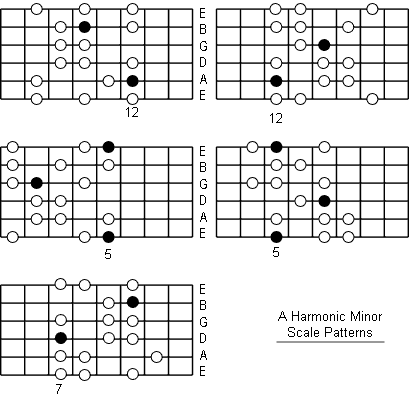
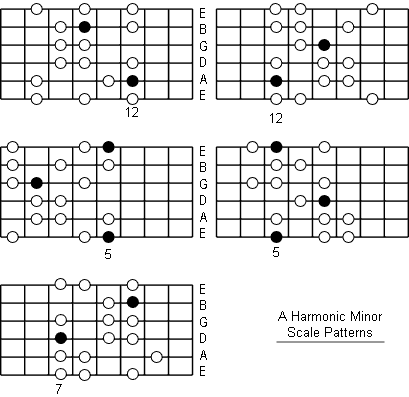
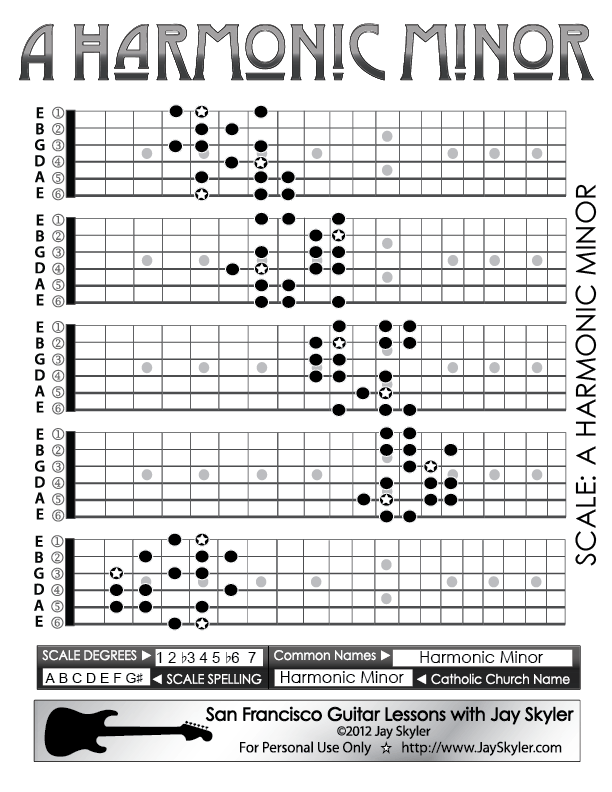
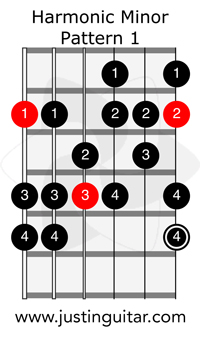
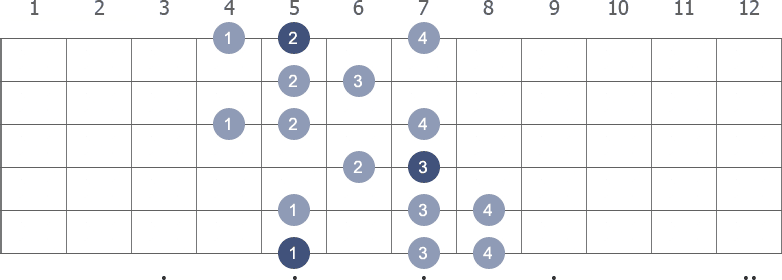
You can play the A harmonic minor guitar scale in many areas of the fretboard. The best approach is to learn one useful shape first, then connect it to nearby positions.
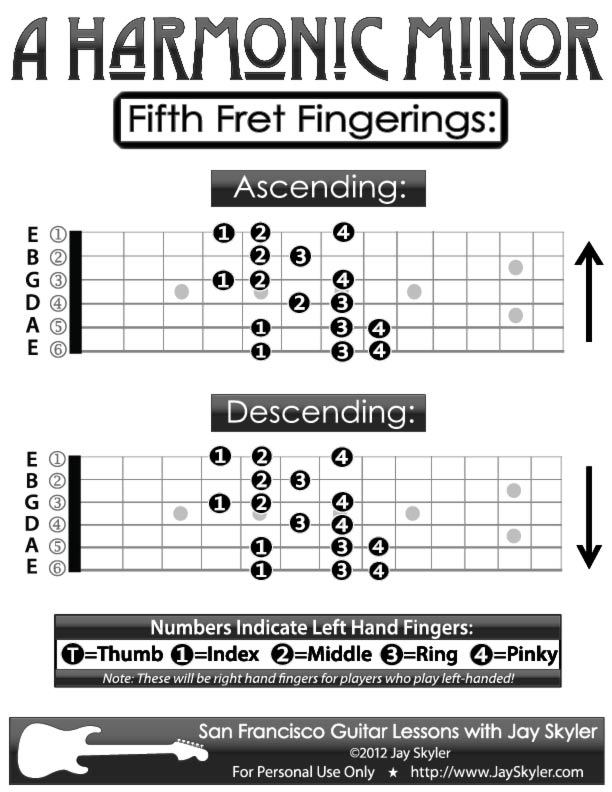
Here is a practical fifth-position pattern. The numbers show frets, and the strings are listed from low E to high E.
e|----------------4-5-|
B|------------5-6-----|
G|--------4-5---------|
D|----5-7-------------|
A|--4-7---------------|
E|5-7-----------------|
This shape includes:
• A at the sixth string, fifth fret
• G♯ at the sixth string, fourth fret
• C at the fifth string, third fret if you extend the shape downward
• A at the first string, fifth fret
The fingering may vary based on your hand size and playing style. Use one finger per fret when comfortable, but do not force a stretch that causes tension.
Another useful approach is to play the scale on one string. On the fifth string, the notes are:
A|--0--2--3--5--7--8--11--12--|
   A  B  C  D  E  F  G# A
This single-string method helps you hear the scale clearly. It also shows the uneven spacing that makes harmonic minor different from many familiar scale patterns.
On the low E string, the same notes appear here:
E|--5--7--8--10--12--13--16--17--|
   A  B  C  D   E   F   G#  A
Practice each position slowly. Say the note names out loud. This may feel basic, but it links the fretboard to your ear and prevents you from treating the scale as a meaningless finger pattern.
How to Play the A Harmonic Minor Guitar Scale on the Fretboard
A scale shape is useful, but music begins when you can move through the shape with control.
Start with these steps:
- Play the scale upward and downward with alternate picking.
- Use a metronome at 50 to 60 beats per minute.
- Play one note per click.
- Increase the tempo only when every note sounds clean.
- Stop on A and listen to the feeling of resolution.
- Repeat the exercise from different starting notes.
Do not rush to play the scale at high speed. The raised seventh, G♯, must sound intentional. If you blur past it, you lose the main feature of the A harmonic minor guitar scale.
Try this short melodic exercise:
e|-------------------------|
B|-------------------------|
G|-----------------5-6-5---|
D|---------5-7-6-7-------7-|
A|---4-7-8-----------------|
E|-------------------------|
The exact fingering can change, but the idea is more important:
A, E, F, G♯, A
This phrase highlights the tension between F and G♯ before resolving to A. Play it slowly first. Then try slides, hammer-ons, pull-offs, and bends.
A useful practice rule is to spend equal time going up and down. Many players can climb a scale but cannot create a convincing phrase back toward the root. Descending lines are especially important in minor music because they help you hear how tension relaxes.

A Harmonic Minor Guitar Scale Chords
The A harmonic minor guitar scale produces a distinct group of chords. Build each triad by stacking notes from the scale in thirds.
The diatonic triads are:
• A minor: A, C, E
• B diminished: B, D, F
• C augmented: C, E, G♯
• D minor: D, F, A
• E major: E, G♯, B
• F major: F, A, C
• G♯ diminished: G♯, B, D
The most important chord is E major or E7. It contains G♯, the leading tone that resolves to A.
Common progressions include:
• Am → E7 → Am
• Am → Dm → E7 → Am
• Am → F → E7 → Am
• Am → C+ → E7 → Am
The C augmented chord is also worth exploring. Its notes are C, E, and G♯. It can sound unstable and colorful, especially when it moves to F, Dm, or Am.
For a basic guitar application, try this progression:
| Am | Dm | E7 | Am |
Over Am, use A, C, and E as strong target notes. Over Dm, emphasize D, F, and A. Over E7, bring out E, G♯, B, and D. When the progression returns to Am, resolve G♯ upward to A.
This chord-aware approach sounds much more musical than playing the full scale over every chord. The A harmonic minor guitar scale is a vocabulary. The chords tell you which words deserve emphasis.
A Harmonic Minor Guitar Scale Compared With Other Minor Scales
Comparing minor scales makes the sound easier to understand.
A Natural Minor
A natural minor contains:
A, B, C, D, E, F, G
It has a soft, familiar minor sound. It works well for folk, rock, pop, blues, and many basic minor-key progressions.
A Harmonic Minor
A harmonic minor contains:
A, B, C, D, E, F, G♯
It keeps the minor third and flat sixth but raises the seventh. This produces a stronger dominant chord and a more dramatic sound.
A Melodic Minor
A melodic minor usually contains:
A, B, C, D, E, F♯, G♯
In traditional theory, the sixth and seventh are raised when ascending and lowered when descending. In modern jazz, melodic minor often uses the raised sixth and seventh in both directions.
The main comparison is:
• Natural minor: flat seventh
• Harmonic minor: raised seventh
• Melodic minor: raised sixth and raised seventh
Use A natural minor when you want a simple minor color. Use A harmonic minor when you want a strong V chord and a dramatic leading tone. Use A melodic minor when the raised sixth adds a smoother, more modern sound.
How to Use A Harmonic Minor in Guitar Solos
The A harmonic minor guitar scale is most effective when you treat it as a melodic resource rather than a box to run.
Start with the chord progression. If the backing track uses Am and E7, the scale is a natural choice. Target chord tones on strong beats, then use the other notes as passing tones.
Over Am:
• A is the root
• C is the minor third
• E is the fifth
• G♯ creates tension and usually wants to move to A
Over E7:
• E is the root
• G♯ is the major third
• B is the fifth
• D is the minor seventh
A simple solo idea might use:
A – C – E – G♯ – A
This small phrase already communicates the sound. You do not need to play all seven notes to make the scale clear.
Try these techniques:
• Bend G♯ slightly toward A
• Slide from F to G♯
• Resolve G♯ to A at the end of a phrase
• Use alternate picking for fast runs
• Play repeated notes for a rhythmic effect
• Add vibrato to A, C, or E
• Pause after a tense note before resolving
The scale is common in neoclassical guitar because its symmetrical patterns and strong tension work well with sequences. It also appears in classical guitar, flamenco-influenced music, progressive metal, soundtrack writing, and traditional musical styles from several regions.
Still, avoid forcing the scale over every minor chord. If the song has no E major, E7, or another harmony that supports G♯, the note may sound out of place. Listen first, then choose the scale.
A Harmonic Minor Guitar Scale Practice Routine
A focused routine can make the scale feel natural within a few weeks.
Five-minute note practice
Play the scale slowly in one position. Name each note as you play it. Focus on the location of G♯ and the two A notes around it.
Five-minute sound practice
Play short phrases that end on A. Then play phrases that end on G♯. Notice how unfinished the second group sounds. This trains your ear to recognize tension and release.
Five-minute chord practice
Loop Am, Dm, E7, and Am. Improvise using only three notes at first:
A, C, and G♯
Then add E, D, B, and F one at a time.
Five-minute technique practice
Use sequences such as:
A, B, C
B, C, D
C, D, E
D, E, F
E, F, G♯
F, G♯, A
Move the sequence through the scale with a metronome. Keep your picking relaxed.
Five-minute musical practice
Create a four-bar solo. Include one bend, one slide, one pause, and one clear resolution to A. Record yourself if possible. Listening back often reveals timing problems that are hard to notice while playing.
One mistake I often see in scale practice is focusing only on speed. A clean, slow phrase with good timing is more useful than a fast run with weak rhythm. Build control first. Speed comes later.
Common Mistakes With the A Harmonic Minor Guitar Scale
Several problems can make the scale sound forced.
Treating it like A natural minor
If you play G instead of G♯, you are no longer using the defining form of the scale. G can still work as a passing note, but G♯ gives harmonic minor its identity.
Using G♯ without resolving it
G♯ often sounds strongest when it moves to A. You can hold it for tension, but a phrase that never resolves may feel incomplete.
Ignoring the backing chords
A scale cannot fix a poor harmonic match. If the music uses Am7 and Dm7 without E7, A natural minor may fit better than A harmonic minor.
Playing every note equally
Strong solos use emphasis. Target chord tones and let passing notes support them.
Stretching too far
Some scale shapes create wide fret stretches. Use a position shift if needed. Pain and tension are signs to stop and adjust your technique.
Practicing without rhythm
Play with a metronome, drum loop, or backing track. Musical timing matters as much as correct notes.
A Harmonic Minor Guitar Scale Backing Track Ideas
You can create simple backing tracks with a looper, digital audio workstation, or drum machine.
Try these progressions:
Classical minor progression
| Am | Dm | E7 | Am |
This is the clearest setting for the A harmonic minor guitar scale. Resolve G♯ to A each time the progression returns to Am.
Dramatic rock progression
| Am | F | E7 | E7 |
Hold the E7 chord for two bars. This gives you more time to explore G♯, B, and D before resolving.
Cinematic progression
| Am | C+ | F | E7 |
The augmented C chord adds tension. Use wide intervals, sustained notes, and slow bends for a soundtrack-like effect.
Simple vamp
| Am | E7 |
This two-chord loop is ideal for learning the scale. Begin with short phrases. Do not try to fill every space.
When testing a phrase, ask three questions:
• Does it fit the chord?
• Can I sing or remember it?
• Does the tension resolve in a satisfying way?
If the answer is yes, the phrase is probably working.
Frequently Asked Questions About the A Harmonic Minor Guitar Scale
What notes are in the A harmonic minor guitar scale?
The notes are A, B, C, D, E, F, and G♯. The raised seventh, G♯, separates it from A natural minor.
What is the difference between A minor and A harmonic minor?
A natural minor uses G, while A harmonic minor uses G♯. That one-note change creates a stronger E major or E7 chord and a stronger pull toward A.
What chords work with the A harmonic minor guitar scale?
The main chords include Am, B diminished, C augmented, Dm, E major, F major, and G♯ diminished. The E or E7 chord is especially important because it contains the scale’s raised seventh.
Is A harmonic minor good for metal guitar?
Yes. Its tense sound works well for neoclassical metal, progressive metal, and dramatic lead guitar. Use sequences, alternate picking, palm-muted riffs, and clear resolution from G♯ to A.
Can I use A harmonic minor over an A minor chord?
Yes, but listen to the harmony. G♯ creates tension over Am, so it usually sounds best when the progression also includes E major or E7, or when G♯ resolves quickly to A.
What is the easiest way to practice A harmonic minor on guitar?
Learn one position, play it slowly with a metronome, and focus on hearing G♯ resolve to A. Then practice short phrases over an Am to E7 backing loop.
Why does A harmonic minor sound exotic?
The scale contains an augmented second between F and G♯. That wider interval, combined with the raised seventh, creates a dramatic color that listeners often describe as exotic or cinematic.
Conclusion
The A harmonic minor guitar scale contains A, B, C, D, E, F, and G♯. Its raised seventh creates the strong pull from G♯ to A and supports the powerful E major to A minor resolution.
Learn the notes, connect the fretboard shapes, and practice the scale over Am and E7. Focus on chord tones, use short phrases, and let tension resolve instead of rushing through every note. Spend a few minutes with the scale each day, record your progress, and explore more guitar theory and backing tracks as your confidence grows.

Senior Music Reviewer
Alex Carter is a seasoned music reviewer with over a decade of experience in the world of sound and instruments. Passionate about helping musicians and enthusiasts make informed choices, he brings sharp insights and in-depth knowledge to every review. From classical instruments to modern gear, Alex combines technical expertise with a love for music to deliver content that resonates with readers.
As a Senior Music Reviewer and expert author on Tuneluma.com, Alex is dedicated to sharing honest evaluations, practical advice, and thoughtful commentary to guide readers in their musical journey.