Where Do You Measure Guitar Scale Length: Quick Guide
Measure guitar scale length from the front edge of the nut to the center of the 12th fret, then double that distance.
Knowing where to measure the length of a guitar scale helps you identify an instrument’s feel, string tension, fret spacing, and replacement-part fit. The method sounds simple, but small errors around the nut, 12th fret, or bridge can lead to the wrong result. This guide explains the correct measurement, common mistakes, useful examples, and why scale length matters when buying, repairing, or setting up a guitar.
What Is Guitar Scale Length?
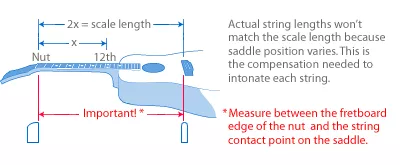
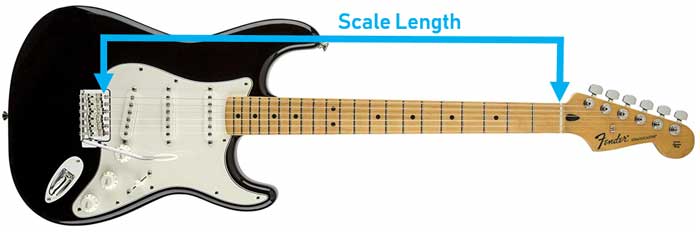
Guitar scale length is the vibrating length of an open string. It runs from the string’s contact point at the nut to its contact point at the bridge saddle.
This measurement affects several important playing traits:
• Fret spacing
• String tension
• Chord comfort
• Bending feel
• Intonation
• The guitar’s overall response
A longer scale places the frets farther apart. It also creates more string tension when the guitar uses the same tuning and string gauge. A shorter scale usually feels softer and more compact under the fingers.
For example, a 25.5-inch electric guitar scale often feels tighter than a 24.75-inch model with the same strings and tuning. Neither scale is better. They simply offer different playing experiences.
In practical guitar design, scale length is also linked to the 12th fret. The 12th fret sits at the halfway point of the theoretical vibrating string length. That is why the 12th fret gives you the most reliable reference point when measuring a guitar scale.
Where Do You Measure the Length of a Guitar Scale?
You measure guitar scale length from the front edge of the nut to the center of the 12th fret, then multiply the result by two.
The front edge of the nut is the side closest to the fretboard. Do not measure from the back edge of the nut, the headstock, or the point where the nut meets the wood.
Use the center of the 12th fret, not the edge of the fret wire. The center is the midpoint of the fret itself, measured along the length of the neck.
The basic formula is:
Scale length = nut-to-12th-fret distance × 2
For example:
- Measure from the front edge of the nut to the center of the 12th fret.
- Suppose the distance is 12.75 inches.
- Multiply 12.75 by 2.
- The estimated scale length is 25.5 inches.
This is the standard answer to where do you measure the length of a guitar scale. It is fast, accurate, and useful for most guitars.
How to Measure Guitar Scale Length Step by Step
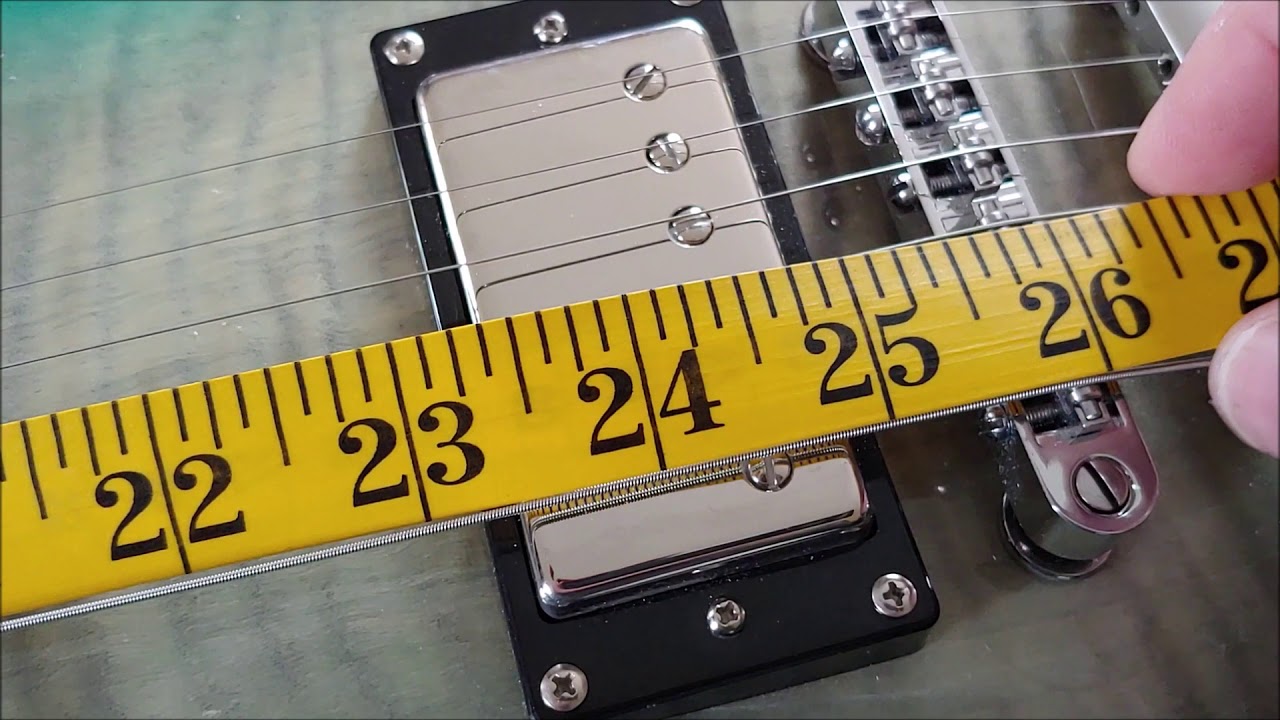
You do not need special tools. A steel ruler, tape measure, or digital measuring tool will work. A long straightedge can make the process easier, but it is not required.
1. Tune the guitar
Tune the guitar close to standard pitch. Tuning does not change the scale length, but it helps keep the strings seated in their normal positions.
2. Find the front edge of the nut
Look at the nut where it meets the fretboard. This edge faces the first fret.
Place the beginning of your ruler at that edge. If the nut is rounded or difficult to read, use the point where the strings leave the nut toward the fretboard.
3. Locate the center of the 12th fret
The 12th fret is usually easy to find because it has a double-dot marker on many guitars. Measure to the middle of the 12th fret wire.
Do not measure to the 12th fret marker itself if the dots sit beside the fret. The marker shows the fret location, but the fret wire is the true reference.
4. Double the measurement
Multiply the nut-to-12th-fret distance by two. Record the result in inches or millimeters.
For example, a measurement of 12.375 inches gives:
12.375 × 2 = 24.75 inches
That guitar likely uses a 24.75-inch scale, although manufacturing tolerances and measurement technique can cause a small difference.
5. Check your result
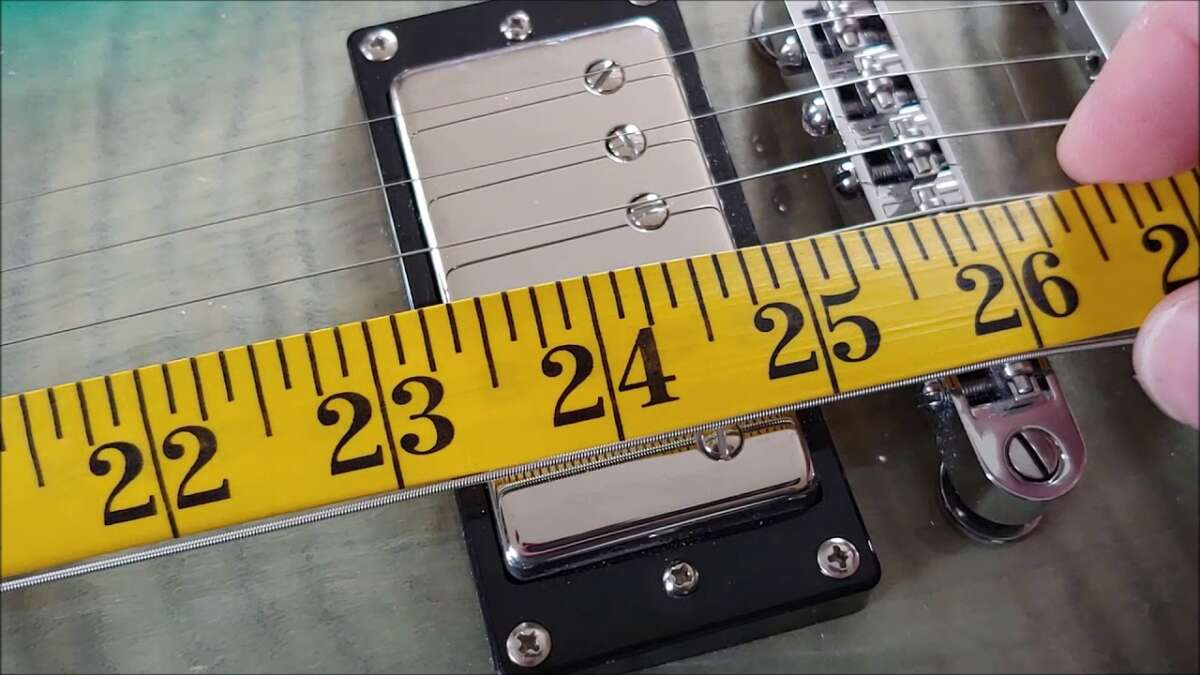
Measure from the nut to the bridge saddle as a second check. The result may be slightly longer than the calculated scale because the saddle is moved backward for intonation compensation.
This second measurement is useful, but the saddle is not always a single exact point. On many guitars, each string has a different contact position.

Why the 12th Fret Is the Best Reference
The 12th fret represents the octave. It divides the vibrating string length into two equal mathematical parts.
This relationship comes from the fret spacing formula used in guitar construction. Each fret shortens the vibrating string by a constant ratio. The 12th fret sits at half the scale length, so doubling the nut-to-12th-fret distance gives the original scale.
This method is more dependable than measuring to the bridge because the bridge saddle includes compensation. Compensation moves the string’s contact point slightly away from the theoretical scale point. The extra distance helps the fretted notes play closer to correct pitch.
Think of the 12th fret as the center mark on a ruler. The bridge is adjusted for real-world string behavior, while the 12th fret reveals the underlying design length.
For this reason, where do you measure the length of a guitar scale is best answered with the nut and 12th fret, not the nut and the back of the bridge.

Nut-to-12th-Fret Measurement Examples
Different guitars produce different half-scale measurements. Here are common examples:
| Nut to 12th fret | Approximate scale length |
|---|---|
| 12 inches | 24 inches |
| 12.25 inches | 24.5 inches |
| 12.375 inches | 24.75 inches |
| 12.5 inches | 25 inches |
| 12.75 inches | 25.5 inches |
| 13 inches | 26 inches |
These numbers are examples, not universal rules. Some guitars use unusual scale lengths, and vintage instruments may have small variations.
A guitar advertised as 25.5 inches may measure slightly above or below that figure depending on production tolerances, fret wear, nut shape, and measuring accuracy. A difference of a few hundredths of an inch does not usually change the guitar’s classification.
If you are ordering a replacement neck, bridge, or pre-slotted nut, use the manufacturer’s official specification when possible. A rough home measurement is helpful, but replacement parts require greater precision.

Where Do You Measure the Length of a Guitar Scale on Different Guitar Types?
The basic method works on electric guitars, acoustic guitars, classical guitars, basses, and most fretted instruments.
Electric guitars
Measure from the front edge of the nut to the center of the 12th fret. Electric guitars often have clear fret markers, which makes the process simple.
The bridge can be misleading because many electric bridges allow individual saddle adjustment. The saddles may sit at different distances from the theoretical scale point.
Acoustic guitars
Use the same nut-to-12th-fret method. Acoustic bridges often have angled saddles, so measuring to the front or back edge of the saddle can produce the wrong answer.
Measure the center of the 12th fret, double it, and compare the result with the guitar’s published specifications.
Classical guitars
Classical guitars usually have nylon strings and a wider neck, but the measurement process does not change. Measure from the nut’s front edge to the center of the 12th fret, then double it.
Some classical instruments use a 650-millimeter scale, while others use shorter or longer designs.
Bass guitars
Bass scale length is measured in the same way. Common bass scales include short scale, medium scale, long scale, and extra-long scale.
Because bass frets are farther apart, use a straight ruler and take your time. A small reading error can become more noticeable when comparing replacement strings or necks.

Common Mistakes When Measuring Guitar Scale Length
A few simple mistakes cause most incorrect measurements.
• Measuring from the back of the nut instead of the front edge
• Measuring to the edge of the 12th fret instead of its center
• Measuring to the bridge body instead of the saddle contact point
• Forgetting to double the nut-to-12th-fret distance
• Measuring along a curved fretboard without keeping the ruler straight
• Assuming the listed scale length must match a rough measurement exactly
• Confusing scale length with the total length of the guitar neck
The most common error I see is measuring from the nut to the 12th fret marker and stopping there. That gives you only half the scale length. Another frequent mistake is measuring to the rear of an acoustic saddle, which includes compensation and can make the guitar appear longer.
Keep the ruler centered along the neck. Do not follow the curve of the fretboard. Scale length is a straight-line design measurement, not the length of the curved surface.

Why Guitar Scale Length Matters
Scale length affects the guitar in several practical ways.
String tension
At the same pitch and string gauge, a longer scale produces higher tension. This can make the guitar feel firm and clear.
A shorter scale usually has lower tension. It may feel easier for bends, vibrato, and wide chords, especially for players with smaller hands.
Fret spacing
Longer scale guitars have wider fret spacing. This can help players who like room between their fingers, but it may feel demanding for compact chord shapes.
Shorter scale guitars bring the frets closer together. Many players find them comfortable for stretching less across the neck.