How Many Guitar Scales Are There: A Complete Guide
There are infinitely many guitar scales, but most players use about 10 to 20 practical scales regularly.
The answer to “how many guitar scales are there” depends on how you define a scale. Music theory allows countless note combinations, while guitarists usually focus on a small group of useful scales for melody, solos, chords, and improvisation. This guide explains the difference between theoretical and practical scale counts, with clear examples you can use on the fretboard.
How Many Guitar Scales Are There?
There are infinitely many guitar scales in a broad musical sense. You can create a new scale by choosing different notes, changing the order, or using a different tuning system.
However, the number becomes more useful when we divide scales into groups:
• Common scales: Around 10 to 20 scales cover most popular guitar music.
• Major and minor scales: These include the major scale, natural minor, harmonic minor, and melodic minor.
• Modes: The major scale creates seven modes, including Ionian, Dorian, Phrygian, Lydian, Mixolydian, Aeolian, and Locrian.
• Pentatonic scales: Major and minor pentatonic scales are among the most used guitar scales.
• Blues scales: The blues scale adds a lowered fifth to the minor pentatonic scale.
• Exotic and world music scales: These include the whole-tone, diminished, Phrygian dominant, Hungarian minor, and many others.
So, how many guitar scales are there in practical terms? Most guitarists can learn a powerful working vocabulary with fewer than 15 scales. The goal is not to memorize every possible scale. The goal is to understand how useful scales sound and where they fit.

Why There Is No Single Exact Number
A scale is a group of notes arranged in ascending or descending order. Yet musicians do not always agree on what counts as a separate scale.
For example, C major contains the notes C, D, E, F, G, A, and B. If you begin on D and use the same notes, you get D Dorian. The notes are the same, but the tonal center changes. Some musicians call Dorian a separate scale, while others describe it as a mode of C major.
The same issue appears with keys. The A minor pentatonic scale and the C major pentatonic scale use the same five notes. Their musical focus is different, but their note collection is identical.
The count can also change because of:
• Different names for the same scale
• Different starting notes
• Different guitar tunings
• Microtonal music between standard notes
• Regional music traditions
• Scales with repeated or altered notes
This is why a fixed answer can be misleading. When someone asks how many guitar scales are there, the honest answer must explain the system being used.
The Most Important Guitar Scales
Most guitarists do not need hundreds of scales. A small set of core scales can cover rock, blues, pop, country, jazz, metal, and many other styles.
Major Scale
The major scale has seven notes and follows this pattern:
Whole step, whole step, half step, whole step, whole step, whole step, half step.
In the key of C, the notes are:
C, D, E, F, G, A, B
The major scale is the foundation of Western harmony. It helps you understand chord construction, melody, intervals, and modes.
Natural Minor Scale
The natural minor scale has a darker and more emotional sound. A natural minor contains:
A, B, C, D, E, F, G
It uses the same notes as C major but begins and resolves around A. This example shows why the tonal center matters.
Major Pentatonic Scale
The major pentatonic scale uses five notes from the major scale. In C major, those notes are:
C, D, E, G, A
It avoids the half-step tension found in the full major scale. This makes it easy to use in country, folk, pop, blues, and rock.
Minor Pentatonic Scale
The minor pentatonic scale is one of the most important guitar scales. In A minor, the notes are:
A, C, D, E, G
Many famous rock and blues solos use this scale. Its simple shape feels natural under the fingers, which makes it a strong first choice for improvisation.
Blues Scale
The blues scale adds a flat fifth to the minor pentatonic scale. The A blues scale contains:
A, C, D, E♭, E, G
The E♭ is called the blue note. It creates tension that can sound expressive when you bend or slide into it.
Harmonic Minor Scale
The harmonic minor scale raises the seventh note of the natural minor scale. A harmonic minor contains:
A, B, C, D, E, F, G♯
It has a dramatic sound often heard in classical music, neoclassical rock, metal, and flamenco-inspired playing.
Melodic Minor Scale
In traditional theory, the melodic minor scale raises the sixth and seventh notes when ascending. Modern jazz often uses the ascending form in both directions.
The melodic minor scale creates several important sounds, including altered dominant colors and modern jazz modes.

How Many Guitar Scales Are There in the Major Scale System?
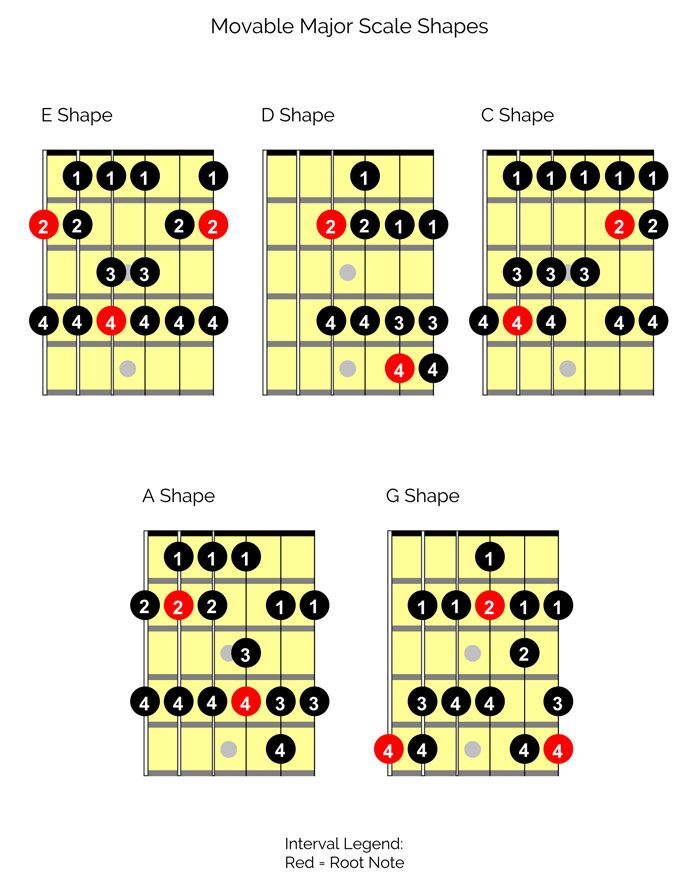
The major scale system contains seven modes. Each mode uses the same seven notes but has a different tonal center and mood.
Ionian
Ionian is the regular major scale. It sounds bright, stable, and complete.
Dorian
Dorian is a minor mode with a raised sixth. It appears in funk, jazz, blues, rock, and modal music.
Phrygian
Phrygian has a lowered second. Its tense, Spanish-style sound works well in metal and flamenco-influenced music.
Lydian
Lydian is a major mode with a raised fourth. It has a bright, floating quality that appears in film music and progressive rock.
Mixolydian
Mixolydian is a major mode with a lowered seventh. It is common in blues, rock, country, and classic guitar riffs.
Aeolian
Aeolian is the natural minor scale. It often sounds sad, serious, or dramatic.
Locrian
Locrian has a lowered second and lowered fifth. It is less common because its main chord is unstable.
If you count the seven major modes as separate scales, the answer to how many guitar scales are there becomes larger. If you view them as variations of one parent scale, the number becomes smaller.
How Many Guitar Scales Are There Across All 12 Keys?
A scale type can be played in 12 different keys. For example, the minor pentatonic scale exists in:
A minor pentatonic
B♭ minor pentatonic
B minor pentatonic
C minor pentatonic
D♭ minor pentatonic
D minor pentatonic
E♭ minor pentatonic
E minor pentatonic
F minor pentatonic
G♭ minor pentatonic
G minor pentatonic
A♭ minor pentatonic
These are not usually counted as 12 completely different scales. They are transpositions of the same scale formula.
For example, the minor pentatonic formula is:
1, ♭3, 4, 5, ♭7
In A, the notes are A, C, D, E, and G. In E, the notes are E, G, A, B, and D. The formula stays the same while the pitch changes.
This means one scale type can produce 12 keys. If you study 10 common scale types in all 12 keys, you could describe that as 120 scale and key combinations. But music theory usually counts the scale types separately.
A Useful List of Guitar Scale Families
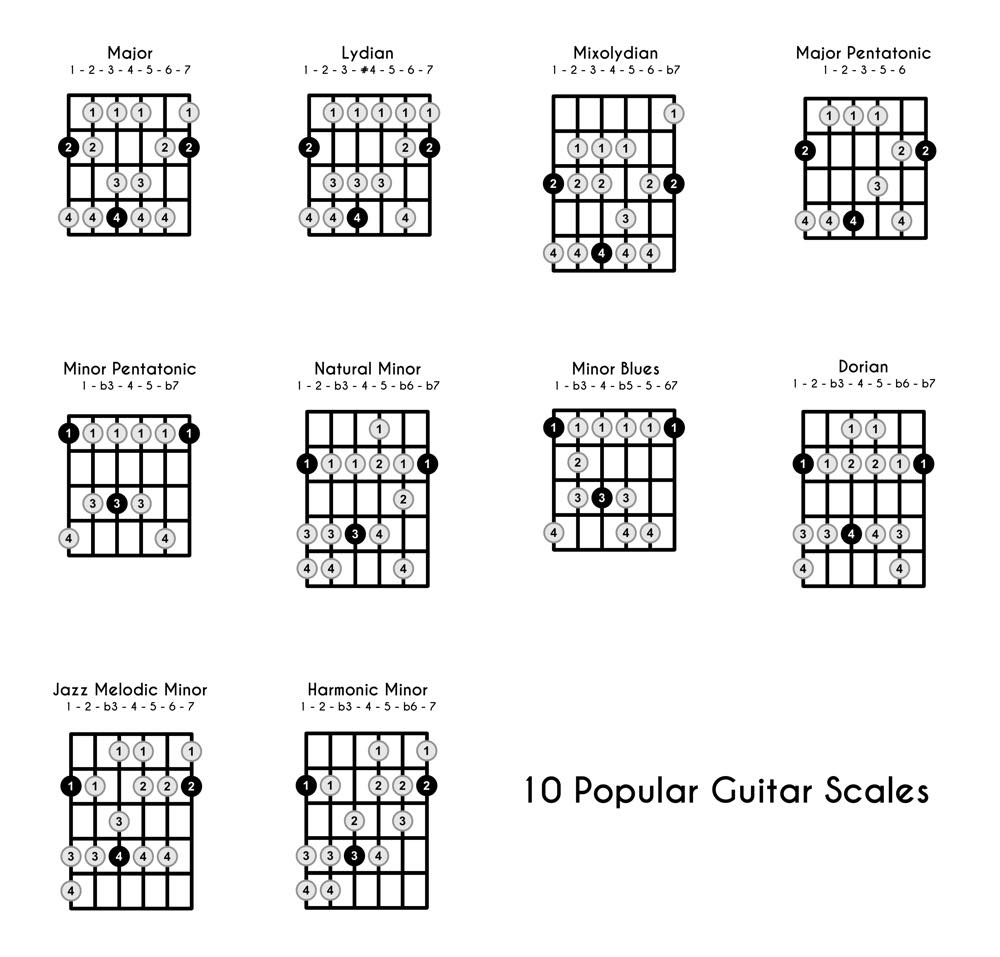
When studying how many guitar scales are there, it helps to organize them by family instead of memorizing a random list.
Diatonic Scales
Diatonic scales contain seven notes within an octave. The major scale and natural minor scale are the best-known examples.
Pentatonic Scales
Pentatonic scales contain five notes. They are simple, flexible, and common in blues, rock, country, folk, and pop.
Hexatonic Scales
Hexatonic scales contain six notes. The blues scale is often treated as a six-note scale because of its added blue note.
Chromatic Scale
The chromatic scale uses all 12 notes in the Western musical system. On guitar, it includes every fret within an octave.
It is not usually used as one long melody. Instead, guitarists use chromatic notes as passing tones, approach notes, and tension notes.
Symmetrical Scales
Symmetrical scales use repeating patterns. Examples include:
• Whole-tone scale
• Diminished scale
• Augmented scale
These scales are useful in jazz, fusion, film music, and advanced improvisation.
Synthetic Scales
A synthetic scale is created by altering or combining familiar scale ideas. Many modern composers and players use synthetic scales to create sounds outside standard major and minor harmony.

How Many Guitar Scales Should a Beginner Learn?
A beginner does not need to learn every scale. Start with scales that help you play real music quickly.
A strong beginner path includes:
-
Minor pentatonic scale
-
Major pentatonic scale
-
Major scale
-
Natural minor scale
-
Blues scale
After learning these, add the Dorian and Mixolydian modes. This group gives you a useful foundation for blues, rock, pop, country, funk, and basic improvisation.
The minor pentatonic scale is often the best starting point because it has a simple shape and works over many common progressions. Still, do not learn the shape without learning the root notes. The root tells you where the scale belongs and how it relates to the chord.
One mistake I often see in practice is treating a scale as a finger exercise only. A player may move through all five pentatonic shapes but still struggle to create a musical phrase. Practice short melodies, bends, rests, and repeated ideas instead.

Guitar Scale Patterns Versus Musical Scales
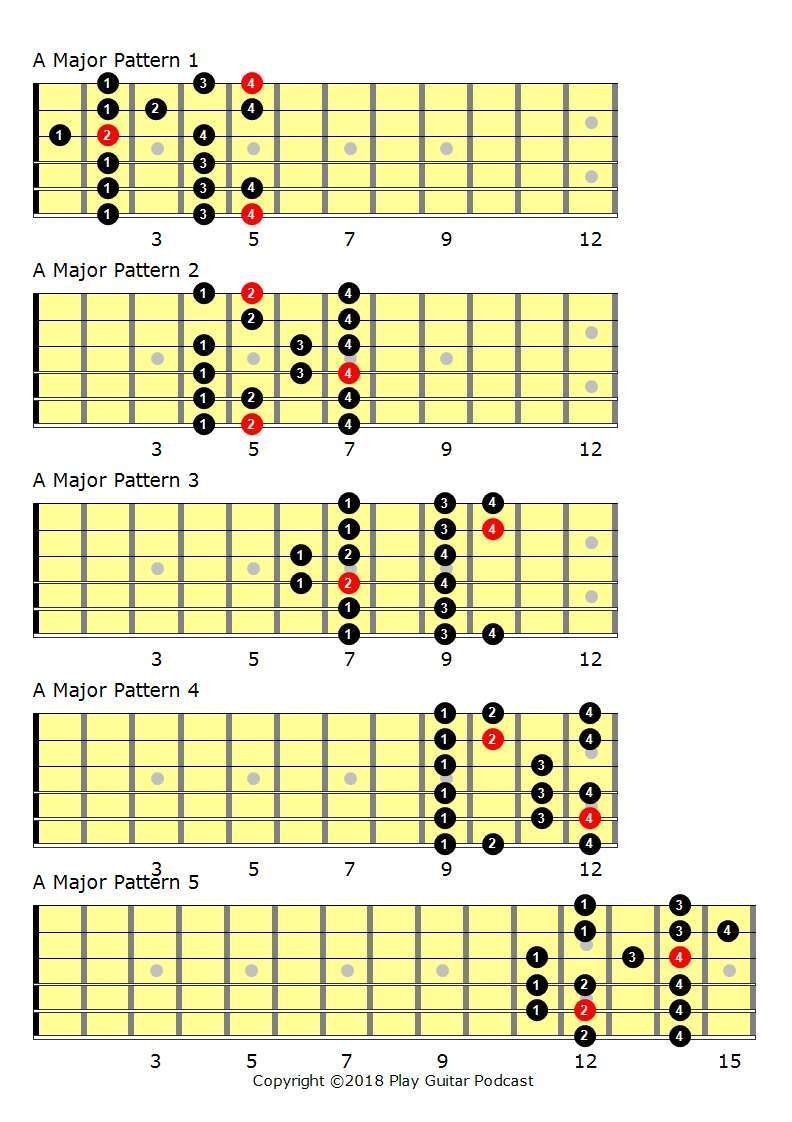
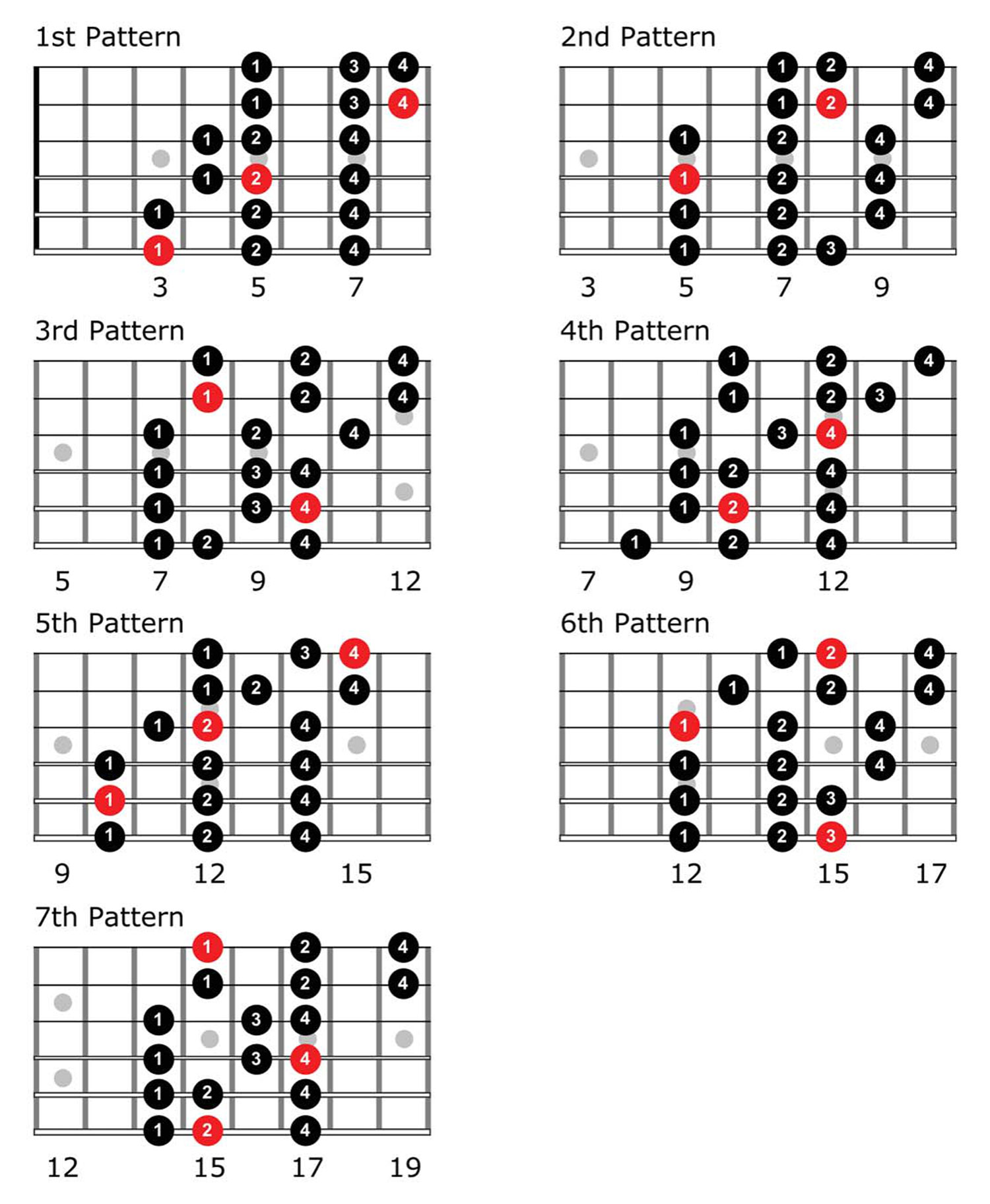
A guitar scale pattern is a visual shape on the fretboard. The musical scale is the group of notes and the relationship between those notes.
The same A minor pentatonic scale can appear in five connected patterns across the neck. These patterns do not represent five separate scales. They are five positions of one scale.
This difference matters because guitar players often ask how many guitar scales are there when they are really asking how many fretboard patterns exist.
For example:
• One minor pentatonic scale has five common CAGED positions.
• One major scale can be played in several connected positions.
• One mode may use the same notes as another mode but emphasize a different root.
Learning patterns is helpful, but connecting those patterns is more important. Try playing one scale across two or three positions. Then connect them with slides, shifts, or short phrases.

How Guitar Tuning Changes the Answer
Standard tuning uses the notes E, A, D, G, B, and E. This tuning makes many scale patterns easy to repeat, but the interval between the G and B strings creates a small change in some shapes.
Alternative tunings can change the physical pattern without changing the musical scale. Drop D, open G, open D, and DADGAD are common examples.
In an open tuning, the open strings form a chord. This can make certain scales and chord shapes easier to play. It can also require new fingerings.
The number of musical scales does not increase simply because you change tuning. The fretboard layout changes, not the basic collection of musical notes. However, new tunings can inspire different sounds and make some scale ideas more practical.

How to Choose the Right Guitar Scale
Choose a scale based on the chord progression, style, and mood.
Use these simple guidelines:
• Over a basic minor blues progression, try the minor pentatonic or blues scale.
• Over a major country or pop progression, try the major pentatonic scale.
• Over a Dorian groove, emphasize the Dorian root and raised sixth.
• Over a dominant seventh chord, try Mixolydian.
• Over a dramatic minor progression, compare natural minor and harmonic minor.
• Over jazz chords, study chord tones before adding advanced scales.
The chord underneath your solo acts like a map. A scale may contain correct notes, but not every note will sound equally strong over every chord.
A practical method is to target chord tones on strong beats. Then use scale notes between them. This approach usually sounds more musical than running up and down the scale.
Common Mistakes When Learning Guitar Scales
Learning too many scales too soon can slow your progress. Many players collect shapes but do not learn how to use them.
Avoid these common problems:
• Memorizing patterns without knowing the root notes
• Practicing only from the lowest note to the highest note
• Ignoring rhythm and phrasing
• Using one scale over every chord progression
• Avoiding bends, slides, vibrato, and pauses
• Failing to play scales in more than one key
• Practicing fast before playing cleanly
One lesson I have seen repeatedly is that five minutes of creative scale use can be more valuable than 30 minutes of mindless repetition. Play a short phrase. Change its rhythm. Move it to another string set. Then answer it with a different phrase.
Scales are vocabulary, not the finished conversation.
A Practical Guitar Scale Practice Plan
Use this 20-minute routine several times each week.
Minutes 1 to 4: Learn the Notes
Say the note names as you play. This connects your fingers to the fretboard and helps you find roots faster.
Minutes 5 to 8: Play the Pattern
Play slowly with a metronome. Use alternate picking and keep every note clear.
Minutes 9 to 12: Change the Rhythm
Play the scale in groups of three, four, or six notes. Add rests and accents.
Minutes 13 to 16: Create Short Phrases
Use only three to five notes. Add bends, slides, hammer-ons, or pull-offs.
Minutes 17 to 20: Play Over a Backing Track
Choose a track that matches the scale. Listen for notes that sound stable and notes that create tension.
This practice plan works because it combines knowledge, technique, rhythm, and musical application. It also prevents scales from becoming a dull mechanical task.
Do You Need to Learn Every Guitar Scale?
No. You do not need to learn every guitar scale to become a strong player.
Professional musicians often know many scales, but they also understand chord tones, intervals, rhythm, phrasing, and ear training. A player who deeply understands five scales may sound more musical than someone who has memorized 50 shapes without context.
Learn new scales when they solve a musical problem. If your solos sound too predictable, try a mode or a different pentatonic scale. If you want a darker sound, compare natural minor with harmonic minor. If you want more tension, explore chromatic notes or altered scales.
The best scale is the one that supports the music.
Theoretical Limits and the 12-Note System
In Western music, the chromatic system divides the octave into 12 pitch classes. Each note can be included or excluded from a possible scale, creating many possible note collections.
Mathematically, there are 2¹² possible subsets of 12 pitch classes. If you remove the empty set and the complete 12-note set, there are 4,094 nonempty, incomplete subsets. However, this number does not equal the number of useful named guitar scales.
Many of those note collections are not common scales. Some are transpositions of one another. Others have no established musical use or may sound like fragments of familiar scales.
This mathematical view explains why the answer to how many guitar scales are there can become very large. It is useful for theory, but it is not a practical learning list.
How to Build Your Own Guitar Scale
You can create a scale by starting with a familiar scale and changing one note.
For example:
• Start with natural minor.
• Raise the seventh note to create harmonic minor.
• Raise the sixth and seventh notes for melodic minor.
• Remove two notes from the major scale to create major pentatonic.
• Add a lowered fifth to minor pentatonic to create the blues scale.
This method teaches you how scale formulas work. It also helps you hear the effect of each interval.
Try playing a basic scale, then change one note. Ask yourself whether the new sound feels brighter, darker, more tense, or more open. Your ear should guide your theory, not the other way around.
Frequently Asked Questions
How many guitar scales are there in total?
There is no single official total because scales can be counted by type, key, mode, tuning, or musical tradition. In practical guitar playing, around 10 to 20 scale types cover most common styles, while theoretical systems allow thousands of possible note collections.
What are the five most important guitar scales?
The major scale, natural minor scale, major pentatonic, minor pentatonic, and blues scale are excellent choices. These scales cover a wide range of rock, blues, pop, country, folk, and beginner improvisation.
Are guitar scales different from regular music scales?
No. A guitar scale uses the same musical notes and intervals as a scale played on piano, violin, or another instrument. The main difference is the guitar’s fretboard layout and the available fingering patterns.
How many scales should a beginner learn?
A beginner should start with the minor pentatonic, major pentatonic, major, natural minor, and blues scales. It is better to understand a few scales deeply than to memorize many patterns without knowing how to use them.
Are guitar scale shapes the same as guitar scales?
No. A shape is a fingering pattern for playing a scale in one area of the neck. One scale can have several shapes, so five patterns do not necessarily mean five different scales.
Can one scale work over an entire song?
Sometimes, especially when a song stays in one key or uses a simple blues progression. In songs with changing chords, you may need to target chord tones or change scales to match the harmony.
What is the easiest guitar scale to learn?
The minor pentatonic scale is often the easiest because it uses five notes and has a compact pattern. It is also highly useful for rock, blues, and many beginner solos.
Conclusion
So, how many guitar scales are there? The theoretical answer is practically unlimited, while the useful answer for most players is about 10 to 20 core scales. Major, minor, pentatonic, blues, and modal scales can give you a strong foundation for nearly any style.
Start with one scale, learn its root notes, connect its positions, and use it to create real music. Practice slowly, listen closely, and add new scales only when they help you express a new sound. Choose one scale today, play it in two keys, and use it over a backing track to turn theory into music.

Senior Music Reviewer
Alex Carter is a seasoned music reviewer with over a decade of experience in the world of sound and instruments. Passionate about helping musicians and enthusiasts make informed choices, he brings sharp insights and in-depth knowledge to every review. From classical instruments to modern gear, Alex combines technical expertise with a love for music to deliver content that resonates with readers.
As a Senior Music Reviewer and expert author on Tuneluma.com, Alex is dedicated to sharing honest evaluations, practical advice, and thoughtful commentary to guide readers in their musical journey.