How Many Drum Rudiments Are There: Complete Guide
There are 40 official drum rudiments in the Percussive Arts Society’s standard list.
The answer to “how many drum rudiments are there” seems simple, but the full story is more interesting. Different schools, countries, and older traditions use different lists, so the number can change depending on the source. This guide explains the accepted count, the history behind it, the main rudiment families, and how to practice them with real musical value.

How many drum rudiments are there?
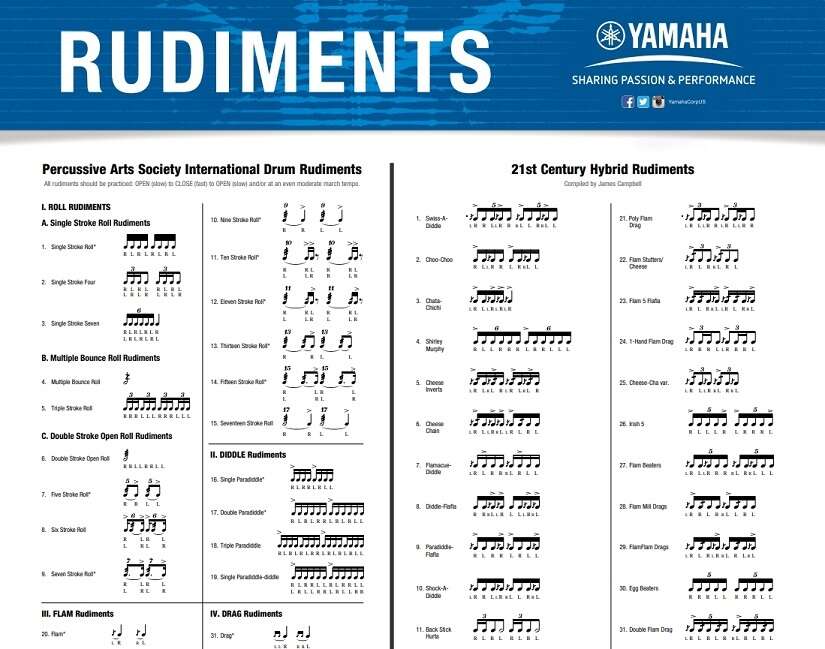
The most widely accepted answer is 40. The Percussive Arts Society, often called PAS, recognizes 40 International Drum Rudiments as the modern standard for drummers.
These rudiments cover key skills such as:
• Single strokes
• Double strokes
• Multiple-bounce rolls
• Flam notes
• Drags
• Diddles
• Ratamacues
• Combinations of these patterns
A rudiment is a short drum pattern. Think of it as a word in the language of drumming. By learning these “words,” you gain better control, speed, timing, and musical expression.
So, how many drum rudiments are there in the official modern list? There are 40. However, that number does not mean that only 40 drum patterns exist.
Drummers have created many exercises, hybrid rudiments, regional patterns, and personal variations. The official 40 simply provide a shared foundation for study, teaching, auditions, and competitions.

Why are there different numbers of drum rudiments?
The answer to how many drum rudiments are there depends on the organization or tradition being discussed. Drum rudiments have changed over time, much like spelling rules or music notation.
The National Association of Rudimental Drummers, or NARD, helped establish an earlier list of 26 standard rudiments in the United States. Later, the Percussive Arts Society expanded and updated the list to 40.
This history explains why one teacher may say there are 26 rudiments while another says there are 40. Both answers can be correct within their historical context.
Common counts include:
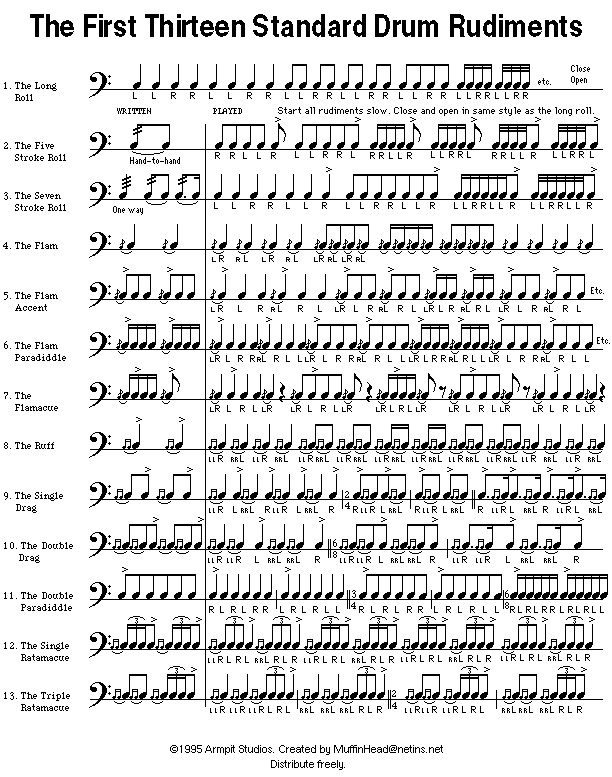
• 13 essential rudiments in some beginner programs
• 26 NARD rudiments in older American teaching systems
• 40 PAS International Drum Rudiments in the modern standard
• Hundreds of hybrid rudiments used by advanced players
When someone asks how many drum rudiments are there, it is best to ask which list they mean. For most modern lessons, the PAS list is the clearest answer.
The 40 official drum rudiments
The PAS list includes patterns that build nearly every major drumming skill. Some are simple enough for a beginner, while others demand years of focused practice.
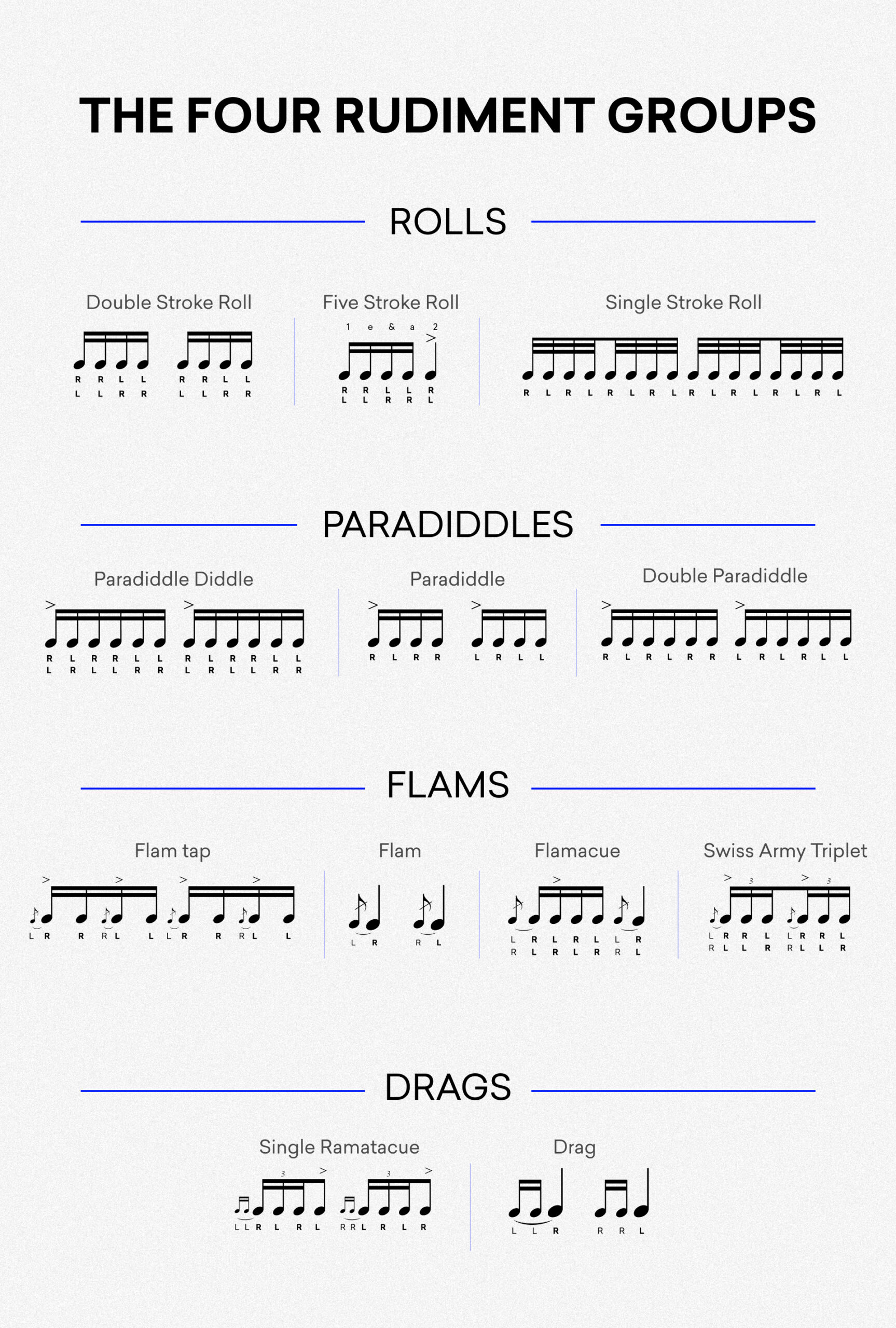
Here are the main types found in the 40 rudiments:
Roll rudiments
Roll rudiments teach smooth, even sound. They include single-stroke rolls, double-stroke rolls, and several forms of multiple-bounce rolls.
A single-stroke roll alternates the hands:
R L R L R L
A double-stroke roll uses two notes per hand:
R R L L R R L L
These patterns help develop hand speed and control. They also appear in marching music, concert percussion, drum set fills, and orchestral passages.
Diddle rudiments
A diddle is a repeated pair of notes. The most familiar example is the paradiddle:
R L R R | L R L L
The paradiddle is useful because it combines alternating strokes with double strokes. It helps drummers move around the kit while keeping their hands balanced.
Other diddle patterns add accents, changes in sticking, or more complex note groupings.
Flam rudiments
A flam has a soft grace note placed just before a louder main note. It sounds wide and powerful when played well.
A basic flam can be written as:
Grace note plus main note
The two notes should sound almost together. If the grace note becomes too loud or too far from the main note, the flam loses its shape.
Flam rudiments are common in marching percussion, concert snare drumming, drum corps, and expressive drum set playing.
Drag rudiments
A drag uses extra grace notes before a main stroke. It can sound thick, sharp, or rolling, depending on the tempo and style.
Drag patterns improve control over small notes. They also teach the hands to stay relaxed while playing dense rhythms.
When learning a drag, start slowly. Many players rush the grace notes or squeeze the sticks too tightly. A relaxed grip produces a cleaner sound.

A list of the 40 PAS drum rudiments
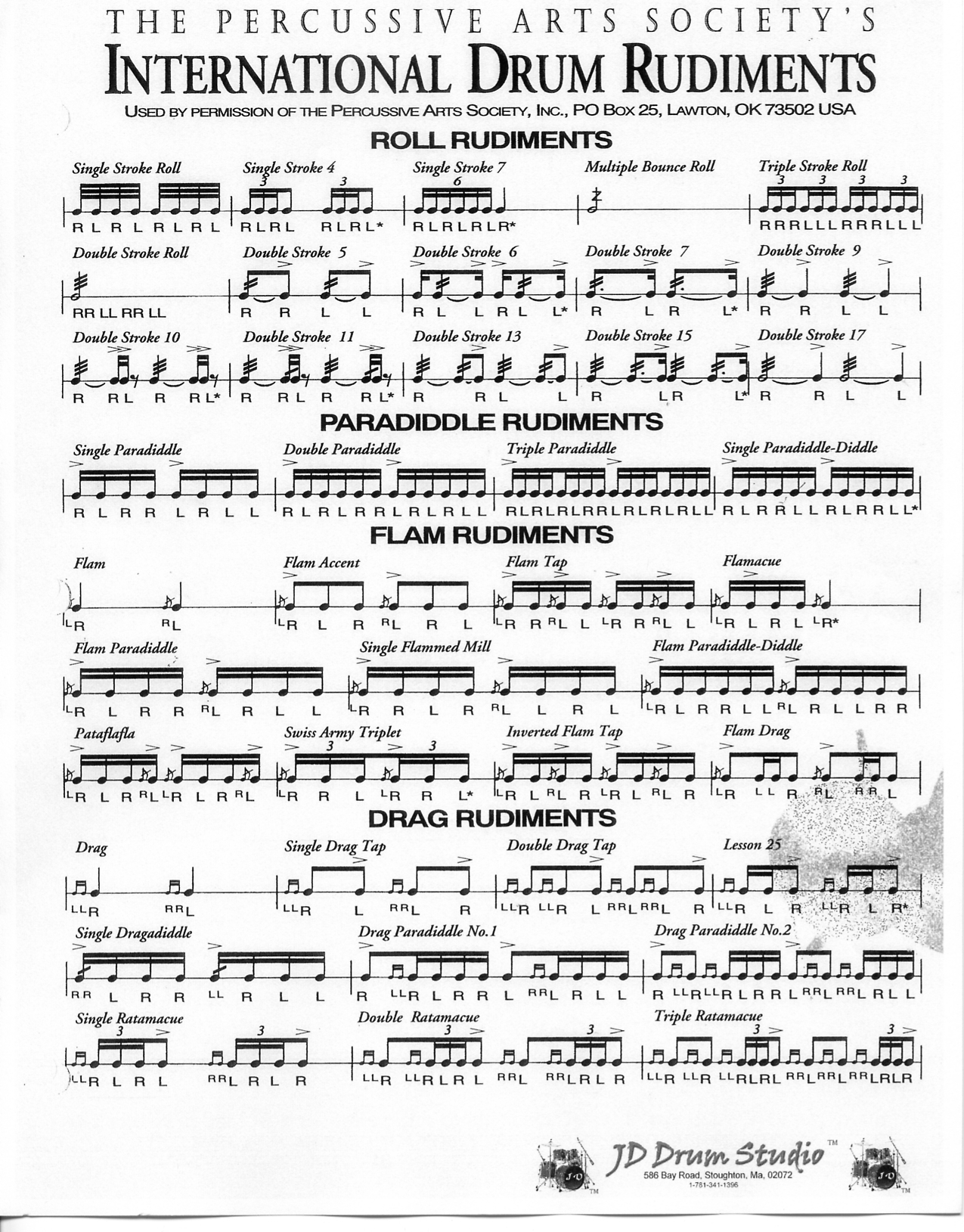
The modern PAS list includes the following 40 rudiments:
- Single Stroke Roll
- Five Stroke Roll
- Six Stroke Roll
- Seven Stroke Roll
- Nine Stroke Roll
- Ten Stroke Roll
- Eleven Stroke Roll
- Thirteen Stroke Roll
- Fifteen Stroke Roll
- Seventeen Stroke Roll
- Single Stroke Four
- Single Stroke Seven
- Multiple Bounce Roll
- Triple Stroke Roll
- Double Stroke Roll
- Double Paradiddle
- Triple Paradiddle
- Quadruple Paradiddle
- Single Paradiddle-diddle
- Flam
- Flam Accent
- Flam Tap
- Flamacue
- Flam Paradiddle
- Pataflafla
- Swiss Army Triplet
- Inverted Flam Tap
- Flam Drag
- Drag
- Single Drag Tap
- Double Drag Tap
- Lesson 25
- Single Ratamacue
- Double Ratamacue
- Triple Ratamacue
- Paradiddle
- Single Paradiddle
- Double Stroke Open Roll
- Triple Stroke Roll
- Single Stroke Roll variations
Different teaching charts may arrange or name some patterns differently. Some lists also combine related patterns, so check the terminology used by your instructor or exam board.
The important point is not to memorize a number without context. The PAS list is the main modern reference, but rudimental drumming is larger than any single chart.
What are the most important drum rudiments for beginners?
Beginners do not need to learn all 40 at once. A small group of core patterns can build a strong base.
Start with these:
• Single strokes
• Double strokes
• Single paradiddles
• Double paradiddles
• Five-stroke rolls
• Flam taps
• Flams
• Drag patterns
Single strokes teach hand alternation. Double strokes teach rebound and control. Paradiddles improve hand movement and accents. Rolls help you create smooth, sustained sound.
If you are still asking how many drum rudiments are there because the list feels overwhelming, remember this: quality matters more than speed. One clean rudiment is more useful than ten rushed patterns.
Try this simple practice plan:
- Play each pattern slowly with a metronome.
- Keep the volume even unless the pattern includes accents.
- Practice both starting hands.
- Increase the tempo only when the sound stays clean.
- Apply the pattern to a drum beat or short fill.
This method turns an exercise into music.

How drum rudiments improve your playing
Rudiments are not just tests for snare drum students. They develop skills that transfer to almost every type of drumming.
Better hand control
Rudiments train each hand to move with accuracy. This matters when you play fast fills, soft ghost notes, or complex grooves.
Stronger timing
Practicing with a metronome teaches you to place notes correctly. Good timing makes simple patterns sound strong and advanced patterns sound clear.
More speed
Speed comes from relaxed movement, not force. Rudiments help your hands learn efficient motion through repeated, controlled practice.
Cleaner accents
Many rudiments include strong and soft notes. This trains dynamic control, which helps your grooves sound more musical.
More creative fills
A paradiddle can become a drum set fill. A flam can add weight to a backbeat. A drag can create a smooth lead-in to a crash or tom phrase.
In my experience, players often make the mistake of practicing rudiments only on a practice pad. The pad is useful, but the real test is using the pattern in music. Move the sticking between the snare, toms, hi-hat, and cymbals.
How to practice drum rudiments correctly
Good rudiment practice is simple, but it must be consistent. Ten focused minutes can help more than an hour of unfocused playing.
Use these steps: