Which Strings Are Which On A Violin: Easy Guide
A violin’s strings, from lowest to highest pitch, are G, D, A, and E.
Knowing which strings are which on a violin is the first step toward reading music, tuning well, and playing with confidence. The strings follow a simple order, but their names can feel confusing when you first hold the instrument. This guide explains the violin string order, pitch, position, sound, tuning, and common mistakes in a clear way.

Which strings are which on a violin?
A standard violin has four strings. From the lowest pitch to the highest pitch, they are:
| String name | Order | Open-string pitch | Common description |
|---|---|---|---|
| G string | 4th string | G3 | Lowest and usually thickest |
| D string | 3rd string | D4 | Low-middle string |
| A string | 2nd string | A4 | Middle string |
| E string | 1st string | E5 | Highest and usually thinnest |
The order is G, D, A, E. A simple memory aid is: “Go Down And Eat,” using the first letter of each word.
The string number works in reverse order. The E string is the first string, while the G string is the fourth string. This may seem backward at first, but it follows the way violinists usually count from the highest string down.
When asking which strings are which on a violin, always consider pitch rather than only physical position. The G string produces the lowest note, and the E string produces the highest note when played open.
Violin string order from the player’s view
When you hold the violin in normal playing position, the strings appear from left to right as:
- G string
- D string
- A string
- E string
The G string is closest to your left side. The E string is closest to your right side and is usually the thinnest string.
This view can change if you turn the violin around or look at it from the opposite side. That is why pitch and string names are more reliable than visual position alone.
A violinist may say, “Play that note on the A string.” This means the note should be played on the second string, not simply anywhere on the violin. Many notes can be played in more than one place, so the named string often affects tone and technique.
Understanding which strings are which on a violin also helps when using a beginner book. Instructions such as “open D” or “third finger on the A string” tell you both the string and the hand position.

What does each violin string sound like?
Each string has its own color, feel, and role. The strings are tuned in perfect fifths, which means each open string is five scale steps above the one before it.
G string
The G string is the lowest violin string. It has a deep, warm, and rich sound.
The G string often carries bold melodies and strong bass notes. It can sound dark and full, especially when played near the fingerboard. Many players use it when they want a serious or powerful tone.
The open G note is G3. This means it is the G below middle C. It is often the easiest string to identify by sound because it has the lowest pitch on the instrument.
D string
The D string sits next to the G string. It has a warm sound but is clearer and lighter than the G string.
The D string is useful for melodies, scales, and harmony. Many beginner exercises begin on the D string because it responds well and feels comfortable under the bow.
Its open pitch is D4. This D is below middle C. The D string often creates a smooth bridge between the darker G string and the brighter A string.
A string
The A string is the second string from the E string. It has a clear, focused, and bright sound.
The open A note is A4, which is the note used to tune the violin. Players usually tune the A string first, often to 440 hertz in standard orchestral tuning. The other strings are then tuned by listening for perfect fifths.
The A string is common in beginner songs because many early melodies use notes that fit naturally on it. It is also central to violin music at every skill level.
E string
The E string is the highest violin string. It is thin, bright, and direct.
The E string can sound brilliant and exciting, but it may also sound sharp or harsh if the bow pressure is too heavy. A light, steady bow often creates a cleaner sound.
Its open pitch is E5. This is one octave above the E above middle C. Because the E string is thin, it can feel more sensitive under the fingers and bow.

How are violin strings tuned?
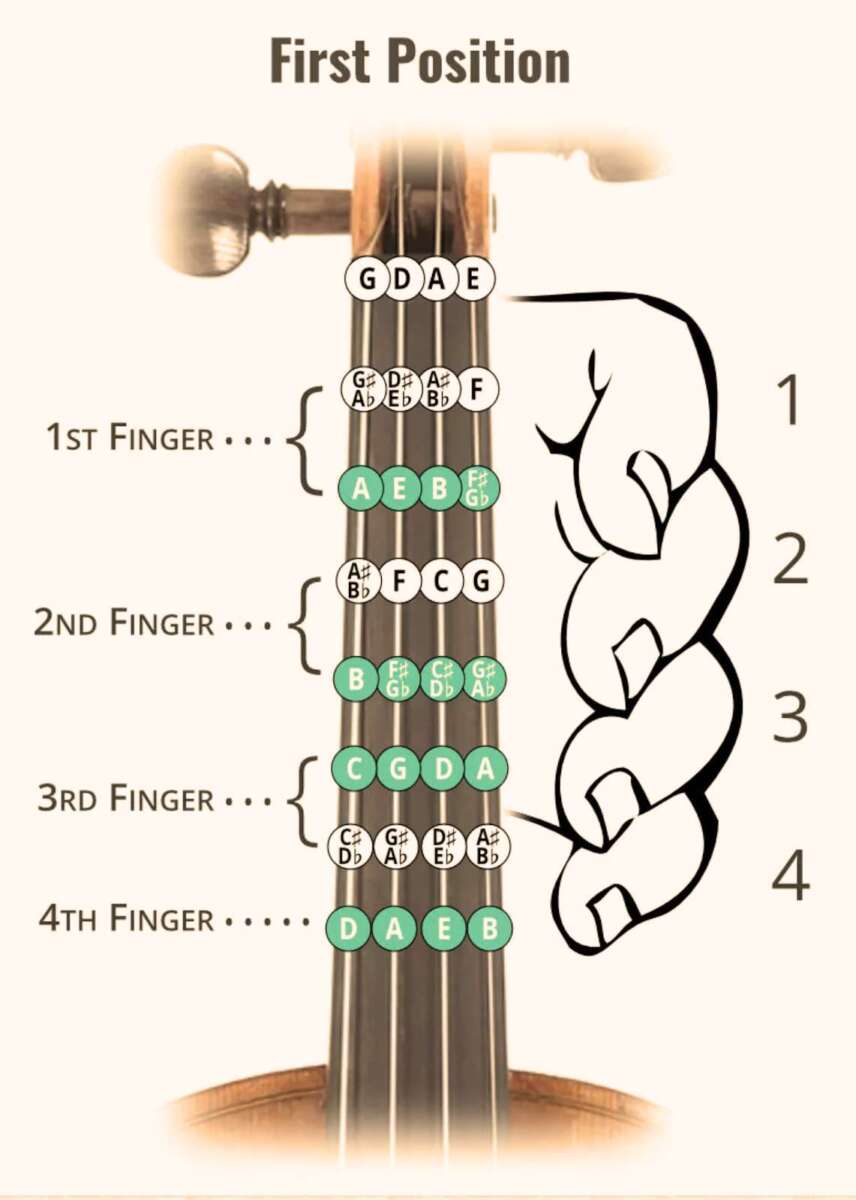
Standard violin tuning uses these open-string notes:
- G
- D
- A
- E
Each string is tuned a perfect fifth above the string before it. The usual tuning sequence is:
G to D
D to A
A to E
Most players tune the A string first. Then they tune the D, G, and E strings by comparing each string with the neighboring open string.
A digital tuner can show whether a string is too high or too low. Many violinists also tune by listening for a smooth, stable sound between two strings. When two strings form a pure fifth, the sound feels settled rather than wobbly.
Standard reference pitches are approximately:
• G3: 196 hertz
• D4: 293.66 hertz
• A4: 440 hertz
• E5: 659.25 hertz
Temperature, humidity, string age, and instrument setup can affect tuning. A violin may go out of tune after travel or a major weather change. This is normal and does not always mean the instrument has a serious problem.
When learning which strings are which on a violin, tune slowly. Turn the peg or fine tuner in small movements. Large turns can make the string snap or cause the pitch to pass the target.

How to identify violin strings by sight
You can often identify the strings by their thickness, but appearance alone is not always enough. Different brands use different colors, materials, and winding patterns.
In general:
• The G string is the thickest string.
• The D string is slightly thinner than the G.
• The A string is thinner still.
• The E string is the thinnest and may be a plain steel wire.
Some string sets use colored silk near the peg and tailpiece. These colors can help identify a string, but color codes vary by brand. Do not rely on color unless you know the specific manufacturer’s system.
The G, D, and A strings are often wound with metal around a core. The E string may be plain steel or have a special coating. Wound strings feel more textured, while a plain E string feels smooth.
The safest way to identify which strings are which on a violin is to combine three clues:
- Check the string’s pitch.
- Compare its thickness with the other strings.
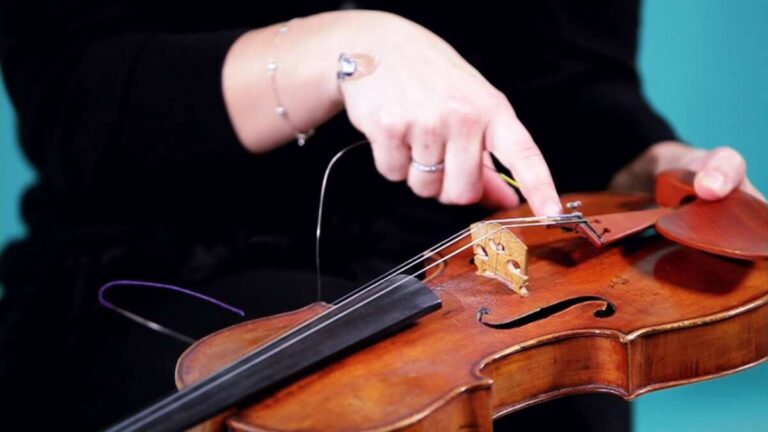
- Trace it from the tailpiece to the correct peg.
The string path matters because pegs can look confusing. On many violins, the G and A pegs sit on one side of the pegbox, while the D and E pegs sit on the other. The exact layout can vary slightly by instrument.
Common mistakes when learning violin string names
Beginners often make the same few errors. These mistakes are easy to fix once you understand the system.
Confusing string number with pitch
The E string is called the first string because it is the highest string. The G string is called the fourth string because it is the lowest.
This can feel opposite to the way people count from low to high. Keep the phrase “first is E, fourth is G” near your music stand until it becomes automatic.
Mixing up left and right
The string nearest your left side is usually the G string when you hold the violin in playing position. However, this can be confusing when viewing a photo, diagram, or violin lying flat.
Use the string names and pitches instead of trusting left and right in an image.
Turning the wrong peg
A peg may control a string that does not look close to it. Before turning a peg, gently pluck the string and trace it through the pegbox.
Turn the peg only a little. If the pitch rises too quickly, stop and check that you are turning the correct peg.
Using too much bow pressure on the E string
The E string reacts quickly. Heavy pressure can produce a scratchy or piercing sound.
Try a slower bow with less weight. Keep the bow straight and use a clean contact point between the bridge and fingerboard.
Pressing too hard with the left hand
A violin string only needs enough finger pressure to stop it against the fingerboard. Excess pressure can make the hand tired and can pull notes sharp.
Use a relaxed finger and check the note with a tuner or a reference pitch.

How string choice affects violin tone
The names G, D, A, and E describe the strings, but not every violin string sounds the same. String material and tension can change the instrument’s response.
Common string types include:
• Gut-core strings, known for a complex and flexible tone
• Synthetic-core strings, known for warmth and stability
• Steel-core strings, known for a clear and direct response
String choice depends on the violin, the player, the style of music, and personal taste. A bright violin may sound smoother with a warmer string set. A dark violin may benefit from strings with more focus and projection.