Where Is F Sharp On A Piano: Easy Key Guide
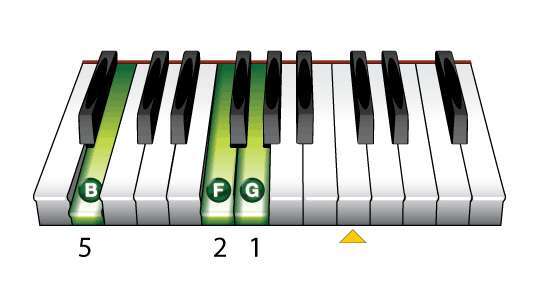
F-sharp is the black key directly to the right of every F key on a piano.
If you can find the groups of black keys, locating F-sharp becomes easy. This guide explains where is f sharp on a piano, how to find it in any octave, how it sounds, and how to use it in scales and chords.
Where Is F-Sharp on a Piano?
F-sharp, written as F♯, is a black key. It sits between the white keys F and G.
Look at any group of three black keys. F-sharp is the first black key in that group. It is the black key immediately to the right of F and immediately to the left of G.
A simple way to remember it is:
- Find a group of three black keys.
- Look at the first black key in the group.
- The white key just to its left is F.
- That black key is F-sharp.
This pattern repeats across the whole keyboard. So, where is f sharp on a piano? It is always found in the same place within each octave: the first black key in a group of three.
How to Find F-Sharp Quickly
You do not need to know every note on the piano to find F-sharp. You only need to recognize the keyboard’s black-key pattern.
Piano keys repeat in groups of two and three black keys:
• The first black key in a group of three is F-sharp.
• The second black key in a group of three is G-sharp.
• The third black key in a group of three is A-sharp.
• The first black key in a group of two is C-sharp.
• The second black key in a group of two is D-sharp.
Start at the left side of any group of three black keys. Move down to the white key on the left. That white key is F. The black key above it is F-sharp.
For beginners, this is often easier than counting white keys. The black keys act like road signs. Once you see the group of three, F-sharp is close by.
What Does F-Sharp Look Like on a Piano?
F-sharp looks like every other black key, but its position gives it its name. It is not marked with a special color or shape.
On a full-size 88-key piano, F-sharp appears several times. Each F-sharp has the same note name but a different pitch. The F-sharp near the middle of the keyboard sounds lower than the F-sharp near the top.
The center area of the keyboard is often called middle register. Middle C is a useful reference point, but F-sharp is not middle C. To find F-sharp near middle C:
- Find middle C.
- Move right to D.
- Move right to E.
- Move right to F.
- Play the black key just above and to the right of F.
That black key is F-sharp. This method helps if you are still learning the white-key names.
F-Sharp and G-Flat Are the Same Piano Key
F-sharp and G-flat are enharmonic names. This means they describe the same piano key and the same pitch in standard tuning.
The note may be written as F♯ or G♭, depending on the key, scale, or chord. On a piano, both names point to the black key between F and G.
For example:
• F♯ is often used in the keys of D major and A major.
• G♭ is often used in the keys of D-flat major and G-flat major.
• F♯ and G♭ sound the same on a normally tuned piano.
The name changes because music notation follows the notes in a scale. A composer may choose F-sharp to keep a scale’s letter order clear. In another musical setting, G-flat may make the notation easier to read.
This is similar to calling the same street by two names in different maps. The location stays the same, but the label changes.
How to Find F-Sharp Without Looking at the Keys
You can also locate F-sharp by touch. This skill is useful when you play scales, chords, or songs while looking at sheet music.
Place your fingers on the black keys. You will feel that the black keys form groups of two and three. Find a group of three, then play its first key.
That key is F-sharp.
With practice, your hand will learn the pattern. Many pianists use touch more than sight when moving around the keyboard. Still, beginners should check the key pattern often. A common mistake is to confuse the first black key in a group of three with the last black key in a group of two.
Use this short practice drill:
- Find one group of three black keys.
- Play the first key and say “F-sharp.”
- Play the white key below it and say “F.”
- Play the white key to the right and say “G.”
- Repeat the drill in several octaves.
This takes less than a minute and builds strong visual and physical memory.

F-Sharp in the Musical Alphabet
The musical alphabet uses seven letter names:
A, B, C, D, E, F, and G.
After G, the names begin again at A. Sharp and flat signs add the black keys between many of these white notes.
The note order around F-sharp is:
F, F-sharp, G
In written music, F-sharp is shown with a sharp symbol, which looks like this: ♯. The sharp sign raises F by one half step.
A half step is the smallest common distance between two neighboring piano keys. On the piano, the distance from F to F-sharp is one half step. The distance from F-sharp to G is also one half step.
This gives us a useful pattern:
• F to F-sharp equals one half step.
• F-sharp to G equals one half step.
• F to G equals one whole step.
Understanding half steps makes it easier to read music and build scales.
F-Sharp in the F-Sharp Major and Minor Scales
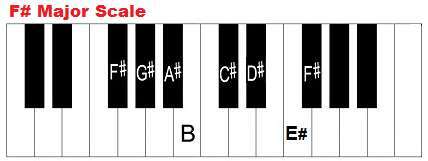
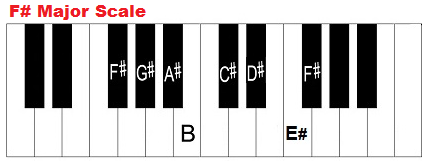
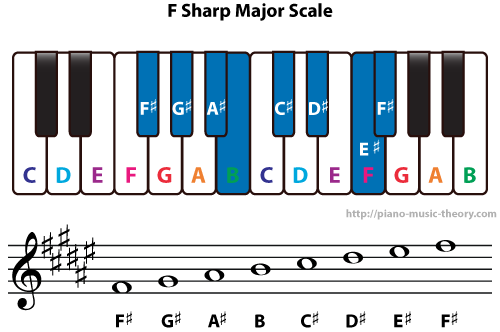
F-sharp is important in many scales and keys. The F-sharp major scale uses six sharps:
F♯, G♯, A♯, B, C♯, D♯, and E♯.
E-sharp sounds like F on a piano, but it is written as E-sharp because each letter name must appear once in the scale. This is a good example of why music notation and piano sound are related but not always identical.
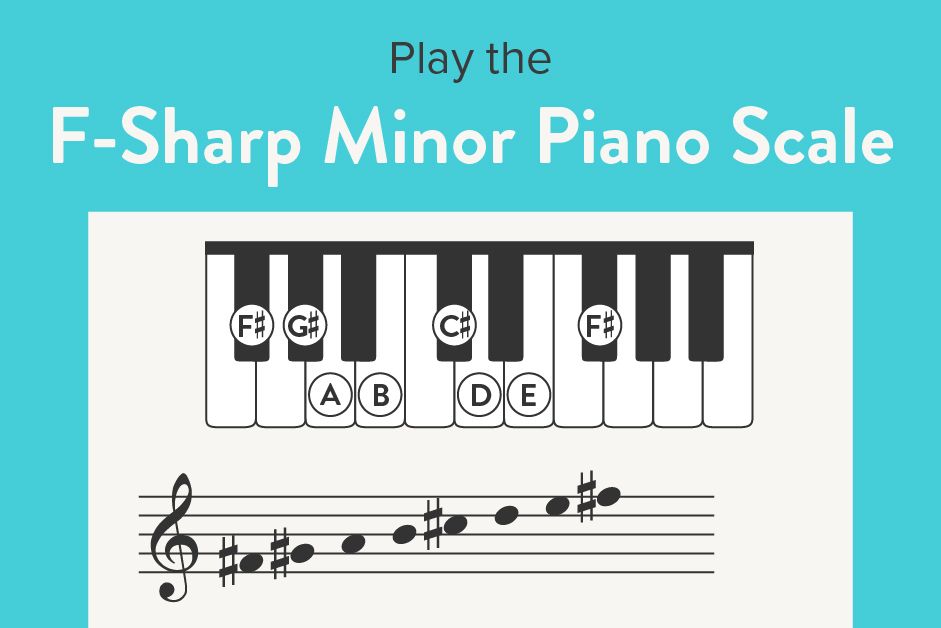
The F-sharp natural minor scale uses three sharps:
F♯, G♯, A, B, C♯, D, and E.
F-sharp also appears in the D major scale:
D, E, F♯, G, A, B, and C♯.
It appears in the A major scale as well:
A, B, C♯, D, E, F♯, and G♯.
If a song has a key signature with F-sharp, you will play F-sharp each time the note F appears, unless the music includes a natural sign or another accidental.
F-Sharp in Common Piano Chords
F-sharp appears in many chords. Learning these shapes can help you connect note names with hand positions.
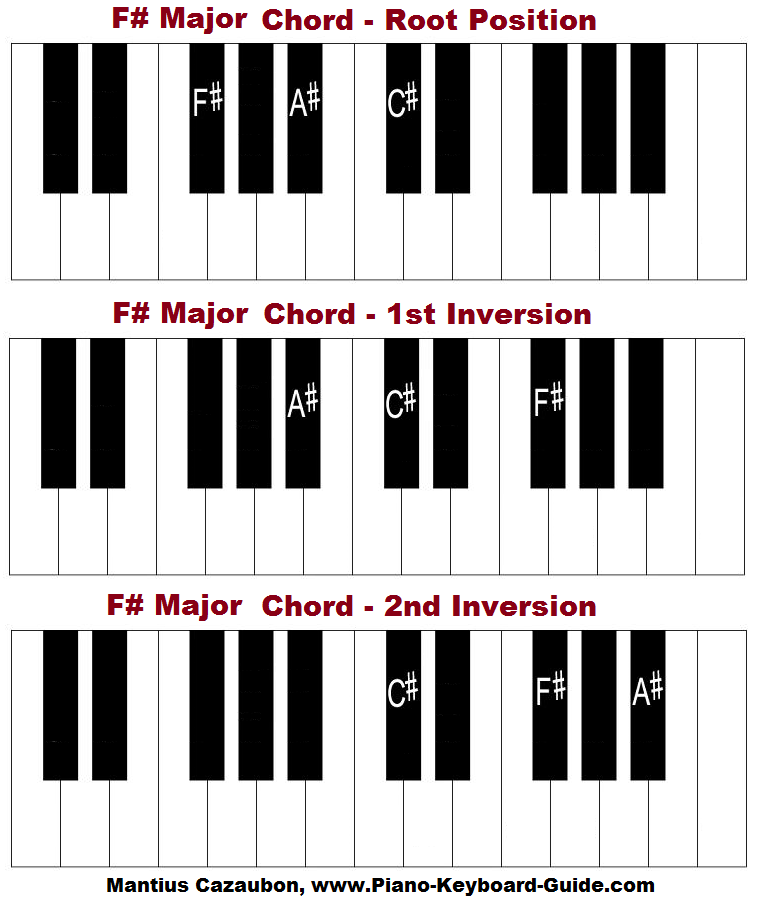
F-Sharp Major
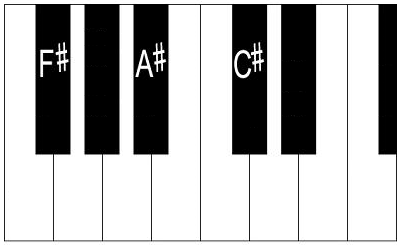
An F-sharp major triad contains:
• F-sharp
• A-sharp
• C-sharp
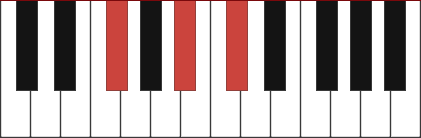
On the piano, play the black key F-sharp, the black key A-sharp, and the black key C-sharp.
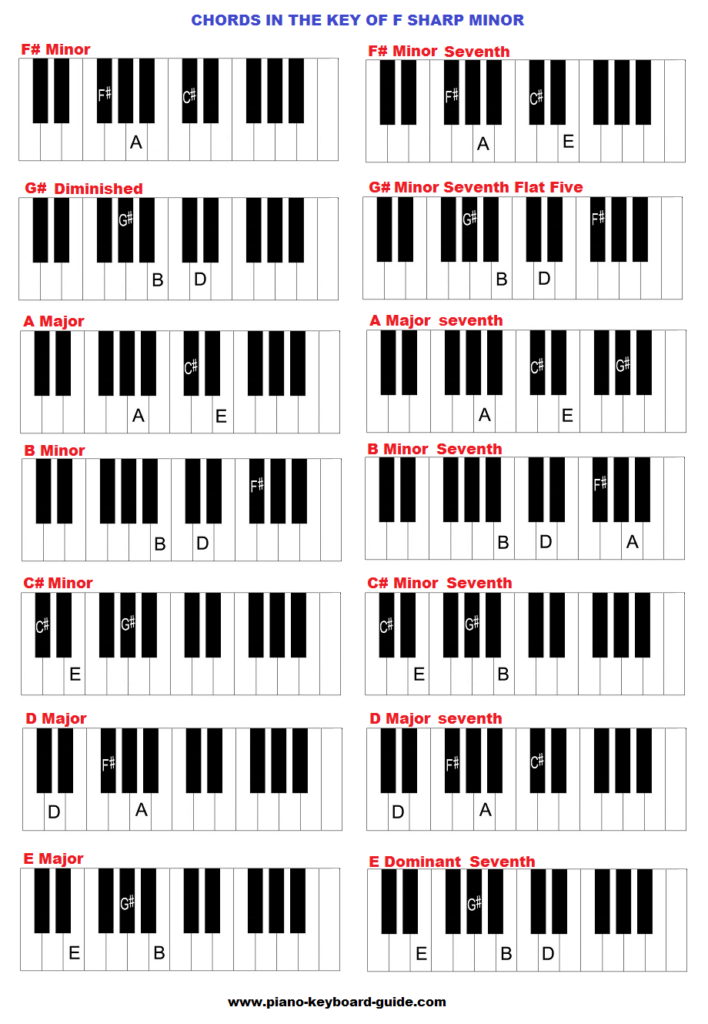
F-Sharp Minor
An F-sharp minor triad contains:
• F-sharp
• A
• C-sharp
Only the middle note changes from F-sharp major. A-sharp moves down to A.
D Major
A D major triad contains:
• D
• F-sharp
• A
This is one of the easiest ways for beginners to practice F-sharp in a chord.
B Minor
A B minor triad contains:
• B
• D
• F-sharp
When learning where is f sharp on a piano, try playing D major and B minor. Both chords use F-sharp, and their shapes feel different under the fingers.
F-Sharp in the Middle of the Keyboard
Many beginners ask where is f sharp on a piano when they mean the F-sharp near middle C. The answer depends on the piano’s octave layout, but the pattern stays reliable.
Find middle C first. Middle C is usually near the center of an 88-key piano. From middle C, count upward:
C, C-sharp, D, D-sharp, E, F, F-sharp.
The F-sharp above middle C is the black key after F. It is also the first black key in the nearby group of three.
Some piano teachers call this note F-sharp 4, while others may use a different octave numbering system. The pitch is the same, but octave labels can vary between regions and music software. The key’s position and sound do not change.

A Simple Practice Exercise
Try this five-minute exercise to make F-sharp easy to find.
- Sit at the piano and relax your shoulders.
- Find every group of three black keys.
- Play the first black key in each group.
- Say “F-sharp” each time.
- Move from the low end of the keyboard to the high end.
- Play each F-sharp again while saying “F-sharp or G-flat.”
- Finish by playing F, F-sharp, and G in order.
Do not rush. Accuracy matters more than speed.
When I help new players with this pattern, the most common error is starting from the wrong black-key group. Players often see a group of two and try to guess the note. It is safer to find the group of three first, because its first black key is always F-sharp.
Common Mistakes to Avoid
Finding F-sharp is simple, but a few habits can cause confusion.
• Do not assume every black key is a sharp. Some black keys are better named as flats in certain keys.
• Do not count only the white keys. Use the groups of two and three black keys.
• Do not confuse F-sharp with G-sharp. F-sharp is first in the group of three; G-sharp is second.
• Do not forget that F-sharp and G-flat use the same physical key.
• Do not worry if a digital keyboard has fewer keys. The repeating pattern remains the same.
• Do not press the white key F when the music calls for F-sharp. The sharp raises the note by one half step.
A small visual check can prevent a large musical mistake. Before playing, locate the group of three and confirm the first black key.
Why Learning F-Sharp Matters
Knowing where is f sharp on a piano helps with more than one note. It improves your understanding of scales, chords, key signatures, and sheet music.
F-sharp is especially useful because it appears in common keys such as D major, A major, B minor, and F-sharp minor. It also appears in many melodies, chord progressions, and beginner piano exercises.
This knowledge gives you a stronger sense of the keyboard. Instead of seeing a row of unrelated keys, you begin to see a repeating map. That map makes sight-reading and memorization easier.
It also helps your ear. Play F, then F-sharp, then G. Listen to how each half step changes the sound. This small exercise trains both your fingers and your musical hearing.
Frequently Asked Questions About Where Is F-Sharp on a Piano
Where is F-sharp on a piano?
F-sharp is the black key directly to the right of F. It is the first black key in every group of three black keys.
Is F-sharp the same as G-flat?
Yes. F-sharp and G-flat are two names for the same piano key and pitch in standard tuning. The correct name depends on the musical key and notation.
Is F-sharp a black key?
Yes, F-sharp is a black key on a standard piano. It is located between the white keys F and G.
How do I find F-sharp near middle C?
Find middle C, then move right until you reach F. The black key directly above and to the right of F is F-sharp.
What chords use F-sharp?
F-sharp appears in F-sharp major, F-sharp minor, D major, B minor, and many other chords. Its exact role depends on the chord and key.
How many F-sharp keys are on an 88-key piano?
An 88-key piano normally has several F-sharp keys across its range. The exact count depends on the keyboard’s starting and ending notes, but each F-sharp follows the same black-key pattern.
What is the difference between F and F-sharp?
F-sharp is one half step higher than F. On a piano, F is a white key and F-sharp is the black key immediately above it.
Conclusion
F-sharp is easy to find once you recognize the keyboard pattern. It is the first black key in each group of three, placed between the white keys F and G. The same key may also be called G-flat, depending on the music.
Practice finding every F-sharp on your keyboard, then use it in D major, B minor, and F-sharp chords. Spend a few minutes each day building this skill, and the piano will soon feel much less mysterious. Explore more note-finding exercises, practice with a favorite song, and keep learning one key at a time.

Senior Music Reviewer
Alex Carter is a seasoned music reviewer with over a decade of experience in the world of sound and instruments. Passionate about helping musicians and enthusiasts make informed choices, he brings sharp insights and in-depth knowledge to every review. From classical instruments to modern gear, Alex combines technical expertise with a love for music to deliver content that resonates with readers.
As a Senior Music Reviewer and expert author on Tuneluma.com, Alex is dedicated to sharing honest evaluations, practical advice, and thoughtful commentary to guide readers in their musical journey.