When We Were Young Piano Chords: Easy Guide
The most useful “When We Were Young” piano chords are Ab, Eb/G, Fm, and Db in the original key.
Adele’s “When We Were Young” uses a warm, repeating chord pattern that sounds rich without being hard to learn. With the right inversions, timing, and soft dynamics, these when we were young piano chords can help beginners sound musical while giving experienced players room to add emotion and style.
When We Were Young Piano Chords at a Glance
The song is commonly played in A-flat major. Its main progression uses four chords:
| Chord | Notes |
|---|---|
| Ab | Ab, C, Eb |
| Eb/G | G, Bb, Eb |
| Fm | F, Ab, C |
| Db | Db, F, Ab |
The core progression is:
| Ab | Eb/G | Fm | Db |
This pattern carries much of the verse and chorus. The bass moves from Ab to G, then F, and finally Db. That falling motion gives the song its reflective and nostalgic sound.
If you are new to piano, start with root-position chords. Once your hands feel comfortable, use inversions. They make the changes smoother and reduce large jumps across the keyboard.

The Main Chord Progression
The main when we were young piano chords follow a simple four-chord cycle:
Ab Eb/G Fm Db
Each chord usually lasts for one bar in a basic arrangement. The exact rhythm may change with the vocal line, so treat this as a useful foundation rather than a strict rule for every measure.
The Eb/G chord is an important detail. It is an E-flat major chord with G in the bass. The notes are:
Left hand: G
Right hand: Eb, G, Bb
You can also play the full chord as G, Bb, Eb. This creates a smooth bass line between Ab and Fm.
Easy right-hand shapes
Try these comfortable voicings:
Ab:   C  Eb  Ab
Eb/G: Bb Eb  G
Fm:   C  F   Ab
Db:   Ab Db  F
These shapes keep the right hand near the same area. That makes the progression easier to play and helps the chords sound connected.
A common beginner mistake is to return to root position after every chord. That makes the hand jump and can interrupt the mood. Keep your fingers close, like stepping stones across a stream.
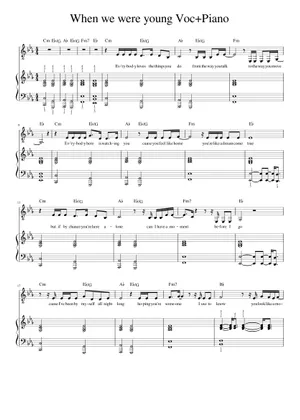
Chord Progressions for Each Song Section
The song has a strong repeating structure, but some sections use additional chords. The exact chord chart can vary by arrangement, key, and transcription.
Verse progression
A simple verse pattern is:
| Ab | Eb/G | Fm | Db |
Repeat this pattern while keeping the volume low. The verse works best with space. Avoid playing every note too heavily.
Pre-chorus progression
Many simplified arrangements use a variation such as:
| Bbm | Eb | Ab | Db |
You may also hear a return to the main progression:
| Ab | Eb/G | Fm | Db |
The pre-chorus should feel like it is moving forward. You can create that lift by adding more notes, using a wider bass line, or increasing the intensity gradually.
Chorus progression
The chorus often returns to the main sequence:
| Ab | Eb/G | Fm | Db |
This is where fuller playing works well. Use both hands, sustain the chords slightly longer, and let the melody remain clear above the harmony.
Bridge or middle section
A useful simplified bridge pattern is:
| Fm | Eb | Db | Ab/C |
| Bbm | Eb | Ab | Ab |
The Ab/C chord contains the notes Ab, C, and Eb, with C as the bass note. It creates a gentle bass movement into B-flat minor.
Because published chord charts may simplify or label passing chords differently, listen to the recording when checking a detailed arrangement. The main harmonic shape remains consistent, even when the chart uses extra bass notes or passing chords.

How to Play the Left Hand
The left hand gives this song its emotional pull. You do not need a complex pattern. A simple bass note can sound beautiful when played with good timing.
Start with one bass note per chord:
Ab G F Db
Play each note at the start of the bar. Hold it with the sustain pedal if the sound stays clean.
For a fuller style, play an octave:
Ab-Ab G-G F-F Db-Db
Use an octave only if it feels comfortable. Beginners should avoid stretching too far, especially when the hand or wrist feels tense.
Another option is a broken pattern:
Bass note, fifth, chord tone, fifth
For Ab, this might be:
Ab, Eb, C, Eb
For Fm, try:
F, C, Ab, C
The left hand should support the harmony, not overpower it. If the bass sounds too loud, lower its touch and let the right hand carry the main expression.

How to Use Piano Inversions
Inversions change the order of the chord notes without changing the chord itself. They are one of the best ways to make when we were young piano chords sound smooth.
For example, an Ab chord can appear as:
Root position: Ab, C, Eb
First inversion: C, Eb, Ab
Second inversion: Eb, Ab, C
For the main progression, try this movement:
Ab:   C  Eb  Ab
Eb/G: Bb Eb  G
Fm:   C  F   Ab
Db:   Ab Db  F
This voicing keeps the right hand close. It also creates a soft, connected sound that suits the song’s memory-filled mood.
Practice the changes slowly:
- Play Ab and hold it for four counts.
- Move to Eb/G without lifting your hand too far.
- Move to Fm.
- Finish on Db.
- Repeat without stopping.
Do not rush to add rhythm. Smooth movement matters more than speed.
A Beginner-Friendly Playing Pattern
If block chords feel plain, use a gentle broken-chord pattern. Play the notes one at a time rather than together.
Try this right-hand pattern:
1 – 3 – 5 – 3
For an Ab chord in root position, that means:
Ab – C – Eb – C
For Fm, play:
F – Ab – C – Ab
You can use eighth notes for a steady flow. Keep the pattern soft and even.
A simple two-hand arrangement might look like this:
Left hand:  Bass note on beat 1
Right hand: Broken chord across four beats
For example:
Left hand:  Ab
Right hand: C – Eb – Ab – Eb
This style is useful for singers because it leaves room for the vocal line. It also helps new players build coordination without adding too much complexity.
Rhythm, Tempo, and Dynamics
The emotional effect does not come from the chords alone. Rhythm and dynamics shape the performance.
Adele’s recording has a slow, spacious feel. Your arrangement should not sound rushed. Begin with a steady pulse and leave small spaces between chord changes.
Use these practice ideas:
• Start with a metronome at a slow tempo.
• Count four beats for each main chord.
• Play the verse softly.
• Increase volume during the chorus.