What Was The First Electric Guitar: History And Origins
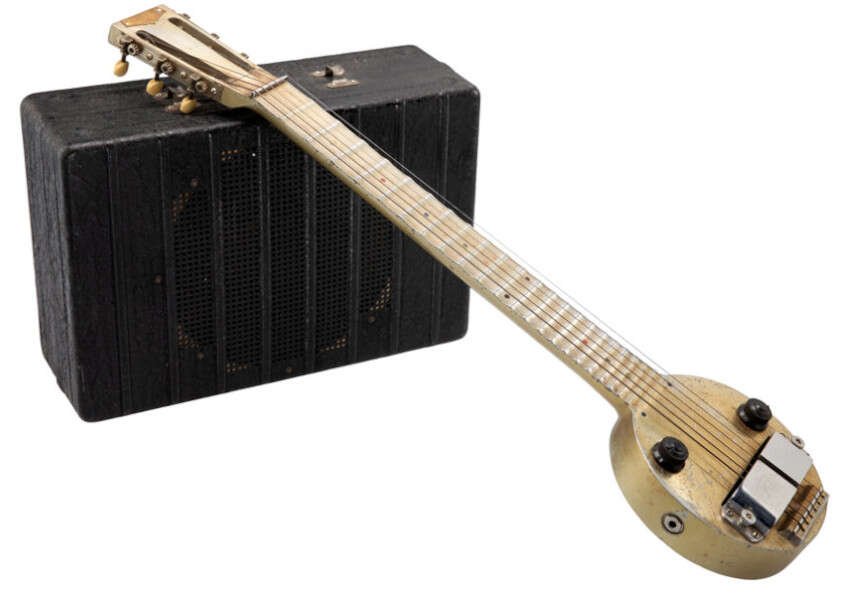
The first electric guitar was Rickenbacker’s 1931–32 “Frying Pan,” developed by George Beauchamp and Adolph Rickenbacker.
The answer to what was the first electric guitar is more interesting than one date or one brand. Early inventors tested pickups on acoustic instruments, while Rickenbacker created the first widely recognized solid-body electric guitar. This guide explains how it worked, who built it, why historians debate the answer, and how it shaped modern music.
What Was the First Electric Guitar?
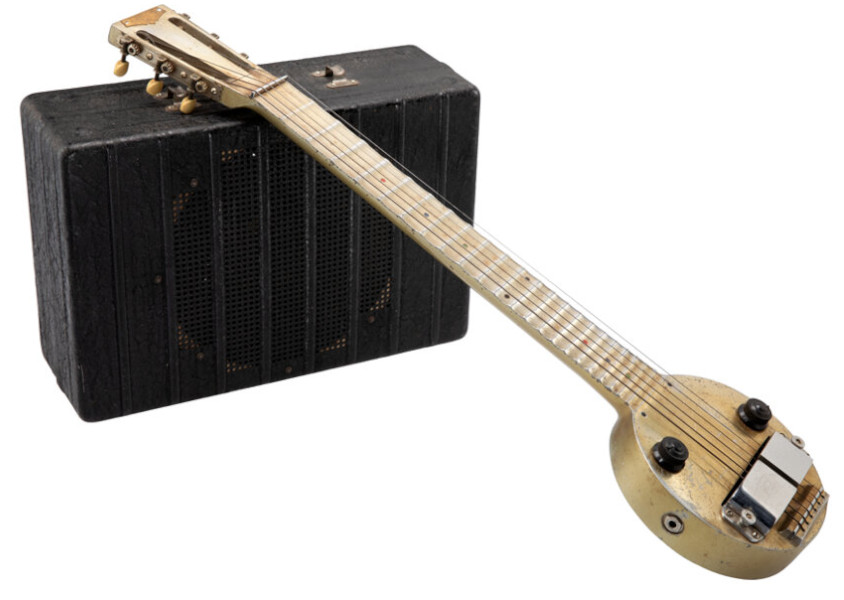
The instrument most often called the first electric guitar was the Rickenbacker “Frying Pan.” Its official name was the Electro A-25, and it appeared around 1931 or 1932. George Beauchamp designed its electromagnetic pickup, while Adolph Rickenbacker helped manufacture the instrument.
The nickname came from its long metal neck and small, circular body. It looked more like a frying pan than a modern guitar. The instrument was made for Hawaiian music and was played across the musician’s lap with a metal slide.
The Frying Pan did not look like a Fender Stratocaster or Gibson Les Paul. Still, it used the basic idea that defines an electric guitar today:
• Metal strings create a magnetic signal.
• A pickup changes string movement into an electrical signal.
• An amplifier makes that signal loud enough to hear.
This is why many music historians identify the Rickenbacker Frying Pan as the first practical electric guitar.
Why the Answer Is Not Completely Simple
When people ask what was the first electric guitar, they may mean several different things. They could be asking about the first guitar with a pickup, the first commercial electric guitar, the first solid-body design, or the first electric guitar played in the modern style.
Those are not always the same instrument.
Early experiments with electrical amplification began before the Frying Pan. In the 1920s, musicians and inventors tried to amplify violins, banjos, resonator instruments, and guitars. Many of these attempts used large telephone-style pickups or experimental microphones.
The term “first” also depends on how historians define an electric guitar. A standard acoustic guitar with a temporary pickup may qualify in one account. In another account, the instrument must be designed from the start for electric amplification.
For that reason, the most accurate answer is this:
• The Rickenbacker Frying Pan was the first commercially recognized solid-body electric guitar.
• The Gibson ES-150 was one of the first commercially successful electric Spanish guitars.
• Earlier experimental guitars and amplified string instruments existed before both.
That distinction gives a clearer answer to what was the first electric guitar without ignoring the inventors who came before Rickenbacker.
The Story Behind the Rickenbacker Frying Pan
George Beauchamp was a musician and inventor who wanted more volume from the steel guitar. In the early 1930s, Hawaiian music was very popular, but acoustic guitars often disappeared beneath drums, horns, and other loud instruments.
Beauchamp worked on an electromagnetic pickup. His design used two horseshoe-shaped magnets placed around the strings. When the strings moved, they disturbed the magnetic field and created a small electrical signal.
That signal could then travel through a cable to an amplifier. The result was much louder than an unamplified steel guitar.
Beauchamp worked with Adolph Rickenbacker, whose company had metalworking skills and manufacturing experience. Together, they developed an aluminum-bodied instrument with a distinctive circular shape. The design became known as the Frying Pan because of its appearance.
The instrument had several features that made it important:
• A solid metal body reduced feedback.
• The electromagnetic pickup offered strong volume.
• The long neck supported steel guitar playing.
• The instrument worked with an external amplifier.
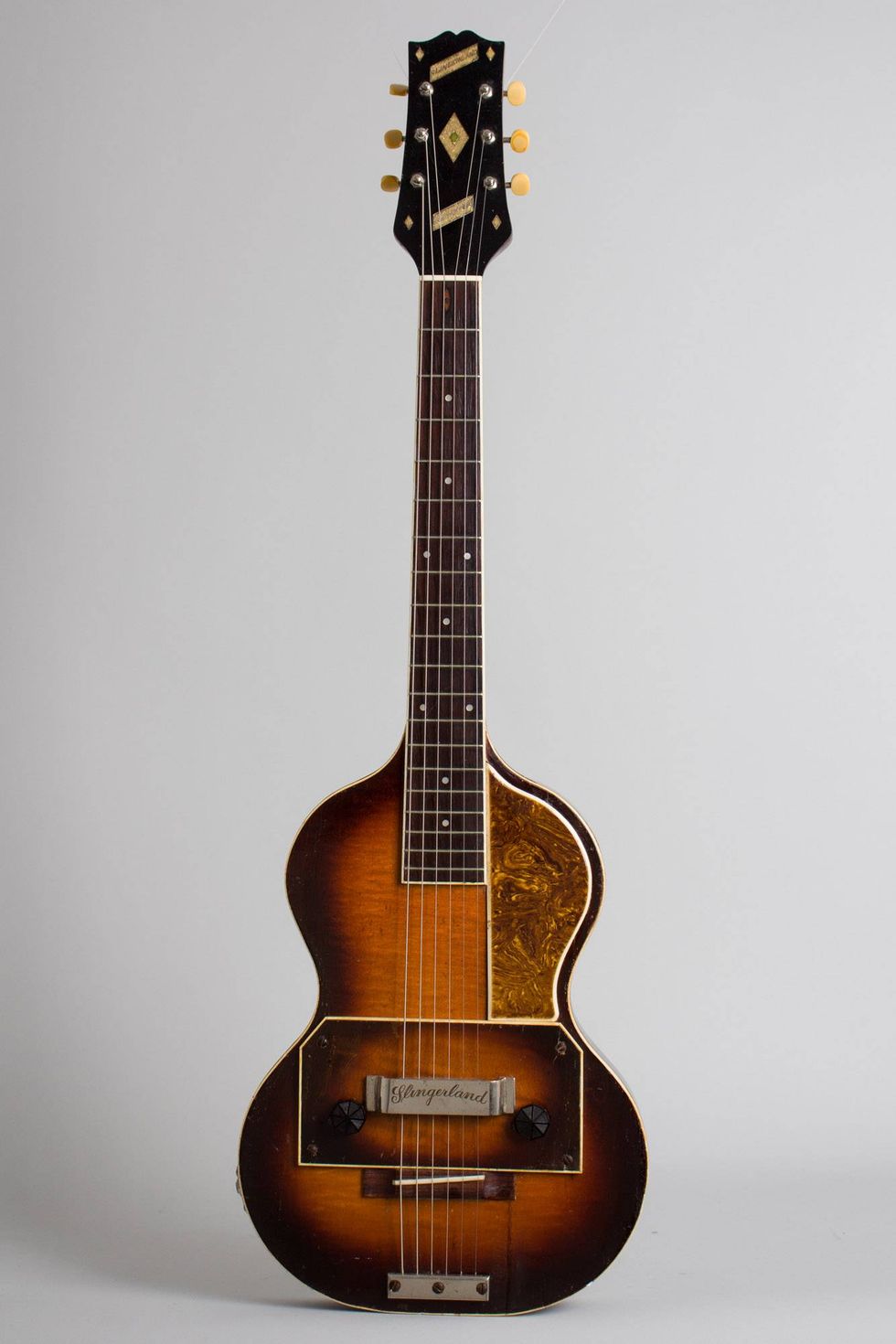
The Frying Pan was not perfect. It was specialized, expensive, and mainly associated with Hawaiian music. Even so, it proved that an electric guitar could work on stage and in commercial music.
How the First Electric Guitar Pickup Worked
A guitar pickup is a small electrical generator. It does not create sound on its own. Instead, it senses the movement of a metal string and converts that movement into an electrical signal.
A basic magnetic pickup contains:
• A magnet or group of magnets.
• Coils of thin copper wire.
• A metal string that can disturb the magnetic field.
When the player plucks the string, the string vibrates near the pickup. That movement changes the magnetic field around the coil. The coil produces a weak voltage that follows the same pattern as the string’s vibration.
The amplifier increases this signal. The speaker then changes the electrical signal back into movement, creating the sound that reaches the listener.
This process explains why an electric guitar needs more than a pickup. The full system usually includes:
-
The guitar and its strings.
-
The pickup.
-
A cable.
-
An amplifier.
-
A speaker.
The early Rickenbacker design used the same basic science found in many modern electric guitars. The parts became smaller, stronger, and more refined, but the central principle stayed the same.
The Gibson ES-150 and the Rise of the Electric Spanish Guitar
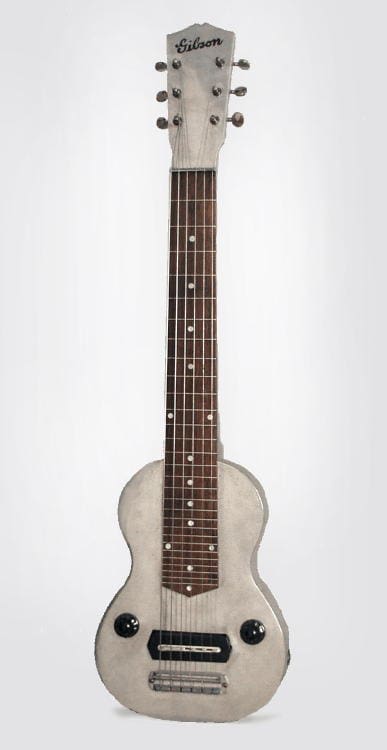
The Rickenbacker Frying Pan was a lap steel guitar. It was not held against the body like a standard acoustic or electric guitar. That difference matters when answering what was the first electric guitar.
In 1936, Gibson introduced the ES-150. The letters “ES” stood for Electric Spanish, meaning the instrument was played in the traditional guitar position. The ES-150 had a hollow body and a magnetic pickup designed by Walt Fuller.
The ES-150 became famous because jazz guitarist Charlie Christian used it. His single-note lines could cut through a full big band. That helped show other musicians that the electric guitar could be a lead instrument, not just a louder rhythm guitar.
The ES-150 also had a warm, clear tone. Its sound became closely linked with early jazz guitar. However, its hollow body could produce feedback at high volume.
This creates an important historical split:
• The Frying Pan was an early solid-body electric guitar.
• The ES-150 was an early successful electric Spanish guitar.
Both instruments played a major role in electric guitar history. Neither completely replaces the other in every definition of “first.”
Did Earlier Electric Guitars Exist?
Yes. Several experiments came before the Rickenbacker Frying Pan.
In the 1920s, musicians needed louder instruments for radio, dance halls, and large ensembles. Inventors explored ways to amplify string instruments. Some used microphones, while others tried early electromagnetic systems.
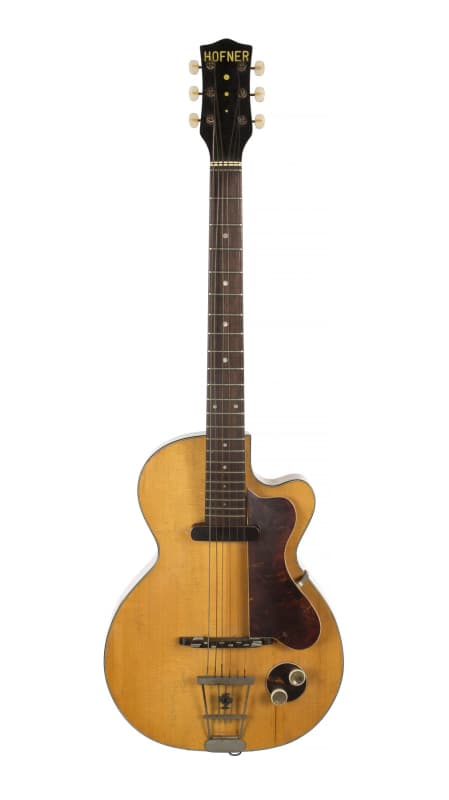
The Stromberg-Voisinet company marketed an electric guitar in 1928. It used a pickup system, but the design had limited commercial success. The instrument is still important because it shows that electric guitar development was already underway before Rickenbacker.
Other early designs included:
• Acoustic guitars fitted with experimental pickups.
• Resonator guitars used with microphones.
• Hawaiian steel guitars connected to early amplifiers.
• Instruments influenced by telephone and radio technology.
These early attempts often had problems with noise, weak signals, feedback, or poor reliability. The Frying Pan stood out because it combined a practical pickup with a body designed for amplification.
So, what was the first electric guitar? If the question means the first experiment, there is no single universally accepted answer. If it means the first practical and commercially recognized solid-body model, the Rickenbacker Frying Pan is the strongest answer.

Why Solid-Body Design Changed Guitar History
The solid body solved one of the biggest problems faced by early electric guitars: feedback.
Feedback happens when sound from the speaker enters the guitar’s vibrating body and returns through the pickup. The signal loops again and again until it becomes a loud squeal.
Hollow guitars are more likely to feed back because their bodies act like acoustic chambers. A solid body gives the strings and pickups less unwanted vibration to amplify.
The Rickenbacker Frying Pan used a metal body. Later builders developed solid wood designs. These instruments could be played louder and with more sustain.
The solid-body idea eventually led to famous guitars such as:
• The Fender Telecaster.
• The Gibson Les Paul.
• The Fender Stratocaster.
• The Gibson SG.
These guitars were not direct copies of the Frying Pan. They used improved pickups, better neck designs, and more comfortable body shapes. Still, they followed the same important lesson: an electric guitar does not need to act like an acoustic guitar.

The Role of Amplifiers in Early Electric Guitar History
An electric guitar is only useful when its signal can be amplified. Early guitarists faced a major challenge because guitar amplifiers were still developing.
The first amplifiers were often small, noisy, and unreliable. They used vacuum tubes and large speakers. Players had to manage volume, cables, electrical noise, and fragile equipment.
Early amplifiers also changed the way guitarists played. A musician no longer needed to strum hard to be heard. Instead, the player could use smoother picking, longer notes, and more controlled phrasing.
This helped the electric guitar move into new musical roles. It became useful for:
• Jazz solos.
• Hawaiian steel guitar.
• Blues accompaniment.
• Country lead lines.
• Dance-band rhythm parts.
The amplifier was not just an accessory. It was part of the instrument’s identity. In practical terms, the first electric guitar was a complete partnership between strings, pickup, amplifier, and speaker.
How the First Electric Guitar Influenced Modern Music
The first electric guitar changed music because it solved a basic volume problem. A quiet guitar could now compete with a large ensemble.
That change had a wide effect. Guitarists could play melodies in higher registers. They could use bends, vibrato, slides, and sustained notes with greater impact. Later, overdrive and distortion added even more expressive options.
The electric guitar helped create or shape many styles:
• Jazz used it for single-note lines and chord work.
• Blues used it for expressive bends and call-and-response phrases.
• Country music used it for bright lead parts and pedal steel-style sounds.
• Rock music used it for riffs, power chords, and solos.
• Surf music used reverb and tremolo for wide, atmospheric tones.
• Heavy metal pushed amplification, distortion, and sustain to extreme levels.
The Frying Pan did not sound like a modern rock guitar. Its importance comes from the path it opened. It was an early bridge between acoustic guitar traditions and the amplified future.
What Did the First Electric Guitar Sound Like?
The Rickenbacker Frying Pan had a bright, sharp, and focused tone. Its sound was especially suited to Hawaiian steel guitar. Players used a metal bar to glide across the strings instead of pressing the strings to the fingerboard.
The tone depended on several factors:
• The metal body.
• The horseshoe pickup.
• The steel strings.
• The amplifier.
• The player’s slide technique.
Compared with a modern electric guitar, the Frying Pan had fewer tone controls and less flexibility. It was built for a specific musical purpose.
A modern player may hear its sound as clean, direct, and slightly metallic. It does not have the thick overdrive associated with later blues and rock guitars. That difference is useful to remember: the first electric guitar was designed to make a quiet instrument louder, not to create every guitar sound used today.
First Electric Guitar Versus First Solid-Body Electric Guitar
These phrases often appear together, but they can mean different things.
A hollow-body electric guitar has an acoustic-style body with a sound chamber. A solid-body electric guitar uses a dense body that does not depend on acoustic resonance for its main sound.
The Rickenbacker Frying Pan is often described as the first solid-body electric guitar. Its metal body made it very different from traditional wooden acoustic guitars.
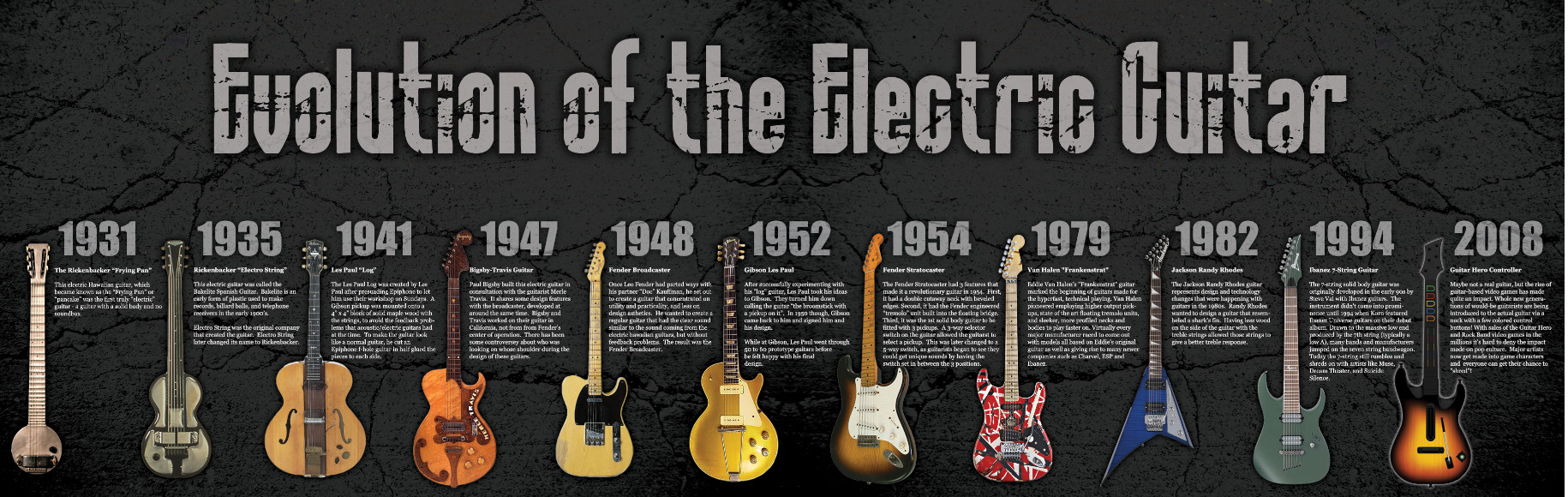
However, the history of solid-body guitars continued through many experimental designs. Les Paul built early solid-body prototypes, including the famous “Log,” during the 1940s. Fender later made solid-body guitars practical for a mass market with instruments such as the Broadcaster and Telecaster.
A simple timeline helps:
• 1920s: Early pickup and amplification experiments.
• 1928: Stromberg-Voisinet marketed an electric guitar.
• 1931–32: Rickenbacker developed the Frying Pan.
• 1936: Gibson introduced the ES-150.
• 1940s: More solid-body prototypes appeared.
• 1950s: Fender and Gibson helped make solid-body electric guitars mainstream.
This timeline explains why the answer to what was the first electric guitar depends on the exact definition being used.
Common Mistakes When Researching the First Electric Guitar
Historical guitar stories are often simplified. That can create confusion.
One common mistake is saying that Leo Fender invented the first electric guitar. Fender was extremely important, but his major contribution came later. His guitars helped make solid-body electric instruments affordable, durable, and popular.
Another mistake is calling the Gibson Les Paul the first solid-body electric guitar. Les Paul helped develop important solid-body ideas, but the Rickenbacker Frying Pan appeared earlier.
A third mistake is treating the first electric guitar as one final invention made by one person. In reality, the instrument developed through many steps. Musicians, engineers, manufacturers, and performers all contributed.
Reliable research should separate:
• Experimental prototypes from commercial products.
• Lap steel guitars from Spanish-style guitars.
• Electric amplification from solid-body construction.
• The first design from the first widely successful model.
That approach gives credit to the full history instead of reducing it to one famous name.
A Practical Lesson for Today’s Guitar Players
Studying the first electric guitar offers a useful lesson for modern players: the best design solves a real problem.
The Rickenbacker Frying Pan was not created to impress people with a familiar shape. It was created because musicians needed more volume. Its unusual design made sense for its purpose.
When choosing or using a guitar today, think about the same principle. Ask what problem you want to solve:
• Do you need a bright sound for country or clean pop?
• Do you need sustain for blues or rock?
• Do you need low feedback for loud stages?
• Do you need a comfortable neck for long practice sessions?
• Do you need a pickup that responds well to your amplifier?
In practical playing, one mistake is chasing history without considering comfort. A vintage-style instrument can be inspiring, but it may not suit every player. Test the neck, controls, balance, and sound before buying.
The best guitar is the one that encourages you to play. That lesson applies just as much now as it did when early musicians searched for more volume.
A Short Timeline of Electric Guitar Development
The history of the electric guitar becomes easier to understand when viewed as a series of improvements.
-
In the 1920s, inventors tested microphones and electromagnetic pickups.
-
In 1928, Stromberg-Voisinet marketed an early electric guitar.
-
Around 1931 and 1932, George Beauchamp and Adolph Rickenbacker developed the Rickenbacker Frying Pan.
-
In 1936, Gibson released the ES-150 electric Spanish guitar.
-
During the 1930s and 1940s, jazz and Hawaiian musicians expanded electric guitar use.
-
In the 1940s, inventors experimented with solid-body guitar designs.
-
During the 1950s, Fender and Gibson helped establish the modern electric guitar market.
-
In the 1960s and 1970s, rock, blues, and popular music made the electric guitar a central instrument.
Each stage built on earlier work. No single inventor created every part of the modern electric guitar.
Frequently Asked Questions About What Was the First Electric Guitar
What was the first electric guitar called?
The instrument most often recognized as the first electric guitar was the Rickenbacker Electro A-25. It became widely known as the “Frying Pan” because of its round body and long neck.
Who invented the first electric guitar?
George Beauchamp developed the key electromagnetic pickup design. Adolph Rickenbacker helped produce the instrument, so both men are closely linked to the Rickenbacker Frying Pan.
Was the Rickenbacker Frying Pan a solid-body guitar?
Yes. The Frying Pan had a solid metal body and was designed as a lap steel guitar. Its solid construction helped reduce feedback and supported louder amplified performance.
Was the Gibson ES-150 the first electric guitar?
The Gibson ES-150 was not the first electric guitar overall, but it was one of the first successful electric Spanish guitars. It was played in the standard guitar position and became famous through jazz guitarist Charlie Christian.
Did electric guitars exist before the Rickenbacker Frying Pan?
Yes. Inventors experimented with amplified string instruments during the 1920s, and Stromberg-Voisinet marketed an early electric guitar in 1928. These instruments had less commercial impact than the Frying Pan.
Why did musicians need the first electric guitar?
Musicians needed more volume so guitars could be heard in dance bands, jazz groups, and other loud ensembles. Electrical amplification allowed the guitar to move from a mainly rhythm role into a lead role.
Is the first electric guitar still playable today?
Some original Frying Pan guitars can still be played, but they are rare and valuable. Modern reproductions offer a safer and more affordable way to experience the design and its distinctive lap steel sound.
Conclusion
The best answer to what was the first electric guitar is the Rickenbacker Electro A-25, better known as the Frying Pan. Developed around 1931 and 1932 by George Beauchamp and Adolph Rickenbacker, it brought electromagnetic amplification into a practical solid-body design.
Earlier experiments deserve credit, and the Gibson ES-150 later helped establish the electric Spanish guitar. Still, the Frying Pan remains the clearest landmark in the story of the first electric guitar.
Its main lesson is simple: great instruments begin by solving real problems. Explore recordings, museum collections, and modern reproductions to hear how this pioneering design helped shape the electric guitar you know today.

Senior Music Reviewer
Alex Carter is a seasoned music reviewer with over a decade of experience in the world of sound and instruments. Passionate about helping musicians and enthusiasts make informed choices, he brings sharp insights and in-depth knowledge to every review. From classical instruments to modern gear, Alex combines technical expertise with a love for music to deliver content that resonates with readers.
As a Senior Music Reviewer and expert author on Tuneluma.com, Alex is dedicated to sharing honest evaluations, practical advice, and thoughtful commentary to guide readers in their musical journey.