What Size Guitar Should I Get: Find Your Fit
Most adults need a full-size guitar, while children and smaller players often need a shorter scale.
Choosing the right guitar size is about comfort, reach, body shape, and playing goals—not age alone. After helping new players compare acoustic, electric, and classical guitars, I’ve found that the best choice is the guitar that feels easy to hold and does not force your hands or shoulders into awkward positions. This guide explains what size guitar should i get, how guitar measurements work, and how to test a guitar before you buy.
What Size Guitar Should I Get?
For most adults, a full-size guitar is the best starting point. This usually means a 25.4-inch scale acoustic guitar, a 24.75- to 25.5-inch scale electric guitar, or a full-size classical guitar with a 25.6-inch scale.
However, “full-size” does not always mean one exact body shape. A full-size dreadnought can feel much larger than a concert acoustic, even when both use a similar scale length. Your ideal guitar size depends on both the neck length and the body size.
Use this simple guide:
| Player | Commonly suitable guitar size |
|---|---|
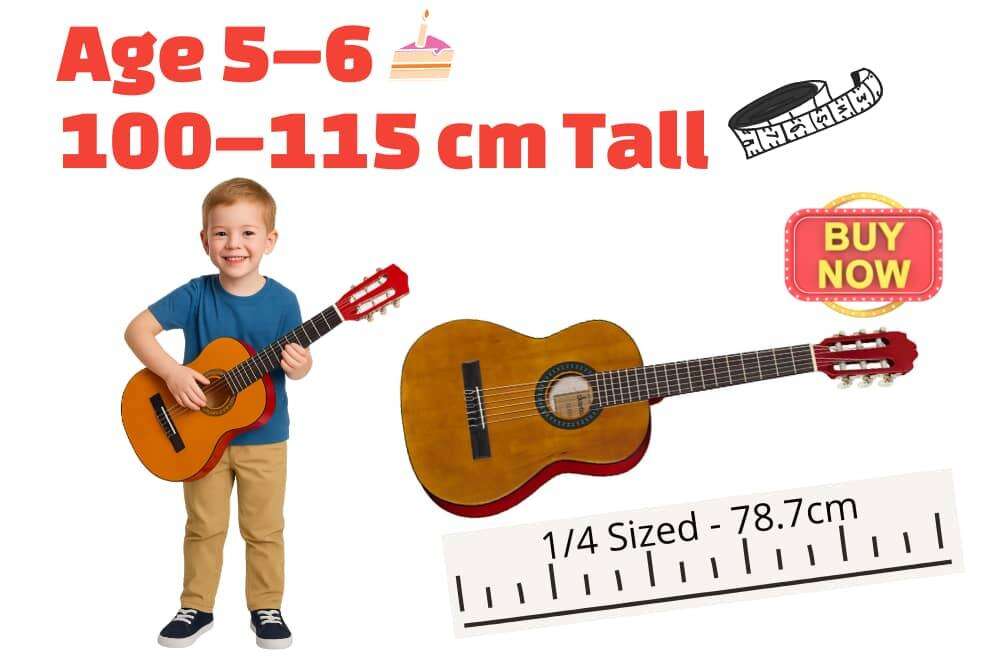
| Young child, about 3 to 5 years old | 1/4-size guitar |
| Child, about 5 to 8 years old | 1/2-size guitar |
| Child, about 8 to 11 years old | 3/4-size guitar |
| Smaller teen or adult | 3/4-size, parlor, concert, or short-scale guitar |
| Average teen or adult | Full-size guitar |
| Tall adult with long arms | Full-size guitar, including larger body styles |
These age ranges are only starting points. Two children of the same age may need different guitars because height, arm length, hand size, and posture can vary widely.
The best answer to “what size guitar should i get” is the size that lets you:
• Reach the first few frets without strain
• Wrap your picking arm around the body with ease
• Keep your wrist fairly straight
• Press the strings without excessive force
• Sit or stand comfortably for at least 10 minutes

Guitar Size Terms You Need to Know
Guitar size can be confusing because manufacturers use several measurements. The most important terms are scale length, body size, nut width, and overall length.
Scale length
Scale length is the distance from the nut to the center of the bridge. It affects how far apart the frets feel and how much tension the strings have.
A longer scale usually creates:
• More space between frets
• Slightly higher string tension
• A bright, clear response
• More reach for the fretting hand
A shorter scale usually creates:
• Smaller gaps between frets
• Lower string tension
• Easier bends and chord stretches
• A comfortable feel for smaller hands
The scale length is not the same as the guitar’s total length. A guitar may be nearly as long as another model but still feel easier to play because it has a shorter scale.
Body size
Body size describes the shape and depth of the guitar’s main body. Common acoustic body styles include dreadnought, concert, auditorium, parlor, and jumbo.
A large body can produce more volume and strong bass, but it may feel bulky. A smaller body often feels easier to control and may offer a balanced, focused tone.
Nut width
Nut width is the width of the neck near the headstock. A wider nut gives your fingers more room, which many classical and fingerstyle players prefer. A narrower nut may feel faster and easier for players with smaller hands.
Overall guitar length
Overall length matters most for children and very small players. It can help you estimate whether the instrument will fit the player’s body, but scale length and body comfort usually matter more for teens and adults.
Understanding these terms makes it easier to answer “what size guitar should i get” without relying only on labels such as 3/4 or full-size.

Acoustic Guitar Sizes Explained
Acoustic guitars come in many body shapes. The right shape depends on your comfort, music style, and desired sound.
Dreadnought guitars
Dreadnoughts are large, deep-bodied guitars with strong bass and plenty of volume. They work well for strumming, country, bluegrass, rock, and folk music.
A dreadnought may be a good choice if you:
• Have a larger frame
• Want a loud guitar for group playing
• Prefer a deep, powerful sound
• Mostly play with a pick
A dreadnought may feel too wide or deep for a child, petite adult, or player with short arms. Many beginners buy one because it is common, then discover that the body makes practice tiring.
Concert and grand concert guitars
Concert and grand concert guitars are smaller than dreadnoughts. They often have a comfortable waist and a balanced tone.
These guitars suit:
• Smaller adults
• Teenagers
• Fingerstyle players
• Beginners who want an easy sitting position
• Players who dislike a deep guitar body
For many people, a concert guitar is the safest answer to “what size guitar should i get” when a dreadnought feels uncomfortable but a child-size guitar feels too small.
Auditorium and grand auditorium guitars
Auditorium guitars sit between small concert guitars and large dreadnoughts. They offer a useful blend of comfort, volume, bass, and treble balance.
They are a strong all-purpose choice for players who want to strum and fingerpick. Their narrower waist can also make them easier to hold than a wide dreadnought.
Parlor guitars
Parlor guitars have a small body and often a shorter scale. They are comfortable for smaller players and work well for blues, folk, light strumming, and fingerpicking.
Their tone may be less powerful than a large acoustic. That is not a flaw; it is part of their character. A parlor guitar can sound warm and focused, especially when played close to a microphone.
Jumbo guitars
Jumbo guitars are large and deep. They can produce high volume and a full, rich tone.
They are usually better for experienced players who know they enjoy a large body. If you are asking “what size guitar should i get” as a first-time player, a jumbo is rarely the easiest choice unless it feels natural in your hands.

Electric Guitar Size Guide
Electric guitars often feel easier to manage than acoustic guitars because their bodies are thinner and their strings usually have lower tension. Still, electric guitars vary in scale length, body weight, neck shape, and balance.
Standard electric guitar sizes
Many electric guitars use a scale length between 24.75 and 25.5 inches. Short-scale electric guitars may use a length near 24 inches.
A shorter electric guitar can help players who have:
• Small hands
• Limited finger reach
• Difficulty stretching across frets
• A preference for light string tension
A longer scale may suit players who want more space between notes or a tighter string feel. Neither scale is automatically better.
Body weight and balance
Weight is often more important than total length on an electric guitar. Some models are light and compact, while others can feel heavy after a long practice session.
Try playing the guitar while seated and standing. Check whether the neck stays in place or falls toward the floor. A neck-heavy guitar can make a beginner tense the shoulder and wrist.
Neck shape
Neck shape affects comfort as much as size. A thick, rounded neck may feel secure to some players but tiring to others. A slim neck may feel quick, but it is not always better for every hand.
When deciding what size guitar should i get, test several necks if possible. Your hand should move freely without squeezing the neck tightly.

Classical Guitar and Nylon-String Sizes
Classical guitars use nylon strings and usually have wider necks than steel-string acoustic guitars. Their soft strings can feel gentle on the fingertips, but the wider neck requires more finger separation.
A full-size classical guitar commonly has a scale close to 25.6 inches. Smaller classical guitars may be labeled 1/2, 3/4, or 7/8 size.
Classical guitar size chart
| Classical guitar | Typical player |
|---|---|
| 1/4 size | Very young children |
| 1/2 size | Young children with small reach |
| 3/4 size | Older children and smaller players |
| 7/8 size | Smaller teens and adults |
| Full size | Most teens and adults |
Classical guitar labels can vary between brands. Always check the listed scale length rather than trusting the size name alone.
If you plan to study classical technique, ask a teacher to check your posture. A guitar that seems comfortable at first may still encourage poor hand position if it is too large or too small.

How Height and Hand Size Affect Your Choice
Height is useful, but it should not decide everything. Arm length and hand span often tell you more about guitar comfort than height alone.
A tall player with short fingers may prefer a smaller body or shorter scale. A shorter player with long arms may handle a full-size guitar with no trouble.
Use these checks when trying a guitar:
- Sit with your back relaxed and both feet supported.
- Rest the guitar on your leg without lifting your shoulder.
- Place your fretting hand near the first fret.
- Check whether your thumb can rest behind the neck.
- Play a simple open chord, such as G, C, or D.
- Move between two chords without twisting your wrist.
- Reach the higher frets without pulling the guitar toward you.
- Stand with a strap and check whether the guitar stays balanced.
Your fingers do not need to reach every fret easily on the first try. New players need time to build coordination. The warning sign is pain, sharp pressure, or a posture that feels forced.
A useful rule is this: if the guitar makes you want to stop after five minutes, it is probably the wrong fit, even if the size looks correct on paper.

Choosing a Guitar Size for Children
Children grow quickly, so it can be tempting to buy a larger guitar that they will “grow into.” That approach often backfires. A guitar that is too large can make chords difficult, cause poor posture, and reduce motivation.