What Is The CAGED System For Guitar: Easy Guide
The CAGED system for guitar maps five open chord shapes across the neck to unlock chords, scales, and solos.
The CAGED system for guitar is one of the clearest ways to understand the fretboard. It connects familiar open chord shapes to movable forms, helping you find the same chord, scale, and notes in several positions. Once the system clicks, the neck feels less like a maze and more like a set of connected paths.
What Is the CAGED System for Guitar?
The CAGED system for guitar is a fretboard method based on five open major chord shapes:
• C shape
• A shape
• G shape
• E shape
• D shape
These five letters spell “CAGED.” Each shape can move up the neck when you use a barre chord or adjust the fingering. Together, the shapes cover the entire guitar neck.
For example, an open E major chord can move up two frets to become an F-sharp major barre chord. The chord still uses the same basic E shape, but your index finger acts as a movable nut.
The CAGED system for guitar does not create five new chord types. Instead, it shows five ways to play the same type of chord in different areas of the neck. This makes it easier to play chords, locate root notes, build scales, and create lead guitar phrases.
Think of the system as a set of five connected maps. Each map shows one part of the neck, and the maps overlap so you can move smoothly from one position to another.

The Five CAGED Chord Shapes
Each CAGED shape has a unique visual pattern. Learning these shapes is the first step, but you also need to understand where the root note sits inside each shape.
The C shape
The open C major chord uses the notes C, E, and G. When moved up the neck, it becomes a movable chord shape that is usually played with a partial or full barre.
The root note is found on the fifth string. This makes the C shape useful for major chords whose root lies on the fifth string.
The C shape can feel awkward at first because it often requires a wide stretch. Many players use only part of the shape when playing rhythm or lead lines.
The A shape
The open A major chord has its main root on the fifth string. When moved up the neck, it becomes a common fifth-string barre chord.
For example, moving the A shape up two frets produces a B major chord. Your index finger bars the second fret, while the remaining fingers form the A shape.
This is one of the most useful CAGED forms for rhythm guitar. It appears in rock, blues, country, pop, and jazz.
The G shape
The open G major chord has a root on the sixth string and another root on the first string. The movable G shape can be difficult to finger because it requires a broad reach.
Many players do not use the full G shape as a complete barre chord. Instead, they use smaller parts of it, such as the top three strings or a partial chord fragment.
Even when you rarely play the full shape, the G form still helps you understand the order of chord shapes across the fretboard.
The E shape
The open E major chord becomes a sixth-string barre chord when moved up the neck. This is one of the first movable chord forms most guitarists learn.
Move the E shape up one fret, and it becomes F major. Move it up two frets, and it becomes F-sharp major.
The root notes are on the sixth, fourth, and first strings. This makes the E shape very useful for finding power chords, major scales, and blues licks.
The D shape
The open D major chord has its main root on the fourth string. When moved up the neck, it creates a compact chord voicing with a bright, higher sound.
The D shape is especially useful for playing triads on the top four strings. It can also help you create melodic rhythm parts that sound more open than a standard barre chord.
The full movable D shape may require a partial barre or a different finger arrangement. Do not worry if it feels less natural at first. Small parts of the shape are often more practical than the complete form.

How the CAGED System Connects Across the Neck
The power of the CAGED system for guitar comes from the order of its shapes. A single major chord can appear through five connected forms as you move up the neck.
The shape order is:
- C shape
- A shape
- G shape
- E shape
- D shape
- C shape again
This cycle repeats higher up the neck.
Suppose you play a C major chord near the open position. You can find another C major chord using the A shape at the third fret. Higher up, you can find another C chord using the G shape, then the E shape, and then the D shape.
The exact fingerings may vary. The important point is that the forms overlap. The end of one shape leads into the next shape.
This overlap helps you:
• Find the same chord in several positions
• Play rhythm parts without jumping across the neck
• Build scales around chord tones
• Connect lead patterns
• Understand where the root, third, and fifth are located
A useful way to learn the CAGED system for guitar is to choose one chord and find all five forms. Start with C major, then try G major, A major, and E major.

Why Learn the CAGED System for Guitar?
The CAGED system for guitar can solve several common problems. Many players know open chords and a few barre chords but still feel lost above the fifth fret. CAGED gives those players a clear structure.
It improves fretboard knowledge
Instead of memorizing random notes, you learn how chord shapes organize the neck. Every shape gives you a visual reference point.
This makes it easier to answer questions such as:
• Where is the nearest C major chord?
• Where is the root note in this position?
• Which notes belong to the chord?
• Where can I play the same melody higher?
It supports better soloing
A scale pattern can sound musical when it follows the chord beneath it. CAGED helps you see chord tones inside each scale position.
For example, over an A major chord, you can use an A major scale pattern connected to the A, C-sharp, and E chord tones. These notes often sound stable when used at strong points in a phrase.
This approach is more focused than playing a scale from top to bottom. You begin to target notes instead of hoping the scale will sound good.
It creates better chord voicings
The same chord can sound very different in different positions. An open G chord has a wide, ringing sound. A higher G chord using a D shape sounds tighter and brighter.
This variety helps you arrange songs with more movement. You can avoid playing the same six-string chord shape for every section.
It helps you play in more than one position
Many beginners learn a song in one area of the neck. If they need to play higher, they may not know where to begin.
The CAGED system for guitar gives you several starting points. You can play the same chord progression in a lower, middle, or high position.

CAGED Chords, Scales, and Arpeggios
The CAGED system is not only a chord system. It also connects chord shapes to major scales, pentatonic scales, and arpeggios.
Each chord form has a nearby scale pattern. The scale surrounds the chord shape, while the chord tones act as the strongest notes inside the pattern.
For example, an E-shape C major barre chord at the eighth fret has a C root on the sixth string. Around that chord, you can find a C major scale pattern and a C major pentatonic pattern.
The same idea works with the A shape, D shape, and other forms. You are not learning unrelated scale boxes. You are learning how each box fits around a chord.
Chord tones
The main chord tones in a major triad are:
• Root
• Major third
• Perfect fifth
For C major, those notes are C, E, and G. If you know where these notes are inside a CAGED shape, your solos can sound more connected to the harmony.
Arpeggios
An arpeggio plays the notes of a chord one at a time. CAGED shapes make arpeggios easier to see because the chord form already shows the root, third, and fifth.
Try playing a C major chord shape. Then pick each note one at a time from the lowest string to the highest string. You are already close to playing a C major arpeggio.
Pentatonic scales
The minor pentatonic scale is often taught as five separate boxes. CAGED can help connect those boxes to chord shapes.
For example, an E-shape barre chord can sit inside a nearby pentatonic pattern. The root notes give you a reference, while the surrounding notes provide useful blues and rock sounds.
This is one reason the CAGED system for guitar is popular among blues, rock, country, and jazz players.

How to Learn the CAGED System Step by Step
Learning all five forms at once can create confusion. A slower plan usually works better.
Step 1: Review the open chords
Make sure you can play these open chords clearly:
• C major
• A major
• G major
• E major
• D major
You do not need perfect speed. You do need to know the shape and the location of its root notes.
Step 2: Learn the root notes
Find the root note in each shape. Say the note name while you play the chord.
For an E-shape chord, focus first on the sixth-string root. For an A-shape chord, focus on the fifth-string root. This habit helps you name movable chords quickly.
Step 3: Start with the E and A shapes
These two shapes are the most practical for many players. They form the standard sixth-string and fifth-string barre chords.
Practice moving one shape to different frets. Name each chord as you move it.
For example, with the E shape:
• Open position: E major
• First fret: F major
• Third fret: G major
• Fifth fret: A major
• Seventh fret: B major
Step 4: Add the D shape
The D shape is smaller and easier to use for high-position chord parts. Practice it as a triad on the top four strings.
Play a D chord near the open position. Then move the same shape up the neck while keeping track of the root on the fourth string.
Step 5: Add the C and G shapes
These forms can feel less comfortable. Start with small sections rather than forcing the full chord.
Practice the top three or four strings first. Once the shape feels familiar, explore more of the full form.
Step 6: Connect the shapes
Choose one chord, such as G major. Find it through the C, A, G, E, and D forms.
Play each shape slowly. Notice which notes remain close as you move between positions.
Step 7: Add scales and arpeggios
After learning a chord shape, play the nearby major scale or pentatonic pattern. Then locate the chord tones within that pattern.
This turns the CAGED system for guitar into a complete fretboard method rather than a collection of chord diagrams.

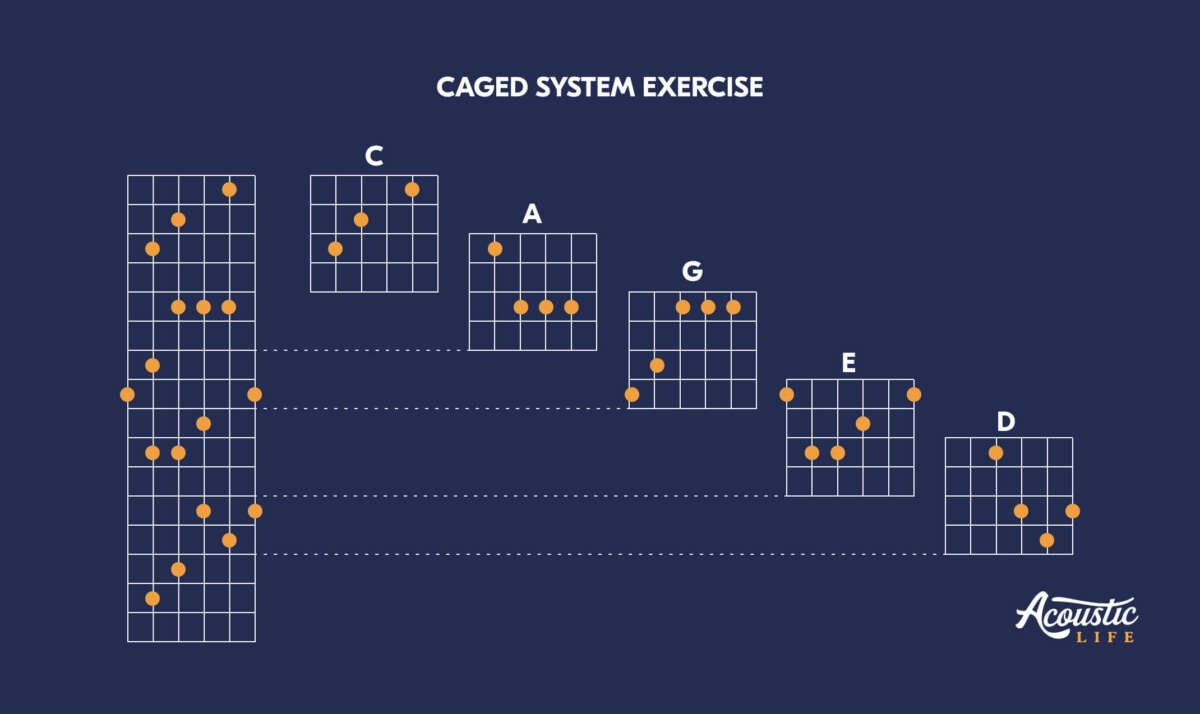
A Practical CAGED Exercise
Use this exercise with a metronome set between 60 and 80 beats per minute.
- Play a C major chord in the open C shape.
- Play a C major chord using the A shape at the third fret.
- Find a C major chord using the G shape.
- Play a C major chord using the E shape at the eighth fret.
- Play a C major chord using the D shape around the tenth fret.
- Return to the open C shape.
Do not rush to complete the full cycle. Focus on clean notes and correct root names.
Next, play each chord as an arpeggio. Pick the notes one at a time. Then improvise a short melody using only the notes inside or near that shape.
A strong variation is to play a simple progression such as C, F, and G. Try to keep your hand in one area of the neck rather than returning to open chords after every change.
This teaches your hands to see nearby chord shapes. It also shows why the CAGED system for guitar is useful for rhythm guitar and arrangement.

Common Mistakes to Avoid
The CAGED system is useful, but it is easy to study it in a way that creates more confusion.
Memorizing shapes without root notes
A shape alone does not tell you the chord name. If you do not know where the root is, the pattern becomes a movable picture with no meaning.
Always identify the root before moving a shape.
Forcing every full chord shape
Some CAGED forms are difficult to play as complete chords. The G and C shapes can require uncomfortable stretches.
Use partial chords, triads, and chord fragments. You do not need to play every note to benefit from the shape.
Treating CAGED as five scale boxes
CAGED can include scales, but it begins with chord forms. If you learn only five scale patterns, you may miss the main point.
Connect every scale pattern to its chord shape and root notes.
Playing scales without targeting chord tones
Running a scale can sound like an exercise. Strong solos often come from landing on chord tones at the right time.
Practice ending short phrases on the root, third, or fifth.
Moving too quickly
Fretboard knowledge grows through repetition. It is better to master one shape in three keys than to rush through all five shapes in one day.
Short practice sessions work well. Ten focused minutes can be more useful than an hour of unfocused drilling.

How Guitar Players Use CAGED in Real Music
The CAGED system for guitar appears in many playing styles, even when musicians do not call it by that name.
Blues players use it to connect chord tones with bends and pentatonic phrases. Country players use it for double stops, major pentatonic lines, and compact chord parts. Rock players use it to find barre chords, power chord roots, and lead positions.
Jazz players often use related ideas through triads, arpeggios, and guide tones. They may not use every traditional CAGED fingering, but the concept of seeing harmony across the neck remains valuable.
A practical example is a 12-bar blues in A. You can play an open A chord, then move to an A-shape or E-shape voicing higher on the neck. Around that voicing, you can find A pentatonic notes and target the chord tones as the progression changes.
This creates a direct link between rhythm and lead guitar. You are not switching between two unrelated skills. You are viewing the same harmony from different angles.

Is the CAGED System Right for Every Guitarist?
The CAGED system for guitar is helpful for many players, but it is not the only way to learn the fretboard.
Some guitarists prefer the three-notes-per-string method. Others learn through interval shapes, chord-tone maps, or traditional notation. These systems can work well too.
CAGED also has limits. Some players become too dependent on fixed shapes and fail to learn the actual notes. Others use the system as a strict rule and avoid voicings that fall outside the five forms.
Use CAGED as a framework, not a cage. Learn the shapes, then expand into triads, intervals, inversions, and note names.
The best method is the one that helps you hear, understand, and play music. CAGED is especially useful when you want a visual link between chords, scales, and solos.
Frequently Asked Questions About the CAGED System for Guitar
What does CAGED stand for on guitar?
CAGED stands for the five open major chord shapes: C, A, G, E, and D. These shapes can be moved across the neck to create different chord voicings.
Is the CAGED system hard to learn?
The basic idea is simple, but learning all five shapes takes regular practice. Start with the E and A shapes, then add the D, C, and G shapes one at a time.
Can beginners use the CAGED system for guitar?
Yes. Beginners can use CAGED after learning the basic open chords. It is best to learn one shape, its root notes, and one practical exercise before adding another shape.
Does CAGED work for minor chords?
Yes, but the standard system is first taught with major chords. You can adapt the shapes for minor chords by lowering the major third by one fret or using minor chord variations.
Does CAGED help with guitar solos?
Yes. CAGED places chord tones inside nearby scale and pentatonic patterns. This helps you target notes that match the chord while moving around the fretboard.
Do I need to learn music theory before CAGED?
No. You can begin with chord shapes and root notes. Basic knowledge of intervals, chord tones, and scales will make the system more useful as you progress.
What should I learn first in the CAGED system?
Start with the open C, A, G, E, and D chords. Then learn the E and A movable forms, identify their root notes, and practice connecting each form to a scale or arpeggio.
Conclusion
The CAGED system for guitar connects five open chord shapes across the fretboard. It helps you find chords in new positions, understand root notes, build scales, play arpeggios, and create more musical solos.
Start with the E and A shapes. Learn the root notes. Add the D, C, and G shapes slowly, and use short exercises instead of trying to memorize the entire neck at once.
With steady practice, the CAGED system for guitar can turn the fretboard from a set of confusing frets into a clear musical map. Pick one chord today, find its five forms, and use those shapes to build your next rhythm part or guitar solo.

Senior Music Reviewer
Alex Carter is a seasoned music reviewer with over a decade of experience in the world of sound and instruments. Passionate about helping musicians and enthusiasts make informed choices, he brings sharp insights and in-depth knowledge to every review. From classical instruments to modern gear, Alex combines technical expertise with a love for music to deliver content that resonates with readers.
As a Senior Music Reviewer and expert author on Tuneluma.com, Alex is dedicated to sharing honest evaluations, practical advice, and thoughtful commentary to guide readers in their musical journey.