For guitarists in the United States, Drop D tuning is one of the easiest ways to change a standard-tuned guitar for rock, metal, folk, country, and worship music. You lower the thickest string, the low E, by one whole step to D. The other five strings stay the same.
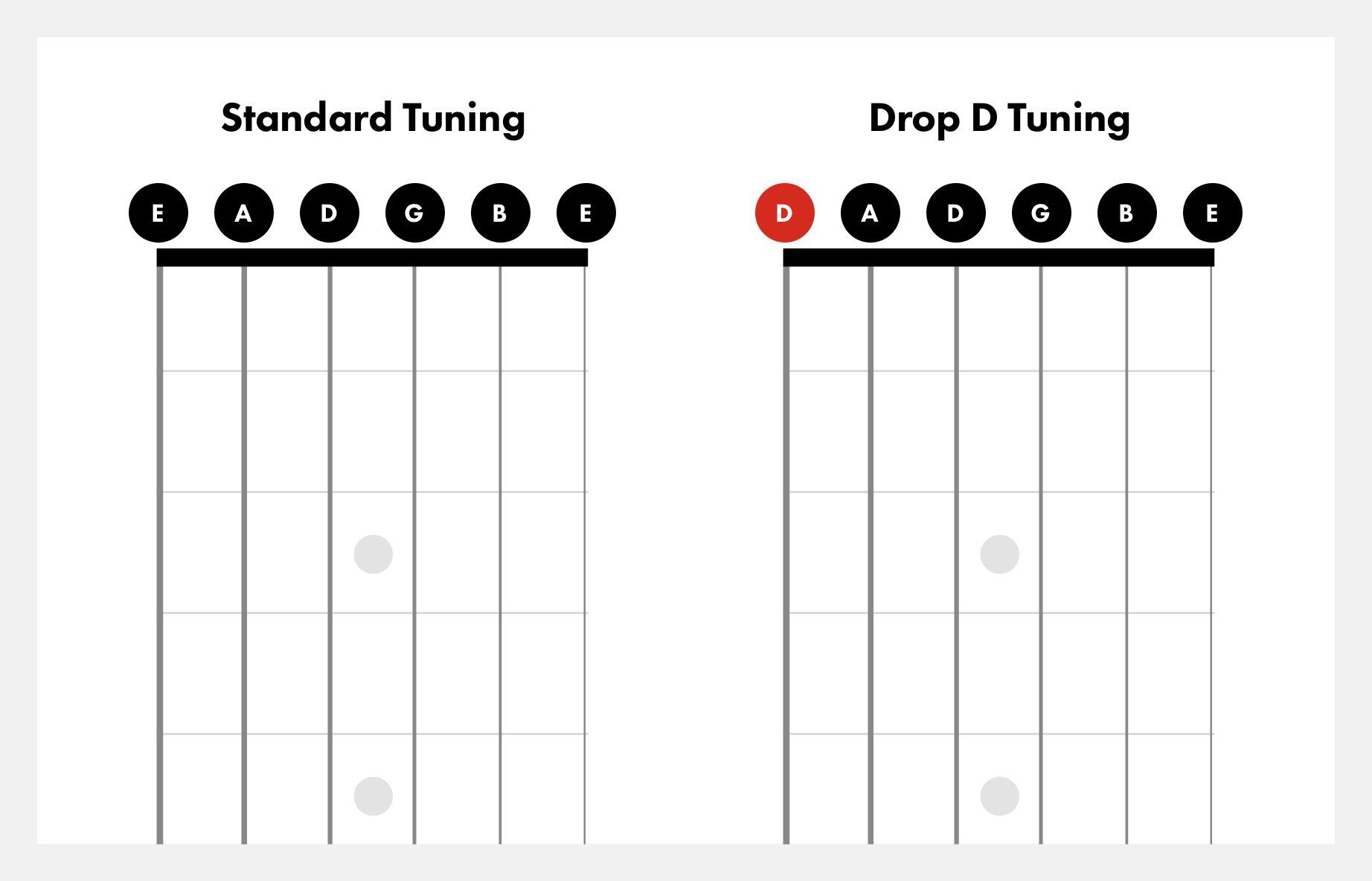
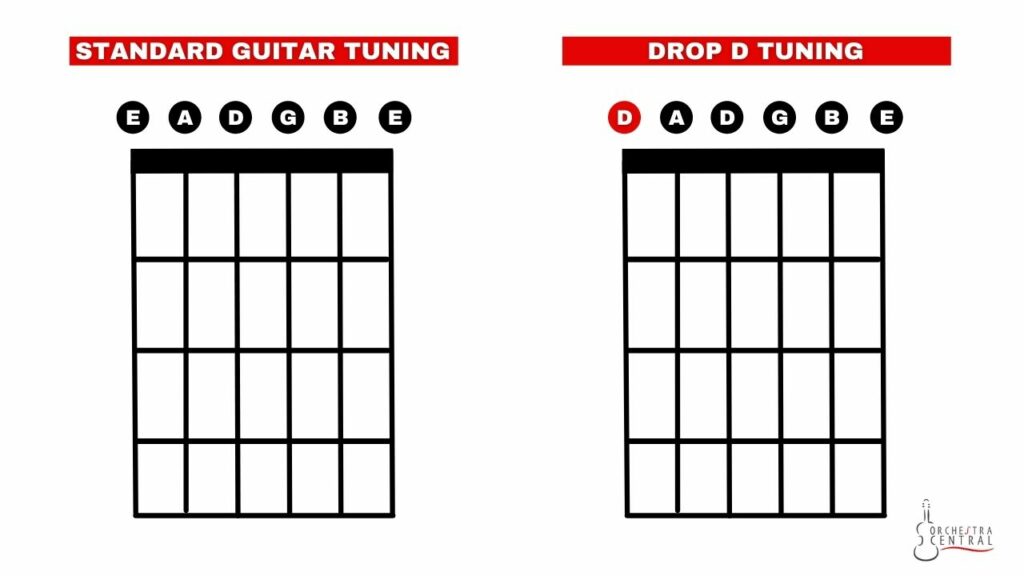
Standard tuning is:
E–A–D–G–B–E
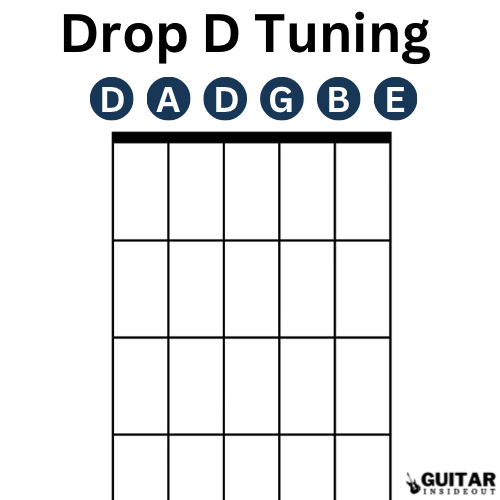
Drop D tuning is:
D–A–D–G–B–E
This small change gives the guitar a lower bass note and lets you play many power chords with one finger. It can make heavy riffs sound bigger without changing every string.
How Does Drop D Tuning Work?
Drop D tuning changes only the sixth string. You tune the low E string down from E to D while keeping the other five strings in standard tuning.
| String | Standard tuning | Drop D tuning |
|---|---|---|
| 6th string, thickest | E | D |
| 5th string | A | A |
| 4th string | D | D |
| 3rd string | G | G |
| 2nd string | B | B |
| 1st string, thinnest | E | E |
The low string moves from E2, about 82.41 Hz, to D2, about 73.42 Hz. The note is lower, but the guitar still uses the same basic tuning pattern on the top five strings.
The name comes from the action: you “drop” the low E string down to D. It is not the same as lowering every string. That distinction matters when you read chord charts or switch back to standard tuning.
Why does Drop D sound different?
The lower sixth string adds a deeper bass range. It also matches the open fourth string, which is already tuned to D. As a result, the lowest two strings form an octave relationship:
- 6th string open: D
- 4th string open: D
That relationship makes one-finger power chords possible. For example, placing one finger across the sixth, fifth, and fourth strings creates a power chord.
The tuning also reduces tension on the sixth string. With the same string gauge and scale length, the lower pitch produces less tension. The exact change depends on the guitar and string design, but the drop is roughly one-fifth under ideal string conditions.
How to Tune a Guitar to Drop D
You can tune to Drop D with a clip-on tuner, pedal tuner, phone app, keyboard, or another reliable pitch source. A chromatic tuner is the simplest choice because it detects the note directly.
Step-by-step instructions
-
Start in standard tuning.
Confirm that the strings are tuned to E–A–D–G–B–E. -
Play the sixth string.
This is the thickest string and the one closest to your face when you hold the guitar. -
Lower the sixth string slowly.
Turn its tuning peg so the pitch moves down from E. -
Stop at D.
The tuner should show D. Many tuners also show the octave or register, such as D2. -
Check the fourth string.
Play the open sixth string and compare it with the open fourth string. Both should sound like D, with the sixth string one octave lower. -
Check the other strings.
Tuning one string can slightly affect the neck and bridge balance. Recheck A, D, G, B, and high E. -
Play a few chords and recheck.
New strings may settle, and the low string may need a second adjustment.
How to tune by ear
If the other strings are already in tune, play the seventh fret of the sixth string. That note is D and should match the open fourth string, one octave apart.
You can also compare harmonics if you know how to play them. A tuner is still more accurate for beginners and in noisy rooms.
Signs that the tuning is correct
Your guitar is likely in Drop D when:
- The tuner reads D on the sixth string.
- The open sixth and fourth strings have the same note name.
- A one-finger barre across the lowest three strings produces a clear power chord.
- Songs written in Drop D sound in tune with the recording or backing track.
What Chords Can You Play in Drop D?
Drop D keeps most familiar open chords unchanged. Chords that use the sixth string may need a small adjustment, because that string no longer plays E.
The most useful change affects power chords. In standard tuning, a power chord often needs two or three fingers. In Drop D, the lowest three strings are tuned D–A–D, so they form a power chord when played open.
To move that shape up the neck, place one finger across the sixth, fifth, and fourth strings.
For example:
| Fret position | Root note | Power chord |
|---|---|---|
| Open | D | D5 |
| 2nd fret | E | E5 |
| 3rd fret | F | F5 |
| 5th fret | G | G5 |
| 7th fret | A | A5 |
| 10th fret | C | C5 |
The root note is on the sixth string. Each fret raises the note by one semitone.
Common Drop D power-chord shape
To play a basic power chord:
- Choose a fret on the sixth string.
- Lay one finger across the sixth, fifth, and fourth strings.
- Strum only those three strings.
- Mute the higher strings with your picking hand or unused fingers.
This shape is fast to move. That is why Drop D appears often in hard rock, alternative rock, metal, punk, and post-grunge guitar parts.
Do standard chords still work?
Many do, but watch the sixth string.
- D major: Usually works as normal.
- A major: Often works if you avoid the sixth string.
- E major: The open sixth string now plays D, so the usual shape no longer sounds like E major if you strum all six strings.
- G major: You may need to avoid or change the sixth-string note.
- C major: Usually works when you do not use the low sixth string.
A chord chart made for standard tuning may still be useful, but check every chord that includes the lowest string.

Why Do Guitarists Use Drop D Tuning?
Drop D makes low riffs and power chords easier. It also gives a guitar a heavier low end without requiring a longer-scale instrument or a new set of strings.
Main benefits
Fast power chords: One finger can cover three low strings.
Lower range: The lowest note falls from E to D.
Easy riff movement: You can move a single shape along the neck.
Useful drone note: The open sixth string can create a steady low D beneath melodies or chords.
Simple transition: Five strings remain in standard tuning, so much of your existing knowledge still applies.
Drop D is especially useful when a song centers on D or uses repeated low D riffs. It can also work well for guitarists who want a heavier sound but do not want to learn a completely new tuning system.
What are the limits?
Drop D does not lower the whole guitar. Only the sixth string changes. If a song requires every string to be lower, Drop D will not provide the correct intervals.
The low string also has less tension. Some players like the looser feel, while others find that it feels soft or produces more fret buzz. Aggressive picking can make a loose sixth string move more than it does in standard tuning.

Drop D Compared With Other Guitar Tunings
Drop D is one of several alternate guitar tunings. The right choice depends on the sound, range, and chord shapes you need.
| Tuning | Notes, from low to high | Main feature |
|---|---|---|
| Standard | E–A–D–G–B–E | Familiar chord and scale shapes |
| Drop D | D–A–D–G–B–E | Low D and simple power chords |
| Drop C | C–G–C–F–A–D | Lower, heavier sound with Drop D-style intervals |
| D standard | D–G–C–F–A–D | Every string is one whole step lower |
| Open D | D–A–D–F#–A–D | Open strings form a D major chord |
Drop D vs. D standard
These tunings are not the same.
In Drop D, only the sixth string is lowered:
D–A–D–G–B–E
In D standard, every string is lowered:
D–G–C–F–A–D
Drop D keeps the top five strings familiar. D standard lowers the entire guitar and changes the pitch of nearly every chord and scale shape.
Drop D vs. Drop C
Drop C lowers the sixth string to C and the other strings as well:
C–G–C–F–A–D
It gives a lower, heavier sound, but the strings feel looser unless you use suitable gauges. Drop C may also require a setup adjustment, especially on guitars with light strings.

Do You Need Different Strings or a Guitar Setup?
Most guitars can use Drop D without new strings or a setup. The change is small, especially when you switch between standard tuning and Drop D.
Still, the sixth string will feel looser. You may notice:
- More fret buzz on the low string
- Less resistance when bending or picking
- A softer attack
- Slightly weaker tuning stability
- Intonation that is not quite as accurate on some guitars
For occasional use, these effects are usually minor. If you keep the guitar in Drop D, play with strong attack, or use a very light string set, a thicker sixth string may feel better.
Do not force a tuning peg. If the string feels stuck, inspect the post, nut, and winding. A qualified guitar technician can check the instrument if the string will not hold pitch, the buzz is severe, or the neck relief appears unusual.
Electric guitars with floating tremolo systems can be more difficult to retune. Lowering one string changes the balance of the bridge springs and may raise the other strings. Fixed-bridge guitars are usually easier to move into Drop D.

Common Drop D Mistakes
The most common mistake is lowering the wrong string. Drop D changes the thickest sixth string, not the fourth string, which is already D.
Other mistakes include:
- Tuning the sixth string to D-flat or D-sharp instead of D
- Assuming every standard chord shape remains correct
- Strumming all six strings without checking the bass note
- Forgetting to retune before playing in standard tuning
- Using a Drop D tab while the guitar is still in standard tuning
- Ignoring buzz from a loose low string
- Confusing Drop D with D standard
A useful habit is to say the tuning aloud before you play: D–A–D–G–B–E. Then check the sixth string and the open fourth string.
If a riff sounds wrong, check tuning first. Next, confirm that the tab gives string numbers and fret numbers for Drop D. Finally, check whether the song uses a capo or a different low tuning.

Key Takeaways
- Drop D tuning lowers only the sixth string from E to D.
- The notes are D–A–D–G–B–E.
- It gives the guitar a lower bass note and a deeper sound.
- One finger can play movable power chords across the lowest three strings.
- Most of the top five strings remain familiar.
- Standard chord shapes may change when they use the sixth string.
- Most fixed-bridge guitars can switch to Drop D without a setup.
- Floating tremolo systems may need extra care when changing tuning.
FAQs About Drop D Tuning
Is Drop D tuning lower than standard tuning?
Yes, but only on the sixth string. The lowest note changes from E to D. The other five strings stay at their standard pitches.
Can beginners learn Drop D tuning?
Yes. Drop D is beginner-friendly because only one string changes. It is also a useful way to learn power chords and movable riff shapes.
Can I use a capo in Drop D tuning?
Yes. A capo raises every string by the same amount. For example, a capo on the second fret makes the open sixth string sound like E, but the string relationships remain based on Drop D.
Does Drop D damage a guitar?
Normal use of Drop D does not usually damage a guitar. The main issue is balance and playability, especially on guitars with floating tremolo bridges. Do not force tuning hardware, and have the guitar checked if it develops severe buzz or will not hold pitch.
Why does my Drop D guitar sound out of tune?
The sixth string may be at the wrong pitch, or the other strings may have shifted slightly. Check the low string with a chromatic tuner, compare it with the open fourth string, and then retune all six strings.
What songs use Drop D tuning?
Many rock and metal songs use Drop D because it makes low power-chord riffs easy to play. Song-specific tuning can vary by recording, live performance, or guitar part, so verify the tuning listed with the tab or official lesson.
Conclusion
Drop D tuning means lowering the low E string to D while leaving the other five strings unchanged. The result is D–A–D–G–B–E, a tuning that adds low range and makes power-chord riffs simple.
To try it, tune the sixth string down until it matches D, then compare it with the open fourth string. Start with simple one-finger power chords, listen for buzz, and retune before switching back to standard tuning.

Senior Music Reviewer
Alex Carter is a seasoned music reviewer with over a decade of experience in the world of sound and instruments. Passionate about helping musicians and enthusiasts make informed choices, he brings sharp insights and in-depth knowledge to every review. From classical instruments to modern gear, Alex combines technical expertise with a love for music to deliver content that resonates with readers.
As a Senior Music Reviewer and expert author on Tuneluma.com, Alex is dedicated to sharing honest evaluations, practical advice, and thoughtful commentary to guide readers in their musical journey.