A Sharp Minor Guitar Chord: Easy Playing Guide
The A sharp minor guitar chord uses A sharp, C sharp, and F to create a dark, tense sound.
The A sharp minor guitar chord, written as A#m, is a useful minor chord with a rich and dramatic tone. It is also enharmonic with B-flat minor, so many guitarists use the easier-to-read Bb minor name instead. This guide covers the notes, chord shapes, barre technique, substitutions, and practical ways to use the chord in real music.
What Is the A Sharp Minor Guitar Chord?
The A sharp minor guitar chord contains three main notes:
• A sharp, the root
• C sharp, the minor third
• F, the fifth, also called E sharp in strict music theory
These notes create the sound of an A# minor triad. The minor third gives the chord its darker mood. The fifth adds strength and balance.
On guitar, the A sharp minor guitar chord is often shown as A#m. However, A# minor and Bb minor use the same pitch on a standard-tuned guitar. This is called an enharmonic relationship.
In practice, most chord charts use Bb minor because its notes are easier to spell: Bb, Db, and F. The sound is the same, but the written name changes.

A Sharp Minor Guitar Chord Diagram and Finger Placement
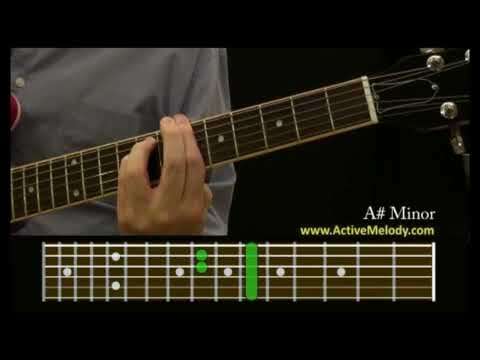
One common A sharp minor guitar chord shape uses the E minor barre form at the sixth fret:
e|—6—  Index finger
B|—6—  Index finger
G|—6—  Index finger
D|—8—  Ring finger
A|—8—  Pinky finger
E|—6—  Index finger
The strings are shown from the thinnest string at the top to the thickest string at the bottom. This shape is often written as 688666, using the low E string first.
To play it:
- Lay your index finger across all six strings at the sixth fret.
- Place your ring finger on the D string at the eighth fret.
- Place your pinky on the A string at the eighth fret.
- Strum all six strings.
- Check each note for a clean sound.
This shape can feel hard at first. The sixth fret is wide, and the barre needs steady pressure. Keep your thumb behind the neck. Try not to squeeze harder than needed.
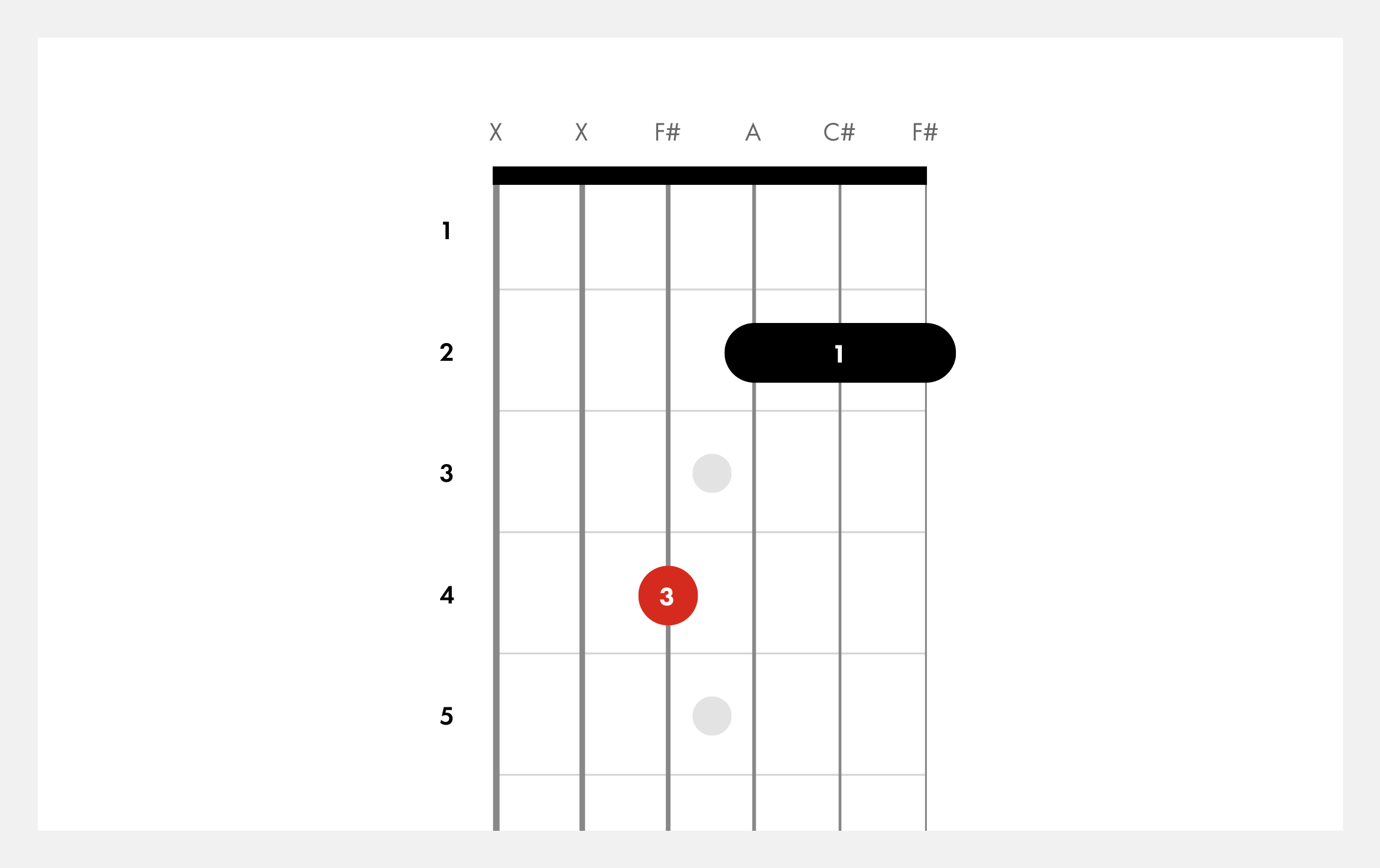
A second shape is the Bb minor form at the first fret:
e|—1—
B|—2—
G|—3—
D|—3—
A|—1—
E|—x—
This shape is written as x13321 when the chord uses the A-string root. Technically, it is Bb minor, but it sounds exactly like A# minor. Many players use this version when the song chart labels the chord as Bb minor.
How to Play the A Sharp Minor Barre Chord
The A sharp minor guitar chord is a barre chord, so clean technique matters more than raw hand strength. Start with the first-fret Bb minor shape if the sixth-fret version feels too tiring.
Place your index finger close to the fret wire. Do not place it in the middle of the fret space. A position near the fret usually needs less pressure and creates fewer buzzing notes.
Use these steps:
- Fret only the index barre.
- Pick each string one at a time.
- Find any muted or buzzing strings.
- Roll your index finger slightly toward its side.
- Add the other fingers.
- Strum slowly when every note rings clearly.
A common mistake is to flatten the index finger too much. The soft center of the finger can mute nearby strings. The firmer side often works better.
Another mistake is bending the wrist too sharply. Keep the wrist relaxed and let your elbow move slightly away from your body. This gives your fingers a better angle.
When I first learned this shape, I practiced it for five minutes at a time rather than forcing long sessions. Short practice helped my hand stay relaxed. That approach also reduced soreness and made the A sharp minor guitar chord sound cleaner.

Easier A Sharp Minor Guitar Chord Options
Full barre chords are useful, but they are not the only way to play the A sharp minor guitar chord. Smaller voicings can help beginners, singers, and players who want a lighter sound.
Three-string A sharp minor shape
You can play a small minor triad on the top three strings:
e|—6—
B|—6—
G|—6—
This shape gives you A#, F, and A# on the highest strings. It does not include the C# note, so it has a more open and powerful sound than a complete minor triad.
Power chord version
For a heavier sound, use an A#5 power chord:
e|—x—
B|—x—
G|—x—
D|—8—
A|—8—
E|—6—
A power chord uses the root and fifth but leaves out the minor third. Because of this, it is neither clearly major nor minor. It works well in rock, punk, metal, and pop.
Bb minor as a practical substitute
If the chart allows enharmonic spelling, use Bb minor instead. The common Bb minor shape is:
e|—1—
B|—2—
G|—3—
D|—3—
A|—1—
E|—x—
This is one of the most practical A sharp minor guitar chord alternatives. It uses the same pitches but may fit the song’s key more naturally.

A Sharp Minor Guitar Chord in Common Progressions
The A sharp minor guitar chord sounds strongest when it moves to chords that share one or more notes. Common progressions include:
• A#m to F# to C# to G#
• A#m to D#m to F#
• A#m to C# to G#
• A#m to Fm to C#
• A#m to G# to F#
In the key of A# minor, the basic chords are:
• A#m, the i chord
• B# diminished, the ii° chord
• C# major, the III chord
• D#m, the iv chord
• E#m, the v chord
• F# major, the VI chord
• G# major, the VII chord
Music often uses Bb minor instead of A# minor. In Bb minor, the same progression is easier to read:
• Bbm to Gb to Db to Ab
This is one reason professional charts often choose Bb minor. The sound does not change, but the notation becomes clearer.
Try this slow progression:
| A#m | F# | C# | G# |
Play four steady downstrokes per bar. Then try a pattern with a softer downstroke on beats two and four. The chord movement creates a strong emotional lift without needing a complex picking pattern.

Strumming Patterns for A Sharp Minor
The A sharp minor guitar chord can sound heavy with simple downstrokes. It can also sound gentle with light fingerpicking. Your right hand changes the mood as much as the chord itself.
Try these patterns in 4/4 time.
Beginner downstroke pattern
1   2   3   4
D   D   D   D
Keep each stroke even. Use a metronome at a slow tempo, such as 60 beats per minute.
Pop strumming pattern
1 & 2 & 3 & 4 &
D   D U   U D U
Let your wrist stay loose. The upstrokes should be lighter than the downstrokes.
Ballad pattern
Pick the bass note first, then play the higher strings:
Bass, G, B, e, B, G
This pattern gives the A sharp minor guitar chord a wide, gentle sound. It works well under a vocal line.
Muted rhythm pattern
Rest the side of your picking hand near the bridge. Play short, controlled strokes. This creates a tight sound that suits modern rock and pop.
Start with one pattern. Change patterns only after the chord transitions feel steady. A simple pattern played in time sounds better than a complex pattern played unevenly.
How to Change to and From A Sharp Minor
Chord changes are often harder than holding the A sharp minor guitar chord. Practice the movement in small loops rather than playing an entire song at once.
For A#m to F#:
- Keep your index finger near the sixth fret.
- Move your ring and pinky fingers together.
- Place the remaining fingers before strumming.
- Start with one chord change every four beats.
For A#m to C#:
- Release the barre slightly.
- Move the hand toward the fourth fret.
- Keep your fingers close to the strings.
- Strum only after the shape is ready.
For A#m to G#:
- Lift the full A#m shape.
- Slide the hand down two frets.
- Form the G# barre chord.
- Keep the motion smooth and small.
A useful practice drill is to set a timer for two minutes. Change between two chords without stopping. Count every beat aloud. This builds timing and muscle memory at the same time.
One lesson I learned from teaching barre chords is that speed should come last. Players often rush the movement and create gaps in the rhythm. Slow, clean changes build a much stronger foundation.
Common Problems When Playing A Sharp Minor
Several issues appear again and again with the A sharp minor guitar chord.
Buzzing strings
Buzzing usually comes from weak pressure, poor finger placement, or a finger touching a nearby string. Move your finger closer to the fret and test each string alone.
Muted high strings
The index finger may be resting too flat. Roll it slightly toward the thumb side so the high strings can ring.
Hand fatigue
Barre chords can tire the hand. Relax between repetitions, shake out your fingers, and avoid practicing through sharp pain.
Slow chord changes
This often happens when the hand lifts too far from the neck. Keep your fingers close to the strings during every movement.
Unclear chord names
A# minor and Bb minor sound the same on a standard guitar. The correct written name depends on the key and the chord progression.
A guitar setup can also affect playability. High action makes barre chords harder. If the chord feels unusually difficult, ask a qualified guitar technician to check the neck, nut, and string height.
A Sharp Minor Guitar Chord Versus Bb Minor
A# minor and Bb minor are enharmonic equivalents. On a fretted guitar, they use the same notes and produce the same pitch. The difference is mainly one of musical spelling.
A# minor is spelled:
• A#
• C#
• E#
Bb minor is spelled:
• Bb
• Db
• F
The Bb minor spelling is more common because it avoids several difficult symbols. In the key of Bb minor, the scale is easier to read and the chord names are more familiar.
Use A# minor when the song or chart is written in a sharp-based key. Use Bb minor when the music is written in a flat-based key. If you are learning by ear, either name may describe the same guitar shape.
This distinction matters most when reading sheet music, building scales, or working with other musicians. In casual chord playing, the physical shape and sound are usually the main concerns.
How Songwriters Use the A Sharp Minor Sound
The A sharp minor guitar chord often suggests sadness, tension, mystery, or quiet strength. It does not force a song to sound sad, but its minor quality gives the harmony a serious color.
Songwriters may use it to:
• Begin a verse with emotional weight
• Create contrast after a major chord
• Support a reflective vocal melody
• Build tension before a chorus
• Add depth to a repeating loop
Try moving from C# major to A#m. The shared notes make the change sound smooth. Then move from A#m to F#. This creates a familiar emotional pattern found in many pop and rock styles.
You can also use a capo to change the chord shapes. For example, a familiar minor shape may produce the sound you need in another position. Always check the actual pitch when using a capo, especially if you play with a singer or another instrument.
The best way to understand the chord is to listen to its role. Play it alone, then place it inside a progression. A chord is like a word in a sentence. Its meaning comes from what surrounds it.
Practice Plan for the A Sharp Minor Guitar Chord
Use this simple plan for ten minutes a day.
- Hold the A sharp minor guitar chord for five seconds.
- Pick each string slowly.
- Relax your hand for five seconds.
- Repeat the hold and release five times.
- Change between A#m and F# for two minutes.
- Change between A#m and C# for two minutes.
- Play a four-chord progression with a metronome.
- Finish by playing the chord in a song.
Do not judge progress only by speed. A clean chord at a slow tempo is useful practice. Speed will grow as your fingers learn the path.
Record yourself once a week. Listen for buzz, timing gaps, and uneven strums. A phone recording can reveal problems that are hard to notice while you are playing.
If you feel pain in your wrist or fingers, stop and rest. Mild effort is normal. Sharp pain is a warning, not a sign of progress.
Frequently Asked Questions About the A Sharp Minor Guitar Chord
What notes are in the A sharp minor guitar chord?
The A sharp minor guitar chord contains A sharp, C sharp, and F. In formal theory, the fifth may be written as E sharp, but E sharp and F sound the same on guitar.
Is A sharp minor the same as Bb minor?
Yes. A sharp minor and Bb minor are enharmonic equivalents on a standard-tuned guitar. They use the same pitches, although Bb minor is usually easier to read.
What is the easiest way to play A sharp minor?
The easiest practical option is often the Bb minor barre shape at the first fret, written x13321. You can also use a small three-string shape or an A#5 power chord while building strength.
Why does my A sharp minor chord sound muted?
Your index finger may be touching nearby strings or sitting too far from the fret. Pick each string alone, adjust your finger angle, and use only the pressure needed for a clean note.
Can beginners play the A sharp minor guitar chord?
Yes, but barre chords may take time to master. Begin with short practice sessions, use a smaller voicing, and focus on relaxed movement instead of squeezing the neck.
What key uses A sharp minor?
A sharp minor can function as the tonic chord in the key of A# minor. In practical guitar music, the same key is often written as Bb minor because the notation is simpler.
Conclusion
The A sharp minor guitar chord is a powerful minor chord built from A sharp, C sharp, and F. Its most common full shape is the sixth-fret E-style barre chord, while Bb minor offers the same sound with a more familiar spelling.
Start with a small voicing if the full barre feels difficult. Practice clean notes, relaxed pressure, and slow chord changes. Then place the A sharp minor guitar chord into progressions such as A#m, F#, C#, and G#.
Pick up your guitar today and practice the chord for ten focused minutes. Explore the related progressions, record your progress, and share your favorite A#m song or technique in the comments.

Senior Music Reviewer
Alex Carter is a seasoned music reviewer with over a decade of experience in the world of sound and instruments. Passionate about helping musicians and enthusiasts make informed choices, he brings sharp insights and in-depth knowledge to every review. From classical instruments to modern gear, Alex combines technical expertise with a love for music to deliver content that resonates with readers.
As a Senior Music Reviewer and expert author on Tuneluma.com, Alex is dedicated to sharing honest evaluations, practical advice, and thoughtful commentary to guide readers in their musical journey.