What Is A Guitar Triad: Easy Music Theory Guide
A guitar triad is a three-note chord built from a root, third, and fifth.
If you have ever wondered what is a guitar triad, think of it as the smallest complete chord shape. Triads explain why many chords sound major, minor, bright, dark, tense, or resolved. Once you understand them, the fretboard becomes easier to navigate, and chord changes, riffs, solos, and songwriting all become more connected.
What Is a Guitar Triad?
A guitar triad is a chord made from three different notes. Those notes usually come from the first, third, and fifth degrees of a major or minor scale.
For example, the C major scale contains these notes:
C, D, E, F, G, A, B
The first, third, and fifth notes are C, E, and G. Therefore, a C major triad contains:
• C as the root
• E as the major third
• G as the perfect fifth
The notes may appear in any order, and some guitar shapes may repeat one of them. Even when a chord shape uses four, five, or six strings, it can still be based on a three-note triad.
This explains what is a guitar triad in practical terms: it is a compact chord idea that can appear in many positions across the neck.

The Three Parts of a Guitar Triad
Every basic triad has three important chord tones. Each one has a specific job in the sound.
The root
The root gives the chord its name. In a C major triad, C is the root. It acts like the home base of the chord.
When you move a C major triad shape to another position, the root tells you what chord you are playing. This is why learning the location of root notes is essential for guitarists.
The third
The third tells you whether the triad is major or minor.
• A major third creates a bright, open sound.
• A minor third creates a darker, more emotional sound.
For C:
• C to E is a major third.
• C to E♭ is a minor third.
The third is often the most important note for identifying a chord’s mood.
The fifth
The fifth supports the root and adds stability. In a C major triad, G is the perfect fifth.
The fifth usually does not decide whether a chord is major or minor. Still, it gives the chord strength and makes the harmony sound complete.
A useful way to remember what is a guitar triad is to picture three people in a small band: the root names the song, the third sets the mood, and the fifth adds support.

Types of Guitar Triads
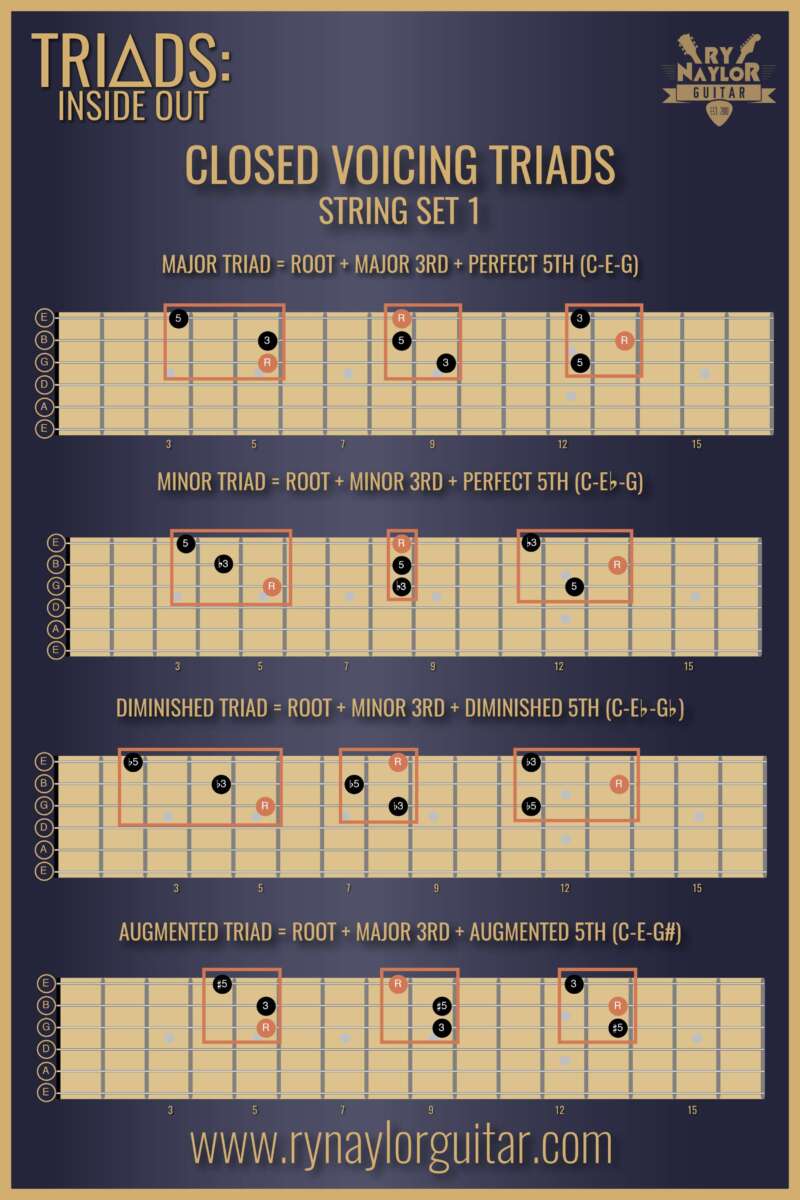
There are four main triad types in basic music theory. They are major, minor, diminished, and augmented.
Major triads
A major triad contains:
• Root
• Major third
• Perfect fifth
The formula is:
1, 3, 5
A C major triad contains:
C, E, G
Major triads often sound stable, bright, and strong. Common examples include G major, D major, A major, and E major.
Minor triads
A minor triad contains:
• Root
• Minor third
• Perfect fifth
The formula is:
1, ♭3, 5
A C minor triad contains:
C, E♭, g
minor triads often sound more serious, thoughtful, or emotional. The only difference between a major and minor triad is the third.
That small change has a major effect. Raise or lower one note, and the entire character of the chord changes.
Diminished triads
A diminished triad contains:
• Root
• Minor third
• Diminished fifth
The formula is:
1, ♭3, ♭5
A C diminished triad contains:
C, E♭, G♭
Diminished triads sound tense and unstable. They often lead toward another chord instead of standing still for long.
Augmented triads
An augmented triad contains:
• Root
• Major third
• Augmented fifth
The formula is:
1, 3, ♯5
A C augmented triad contains:
C, E, G♯
Augmented triads have a floating, unusual sound. They are less common in basic guitar songs but appear in jazz, film music, rock, and songwriting.
These four types give you a complete answer to what is a guitar triad from a theory perspective. They also help you hear how one note can change the color of a chord.

Guitar Triad Formulas and Examples
Learning formulas makes it easier to build triads in any key. Here are the basic formulas:
| Triad type | Formula | Notes in the key of C |
|---|---|---|
| Major | 1, 3, 5 | C, E, G |
| Minor | 1, ♭3, 5 | C, E♭, G |
| Diminished | 1, ♭3, ♭5 | C, E♭, G♭ |
| Augmented | 1, 3, ♯5 | C, E, G♯ |
You can also build triads from each degree of a major scale. The C major scale produces this pattern:
• C major: C, E, G
• D minor: D, F, A
• E minor: E, G, B
• F major: F, A, C
• G major: G, B, D
• A minor: A, C, E
• B diminished: B, D, F
The pattern is:
Major, minor, minor, major, major, minor, diminished
This pattern appears in every major key. For example, the G major scale produces G major, A minor, B minor, C major, D major, E minor, and F♯ diminished.