Introduction
A Kimball piano can be a good choice in the United States, but its value depends far more on the exact model, age, condition, and service history than on the Kimball name alone. Many Kimball pianos offer a pleasant tone, sturdy cabinets, and fair value on the used market. Others are now too worn to justify repair.
Kimball made many pianos in the United States, especially in Chicago, during its long history. The company built spinets, consoles, studio uprights, player pianos, and grands. Since Kimball stopped regular piano production in the 1990s, most Kimball instruments you see today are used.
That creates one key rule: buy the piano in front of you, not just the brand on the fallboard. A well-kept Kimball can serve a beginner, family, church, or casual player well. A neglected Kimball may need more work than it is worth.


The Short Answer: Are Kimball Pianos Good?
Kimball pianos are often good, serviceable used pianos, but they are not all equal.
A Kimball may be a sensible purchase when:
- The sound is clear and pleasant to you.
- The keys work evenly.
- The soundboard and bridges are sound.
- The piano holds pitch after tuning.
- The cabinet is in reasonable shape.
- A piano technician confirms that major repairs are not needed.
- The price reflects the piano’s age and condition.
A Kimball may be a poor choice when:
- Many keys stick or fail to repeat.
- The piano has serious rust or corrosion.
- The soundboard has major cracks or separation.
- The pinblock cannot hold tuning.
- The action is badly worn.
- The instrument has been stored in a garage, basement, or damp room.
- The repair cost approaches the price of a newer used piano.
The brand has a mixed reputation because Kimball produced a very wide range of instruments. A compact Kimball spinet from one period is not equal to a larger Kimball console, studio piano, or grand from another period.
General Kimball quality by piano type
| Kimball type | Typical strengths | Common limitations |
|---|---|---|
| Spinet | Small size and low moving cost | Short strings, compact action, limited bass |
| Console | Better tone and touch than many spinets | Still limited by age and wear |
| Studio upright | Stronger projection and useful practice tone | Heavy and often more expensive to move |
| Grand | More expressive range and visual appeal | Repair and maintenance costs can be high |
| Player piano | Historical interest and novelty | Player mechanisms may need separate repair |
The best Kimball piano for a buyer is usually the one with the best condition-to-price ratio, not the largest or oldest model.
What Is a Kimball Piano?
Kimball was an American piano brand associated with the W. W. Kimball Company and later Kimball International. The company became closely linked with piano production in Chicago and sold instruments under the Kimball name for many decades.
Kimball produced several kinds of pianos:
- Spinet pianos, usually under 40 inches tall
- Console pianos, often around 40 to 44 inches tall
- Studio uprights, commonly around 45 inches or taller
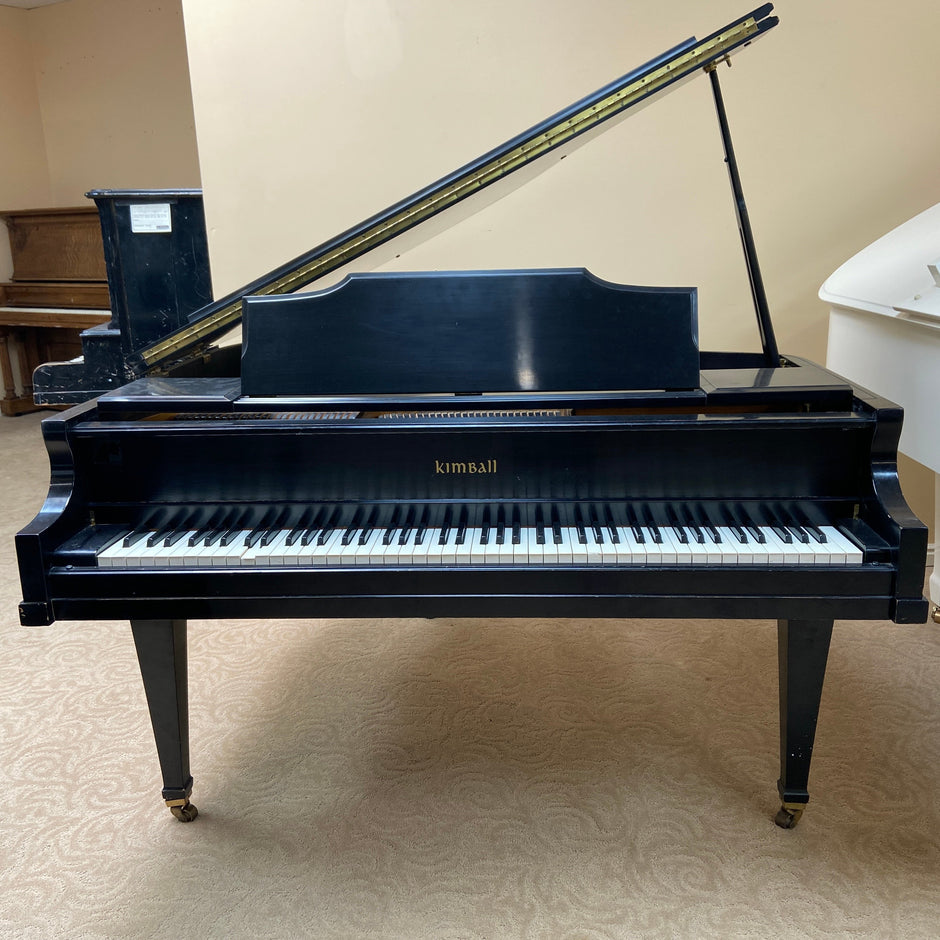
- Grand pianos
- Player pianos
- institutional and commercial instruments
Kimball’s piano business changed over time. Production methods, parts, designs, and quality could vary by decade and model. Later Kimball-branded instruments may also differ in construction and place of manufacture, so the label should be checked rather than assumed.
The brand’s long production history explains why online opinions can conflict. One owner may have a reliable console that has received regular tuning. Another may own a worn spinet with brittle action parts. Both experiences can be genuine.
How to identify the piano
Before judging a Kimball, record these details:


- The full name on the fallboard.
- The serial number.
- The model number, if shown.
- The piano’s height or grand-piano size.
- Any label inside the cabinet.
- Whether it has a player mechanism.
- The location where it was built, if stated.
- The condition of the action, strings, bridges, and soundboard.
The serial number can help estimate the production period. Serial-number references such as the Pierce Piano Atlas are commonly used for this purpose, but dates should be treated as estimates unless they are supported by the manufacturer’s records.

Kimball Piano Strengths
Kimball pianos have several qualities that can make them useful and affordable instruments.
Affordable entry point
Kimball pianos often sell for less than comparable used instruments from premium brands. This can help a beginner obtain an acoustic piano without paying the price of a newer instrument.
A low purchase price does not mean low total cost, however. Moving, tuning, repairs, and humidity control can cost more than the piano itself.
Warm and familiar tone
Many players describe older Kimballs as having a warm or mellow sound. Tone is subjective, and the result depends on the hammers, strings, soundboard, tuning, and room.
A piano technician can voice hammers to change the tone within reasonable limits. Voicing means shaping or adjusting the felt on the hammers. It cannot fix every structural problem.
Broad range of sizes
Kimball made compact pianos for homes as well as larger uprights and grands. This gives buyers more choices when space is limited.
A console is often a better compromise than a very small spinet. It may provide a fuller tone and more comfortable action while still fitting into a typical U.S. home.
Durable cabinet construction
Some Kimball cabinets remain attractive after many years. Solid wood parts and traditional finishes can age well when the piano has been kept away from extreme heat, cold, and moisture.
A good-looking cabinet does not prove that the internal parts are healthy. Cosmetic condition and mechanical condition must be judged separately.
Parts may still be available
Common piano parts, such as strings, felts, springs, and some action components, may be available through piano suppliers. A technician can often adapt modern replacement parts to an older instrument.
That does not mean every repair is practical. Custom parts, rare player mechanisms, damaged pinblocks, and major soundboard work can raise the cost sharply.

Kimball Piano Weaknesses and Limitations
The main weakness of an older Kimball is not necessarily its original design. It is the risk of age-related wear.


Many Kimballs are now several decades old
Wood, felt, leather, rubber, glue, and metal parts all age. A piano that looks clean may still have worn hammers, tired dampers, loose tuning pins, or sluggish keys.
Age alone does not condemn a piano. It does mean that inspection matters more than a simple brand comparison.
Small spinets have limited tone and action
Kimball spinets can work for basic practice, but their short strings and compact action limit the sound. The bass may lack depth, and the action may feel less responsive than that of a console or studio upright.
A spinet can still suit a child or casual player who needs a small acoustic piano. It is less attractive for an advanced pianist who wants a broad dynamic range.
Tuning stability can be uncertain
A piano must hold its tuning to be useful. If the tuning pins are loose or the pinblock is damaged, the piano may go out of tune soon after service.
A technician may be able to stabilize a moderately unstable piano. A severely worn pinblock may require major work or make the instrument uneconomical to repair.
Old action parts may need replacement
The action transfers movement from the keys to the hammers. Its parts include felt, wood, leather, springs, and small metal components.
Common symptoms of action wear include:
- Keys that feel uneven
- Notes that repeat slowly
- Hammers that do not strike cleanly
- Excessive noise
- Keys that remain depressed
- A large difference in volume from note to note
Some repairs are simple. A full action rebuild is not.
A large Kimball may still be a poor bargain
A grand piano takes more space, costs more to move, and may need more expensive repairs. Size alone does not make it better.
A small, healthy console may be a wiser purchase than a damaged grand. The right choice depends on playing needs, room size, budget, and inspection results.
Kimball Piano Quality by Model Type
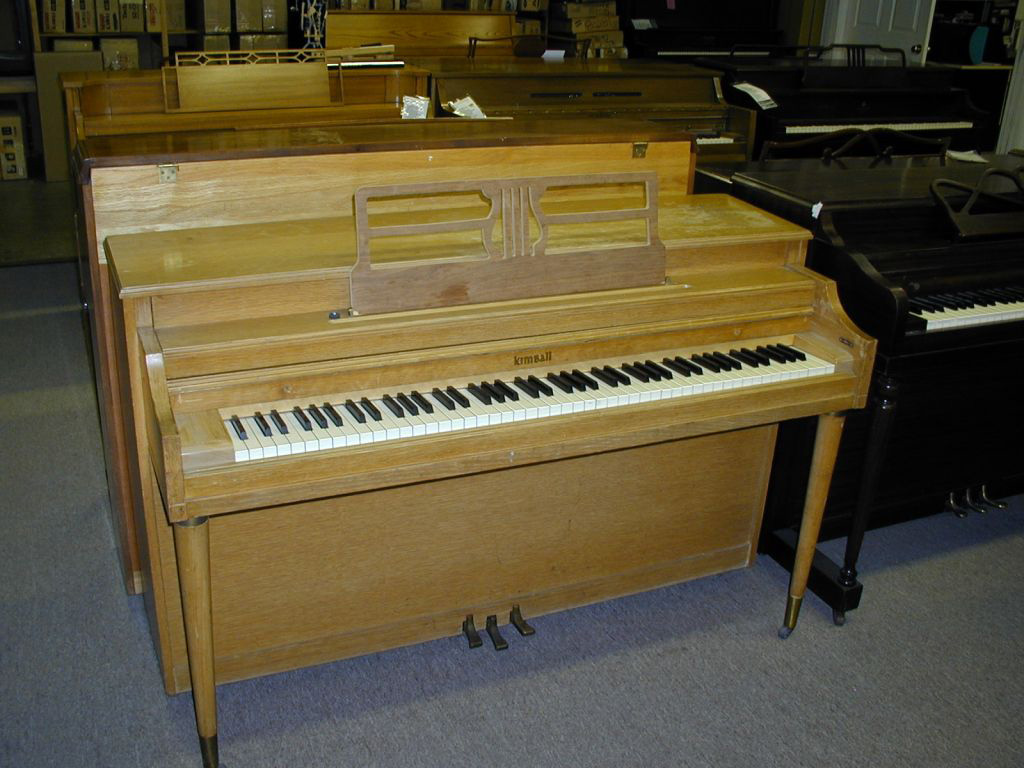
Kimball spinets
Kimball spinets are compact and often inexpensive. They may fit apartments, small homes, and beginner practice areas.
Their trade-offs are clear:
- Shorter strings can reduce tonal depth.
- Compact actions can be harder to service.
- Old felt and rubber parts may be worn.
- Some have limited volume and dynamic control.
- Moving them is easier than moving a full-size upright, but professional handling is still wise.
A Kimball spinet can be acceptable when it is free or inexpensive, recently serviced, and intended for basic use. Do not spend heavily on restoration unless a technician confirms that the structure and action justify it.


Kimball consoles
Consoles are often the most practical Kimball pianos for homes. They usually offer a fuller sound than spinets without the size of a studio upright.
Look for even touch, clean hammers, a stable tuning history, and no major soundboard or bridge damage. A console in good condition can be a reasonable piano for a beginner or intermediate player.
Kimball studio uprights
Studio uprights can offer more power and a stronger bass than smaller pianos. They may be suitable for serious home practice, teaching studios, churches, or community spaces.
Their size also creates added costs:
- Professional moving
- More floor space
- Possible floor-load concerns in unusual settings
- Higher repair costs if the action is heavily worn
A studio upright deserves a complete inspection before purchase.
Kimball grands
Kimball grands vary widely in quality, design, and condition. Some can offer a useful playing experience at a lower price than better-known grand brands. Others require extensive rebuilding.
Check:
- The condition of the soundboard
- Bridge caps and bridge pins
- Tuning-pin tightness
- String corrosion
- Action wear
- Hammer alignment
- Pedal function
- Cabinet and rim stability
- The piano’s service history
A grand should not be bought sight unseen unless you are prepared to pay for inspection, transport, and possible rebuilding.
Kimball player pianos
Player pianos can be appealing, but they have two separate systems:
- The acoustic piano.
- The player mechanism.
The acoustic piano must be judged on its own. A working player system does not make up for a damaged soundboard or failing action. Older pneumatic and electronic systems may require specialist work, and replacement parts may be limited.
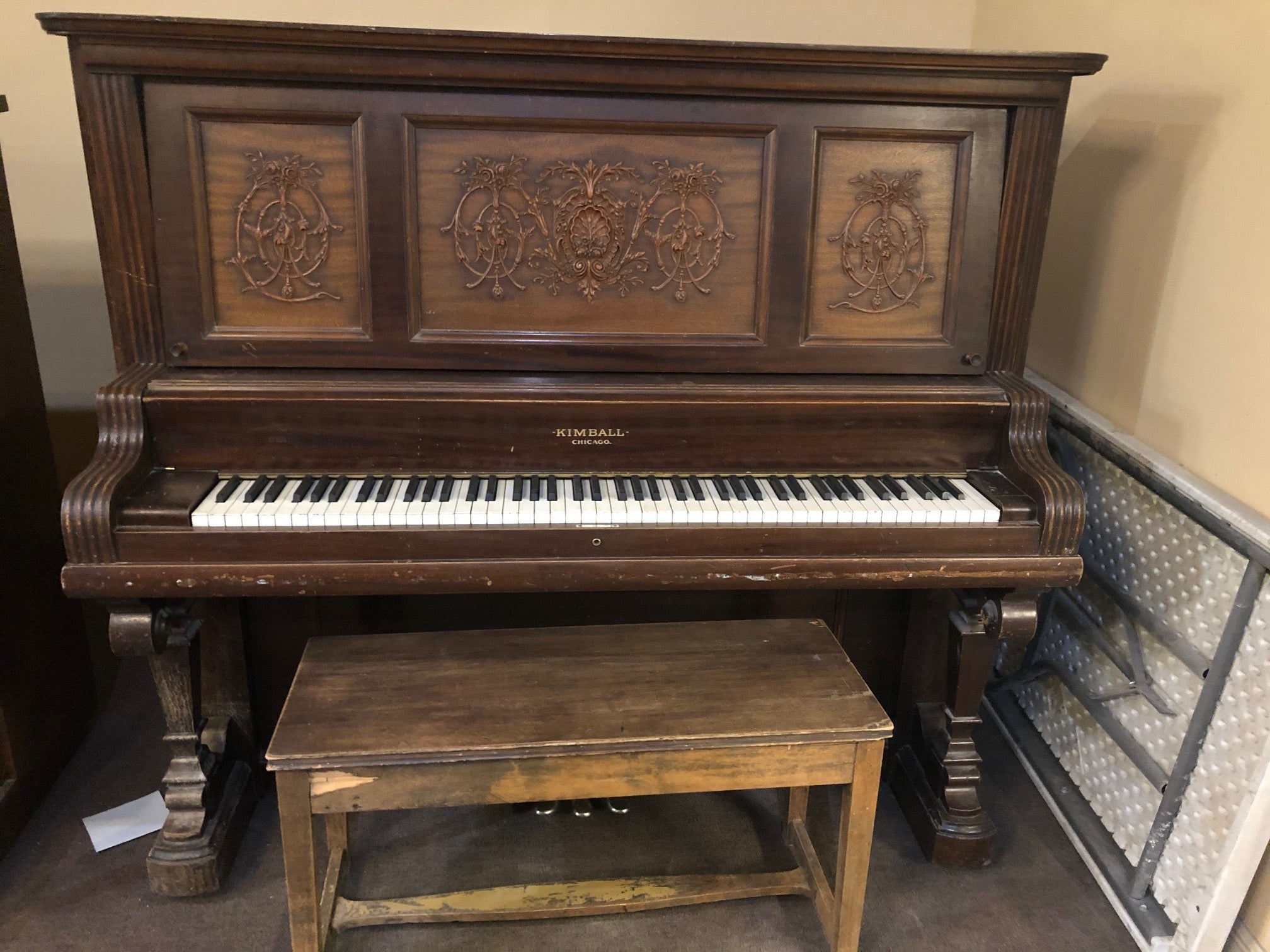
How to Inspect a Used Kimball Piano
A basic inspection can identify obvious problems, but it cannot replace a professional evaluation.
1. Check the outside
Look for:
- Water stains
- Swollen wood
- Veneer lifting
- Cracks in the case
- Signs of insects
- Missing hardware
- Strong musty odors
- Evidence of storage in a damp space
Cosmetic damage may be harmless. Water damage is more serious because it can affect the soundboard, bridges, pinblock, and action.
2. Play every key
Play each key softly and loudly. Listen for notes that sound dull, buzzy, weak, or much louder than nearby notes.


Check for:
- Sticking keys
- Slow return
- Uneven resistance
- Double-striking hammers
- Notes that do not sound
- Loud mechanical noise
- Pedals that do not work
A few minor issues may be repairable. Many problems across the keyboard suggest broader wear.
3. Inspect the hammers and action
Open the piano only if the owner allows it and you know how to do so safely. Look at the hammer felt.
Deep grooves where strings strike may indicate heavy use. Flattened or hardened hammers can produce a harsh tone. Excessive wear in the action can make the piano feel slow and uneven.
Do not force keys, pedals, panels, or stuck parts.
4. Examine the soundboard and bridges
The soundboard is the large wooden panel that helps amplify the strings. Small hairline cracks may be repairable and are not automatically fatal.
More serious warning signs include:
- Large cracks
- Separation from the rim
- Loose bridge sections
- Buzzing that remains after basic checks
- Visible distortion
- Missing or loose bridge pins
A technician should evaluate these problems.
5. Check the strings and tuning pins
Light surface rust may occur on older pianos. Heavy corrosion, broken strings, or rust around tuning pins can signal neglect or moisture exposure.
Do not try to turn tuning pins yourself. A loose pin may worsen, and improper tuning can damage strings or the piano.
6. Ask for service records
Useful records include:
- Past tuning dates
- Repairs
- Rebuilding work
- Moving history
- Storage conditions
- The name of the piano technician
No records do not prove that the piano is bad. They simply increase uncertainty.
7. Pay for a technician’s inspection
A pre-purchase inspection is usually the safest way to judge an older Kimball. Ask the technician to report separately on:
- Structure
- Tuning stability
- Action
- Tone
- Cosmetic condition
- Immediate repairs
- Future repair risks
Ask for an estimated repair range, not just a general opinion.


What Should You Pay for a Kimball Piano?
There is no reliable single price for every Kimball piano. Used-piano values vary by region, model, condition, delivery cost, and demand.
A free piano can still cost hundreds of dollars after moving and tuning. A piano listed for several thousand dollars may be reasonable if it has documented rebuilding by a qualified technician. The asking price alone tells you little.
A practical cost framework
Consider the full first-year cost:
Total first-year cost = purchase price + inspection + moving + initial tuning + immediate repairs
For example, a hypothetical low-cost piano might look like this:
- Purchase price: $300
- Inspection: $150
- Professional moving: $400
- Initial tuning: $200
- Minor repairs: $250
Estimated first-year total: $1,300
These figures are only an example. Actual costs vary by location, piano size, stairs, distance, technician rates, and repair needs.
Price categories
| Condition | Buying outlook |
|---|---|
| Free but uninspected | Risky; moving may cost more than expected |
| Low-cost and playable | Reasonable for basic use if inspected |
| Tuned and serviced | More attractive, especially with records |
| Professionally rebuilt | Can be valuable, but verify the work |
| Major structural damage | Usually avoid unless restoration is the goal |
Do not compare the price of an old Kimball only with the price of another used piano. Compare the likely total cost and the condition after necessary work.

Kimball vs. Other Used Piano Brands
Brand comparisons can help, but they should not replace inspection.
Kimball vs. Baldwin
Baldwin made many respected American pianos, but the quality of both brands varies by model and period. A healthy Kimball console may be a better purchase than a neglected Baldwin spinet.
Kimball vs. Wurlitzer
Wurlitzer also produced many affordable home pianos. The same rules apply: model, age, condition, and service history matter more than a quick brand ranking.
Kimball vs. Yamaha or Kawai
Newer Yamaha and Kawai acoustic pianos often have stronger parts support and more predictable used-market demand. They also commonly cost more.
A clean, well-maintained Kimball may offer good value for a modest budget. A buyer who wants a long-term professional instrument may prefer a newer or better-supported model.
Kimball vs. a digital piano
A digital piano may be the better choice when you need:
- Headphone use
- Volume control
- Easy moving
- Minimal tuning
- Built-in sounds
- A compact footprint
An acoustic Kimball may be better when you want:
- Real strings and hammers
- Natural acoustic resonance
- A traditional piano experience
- No dependence on electronics
The choice is not only about sound quality. It is also about maintenance, neighbors, space, and playing habits.

Who Should Buy a Kimball Piano?
A Kimball may suit:
- Beginners on a modest budget
- Families seeking an acoustic starter piano
- Players who prefer a warm, traditional tone
- Buyers who can arrange a technician inspection
- Homes with enough space for the chosen model
- Churches or community groups seeking a low-cost used instrument
A Kimball may not suit:
- Buyers who cannot budget for moving and tuning
- Players who need a highly responsive concert-level action
- People who want a warranty and predictable support
- Renters who cannot manage the weight or noise
- Buyers unwilling to inspect an older instrument
The best match depends on how often the piano will be played. A piano used for a few minutes each week has different needs from one used for daily lessons.

Common Mistakes to Avoid
Buying because the piano is free
“Free” often means the seller wants to avoid moving costs. Before accepting it, ask a technician whether the piano is worth transporting.
Judging quality by appearance
A polished cabinet can hide serious mechanical problems. Always play the instrument and inspect its interior.
Assuming age equals quality
Older pianos may have excellent materials and craftsmanship, but age also brings wear. A newer piano is not automatically better, either.
Ignoring the room
Direct sunlight, heating vents, fireplaces, damp basements, and unstable humidity can damage an acoustic piano. Place it away from strong heat and moisture changes.
Skipping the tuning test
A piano that sounds good for one short visit may not hold its tuning. Ask about recent tuning and whether the piano can reach standard pitch safely.
Paying for restoration without an estimate
Major rebuilding can cost far more than expected. Get a written scope of work and compare it with the price of another piano.
Moving the piano yourself
Pianos are heavy and awkward. They can injure people, damage floors, and suffer internal damage during a poor move. Use movers who regularly handle pianos.

Key Takeaways
- Kimball can be a good piano brand for used buyers, but condition matters more than the name.
- Consoles and studio uprights are often more useful than very small spinets.
- A Kimball grand may be worthwhile only after a detailed inspection.
- The largest risks are worn action parts, unstable tuning, soundboard damage, and moisture exposure.
- Calculate purchase, inspection, moving, tuning, and repair costs together.
- Never buy an older Kimball sight unseen if the price is significant.
- A local piano technician can identify problems that a short showroom test may miss.
Frequently Asked Questions
Are Kimball pianos good for beginners?
Yes, a healthy Kimball can work well for a beginner. Choose one with even keys, a stable tone, working pedals, and no major structural damage. A console is often a better beginner choice than a worn spinet.
Are Kimball pianos still made?
Kimball’s long-running American piano production ended in the 1990s. Because the brand and production history changed over time, check the label, serial number, and manufacturing details on any specific piano.
How long does a Kimball piano last?
A Kimball can remain usable for many decades when it is kept in a stable indoor environment and receives regular tuning and repairs. Lifespan depends on construction, use, climate, storage, and maintenance.
Is a Kimball piano better than a digital piano?
Neither is always better. A Kimball offers acoustic strings and hammers but needs space, tuning, and care. A digital piano offers headphones, volume control, and easier maintenance.
Can a Kimball piano be worth restoring?
Yes, but restoration makes sense only when the piano has good underlying structure, the sound and design appeal to you, and the expected cost is acceptable. Have a qualified technician inspect it before approving major work.
How can I find the age of a Kimball piano?
Locate the serial number inside the piano or on the frame, then compare it with a trusted piano serial-number reference. Treat the result as an estimate and confirm the model and production details where possible.
Conclusion: Should You Buy a Kimball Piano?
A Kimball piano can be a worthwhile purchase when it is in good condition, priced fairly, and inspected before moving. It is not a brand to reject automatically, but it is also not a brand to buy blindly.
For most buyers, a well-maintained Kimball console or studio upright offers the best balance of tone, size, and cost. Be more cautious with very old spinets, player pianos, and grands that need structural repair.
Before you buy, play every key, check the pedals, inspect for moisture damage, ask for service records, and hire a piano technician when the purchase price or repair risk is significant. That process will tell you far more than the Kimball name alone.

Senior Music Reviewer
Alex Carter is a seasoned music reviewer with over a decade of experience in the world of sound and instruments. Passionate about helping musicians and enthusiasts make informed choices, he brings sharp insights and in-depth knowledge to every review. From classical instruments to modern gear, Alex combines technical expertise with a love for music to deliver content that resonates with readers.
As a Senior Music Reviewer and expert author on Tuneluma.com, Alex is dedicated to sharing honest evaluations, practical advice, and thoughtful commentary to guide readers in their musical journey.